 ProMapRanker
Best App for Sports Card Values in 2026

Key takeaways
- CollX suits free scanning and collection tracking, while Ludex suits collectors who want stronger parallel accuracy.
- Card Ladder suits tracking collection value over time with sales data and charts.
- 130point and eBay sold listings give the closest check of what a card actually sold for, before buying or selling.
- Scanner values are estimates, since condition and grade move real prices far more than a scan can show.
- Pair a scanner for identity with a sold-price check for value, rather than trusting one number alone.
Quick comparison
| Pick | Great for | Pricing starts at | Free tier | |
|---|---|---|---|---|
 CollX | Free card scanning | Free | Yes | Visit |
 Ludex | Accurate parallel scanning | Free | Yes | Visit |
 Card Ladder | Collection value tracking | See website | Yes | Visit |
 Sports Cards Pro | Price guide and tracking | See website | No | Visit |
 130point | Sold-price lookup | Free | Yes | Visit |
 eBay | Sold listings check | Free | Yes | Visit |
 PSA | Graded card prices | Free | Yes | Visit |
 PWCC Marketplace | High-end auction data | See website | No | Visit |
The best app for sports card values
The best app for sports card values depends on the job, since scanning a card, tracking a collection, and checking a real sold price are three different tasks.
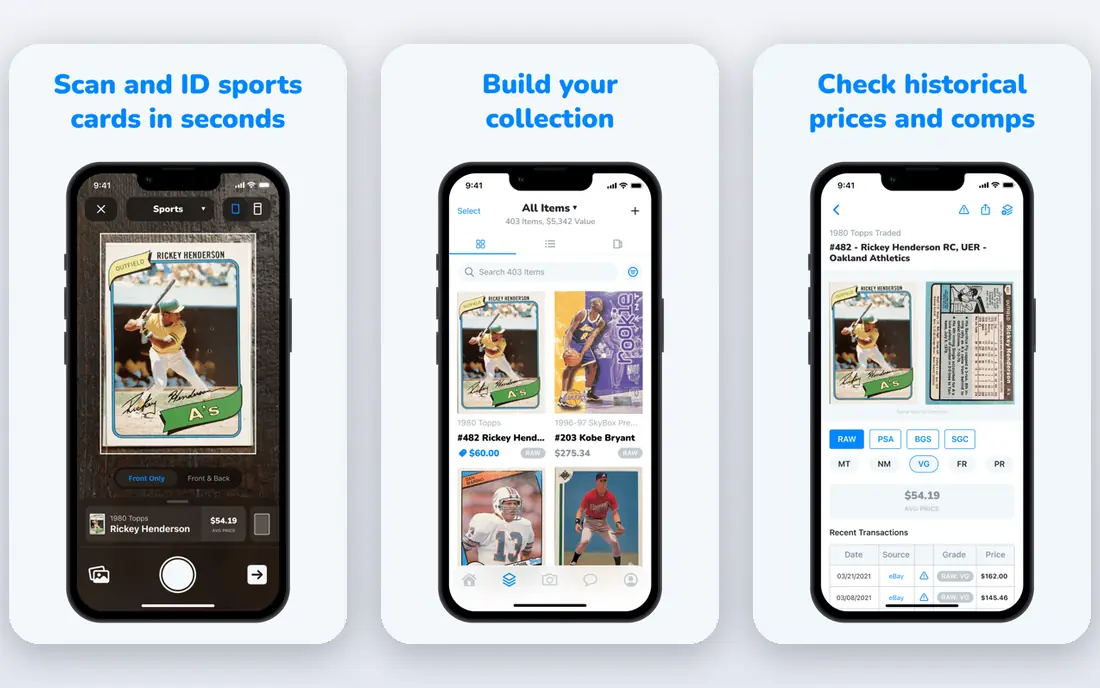
CollX lets collectors scan a card with a phone camera, identify it, add it to a collection, and see an estimated value with a built-in marketplace for buying and selling. The free tier covers unlimited scans and basic collection tracking for many users, which makes it a low-friction starting point for casual collectors. Database coverage spans sports and trading card games, so mixed collections fit in one app. The weakness is pricing accuracy, since estimates blend asking prices with sales and can run above recent sold prices. Parallel and refractor identification is also less reliable than specialist rivals. For quick identification and casual tracking, CollX is still the best free first app to try.
- Free unlimited scanning for many users
- Large card database
- Built-in marketplace
- Price estimates can run above sold prices
- Parallel identification is less accurate than Ludex
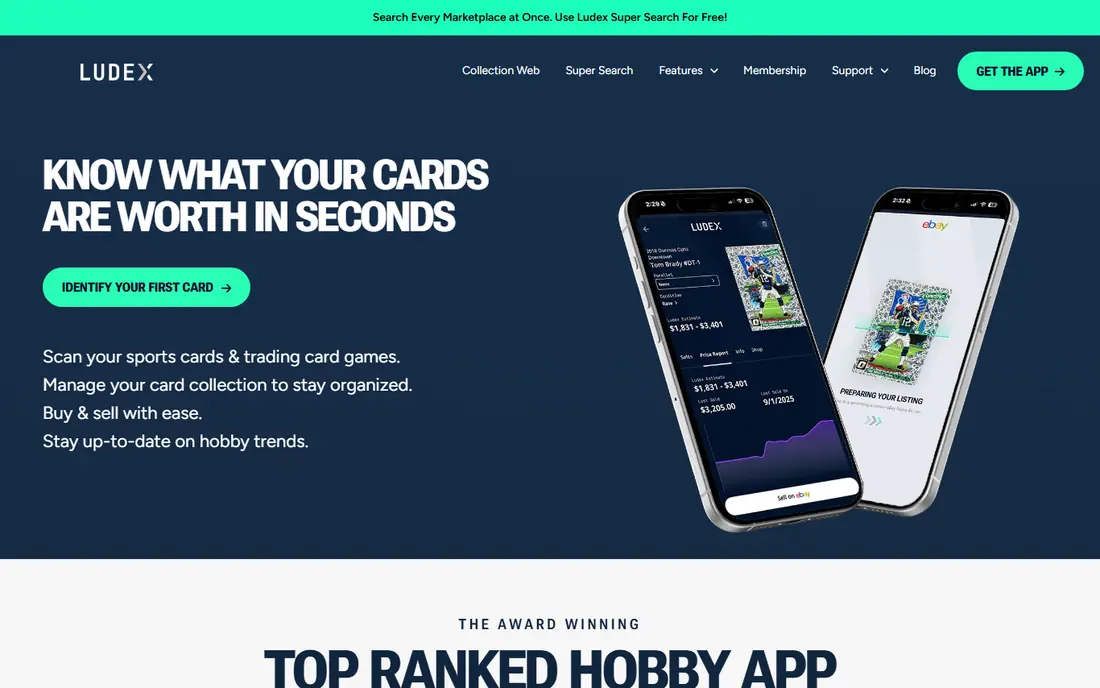
Ludex scans sports and trading cards, identifies parallels and variations with stronger accuracy than many free scanners, and totals a collection in one view. That parallel accuracy matters for modern sets, where a base card and a rare refractor can differ hugely in value despite looking similar. The app also suits collectors who split time between sports cards and trading card games. Ludex pricing is based on aggregated market data rather than only verified sold listings, so values still need a sold-price check before a major sale. Full use may also require a paid plan after the free tier. For collectors who care about getting the exact variation right, Ludex is a strong upgrade from a basic scanner.
- Stronger parallel and variation accuracy
- Covers sports and trading cards
- Clean collection totals
- Full use may require a paid plan
- Price source is aggregated market data, not only sold listings
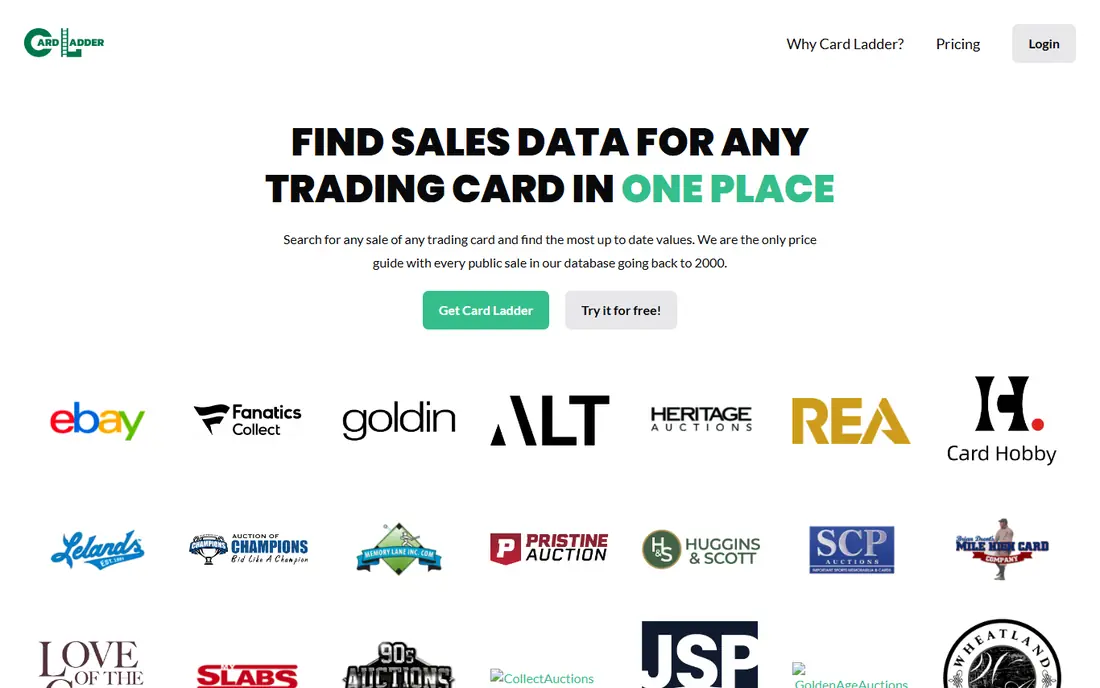
Card Ladder aggregates sales data across marketplaces and presents collection value with charts, trends, and price history for tracked cards. That time view helps collectors see whether a card is rising, falling, or flat, rather than reacting to a single sale. Graded card coverage is a particular strength, since grade-specific prices matter greatly for valuable cards. The free tier shows limited history and tracking, so serious users will likely need a paid plan for full charts. Database coverage is also narrower than large scanner apps, focused on cards with meaningful sales data. For tracking a collection as a portfolio over time, Card Ladder offers the clearest picture.
- Sales data with charts and trends
- Collection tracking over time
- Graded card focus
- Free tier shows limited history
- Database coverage is narrower than scanner apps
Sports Cards Pro offers a price guide and collection tracker that helps collectors catalog cards, follow values, and organize sets in one place. The web and app access makes it easy to check a card on a phone at a show or shop, then review the collection later on a larger screen. Coverage across sports and sets suits collectors with varied interests. Values are algorithmic estimates rather than a direct list of verified sold prices, so they can run high for some cards. That means a sold-price check remains important before buying, selling, or grading an expensive card. For everyday cataloging and a quick value guide, Sports Cards Pro is a useful companion app.
- Price guide with collection tools
- Covers many sports and sets
- Simple web and app access
- Values are algorithmic estimates
- Check sold listings before high-value trades
130point searches sold listings across eBay and other auction sites, showing what buyers actually paid for a specific card, including grade and variation details when available. That sold data is the number that matters before a purchase, sale, or grading decision, since asking prices and estimates can mislead. The service is free and does not invent a single estimated value. The trade-off is scope, since 130point does not scan cards, track collections, or offer portfolio charts. The interface is also plain compared with polished scanner apps. Used as a verification step after scanning, 130point gives collectors the most honest price check available for free.
- Searches eBay sold listings and other auctions
- No price estimate, just actual sales
- Free to use
- No scanning or collection tracking
- Interface is plain compared with modern apps
eBay remains the largest single source of card transactions, and its sold listings filter lets collectors see completed sales for a specific card, grade, and variation. That direct evidence beats any estimate when pricing a card for sale, since it reflects what buyers paid recently. The app also includes a scanner that helps sellers list cards quickly. Sold data still needs care, since results must be filtered by grade, condition, and exact parallel, or the range will mislead. Active listing prices are asking prices, not sold prices, and should not be used as value proof. For a final price check on almost any card, eBay sold listings are essential.
- Largest sold-listing pool for cards
- Sold filter shows real transactions
- Built-in scanner for listings
- Sold data needs manual filtering by grade and variation
- Listing prices are not sold prices
PSA, the grading company, offers an app and auction price data that help collectors check values for graded cards, with population reports showing how many copies exist at each grade. That grade context matters, since a PSA 10 can sell for far more than a PSA 9 of the same card. Auction price history gives a useful reference for high-value graded cards. The focus on graded cards means raw, ungraded values get less attention, and app estimates should still be checked against sold listings. Grading fees and turnaround also affect whether grading makes sense for a given card. For graded collections, PSA data is a key reference alongside Card Ladder and sold listings.
- Auction prices for graded cards
- Population data
- Trusted grading context
- Focused on graded cards, not raw values
- App price estimates are limited for ungraded cards
PWCC Marketplace operates as an auction house and marketplace with a focus on premium and graded cards, and its auction results give useful pricing evidence for higher-end cards. High-end pricing behaves differently from bulk commons, so a dedicated auction source helps collectors avoid underpricing a valuable card. The marketplace also suits sellers who want auction exposure for premium items. For bulk commons and low-value cards, PWCC data is less relevant, and marketplace fees and terms need checking before consigning. Casual collectors will get more value from free scanners and sold listings. For cards in the higher price range, PWCC auction history is a worthwhile extra check.
- Auction data for high-end cards
- Marketplace for premium graded cards
- Useful for cards above mid-range prices
- Less useful for bulk commons
- Marketplace fees and terms need checking
How we picked these
We compared official feature pages, pricing pages, app store listings, privacy policies, and public reviews for sports card apps used by collectors. We favored apps with a clear job, whether scanning, tracking, or sold-price checking, and we included free verification tools alongside paid trackers. We did not claim hands-on testing, and prices were left as See website where vendor pricing was not confirmed at the time of writing.
What to look for before you choose
Start by separating identity, estimate, and sold price, since one app rarely does all three well. Use a scanner to identify the card and variation, then check sold listings on 130point or eBay for the same grade and parallel. If the card is graded or valuable, add Card Ladder or PSA data to see trend and population context. That three-step check prevents the most common pricing mistakes. Also check condition honestly, since centering, corners, edges, and surface move real prices more than any app estimate can capture. A raw card estimate assumes average condition, which your copy may not match. When a card may be worth grading, compare raw and graded sold prices and grading cost before sending it in.
Frequently asked questions
What is the best app for sports card values?
CollX suits free scanning, Ludex suits parallel accuracy, and Card Ladder suits collection tracking over time. For a true sold price, check 130point or eBay sold listings. Most collectors need a scanner plus a sold-price check together.
What is the best card value app for free?
CollX offers free scanning and tracking, while 130point and eBay sold listings offer free sold-price checks. Together they cover identification and value without a subscription. Paid tools add charts and deeper history.
How accurate are sports card scanner apps?
Scanners identify base cards well, but parallel accuracy and price estimates vary, with Ludex generally stronger on parallels than CollX in public comparisons. Always verify valuable cards against sold listings. Condition also affects real price beyond any scan.
What is the best app for pricing sports cards before selling?
Check sold listings first on 130point or eBay for the exact card, grade, and parallel. Then use Card Ladder or PSA data for trend context on graded cards. Price below the sold median for a fast sale, or at the median if you can wait.
Should I trust the value shown by a card scanner?
Treat scanner values as estimates, not sale prices, since they blend asking prices and sales and cannot judge condition. Use them to spot cards worth checking further. For any card above a modest value, confirm with sold data before deciding.
Sources
See where you really rank - block by block
ProMapRanker scans Google Maps across a grid of your service area. Simple monthly plans from $19, white-label on every plan.
Start freeKeep reading
 zendesk alternatives
Best Zendesk Alternatives in 2026
Compare the best Zendesk alternatives in 2026, from budget help desks to AI-first support tools, with current pricing, free plans, and honest trade-offs.
Read → wordpress alternatives
Best WordPress Alternatives in 2026
Looking for the best WordPress alternatives? We compare 8 free and paid options for blogs, business sites, stores, and developer-led projects in 2026.
Read → which real estate company has the best training
Best Real Estate Company Training in 2026
Compare which real estate company has the best training, from Keller Williams and eXp to Compass and Coldwell Banker, by program, mentor, and fit in 2026.
Read →