 ProMapRanker
Best App for Selling Stuff in 2026

Key takeaways
- eBay reaches the widest buyer pool for almost any item, while Facebook Marketplace is best for local, bulky items with no local fee.
- Poshmark, Depop, and Vinted fit clothing best, but their fee models differ sharply, so check the current fee page before listing.
- Mercari and OfferUp suit casual sellers who want a fast mobile listing without running a shop.
- Etsy fits handmade, vintage, and custom goods, not general used items.
- Fees, shipping, and payout timing change often, so confirm the fee in the app before you list, and meet local buyers in a safe public place.
Quick comparison
| Pick | Great for | Pricing starts at | Free tier | |
|---|---|---|---|---|
 eBay | Almost anything, collectibles | Free | Yes | Visit |
 Facebook Marketplace | Local and bulky items | Free | Yes | Visit |
 Mercari | Casual mixed items | Free | Yes | Visit |
 Poshmark | Brand-name clothing | Free | Yes | Visit |
 Etsy | Handmade and vintage | Free | Yes | Visit |
 Depop | Vintage and streetwear | Free | Yes | Visit |
 OfferUp | Fast local sales | Free | Yes | Visit |
 Vinted | Everyday clothing, low seller fees | Free | Yes | Visit |
The best apps for selling stuff
We compared marketplaces on buyer reach, seller fees, shipping help, payout speed, and seller protection. Our pick for most sellers is eBay for shipped items and Facebook Marketplace for local items, with a clothing specialist added when the item fits that audience.
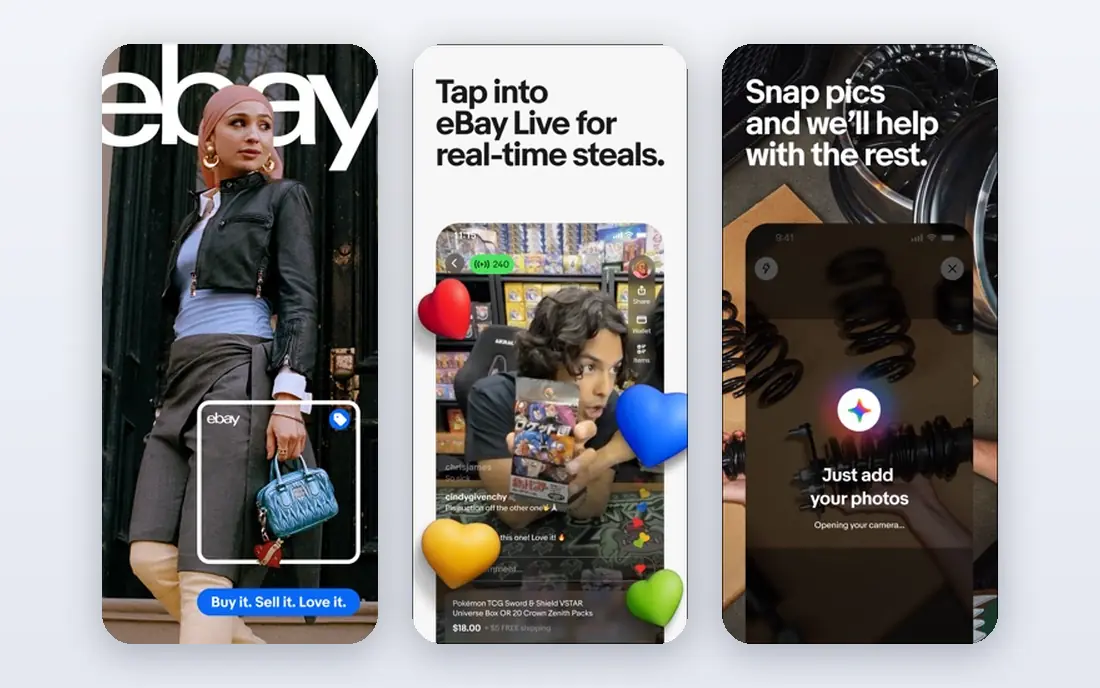
eBay remains the default when you do not know where an item will sell. Collectibles, electronics, parts, vintage goods, and odd items all find buyers there, and the sold listings history helps you price from real sales rather than guesses. You can run an auction for a rare item or set a fixed price for a common one, and the app makes listing from a phone fairly quick. For a one-off sale or a small shop, that reach is hard to match.
Fees are the trade-off. Listing is often free within limits, but a final value fee applies when an item sells, plus payment processing in many cases, so check the current fee page for your category. Shipping, packing, and customer messages also take time, and returns can eat into a thin margin. Still, for shipped sales across many categories, eBay is the most reliable starting point.
- Largest general buyer pool
- Auctions and fixed-price listings
- Strong sold-item price history
- Final value fees apply on sales
- Returns and cases take time
- Shipping and packing fall on the seller

Facebook Marketplace is the best choice for furniture, appliances, and other items you do not want to ship. Local listings are free in most cases, buyers are nearby, and a bulky item can move in a day when priced fairly. The audience is large because many buyers already use Facebook daily, and messaging inside the app keeps the deal simple. For a garage clear-out, it is often faster than packing and posting items one by one.
Local selling has risks. Buyers may not show up, haggle hard, or ask for delivery, and cash deals offer less protection than a marketplace payment. Shipped sales through Marketplace carry a fee, so check that rate before choosing shipping over pickup. Meet in a safe public place, bring someone with you for large items, and keep messages inside the app.
- No fee for most local sales
- Huge local audience
- Fast for furniture and large items
- Shipped sales carry a selling fee
- More no-shows and haggling
- Seller protection is weaker for local cash deals

Mercari suits casual sellers who want to list from a phone in minutes. Photos, a title, and a price are enough to start, and prepaid labels remove much of the shipping guesswork. It covers a wide mix, from toys and home decor to small electronics and clothing, which makes it a good second app when eBay feels too formal or Facebook feels too local. Payout by direct deposit is straightforward once a sale completes.
The fee and price level are the catches. Mercari charges a seller fee on completed sales, so check the current rate before pricing, and many items sell at lower prices than on eBay. It is less strong for rare collectibles or high-end fashion, where a specialist audience pays more. For everyday items you want gone quickly, Mercari is a clean, low-effort choice.
- Fast mobile listings
- Prepaid shipping labels
- Covers toys, decor, tech, and clothing
- Seller fee applies on sales
- Buyer pool smaller than eBay
- Prices skew lower for many items
Poshmark works like a social marketplace for fashion. Sellers list clothing, shoes, and accessories, share listings to gain visibility, and join themed parties and bundles. Brand-name and mall-store fashion does well here, and the prepaid shipping label simplifies posting. Buyers often browse by brand and style, so a well-photographed closet with clear sizes and condition notes can sell steadily over time.
Fees are the main drawback. Low-priced sales carry a flat fee, and higher-priced sales carry a percentage fee, so check the current fee page and price with that cost in mind. Success also takes social effort, since sharing and responding to offers is part of the system. If you sell mostly non-clothing items, eBay or Mercari will serve you better.
- Active social shopping community
- Prepaid shipping label
- Strong for brand-name fashion
- High fee on higher-priced sales
- Sharing and following take time
- Not suited to general household goods
Etsy is the right marketplace when the item is handmade, custom, or vintage. Buyers arrive with that intent, so a handmade bag, a custom print, or a true vintage piece meets an audience that values it. Shop tools cover listings, variations, shipping profiles, and messages, and the global reach helps niche makers find buyers beyond their town. For a small creative business, Etsy can act as a shopfront without building a website.
Fees add up. There is a small listing fee, a transaction fee on the sale price including shipping in many cases, and payment processing, so read the current fee page carefully. Popular categories are crowded, and good photos, titles, and reviews matter a lot. Etsy is a poor fit for general used goods, where eBay or Marketplace will move items faster.
- Buyers search specifically for handmade, vintage, and custom goods
- Strong shop tools
- Global reach
- Listing and transaction fees apply
- Competition is high in popular categories
- Not for general used items
Depop is built around a visual feed, which suits vintage and streetwear sellers who can style a photo well. A single strong image, a clear brand and size, and a fair price can move a piece quickly, and the audience skews younger and trend-aware. It is a good home for thrift finds, reworked pieces, and limited styles that look flat on a general marketplace. Sellers can build a shop identity through their feed, which helps repeat buyers return.
The platform rewards style and activity. Plain photos and vague descriptions get buried, and a payment processing fee applies on sales, so check the current terms. Depop is not a general selling app, and household goods or electronics will do better elsewhere. For fashion with a clear look, it is one of the best specialist choices.
- Visual, social feed suits fashion
- Strong for vintage, Y2K, and streetwear
- Younger buyer audience
- Payment processing fee applies
- Style-driven, so plain listings get less attention
- Smaller general audience
OfferUp is a simple local selling app for furniture, appliances, electronics, and everyday goods. Listing is quick, local buyers can message and meet nearby, and many in-person sales carry no fee. It works well as a second local channel beside Facebook Marketplace, since a second audience can move an item that sat unsold on one app. The shipping option also lets a seller reach buyers beyond the local area when pickup is not practical.
Local selling limits apply here too. Buyers may haggle, cancel, or fail to show, and shipped sales carry fees that change by category. The audience is smaller than Facebook Marketplace in many areas, so results vary by town. Use OfferUp for fast local turnover, meet in public, and keep the price firm if you do not want to negotiate.
- Local-first listings
- No fee for many in-person sales
- Shipping option for wider reach
- Shipped sales carry fees
- Smaller audience than Facebook Marketplace
- Haggling and no-shows are common
Vinted stands out for everyday clothing because sellers often pay no selling fee, with the buyer covering a protection fee instead. That makes it attractive for clearing a closet of everyday brands, children's clothes, and accessories where a percentage fee would eat the whole sale. Listing is simple, and the buyer pool is large for common sizes and styles. For volume clearing rather than high-end resale, Vinted can beat Poshmark on net return.
The trade-off is price level. Everyday items sell, but at modest prices, and luxury or rare pieces may fetch more on Poshmark or a specialist site. Shipping and protection terms vary, so read the current rules for your country before listing. If your goal is to move a lot of everyday clothing with low fees, Vinted is the first app to try.
- No seller fee on many sales
- Buyer pays a protection fee
- Good for everyday clothes and accessories
- Prices skew low for everyday items
- Less suited to luxury or rare pieces
- Shipping rules vary by country
How we picked these
We compared official fee pages, app store listings, shipping options, and public seller guides for marketplaces available in the United States in October 2026. We kept only apps that exist today, allow ordinary sellers to list, and cover a clear category or audience. Fees change often and differ by category, so we describe fee models in general terms and direct readers to the current fee page rather than locking in a rate that may soon change. We did not claim hands-on selling, and we based judgments on published fees, shipping tools, and payout descriptions.
How to choose and list well
Match the app to the item first, then to the fee. Clothing goes to Poshmark, Depop, or Vinted, handmade and vintage goes to Etsy, local bulky goods go to Facebook Marketplace or OfferUp, and everything else starts on eBay or Mercari. Photograph in daylight against a plain background, show flaws honestly, and write the brand, size, model, color, and condition in the title and description. Price from sold listings, not asking prices, and build the fee and shipping cost into your target. For local sales, meet in a safe public place during daylight, keep messages in the app, and never share bank details or accept overpayment checks. This is general selling guidance, not financial advice, and fees and taxes vary by item and location.
Frequently asked questions
What is the best app for selling stuff overall?
eBay is the best general choice for shipped items because it reaches buyers across almost every category. Facebook Marketplace is the best choice for local and bulky items, since most local sales carry no fee.
Which app has the lowest seller fees?
Vinted often has the lowest seller cost for everyday clothing, since the buyer pays a protection fee in many cases. Facebook Marketplace and OfferUp also carry no fee for many local sales, while shipped and fashion marketplaces charge a fee or commission.
Is it better to sell locally or ship items?
Local selling suits furniture, appliances, and heavy items, since shipping would cost more than the item is worth. Shipping suits clothing, collectibles, electronics, and small goods, where a national buyer pool pays more than a local one.
How do I avoid scams when selling?
Keep messages and payments inside the app, meet local buyers in public, and refuse overpayment checks, gift card payments, and requests to move to private messaging for payment. If a deal feels rushed or too generous, pause and check the app's safety guidance.
Can I sell the same item on several apps at once?
Yes, many sellers cross-list, but you must remove the item from every other app as soon as it sells on one. Double-selling the same item leads to cancellations, refunds, and account problems.
What sells best on each app?
Clothing sells best on Poshmark, Depop, and Vinted, handmade and vintage goods sell best on Etsy, collectibles and general goods sell best on eBay, and furniture sells best on Facebook Marketplace and OfferUp.
Sources
See where you really rank - block by block
ProMapRanker scans Google Maps across a grid of your service area. Simple monthly plans from $19, white-label on every plan.
Start freeKeep reading
 zscaler alternatives
Best Zscaler Alternatives in 2026
Looking for zscaler alternatives? We compare 9 SASE and zero trust platforms on architecture, data protection, pricing, and fit for your network and team.
Read → zapier alternatives free
Best Zapier Alternatives Free in 2026
Nine automation tools for zapier alternatives free in 2026, all with genuinely free tiers, plus free plan limits, starting prices and upgrade paths explained.
Read → which platform is best for online reputation
Which Platform Is Best for Online Reputation in 2026
Wondering which platform is best for online reputation? We compare 8 review, listing, and response tools for small and multi-location businesses and agencies.
Read →