 ProMapRanker
Top 7 API Security Testing Tools for 2026, Compared


Security teams that want an open source starting point · Pricing starts at: See website (tiered by API endpoints)
Direct answer
This list puts Akto first for Security teams that want an open source starting point. If your case is different, Salt Security suits enterprises that want ML-driven API runtime protection and StackHawk suits engineering teams that want DAST scans running in CI/CD. All 7 tools are compared below on price, free plan and limits.
Key takeaways
- Akto is the opening pick, best for Security teams that want an open source starting point.
- A free plan is available from 2 of the 7 tools: Akto, APIsec.
- A fair warning about StackHawk: per-contributor pricing gets expensive as the team grows.
- No starting price is shown for any of the 7 tools, Akto and Wallarm included, so plan time for sales calls.
- Wallarm fits teams that want API security bundled with WAF protection.
Quick comparison
| Pick | Great for | Pricing starts at | Free tier | |
|---|---|---|---|---|
| Akto | Security teams that want an open source starting point | See website (tiered by API endpoints) | Yes | Visit |
 Salt Security | Enterprises that want ML-driven API runtime protection | See website (custom quote) | No | Visit |
 StackHawk | Engineering teams that want DAST scans running in CI/CD | See website (per-contributor plans, billed yearly) | Free trial (14 days) | Visit |
 Escape | European teams wanting DAST plus attack surface monitoring | See website (custom quote) | Free trial | Visit |
 APIsec | Compliance-driven teams that require automatic penetration test reports | See website (custom quote) | Yes | Visit |
 Burp Suite Professional | Pentesters, security researchers and bug bounty hunters | See website (annual per-user license) | Community Edition free (manual tools only, no automated scanner) | Visit |
 Wallarm | Teams that want API security bundled with WAF protection | See website (custom quote) | No | Visit |
API Security Testing Tools compared in detail
If you are comparing API security testing tools, this page covers 7 tools in one place: what each is best for, what it costs to start, whether it has a free plan, and the main limit to know about.
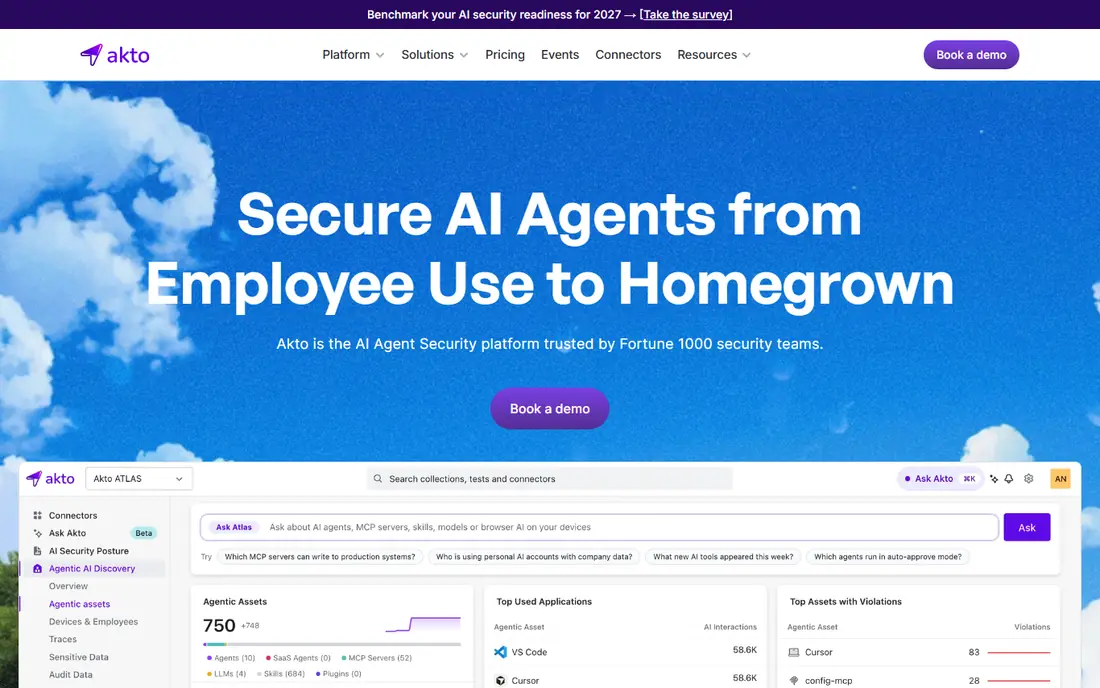
For Security teams that want an open source starting point, Akto is a natural candidate. Akto grew out of the open source community, which presents in how it works. It discovers your APIs by watching traffic, builds an inventory, then runs its test library against what it found.
Limits to weigh: premium-tier pricing has shifted over time, so get a current quote.
Discovery quality relies on your traffic connectors (AWS mirroring, gateways, Kubernetes), and misconfigured connectors mean missed APIs. The free level is genuinely usable for a small team learning API security, not a crippled demo. Akto shows no starting price here, so confirm the cost on the vendor site. Akto offers a free plan.
- Over 1,000 built-in security tests handling OWASP API Top 10
- Open source core with API discovery from traffic
- Traffic-based discovery needs connectors configured correctly
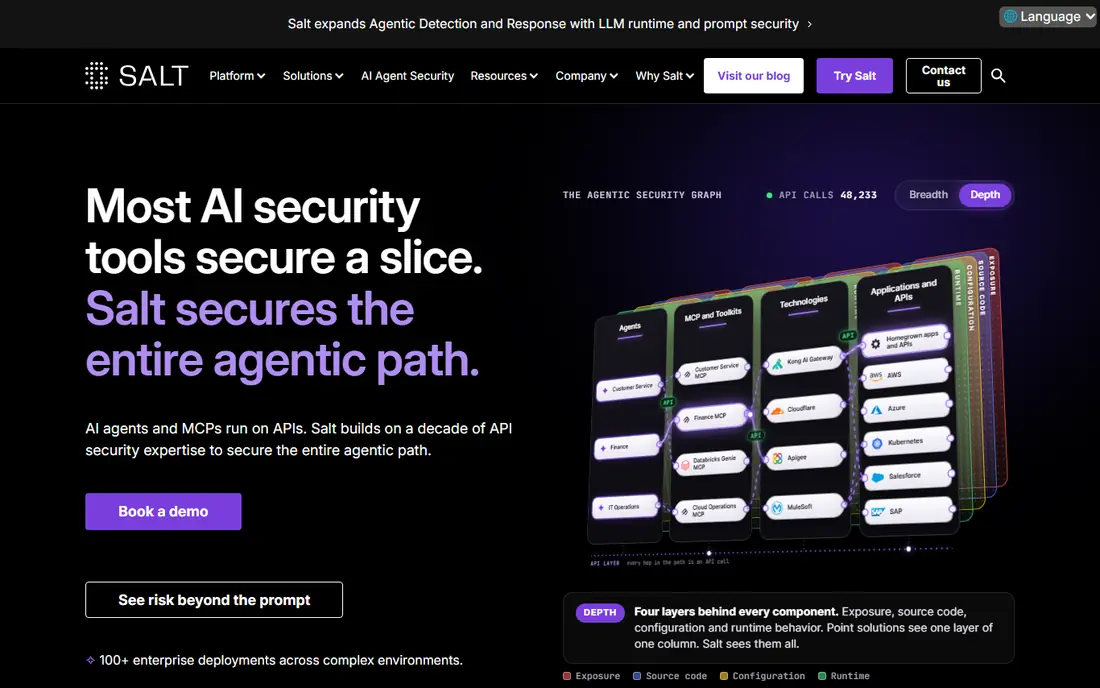
Salt Security is designed for enterprises that want ML-driven API runtime protection. Salt Security helped define the API security category, and its system reflects that maturity. It learns the normal behavior of each API from traffic, then flags and blocks deviations, which catches the low-and-slow attacks that signature tools miss.
There is no self-serve path, no trial you can start today, and no price to model. For everyday use, the posture governance engine brings policy enforcement across large API estates. In daily use, the honest catch is accessibility. No starting price is listed for Salt Security here; confirm pricing on the vendor site. Salt Security has no free plan.
Trade-offs to know: Recent pivots into AI agent security may dilute API focus.
- Posture governance for API security policy at scale
- Patented approach to API attack detection using behavioral analysis
- Squarely enterprise, with the sales cycle that implies
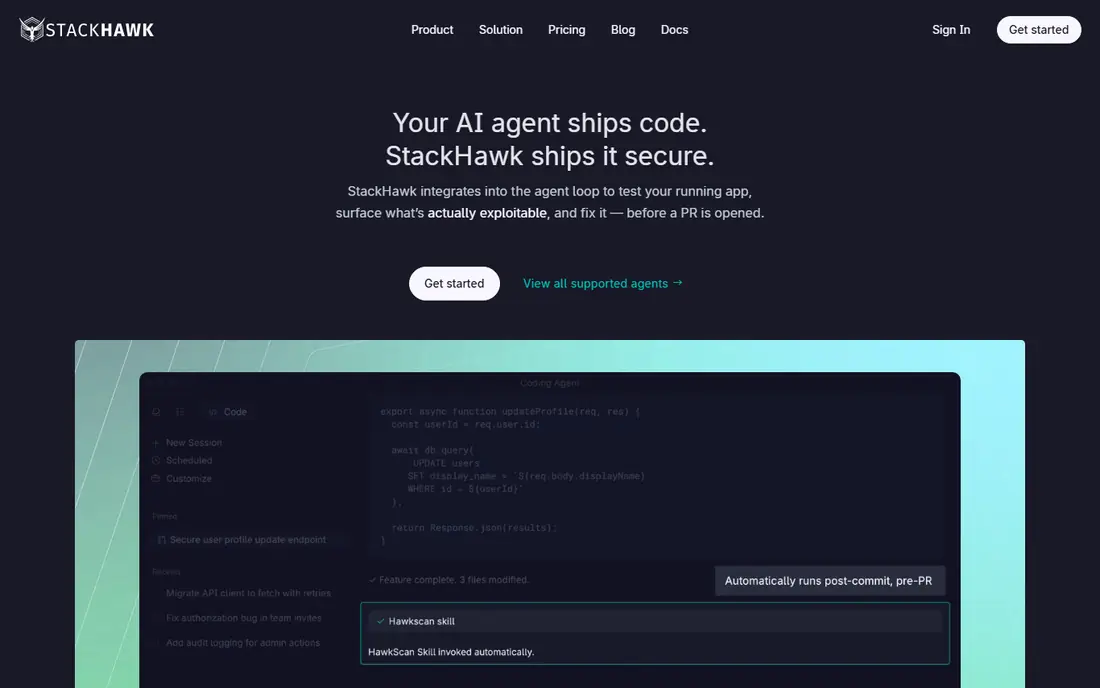
StackHawk serves engineering teams that want DAST scans running in CI/CD. StackHawk is the most natural first scanner for a team that ships code daily. It runs as part of the build, reads your OpenAPI spec, and reports findings where developers already work, including pull requests.
Points against: Per-contributor pricing gets pricey as the team grows.
Confirm the current numbers on their pricing page before you budget. Worth adding: configuration lives in code, so security policy travels with the repository rather than sitting in a dashboard nobody opens. StackHawk shows no starting price here, so confirm the cost on the vendor site. Free access: Free trial (14 days).
- Designed for developers, with YAML configuration and pull-request findings
- Unlimited scans and applications on premium plans
- It is a developer tool first, so manual pentesters will miss Burp-style workflows
Escape is aimed squarely at European teams wanting DAST plus attack surface monitoring. Escape is the newcomer that earned its place by doing two jobs at once.
Drawbacks to consider: Pricing is custom enterprise.
Founded in 2020, Escape has thousands of users but not the decade-long enterprise track record of a Salt or Traceable. The GraphQL testing is genuinely good, and the team ships quick, including IDE integrations for fixing findings where developers work. Check the vendor site for Escape pricing; none is listed in this comparison. On free options: Free trial.
- Developer-friendly with public API and IDE integrations
- Combines DAST scanning with external attack surface monitoring
- Young company with a smaller track record than the leaders
APIsec
Great for: Compliance-driven teams that require automatic penetration test reports
APIsec is designed for compliance-driven teams that require automatic penetration test reports. It learns your API's structure, produces thousands of attack playbooks handling the OWASP API Top 10, and runs them continuously.
From a buyer's view, the differentiator is the output: automatic penetration test reports formatted for compliance, which the vendor says auditors have accepted for SOC 2 work. From a buyer's view, ask for the free test on your own APIs before committing; it is the fastest way to judge coverage. APIsec does not show a starting price in this comparison, so check the vendor site for current pricing. A free plan is available with APIsec.
Trade-offs to know: The completely automatic model fits standard REST APIs best.
- Produces compliance-ready pen-test reports accepted by auditors
- Completely automatic continuous testing with AI-generated attack playbooks
- Onboarding needs registering and mapping your APIs first
Burp Suite Professional
Great for: Pentesters, security researchers and bug bounty hunters
Burp Suite Professional targets Pentesters, security researchers and bug bounty hunters. If your job is to think like an attacker, Burp Suite Professional is still the tool you reach for. The honest catch is that Burp is a testing toolkit, not a testing program.
Honest limits: The automatic scanner lives only in the premium edition.
It finds nothing on its own schedule; someone has to drive it. The intercepting proxy, Repeater and Intruder provide you total control over requests, which is exactly what API testing needs when business logic flaws are the target. This comparison lists no price for Burp Suite Professional; ask the vendor. On free options: Community Edition free (manual tools only, no automated scanner).
- Free Web Security Academy training from the same vendor
- Huge extension ecosystem through the BApp Store
- Per-user annual licensing layers on up for teams
Wallarm serves teams that want API security bundled with WAF protection. Wallarm appeals to infrastructure teams that would rather consolidate than collect tools.
Watch-outs: Deployment is infrastructure work; not a SaaS signup.
For cloud-native shops already running Envoy or Kong, the deployment model feels natural. You are deploying and operating security infrastructure, which needs someone who owns it. No starting price is listed for Wallarm here; confirm pricing on the vendor site. No free plan comes with Wallarm.
- Testing and WAAP in one deployment
- API specification enforcement
- The wide scope means API-specific depth varies
How the list was put together
Each tool was reviewed on what its vendor publishes: price, plan limits, core features and stated drawbacks. We did not run hands-on tests. Plan names, prices and limits change often. Treat the figures here as a starting point and verify them with the vendor. We ordered the tools by general fit, then by how clearly pricing is shown, then by free access. A buyer with unusual needs may reorder them.
Things to verify first
- Confirm the entry price with every vendor: no tool from Akto to Wallarm shows a fixed starting price.
- Read the fine print on the free plans from Akto and APIsec; seat, project and feature caps differ.
- Use real work to test the free trial from StackHawk and Escape, rather than a demo project.
- Read the limits listed for Akto first: premium-tier pricing has shifted over time, so get a current quote.
- Confirm the exact StackHawk plan that includes your must-have features.
- Let daily users try Burp Suite Professional on real work; their feedback beats any feature checklist.
Frequently asked questions
Do I need a dedicated API security tool if I have a WAF?
A WAF blocks known attack patterns at the edge, but it does not understand your API's business logic or find vulnerabilities before release. API security testing tools discover flaws in development and test for logic issues like broken object-level authorization.
How much do API security testing tools cost?
Developer-first tools publish per-contributor or per-endpoint pricing in the tens of dollars a month range, though exact numbers change commonly. Open source choices like Akto's free level and Burp Community Edition cost nothing to start.
Can I try these options before paying?
Often, yes. Akto and APIsec have a free plan and StackHawk and Escape offer a free trial. Use your own data and a real task during the test, and check what the free tier or trial limits before you rely on it.
How are the tools for API security testing tools ordered?
The order follows typical fit for API security testing tools, with Akto first and Wallarm last, then price clarity and free access. It is editorial judgement, not a score, so another team could rank the tools differently.
Is Akto the right pick for everyone comparing API security testing tools?
No single tool suits every team. Akto comes first because it fits Security teams that want an open source starting point, while Salt Security suits enterprises that want ML-driven API runtime protection and StackHawk suits engineering teams that want DAST scans running in CI/CD. Match the tool to your own size, budget and workflow before deciding.
Do these tools publish their prices?
No. None of the tools, from Akto to Wallarm, shows a fixed starting price here, so budget time for quotes.
Sources
See where you really rank - block by block
ProMapRanker scans Google Maps across a grid of your service area. Simple monthly plans from $19, white-label on every plan.
Start freeKeep reading
 zoho inventory alternatives
6 Alternatives to Zoho Inventory, Compared on Price and Fit
Zoho Inventory alternatives: 6 tools compared on price, free plans and fit. Katana leads the list for manufacturers. Fit and flaws are laid out for each entry.
Read → zoho crm alternatives
Best Zoho CRM Alternatives (2026)
Need Zoho CRM alternatives? We compare 7 tools on cost, free access and who each suits. Every pick gets a straight assessment. Built for quick decisions.
Read → zelle alternatives
Best Zelle Alternatives in 2026
Compare the best Zelle alternatives for sending money to friends, paying sellers and moving funds abroad, with honest notes on fees, speed and safety in 2026.
Read →