 ProMapRanker
Best Antique Appraisal App in 2026


Deep antique price research · Pricing starts at: $29.99 per month
Key takeaways
- WorthPoint is the deepest archive for antiques and collectibles, but it is a paid research tool, not a free instant appraisal.
- ValueMyStuff gives expert-led valuations with a written report, which suits insurance, probate, and estate decisions better than a quick scan.
- Underpriced AI and Google Lens help at a sale or in a shop, since a photo can identify an item and point to comparable sales.
- eBay sold listings remain the most useful free check, because they show what buyers actually paid rather than what sellers ask.
- No app in this list replaces a qualified appraiser for a formal valuation, and condition, maker, and provenance change value more than category alone.
Quick comparison
| Pick | Great for | Pricing starts at | Free tier | |
|---|---|---|---|---|
| WorthPoint | Deep antique price research | $29.99 per month | Free trial | Visit |
 ValueMyStuff | Expert written valuations | $10 per valuation | No | Visit |
 Underpriced AI | Photo-based resale values | Free | Yes | Visit |
 Google Lens | Identifying unknown items | Free | Yes | Visit |
 eBay | Checking real sold prices | Free | Yes | Visit |
 Heritage Auctions | Auction values for fine items | See website | No | Visit |
 Barnebys | Searching auction results | See website | Yes | Visit |
 Invaluable | Auction price database | See website | Yes | Visit |
 PriceCharting | Games, cards, and graded items | Free | Yes | Visit |
The best antique appraisal apps
Here are nine research and valuation tools, from deep archives to quick photo checks.
This article covers general information only. It is not a substitute for a professional appraisal, and it is not insurance, tax, or legal advice. Use these tools to research, compare, and prepare questions, then get a qualified appraiser for formal, high-value, or disputed items.
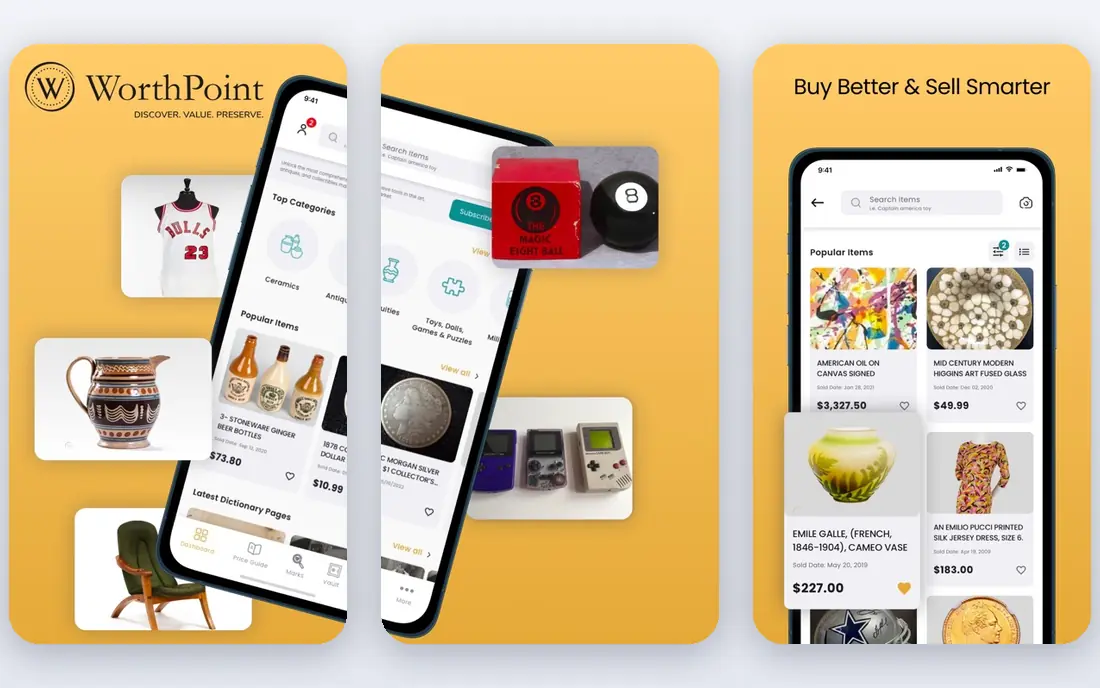
WorthPoint is built for collectors and dealers who research antiques often. Its price guide draws on auction, marketplace, and dealer prices, and its marks library helps identify makers from stamps, labels, and logos. That depth matters for older or unusual pieces, where a general web search returns little useful history.
The limit is that it is a research archive, not a one-tap appraisal. Casual users may find the monthly cost hard to justify for a single item, and the tool works best when you can already describe the piece with reasonable accuracy. For frequent antique work, though, the archive depth is the main reason to pay.
- Very large price guide archive
- Marks and logos library
- Collection cataloguing tools
- Paid subscription
- You usually need to know what the item is before searching
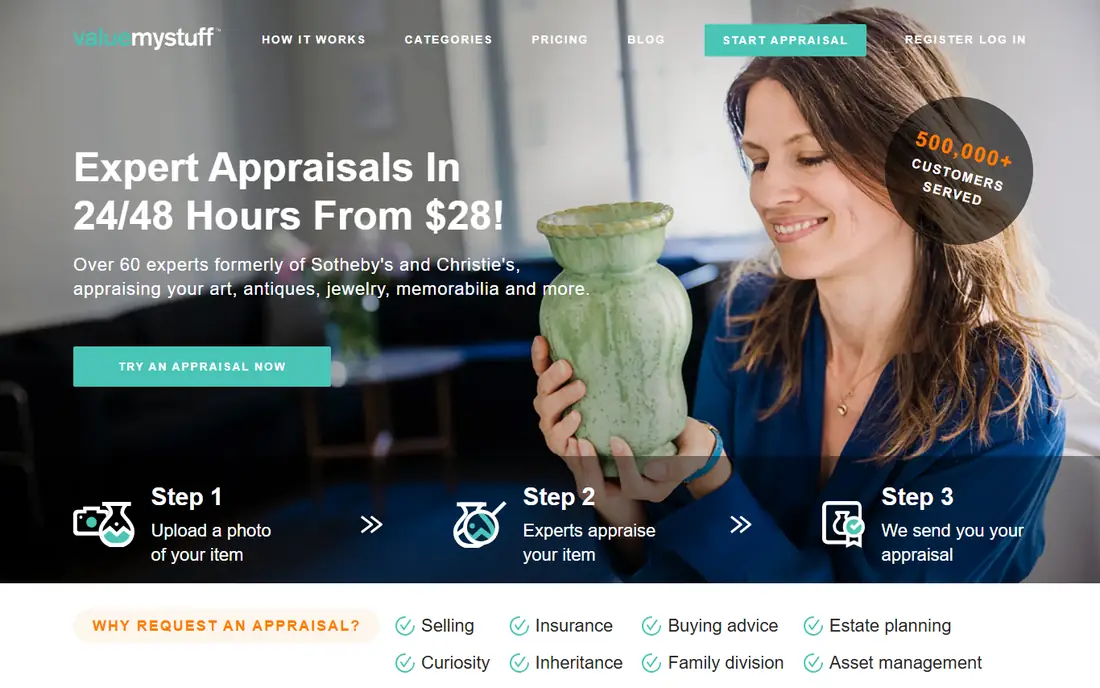
ValueMyStuff connects an item with specialists who have worked in auction houses, and returns an attribution, description, auction value, and insurance value in a report. That format is useful when you need a document for insurance, probate, or an estate discussion, rather than a rough guess for a sale listing.
It is not a browsing tool for quick checks. Each valuation costs money, and the process takes time, so it suits items that are likely to matter financially. For a box of low-value items, a free sold-listing check will usually be enough before deciding which pieces deserve a paid valuation.
- Valuations by auction specialists
- Written report with auction and insurance values
- Wide category coverage
- Per-item cost adds up for a large collection
- Turnaround takes time rather than seconds
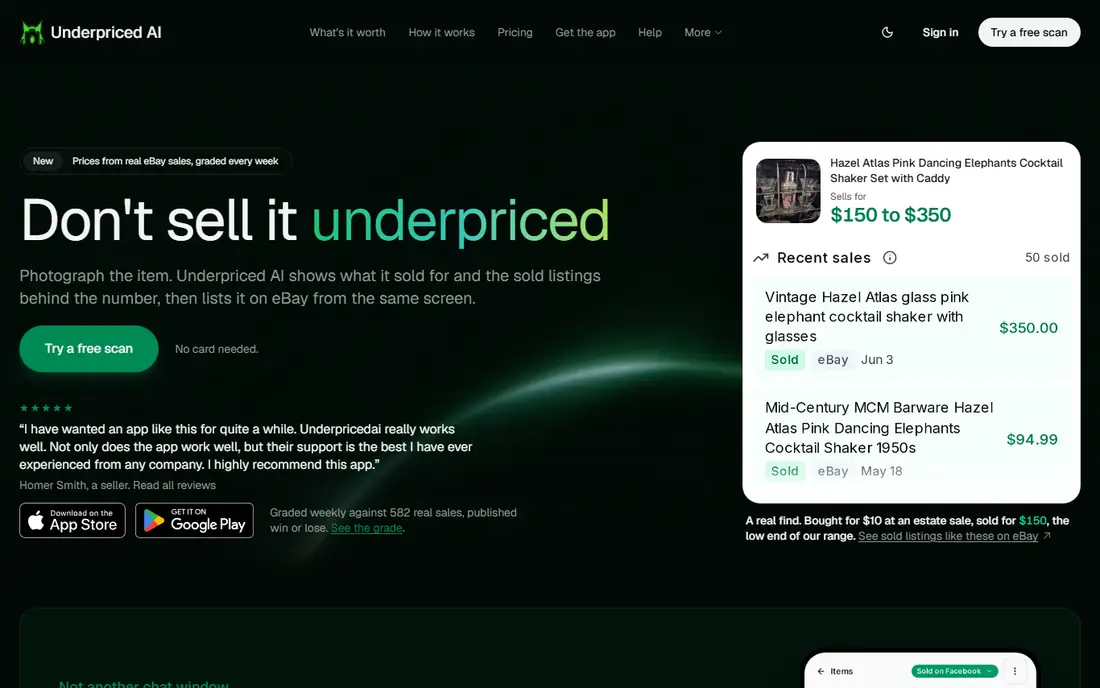
Underpriced AI is designed for fast decisions at a sale, shop, or estate visit. Take a photo, and it identifies the item and returns a resale value based on real sold listings, with the listings shown so you can judge the number yourself. That transparency matters, since a single average can hide a wide spread of prices.
The weakness is common to all photo tools. If comparable sales are few, damaged items are mixed with mint items, or the version is misidentified, the estimate can miss badly. Treat it as a starting point, check the listed sales, and get a formal appraisal before acting on a high value.
- Identifies items from a photo
- Shows sold listings behind the value
- First scan is free
- Estimates are resale guides, not formal appraisals
- Accuracy falls when sold data is thin
Google Lens is the best free first step when you do not know what an item is. Point the camera at a mark, label, pattern, or shape, and it can surface similar items, maker names, and listings. That identification step often matters more than price, since the wrong maker or era can change value by a large amount.
Lens does not give a reliable resale price on its own. Its results lean toward items currently for sale, which show what sellers hope to receive, not what buyers paid. Use Lens to identify the piece, then check sold listings and WorthPoint for price history.
- Free and fast
- Strong at matching objects, marks, and labels
- No subscription needed
- Shows asking prices, not a valuation
- Does not price most antiques directly
The eBay app is not an appraisal app, but its sold listings are still the most practical free price check for many antiques. Filter for sold items, match the exact maker, pattern, size, and condition, and compare several recent sales rather than one high outlier. That habit alone prevents many pricing mistakes.
The work is manual, and common items can produce noisy results. Listings with poor photos, missing details, or damaged condition should not count as comparable sales for a fine piece. For rare items with few eBay sales, an auction archive such as WorthPoint or Heritage Auctions will be more useful.
- Sold listings show real buyer prices
- Huge volume for common antiques
- Free to search
- Requires manual searching
- Results need filtering by condition and exact version
Heritage Auctions is one of the largest auction houses in the United States, and its past auction results are a useful benchmark for fine antiques, art, coins, comics, and other collectibles. When an item has sold at a major auction, that realised price carries more weight than a retail asking price.
Everyday antiques and lower-value household items may not appear in its records, or may appear only in broad lots. Heritage Auctions also offers appraisal and consignment services, but those are separate from simply browsing past results. Use it to test a high-value claim, not to price a full house clearance.
- Strong auction records for fine antiques and collectibles
- Expert departments
- Past sale prices to compare
- Focused on higher-value items
- Not a quick tool for everyday antiques
Barnebys aggregates auction listings and results from many houses, which saves time when you want to see how similar pieces have performed across the market. You can search by maker, category, or keyword, then compare lot descriptions, estimates, and realised prices. That breadth helps for items that appear in regional auctions rather than one famous sale.
Coverage is not uniform, and lot details still matter. A realised price for a damaged piece, a pair, or a later reproduction should not be used as the value for a fine single example. Check the lot page, photos, and condition notes before using a Barnebys result in a decision.
- Searches many auction houses at once
- Useful for realised prices
- Broad antique coverage
- Coverage varies by house and region
- Some results need a closer look at lot details
Invaluable hosts auctions from many houses and keeps a price database that collectors use to research past sales. It is useful when you want to see how a category has moved over time, or when you want alerts for similar lots coming to auction. The breadth across art, antiques, jewellery, and collectibles makes it a good second check after a specialist source.
Be careful with estimates. An auction estimate is a guide set before bidding, not a sale price, so always look for the realised price when one is shown. Condition, provenance, and lot size also affect the result, and those details sit on the lot page rather than in a search summary.
- Large auction database
- Price history for many categories
- Alerts for similar lots
- Some features need an account
- Auction estimates are not the same as realised prices
PriceCharting does not cover furniture, porcelain, or silver, but it is excellent inside its own scope. For video games, trading cards, and graded collectibles, it tracks sold prices by title, set, and condition, which gives a much tighter value range than a general search. Collectors who mix antiques with modern collectibles will use it often.
Do not stretch it beyond that scope. A general antique needs an auction archive or expert valuation, not a games database. PriceCharting earns its place here because many collections include both antiques and graded modern items, and a single tool rarely covers both well.
- Clear sold prices for games and cards
- Grading and condition filters
- Free core access
- Narrow scope
- Not a general antique appraisal tool
How we picked these
We compared official pricing pages, app listings, auction databases, and public guides for antique research in October 2026. We kept tools that are live, that help identify an item or check a price, and that state their limits clearly. Where a price was quoted, we used the vendor page or a recent vendor announcement rather than a review estimate, and we used See website where pricing was not published in a clear form.
How to research an antique value at home
Start by identifying the item exactly. Note the maker, mark, pattern, material, size, and any damage, repair, or missing parts, and take clear photos of marks and labels. A small difference, such as a later mark or a repaired handle, can change value more than the category suggests, so do not skip this step.
Next, compare sold prices, not asking prices. Check eBay sold listings, auction results on Barnebys, Invaluable, or Heritage Auctions, and WorthPoint for older sales. Use at least three close matches, and adjust for condition and completeness. If the matches are thin or the spread is wide, treat the range as a guess and price conservatively.
Finally, decide whether a formal appraisal is needed. For insurance, probate, tax, divorce, or a high-value sale, hire a qualified appraiser who follows professional standards and provides a written report. For a casual sale, a researched price range from sold listings is usually enough, as long as you describe condition honestly in the listing.
Frequently asked questions
What is the best app for antique appraisal?
WorthPoint is best for deep antique research, while ValueMyStuff is best for a written expert valuation. For a quick free check, start with Google Lens to identify the item, then check eBay sold listings for real prices.
Are antique appraisal apps accurate?
They are useful guides, not formal appraisals. Accuracy depends on correct identification, close comparable sales, and honest condition notes. Treat any single number with care, especially for rare, damaged, or high-value pieces.
What are the best antique apps for beginners?
Google Lens, eBay, Barnebys, and Invaluable are good free starting points, since they teach identification and sold-price research without a subscription. WorthPoint is worth adding later if you research antiques often.
How much does an antique appraisal cost?
Costs vary widely. ValueMyStuff starts at $10 per valuation, WorthPoint charges $29.99 per month for archive access, and a formal in-person appraisal can cost much more depending on the item and the appraiser. Always confirm the fee and what the report covers before you pay.
Can an app value an item from a photo alone?
A photo tool can identify many items and suggest a resale range, but it cannot inspect condition, weight, material, or hidden repairs with certainty. Use photo results as a starting point, and get an in-person appraisal for items that matter financially.
Sources
See where you really rank - block by block
ProMapRanker scans Google Maps across a grid of your service area. Simple monthly plans from $19, white-label on every plan.
Start freeKeep reading
 zscaler alternatives
Best Zscaler Alternatives in 2026
Looking for zscaler alternatives? We compare 9 SASE and zero trust platforms on architecture, data protection, pricing, and fit for your network and team.
Read → zapier alternatives free
Best Zapier Alternatives Free in 2026
Nine automation tools for zapier alternatives free in 2026, all with genuinely free tiers, plus free plan limits, starting prices and upgrade paths explained.
Read → which platform is best for online reputation
Which Platform Is Best for Online Reputation in 2026
Wondering which platform is best for online reputation? We compare 8 review, listing, and response tools for small and multi-location businesses and agencies.
Read →