 ProMapRanker
Best Answer Optimization Tools for AI Visibility in 2026

Key takeaways
- Answer optimization tools track whether AI engines mention, recommend, or cite your brand, which classic rank trackers do not show.
- Otterly.AI is the cheapest paid starting point we found, while Profound and Scrunch suit larger teams with more brands and prompts.
- Tools that only monitor leave the fixing to you, so teams with thin content resources should favour tools with content workflows.
- Prompt lists matter more than engine counts: tracking the wrong prompts gives a clean report about the wrong questions.
- No tool can guarantee an AI mention, and any vendor that promises one should be treated with caution.
Quick comparison
| Pick | Great for | Pricing starts at | Free tier | |
|---|---|---|---|---|
 Profound | Enterprise multi-brand tracking | $99 per month | No | Visit |
 Writesonic | Visibility plus content creation | $199 per month | No | Visit |
 Otterly.AI | Solo founders and lean teams | $29 per month | No | Visit |
 Peec AI | Fast multi-engine insights | $95 per month | No | Visit |
 Semrush AI Visibility Toolkit | Teams already on Semrush | $99 per month | No | Visit |
 Ahrefs Brand Radar | Teams already on Ahrefs | See website | No | Visit |
 Scrunch AI | Multi-brand, multi-region tracking | $250 per month | No | Visit |
 Goodie AI | High-volume prompt coverage | $495 per month | No | Visit |
 SE Ranking Visible | Agencies adding AI visibility to SEO | $99 per month | No | Visit |
The best answer optimization tools for ai visibility
Answer optimization, often called generative engine optimization or answer engine optimization, covers tools that run prompts through AI engines, record brand mentions, sentiment, and citations, and help teams fix the pages those engines read. We compared them on engine coverage, prompt capacity, competitor tracking, content actions, and price transparency.
Profound is the enterprise-leaning option on this list, with tracking across major AI engines, competitor comparison, and reporting built for marketing leaders who manage several brands. Its starter plan covers a narrower engine set, while growth and enterprise plans widen coverage to more engines, including shopping and additional surfaces. That ladder suits a team that starts small and expands coverage as the program proves its value.
The honest catch is that the starter price does not buy the full picture. Teams that need Perplexity, AI Overviews, and several other engines together will pay more, and the value depends heavily on choosing prompts that match real buyer questions. Profound fits agencies and larger brands best, and it is a weaker fit for a solo site owner who only needs a basic monthly check.
- Broad engine coverage on higher plans
- Enterprise reporting depth
- Strong for multi-brand programs
- Real entry cost is higher than the starter price for full coverage
- Setup needs a defined prompt strategy
- Overkill for a single small site
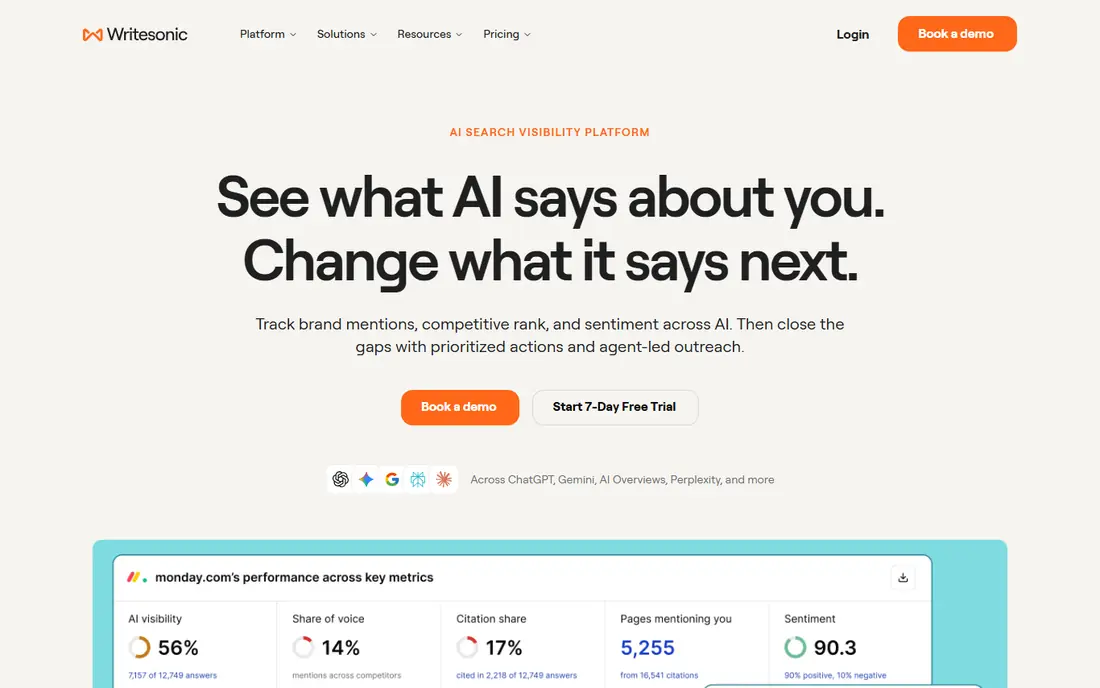
Writesonic pairs AI visibility tracking with content creation, which is the main reason to choose it over a pure monitor. The platform tracks brand mentions across ChatGPT, Gemini, and AI Overviews on its GEO plans, with additional engines on enterprise tiers, and it helps teams create or fix the content that should earn citations. For a team whose bottleneck is writing pages rather than measuring them, that combination saves a handoff between tools.
The trade-off is price structure. Content-only plans cost less than GEO plans, so buyers must confirm which plan includes the tracking they need. Prompt capacity and engine coverage also vary by tier, so a team with many products or regions should verify limits before buying. Writesonic fits content-led marketing teams best.
- Tracking plus in-platform content optimization
- Covers major AI engines
- Suits teams that must act on gaps
- GEO pricing sits above content-only plans
- Enterprise engines need a higher tier
- Credit and prompt limits need checking
Otterly.AI is the cheapest paid way to start monitoring AI visibility, with daily prompt tracking across ChatGPT, Perplexity, Gemini, Copilot, and AI Overviews on its entry plan. For a solo founder or a lean team, that coverage is enough to answer the basic question: do AI engines mention us, and what do they say? Reports focus on brand perception and competitor mentions without requiring an enterprise budget.
The limits are capacity and action. The entry plan covers a modest prompt set, so a team with many products will need a higher tier or a tighter prompt list. Otterly.AI also focuses more on monitoring than on writing the replacement content, so content fixes still happen elsewhere. It fits small teams starting out, and larger programs will likely need a broader tool.
- Lowest paid entry price on this list
- Daily prompt tracking
- Clear brand perception reports
- Prompt capacity is modest on the entry plan
- Fewer content creation features than Writesonic
- Larger teams may outgrow it fast
Peec AI tracks brand visibility, position, and sentiment across a set of AI engines, and it lets teams choose which engines to monitor on its plans. That choice matters, because a business whose buyers use ChatGPT and Google AI Overviews does not need to pay for the same coverage as a business whose buyers use six different engines. Setup is geared toward marketing teams that want fast insights without a long implementation project.
The catch is the cap: the entry plan covers a limited set of engines, so teams that need broad coverage will pay more or choose carefully. Annual billing also lowers the monthly rate compared with monthly billing, so compare like with like. Peec AI fits marketing teams that want clear, fast reporting and already have a content process to act on it.
- Lets teams pick engines to track
- Visibility, position, and sentiment reporting
- Fast setup for marketing teams
- Engine choice is capped on the entry plan
- Annual billing changes the monthly rate
- Content actions are thinner than Writesonic
Semrush AI Visibility Toolkit adds AI search tracking to the Semrush platform, covering ChatGPT, AI Overviews, AI Mode, Gemini, Perplexity, and Copilot depending on the bundle. For teams already paying for Semrush, that integration is the main appeal: AI mentions, citations, and classic rankings live in one workflow, and the team does not need to learn a separate reporting tool. Agencies can also fold AI visibility into client reports they already produce.
The cost question is the bundle. The toolkit is an add-on, so the total bill includes the base Semrush subscription plus the add-on, and the entry add-on covers a limited prompt set. Teams that do not already use Semrush should compare the combined cost with a standalone tool before assuming Semrush is cheaper. It fits existing Semrush users best.
- AI visibility inside a familiar SEO suite
- Combines AI and classic search data
- Suits agencies with existing Semrush workflows
- Add-on price sits on top of a Semrush subscription
- Prompt capacity is limited on the entry add-on
- Not a standalone content tool
Ahrefs Brand Radar layers AI search tracking onto Ahrefs, tracking brand mentions across ChatGPT, Gemini, Perplexity, Copilot, and Google AI Overviews. SEO-led teams benefit most, because they can connect AI citations to the backlink and content data they already use in Ahrefs, and see which pages AI engines cite when they recommend a brand. That link between classic SEO and AI visibility is genuinely useful for content planning.
The drawback is cost structure. Brand Radar pricing combines a base Ahrefs plan with per-index charges, and covering every engine index raises the bill substantially. A team that does not already use Ahrefs will find a standalone monitor cheaper for basic tracking. Ahrefs Brand Radar fits existing Ahrefs teams with a clear SEO workflow.
- AI brand tracking inside Ahrefs
- Strong citation and competitor analysis
- Suits SEO-led teams
- Pricing combines a base plan with per-index costs
- Full engine coverage is expensive
- Not ideal as a first tool for non-Ahrefs users
Scrunch AI is built for teams tracking several brands across regions, with prompt tracking, page audits, and persona-based views that show how AI answers differ by audience. That structure suits agencies and larger brands whose AI visibility varies by market, product line, or customer type. A trial period without a card lowers the risk of testing it against real prompts before committing.
The entry price puts Scrunch out of reach for many small sites, and the reporting value depends on careful prompt and persona setup. A team that tracks generic prompts will get generic insights, no matter how good the tool is. Scrunch fits multi-brand and multi-region programs best, and it is a weaker fit for a single-site owner who needs a simple monthly check.
- Multi-brand and multi-region tracking
- Page audits and persona views
- Free trial without a card on the listed plan
- Entry price is high for small teams
- Value depends on prompt and persona setup
- Content execution still needs a separate workflow
Goodie AI targets growth and enterprise teams that need high-volume prompt coverage across many AI models, with sentiment tracking and optimization actions alongside monitoring. When a brand must track hundreds of prompts across product lines, regions, and competitors, that volume capacity becomes the deciding factor, and cheaper tools with small prompt caps cannot keep up. Goodie also covers a wide engine list, which suits brands whose buyers use several AI surfaces.
The price is the barrier. At its entry level, Goodie costs far more than Otterly.AI or Peec AI, so it only makes sense when prompt volume and engine breadth justify it. Smaller teams will get the same basic insight for less elsewhere. Goodie fits high-volume programs best.
- High prompt volume
- Broad engine coverage including many models
- Sentiment and optimization actions
- High entry price
- Overkill for small prompt lists
- Setup and reporting depth suit larger teams
SE Ranking Visible, also presented as SE Visible, adds AI visibility tracking to the SE Ranking SEO platform, with brand tracking across AI Overviews, AI Mode, Gemini, and ChatGPT, plus competitor insights, cited sources, and sentiment scoring. Agencies benefit because AI visibility can sit next to rankings, audits, and client reporting they already deliver, rather than in a separate tool with a separate login.
The limit is workflow fit. Teams that do not use SE Ranking for SEO will find less reason to choose it over a standalone monitor, and prompt capacity varies by plan, so larger client portfolios need a higher tier. Content fixes also happen outside the tracker, so agencies still need a content process. SE Ranking Visible fits SEO agencies best.
- AI visibility inside SE Ranking
- Competitor insights, sources, and sentiment
- Practical for agencies with SEO clients
- Best value requires an SE Ranking workflow
- Prompt capacity varies by plan
- Content fixes happen outside the tracker
How we picked these
We compared official feature and pricing pages and recent October 2026 pricing guides that read those pages directly, and we kept only tools that track brand mentions, citations, or sentiment in AI answers. We favoured tools with transparent engine lists and prompt limits, competitor tracking, and a plan a small or mid-size team can buy without an enterprise contract. We left out pure rank trackers with no AI answer tracking, tools that only generate content without monitoring, and tools whose pricing or engine coverage could not be tied to a live product page.
What to check before you buy
Start with prompts, not engines. List the exact questions buyers ask before choosing a product like yours, including comparison and recommendation questions, then check which tools track those prompts on the engines your buyers actually use. A tool that tracks fifty prompts you do not care about is less useful than a tool that tracks twenty prompts that decide purchases.
Turning reports into better answers
AI engines cite pages that answer questions directly, with clear facts, structure, and credible sources. Use the tool's citation report to find which of your pages get cited, which competitor pages get cited instead, and where the AI description of your brand is wrong or outdated. Fix the source pages first: add direct answers near the top, keep facts current, use clear headings, and cite your own sources. Then re-run the same prompts over several weeks, because AI answers change as models and source pages change, and a single snapshot can mislead.
Frequently asked questions
What is answer optimization?
Answer optimization is the practice of making your brand visible and accurately described in AI-generated answers, rather than only in classic search result lists. It combines monitoring which AI engines mention you, understanding what they cite, and improving the pages those engines read.
Which AI engines should I track?
Track the engines your buyers actually use, which for most US businesses means ChatGPT, Google AI Overviews or AI Mode, Perplexity, and Gemini, with Copilot and Claude as secondary surfaces. Ask customers and check analytics signals where available, rather than paying for every engine by default.
Can a tool guarantee my brand appears in AI answers?
No. No honest tool can guarantee a mention or a recommendation, because AI answers depend on models, prompts, cited sources, and competition. A good tool shows where you stand, what changed, and which pages to fix, and it measures progress over time.
How many prompts do I need to track?
Start with twenty to fifty prompts that mirror real buyer questions, including direct brand questions, comparison questions, and problem questions. Add prompts as you learn which ones drive mentions, and remove prompts that never relate to a purchase decision.
Is answer optimization the same as SEO?
No, but the two overlap. Classic SEO improves rankings on result pages, while answer optimization improves mentions, accuracy, and citations inside AI answers. Strong source pages help both, because AI engines often cite pages that already rank and answer questions well.
How long does it take to see changes in AI answers?
Expect weeks, not days. Source page fixes must be crawled and reflected in model answers, and different engines refresh at different rates. Track the same prompt set consistently for at least a month before judging whether a content fix worked.
Sources
See where you really rank - block by block
ProMapRanker scans Google Maps across a grid of your service area. Simple monthly plans from $19, white-label on every plan.
Start freeKeep reading
 zoro.to alternatives
Best Zoro.to Alternatives in 2026
We compare the best zoro.to alternatives in 2026, listing only legal licensed anime streaming services, from Crunchyroll to free options for fans today.
Read → zip alternatives
Best Zip Alternatives in 2026
We compare the best zip alternatives for buy now, pay later in 2026, covering pay-in-4 plans, fees, spending limits, and credit reporting options today.
Read → yesware alternatives
Best Yesware Alternatives in 2026
Compare the best yesware alternatives for sales email tracking, templates, and sequences, with current pricing and honest tradeoffs for small sales teams.
Read →