 ProMapRanker
Best Amusement Park Management Software in 2026

Key takeaways
- Ticketing, point of sale, and access control need to work as one system on a busy day, or queues and guest complaints grow quickly.
- Large parks need capacity, season pass, and group tools, while smaller venues need simple booking, waivers, and party packages.
- Most enterprise pricing in this market is quote-based, so get a written quote that covers hardware, payments, and support.
- A pilot on a real operating day, with real tickets and real staff, matters more than a demo with sample data.
Quick comparison
| Pick | Great for | Pricing starts at | Free tier | |
|---|---|---|---|---|
 ROLLER | Admission-led attractions | See website | No | Visit |
 CenterEdge Advantage | Family centres and parks | See website | No | Visit |
 accesso | Large parks and venues | See website | No | Visit |
 Gateway Ticketing | Ticketing and admission | See website | No | Visit |
 Ventrata | Online ticketing for attractions | See website | No | Visit |
 Convious | Attractions and leisure venues | See website | No | Visit |
 Semnox Parafait | Cashless and arcade operations | See website | No | Visit |
 Clubspeed | Karting and multi-attraction venues | See website | No | Visit |
The best amusement park management software
We compared venue management platforms that handle ticketing, point of sale, memberships, and guest operations, using vendor product pages and public descriptions. Each tool below fits a different venue size and mix of attractions.
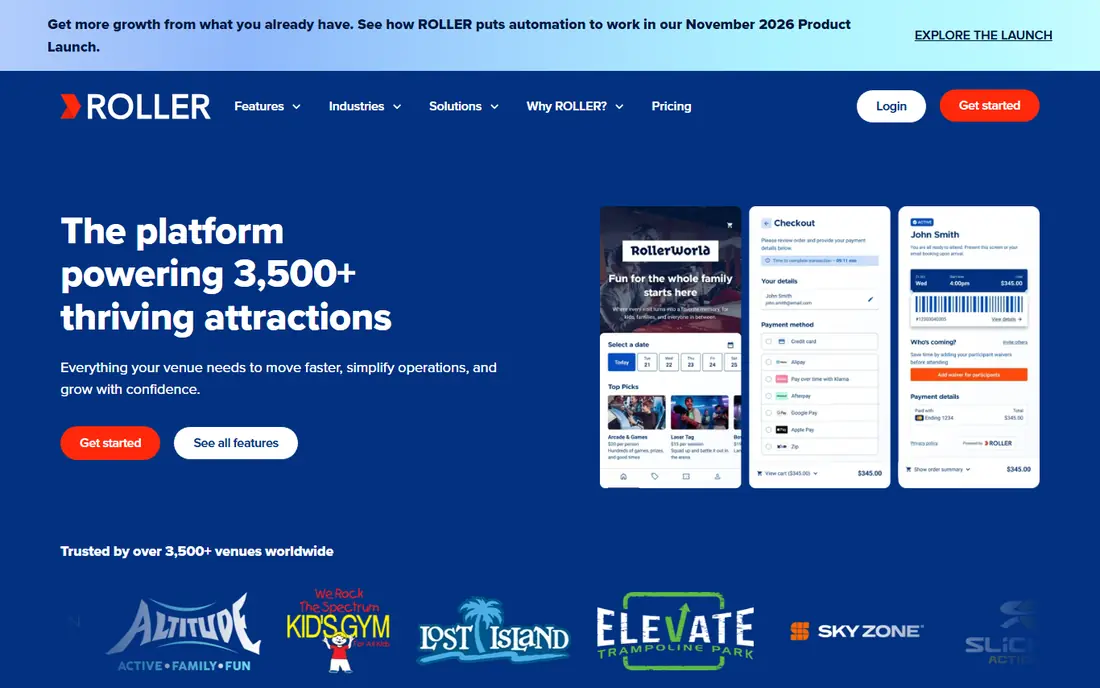
ROLLER is an all-in-one platform for admission-led attractions, including family centres, trampoline parks, water parks, and theme parks. It brings online ticketing, point of sale, memberships, integrated payments, digital waivers, and reporting together, so a guest journey from booking to entry to food and retail stays in one system. Party packages and group bookings are also built in, which helps venues that rely on celebrations.
Pricing is quote-based, and the vendor does not publish a simple rate card, so a buyer should request a written quote that covers venues, devices, payments, and support. Higher tiers add features such as guest flags, wristband management, and mobile food ordering. For a venue that sells admission first, ROLLER is a strong, complete starting point.
- Online checkout, point of sale, memberships, and waivers in one platform
- Party and group booking tools
- Pricing is quote-based
- Advanced features sit on higher tiers

CenterEdge Advantage is built for family entertainment centres, trampoline parks, water parks, and amusement parks that need strong on-site operations. Its point of sale, redemption, food and beverage, inventory, and party tools suit venues where guests buy, play, eat, and redeem prizes in one visit. Online ticketing, waivers, passes, and memberships complete the guest journey.
The platform is quote-based, and a buyer should budget for hardware, training, and setup alongside the software fee. That planning pays off on a busy day, when the point of sale, redemption counter, and entry gates must all work together. For a venue with heavy on-site sales, CenterEdge is a practical, operations-first choice.
- Strong on-site point of sale and redemption
- Online ticketing, waivers, and memberships
- Hardware options
- Quote-based pricing
- Implementation and hardware planning take time
accesso serves large theme parks, attractions, and cultural venues that need enterprise ticketing, eCommerce, and guest experience tools at scale. Its platform can handle high-volume online sales, season passes, group bookings, and virtual queuing, which matter when thousands of guests arrive on the same day. That scale is its main advantage over small-venue tools.
The drawback is fit for smaller operators. accesso is an enterprise platform with quote-based pricing and a longer implementation path, so a small family centre may find it too large and too costly. A large park or a venue group that needs capacity management and a proven high-volume system should shortlist it.
- Enterprise ticketing and eCommerce for large venues
- Virtual queuing and guest experience tools
- Global client base
- Enterprise scope and price
- More system than a small venue needs
Gateway Ticketing focuses on the admission core: selling tickets online and on site, controlling entry, managing season passes and groups, and tracking guest data. That focus suits attractions that already have separate point of sale or food systems, or that want a strong ticketing engine first. Its CRM tools also help a venue understand repeat visitors and members.
A buyer should check how Gateway connects to point of sale, payments, and access hardware, because a ticketing-only purchase can leave gaps elsewhere. Pricing is quote-based, so request a scope that covers ticket types, entry points, and support. For a venue whose main pain is admission, it is a solid, focused choice.
- Ticketing, admission control, and CRM for attractions
- Season pass and group sales
- Integration options
- Quote-based pricing
- Full venue operations may need additional tools
Ventrata helps attractions sell tickets online, manage time slots and capacity, and distribute through resellers and partners. That distribution matters for a tourist attraction that sells through hotels, tour operators, and online travel sites, not just its own website. A modern checkout also reduces abandonment on mobile, where many guests now book.
The trade-off is on-site depth. Ventrata is strongest as a ticketing and distribution platform, so a venue that needs full point of sale, redemption, and food operations should check how it integrates with those systems. Pricing is quote-based, and a buyer should confirm transaction fees, reseller terms, and support coverage in writing.
- Online ticketing with reseller and distribution tools
- Capacity and time-slot controls
- Modern checkout
- Quote-based pricing
- On-site point of sale depth varies by setup
Convious offers eCommerce, ticketing, and guest communication for attractions, zoos, museums, and leisure parks. Its tools for dynamic pricing, capacity management, and targeted offers help a venue smooth demand across peak and quiet days, rather than selling every ticket at one flat price. That control can improve both revenue and the guest experience on busy days.
Pricing is quote-based, and the best fit depends on venue type, region, and sales channels. A buyer should test the checkout, the capacity rules, and the reporting with real ticket types before committing. For a venue that wants smarter pricing and online sales, Convious deserves a demo.
- ECommerce and ticketing for attractions
- Dynamic pricing and capacity tools
- Guest communication features
- Quote-based pricing
- Feature fit varies by venue type and region
Semnox Parafait suits venues where guests pay with RFID cards, play arcade games, and redeem prizes, such as family centres and indoor parks. It handles cashless payments, access control, game management, redemption, and inventory in one system, which reduces cash handling and speeds up play. Analytics also show which games and attractions perform best.
The cost is hardware and setup. Card readers, kiosks, and access points must be planned and installed, and pricing is quote-based. A venue that does not use cashless play may not need this depth, but for an arcade-led venue, Semnox is a strong operational fit.
- RFID cashless cards, access control, and arcade management
- Redemption and inventory tools
- Venue analytics
- Quote-based pricing
- Hardware and card systems add implementation work
Clubspeed is built for karting centres and multi-attraction venues, with race management, timing, leaderboards, and heat scheduling at its centre. It also covers point of sale, memberships, party bookings, and reporting, so a karting venue can run races, food, and retail in one system. That race focus sets it apart from generic ticketing tools.
The limit is scope. A pure theme park without karting may find other platforms a better fit, and pricing is quote-based. For a karting-led venue or a family centre where racing is the headline attraction, Clubspeed matches the daily workflow closely.
- Karting race management and timing
- Point of sale, memberships, and party booking
- Multi-attraction support
- Quote-based pricing
- Strongest fit is karting-led venues rather than a pure theme park
How we picked these
We compared vendor product pages and public descriptions for venue platforms that handle ticketing, point of sale, memberships, or access control for amusement and leisure venues, and we kept only tools live in October 2026. We included large-park, family-centre, and niche tools, because venue size changes the right choice. Where pricing is quote-based, we wrote See website rather than inventing a rate.
Choosing the right amusement park software
Start with the guest journey on your busiest day. Walk through online booking, arrival, entry, food, play, and exit, and note where queues form, where staff retype data, and where payments fail. The tool that fixes those points matters more than a long feature list, because a busy day exposes every weak link in the system.
Next, test capacity, season pass, and group workflows with real ticket types. Check how the system handles timed entry, a sold-out slot, a group booking, a refund, and a season pass renewal, because those cases create the most guest complaints. Also confirm payment fees, hardware costs, and support hours in the written quote, since those costs sit outside the software fee.
Finally, plan staff training and a phased rollout. Train entry, point of sale, and party teams separately, run the new system alongside the old one for a short period if possible, and keep a fallback plan for a payment or network outage. A system that staff trust on a quiet day still needs a test on a peak day before it becomes the only system.
Frequently asked questions
Do small family centres need the same software as a large theme park?
No. A small centre needs simple booking, waivers, point of sale, and party tools, while a large park needs capacity management, season passes, virtual queuing, and high-volume ticketing. Buying a large-park system for a small venue usually adds cost and complexity without improving the guest experience.
How are amusement park platforms usually priced?
Most enterprise platforms in this market are quote-based, with fees that depend on venue size, devices, ticket volume, and support. Some also charge payment processing or transaction fees, and hardware is often separate. Always request a written quote that covers software, hardware, payments, and support for a full year.
What happens if the internet or payment system goes down?
Ask the vendor about offline modes, backup payment options, and manual entry procedures before you buy. A venue should have a written fallback plan for entry and point of sale, because a peak-day outage can create long queues quickly. Test that plan during a pilot, not during a real outage.
Can one platform handle ticketing, food, and arcade play?
Some platforms do, especially those built for family centres, while others focus on ticketing and integrate with separate point of sale or cashless systems. Check each workflow with your own menu, game, and ticket types, and confirm which integrations are included in the quoted price.
How long does implementation usually take?
It depends on venue size, hardware, data migration, and training, and it can range from weeks for a small venue to months for a large park. Agree a timeline, a training plan, and a go-live checklist with the vendor, and allow extra time for peak-season testing before a full launch.
Sources
See where you really rank - block by block
ProMapRanker scans Google Maps across a grid of your service area. Simple monthly plans from $19, white-label on every plan.
Start freeKeep reading
 what’s the best risk software for enterprises
What Is the Best Risk Software for Enterprises in 2026
We compared what’s the best risk software for enterprises on risk registers, controls, third-party risk, and reporting, with pricing notes for large teams.
Read → what's the best pam software for enterprises
What is the Best PAM Software for Enterprises in 2026
Find what's the best pam software for enterprises, with vaulting, session recording, just in time access and pricing compared for large enterprise IT teams.
Read → what’s the best grc software
What Is the Best GRC Software in 2026
We compared what’s the best grc software on risk, compliance, audit and vendor risk, so teams can pick a platform that fits their frameworks and budget.
Read →