 ProMapRanker
Best Alternatives to Facebook Groups in 2026


Paid membership communities with courses and events · Pricing starts at: $89 per month
Key takeaways
- Circle is our pick for most paid communities because it combines discussion, courses, events, and payments in one branded space.
- Discord and Telegram are the strongest free starting points, with Discord better for organized chat and Telegram better for large broadcast groups.
- Mighty Networks and Skool suit creators who sell courses, while Discourse suits open discussion that needs to stay searchable.
- Owning your member list and export options matters more than a free start if you plan to charge later.
- Moving a group takes work: announce early, invite in waves, and keep the old group open during the switch.
Quick comparison
| Pick | Great for | Pricing starts at | Free tier | |
|---|---|---|---|---|
| Circle | Paid membership communities with courses and events | $89 per month | Free trial | Visit |
 Discord | Free real-time chat with voice channels | Free | Yes | Visit |
 Mighty Networks | Courses and programs with a strong community | $79 per month | Free trial (14 days) | Visit |
 Skool | Simple paid coaching communities | $9 per month | No | Visit |
 Discourse | Searchable forums and support communities | Free | Yes | Visit |
 Telegram | Large free groups and broadcast channels | Free | Yes | Visit |
 Slack | Work-focused and professional small groups | Free | Yes | Visit |
 WhatsApp Communities | Groups for people already using WhatsApp daily | Free | Yes | Visit |
 Reddit | Public topic communities that welcome discovery | Free | Yes | Visit |
The best alternatives to Facebook Groups
People leave Facebook Groups for clear reasons: algorithm changes, limited monetization, weak search, and no control over member data. These nine options cover free chat, paid memberships, courses, and public forums, so you can match the tool to how your group actually meets.
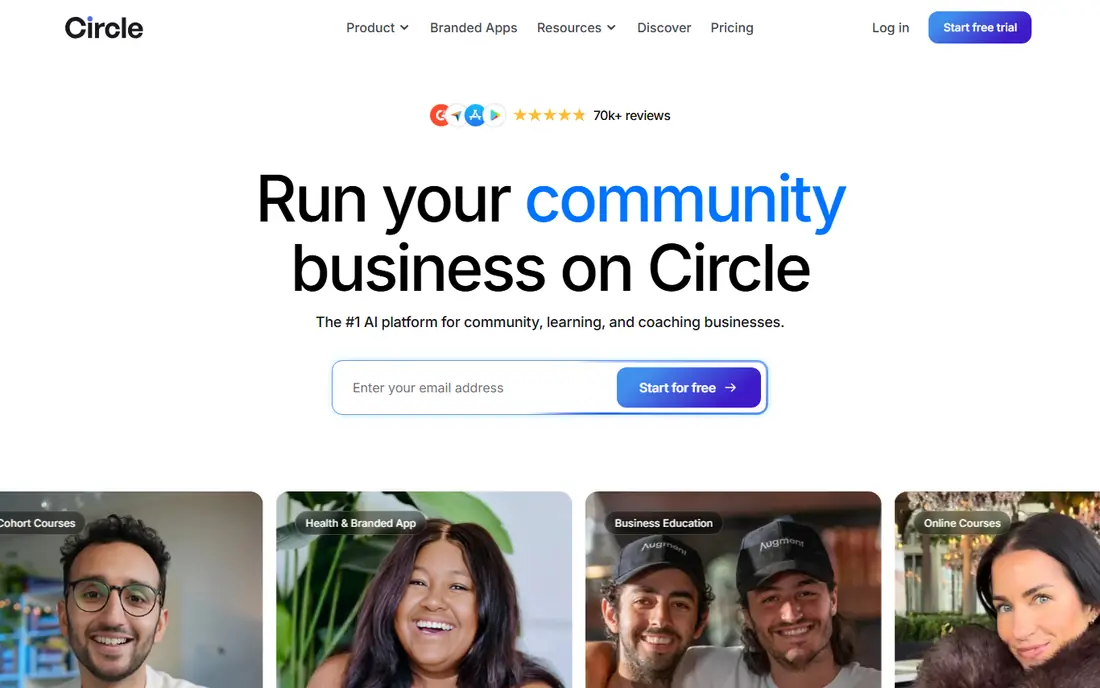
Circle is the closest all-in-one replacement for a serious group that also sells memberships. You can run discussion spaces, live events, courses, and payments under your own brand, without members needing a social media account. The interface feels calmer than a social feed, which helps longer discussions stay visible.
The cost is the main hurdle. The entry plan is $89 per month on annual billing and takes a transaction fee on payments, so small free groups may not need it yet. For creators charging for access, the consolidation often replaces several separate tools. If your group is a business, Circle is the default to compare others against.
- Branded community spaces
- Courses, events, and payments in one system
- Clean mobile apps
- Entry plan takes a transaction fee
- Branded apps need higher tiers
- Price climbs as you add features

Discord is the most popular free move from Facebook Groups, especially for hobby, gaming, and tech communities. Servers split into channels by topic, with voice rooms for live hangouts and events. Roles, moderation tools, and bots help larger groups stay organized, and members can join from a link without a Facebook account.
Search and long-form content are weaker than a forum, since fast chat pushes older posts out of view. Paid memberships need third-party tools, since Discord does not handle subscriptions natively for most creators. For a free, lively group, Discord is still the easiest switch.
- Free servers
- Text, voice, and video channels
- Roles and moderation bots
- Chat buries older content
- No native paid membership billing
- Can feel busy for newcomers
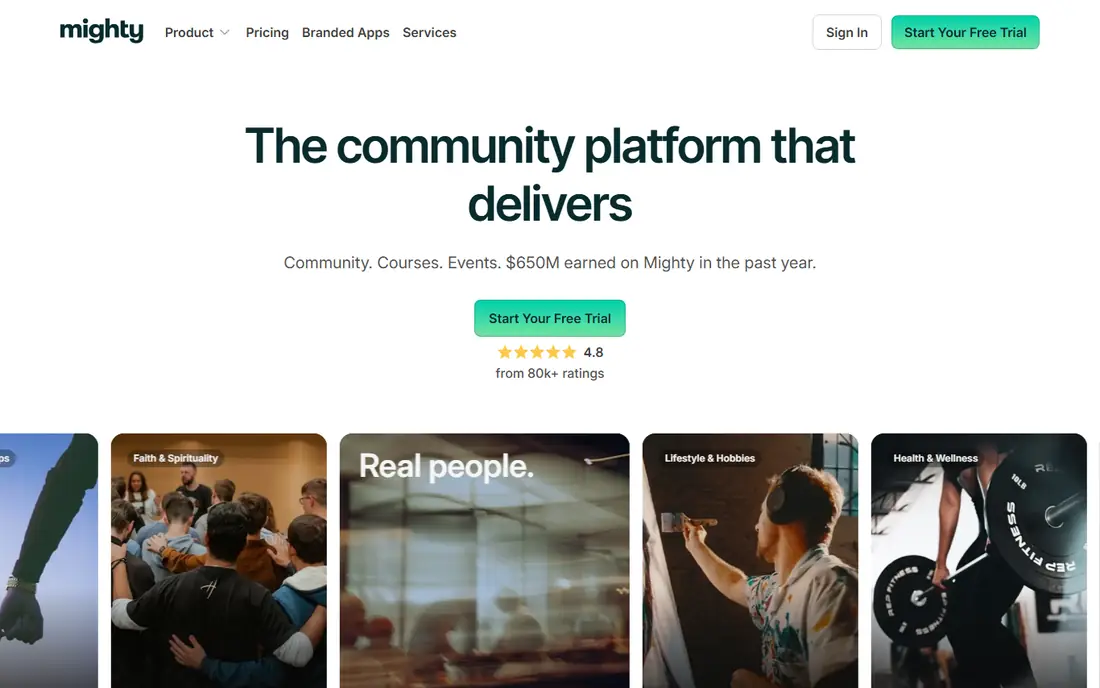
Mighty Networks suits creators who run cohort courses, challenges, or membership programs where discussion supports learning. Members get a feed, course lessons, events, and direct messages in one mobile app, which keeps engagement higher than a scattered set of tools. The platform is built around helping members meet each other, not just read posts.
Pricing rises with features, and lower plans take a transaction fee on sales. Moving years of Facebook content across is not automatic, so plan to bring key resources over by hand. If courses drive your group, Mighty Networks is a strong fit.
- Courses, events, and community in one app
- Strong mobile experience
- Member profiles
- Transaction fees on lower plans
- Higher tiers cost much more
- Migration can be slow
Skool keeps community software deliberately simple: a discussion feed, course modules, a calendar, and member levels. That simplicity helps coaches and course sellers launch fast without configuring dozens of settings. Members earn points for posting, which encourages participation in small groups.
The pricing split matters. The $9 Hobby plan takes a 10 percent transaction fee, while the $99 Pro plan lowers that fee, so high-selling groups should compare total cost, not just the monthly fee. Each community needs its own subscription. For a single paid coaching group, Skool is refreshingly easy.
- Very simple setup
- Courses, calendar, and discussion in one place
- Gamification with points and levels
- Hobby plan takes a high transaction fee
- Fewer customization options
- One subscription per community
Discourse is a modern forum platform used by open-source projects, product communities, and support teams. Unlike chat apps, discussions stay organized by topic, searchable, and easy to link to later. That makes it ideal when answers should last, such as troubleshooting guides, product feedback, and local club records.
Self-hosting is free in software terms, but you pay for a server and handle updates and security. Hosted plans remove that work at a monthly cost. Discourse feels slower and more deliberate than Facebook, which is a strength for knowledge, but a weakness for casual daily chat.
- Free and open source if self-hosted
- Excellent search
- Topics stay findable for years
- Hosting costs if you do not self-host
- Setup needs technical skill
- Less suited to live chat
Telegram groups can hold very large member counts, and channels let admins broadcast updates to followers without reply noise. It works well for news groups, local alerts, creator updates, and hobby communities that mainly share links and short posts. Setup takes minutes, and most people already have the app or can install it free.
Moderation tools are lighter than Discord or Circle, and paid access needs bots or outside payment tools. Content also scrolls away quickly in busy groups. For a free, simple group with a large audience, Telegram is a practical Facebook Groups alternative.
- Free large groups
- Channels for one-way updates
- Fast mobile apps
- Weak moderation for very large groups
- No native paid membership tools
- Search is basic
Slack suits professional networks, alumni groups, and project communities where members already use it at work. Channels keep topics separate, threads keep replies tidy, and integrations connect calendars, docs, and other tools. For a focused group under a few dozen active members, the free plan often suffices.
The free plan limits searchable message history, which hurts groups that need old discussions to stay visible. Paid plans charge per user, so a large casual group becomes expensive fast. Slack is best when the group feels like a team, not a social club.
- Organized channels
- Strong search on paid plans
- Many integrations
- Free plan limits message history
- Per-user pricing grows fast
- Feels work-like for casual groups
WhatsApp Communities let you bundle related groups under one umbrella with an announcement channel for all members. Schools, clubs, neighborhoods, and family networks benefit because members do not need to learn a new app. Messages arrive where people already chat, so participation stays high.
Control is limited compared with Circle or Discourse. There are no native paid memberships, detailed analytics, or rich forum features, and members join with phone numbers visible to admins. For a free local or family group, WhatsApp Communities is the lowest-friction move.
- Free
- Most members already have it
- Announcements reach all sub-groups
- Limited moderation and analytics
- No native payments
- Tied to phone numbers
Reddit suits groups built around a public topic rather than a private membership. Subreddits can grow through search and recommendations, discussions stay threaded and searchable, and moderation tools cover rules, flairs, and post controls. Hobby, local interest, and support communities often thrive there.
The trade-off is control. Reddit sets platform rules, your community is public unless you restrict it, and growth brings moderation work and occasional conflict. Private or paid groups fit better on Circle, Skool, or Discourse. For a free public community that wants new members to find it, Reddit is a strong option.
- Free
- Huge discovery potential
- Threaded discussions stay searchable
- You do not control the platform rules
- Public by nature
- Moderation workload can be high
How we picked these
We compared official pricing pages, community features, moderation tools, and monetization options for platforms used as Facebook Groups replacements in October 2026. We kept only platforms that still operate and support real group discussion, and we excluded Facebook Groups itself. We favored options with a free plan or trial and clear ownership or export options.
How to move a group without losing members
Start by telling members why you are moving and what improves for them, such as less algorithm noise, better search, or paid content in one place. Open the new space early, invite your most active members first, and seed it with the resources people actually need. Keep the old group open for a transition period, with pinned posts pointing to the new home.
Expect a drop in numbers. Not every Facebook member will follow, and that is normal: an active smaller group beats a large silent one. Export your member list where possible, save key posts and files before closing anything, and set clear rules and moderators on day one. A smooth move is about communication, not just software.
Frequently asked questions
What are the best free alternatives to Facebook Groups?
Discord, Telegram, WhatsApp Communities, Reddit, and self-hosted Discourse are the strongest free options. Discord suits live chat, Telegram suits large groups, WhatsApp suits people already on the app, and Discourse suits searchable knowledge. Choose by how your members already communicate.
What is the best alternative to Facebook Groups for a paid community?
Circle is our pick for most paid communities because discussion, courses, events, and payments live in one branded space. Mighty Networks suits course-led programs, and Skool suits simple coaching groups. Compare transaction fees, not just monthly prices, before choosing.
Can I move my Facebook Group members to a new platform?
You can invite members and share a join link, but Facebook does not offer a full member export to another platform. Announce the move in the old group, email members if you have their addresses, and keep the old group open during the transition to catch late movers.
Is Discord better than Facebook Groups?
Discord is better for real-time chat, voice hangouts, and organized channels, and it is free. Facebook Groups are better for discovery among people who already use Facebook daily. Discord is weaker for searchable long-form content and native paid memberships.
Do I need to pay to replace Facebook Groups?
No, for a basic group. Free tools cover chat and discussion well. Pay when you need branding, courses, payments, analytics, or full control over member data. Start free, prove the new space works, then upgrade only if the paid features earn their cost.
Sources
See where you really rank - block by block
ProMapRanker scans Google Maps across a grid of your service area. Simple monthly plans from $19, white-label on every plan.
Start freeKeep reading
 zoho inventory alternatives
6 Alternatives to Zoho Inventory, Compared on Price and Fit
Zoho Inventory alternatives: 6 tools compared on price, free plans and fit. Katana leads the list for manufacturers. Fit and flaws are laid out for each entry.
Read → zoho crm alternatives
Best Zoho CRM Alternatives (2026)
Need Zoho CRM alternatives? We compare 7 tools on cost, free access and who each suits. Every pick gets a straight assessment. Built for quick decisions.
Read → zelle alternatives
Best Zelle Alternatives in 2026
Compare the best Zelle alternatives for sending money to friends, paying sellers and moving funds abroad, with honest notes on fees, speed and safety in 2026.
Read →