 ProMapRanker
Best Alternatives to Bynder in 2026


Marketing teams that need fast adoption and portals · Pricing starts at: See website
Key takeaways
- Brandfolder and Canto suit most mid-market teams, with Brandfolder favoring distribution and Canto favoring approachable DAM.
- Frontify is the brand-governance pick, while Acquia and Aprimo suit enterprises with wide integrations or content operations.
- Cloudinary and Pics.io offer lower-cost or developer-friendly paths, with Cloudinary adding delivery and Pics.io avoiding migration.
- Most enterprise DAM pricing is quoted, so shortlist on fit first, then get comparable quotes on the same user and storage scope.
Quick comparison
| Pick | Great for | Pricing starts at | Free tier | |
|---|---|---|---|---|
| Brandfolder | Marketing teams that need fast adoption and portals | See website | Free trial | Visit |
 Canto | Mid-market teams that want an approachable DAM | See website | Free trial | Visit |
 Frontify | Brand teams that need guidelines plus DAM | See website | Free trial | Visit |
 Acquia DAM | Organizations connecting assets to many systems | See website | Free trial | Visit |
 MediaValet | Video-heavy teams that want unlimited users | See website | Free trial | Visit |
 Cloudinary | Developer-led teams that need DAM plus delivery | Free | Yes | Visit |
 Pics.io | Small teams that want DAM on top of Drive or S3 | $100 per month | Free trial | Visit |
 Aprimo | Large content operations teams | See website | Free trial | Visit |
 PhotoShelter for Brands | Brand and creative teams with large photo libraries | See website | Free trial | Visit |
The best alternatives to Bynder
We compared digital asset management platforms that can replace Bynder for storing, finding, sharing, and governing brand assets, with attention to portals, AI search, and integration breadth.
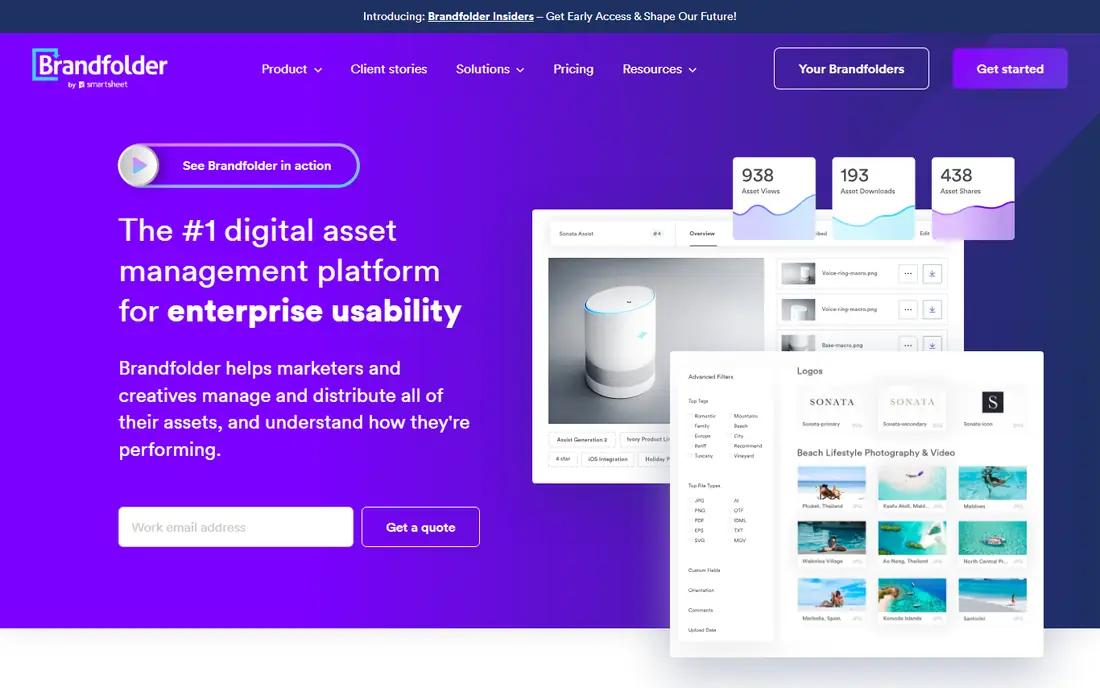
Brandfolder suits marketing teams that need approved assets in the hands of partners quickly. Portals, collections, and sharing links make distribution simple, while analytics show which assets get used. Adoption tends to be fast because the interface favors browsing and sharing over heavy admin work.
The catch is pricing clarity. Plans are quoted, so small teams cannot budget from a public price list. Brandfolder is strongest when distribution and adoption matter more than deep developer-led transformation.
- Easy sharing and brand portals
- Asset analytics and usage insight
- Smartsheet ecosystem integration
- Quote-based pricing
- Advanced transformation depth is narrower than some rivals
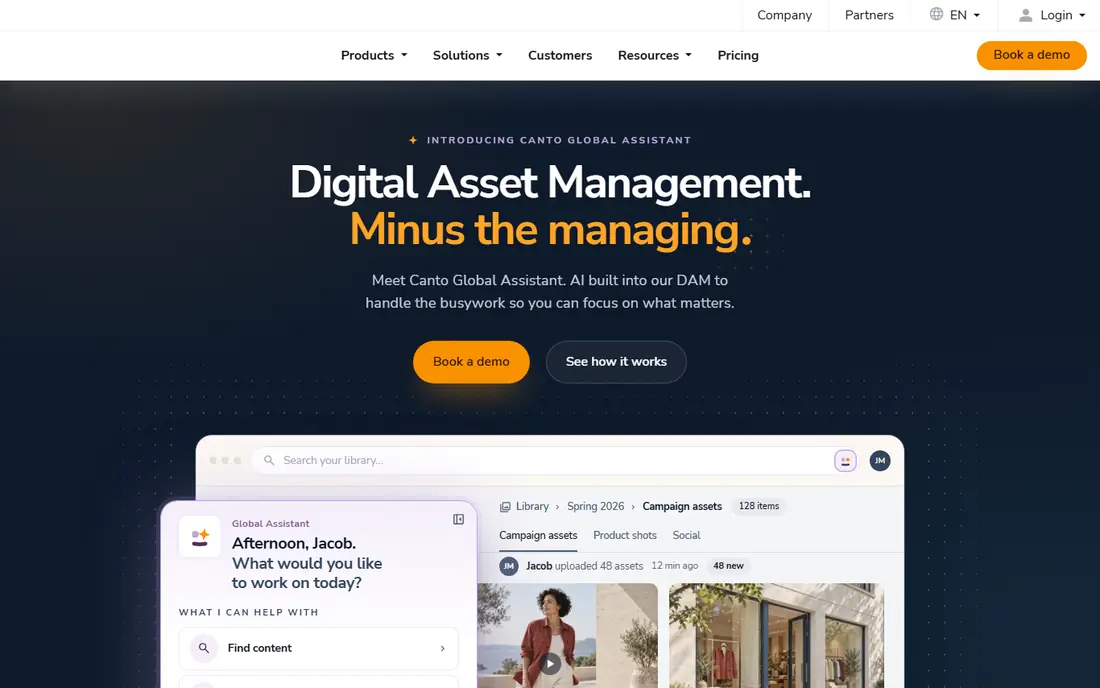
Canto fits mid-market marketing and brand teams that need proper digital asset management without enterprise complexity. Search, metadata, smart albums, and approvals help teams find the right logo, photo, or video without asking around. AI tagging reduces the manual work of organizing large libraries.
The limit is plan variation. Some AI and workflow features sit on higher tiers, so the demo may show more than the entry plan includes. Canto is a good default when ease of use and time to value matter most.
- AI-powered search and auto-tagging
- Approval workflows
- Brand Studio and portal options
- Quote-based pricing
- AI features vary by plan, so confirm inclusions
Frontify combines brand guidelines with asset management, which helps teams explain how assets should be used, not just where they live. Guidelines, templates, and approved files sit together, so partners and agencies see rules alongside downloads. That reduces off-brand use.
The trade-off is DAM depth at the largest scale. Very large, complex libraries may need a deeper enterprise DAM, while brand-led teams will value Frontify's hub approach. It is best for organizations where brand governance is the main problem.
- Brand guidelines, templates, and DAM in one hub
- Visual brand portals
- Collaboration and approval options
- Quote-based pricing
- Less deep as a standalone enterprise DAM for some very large libraries
Acquia DAM, formerly Widen, suits organizations that need assets to flow into websites, product systems, and partner channels. Portals and templates support distribution, while integrations connect the DAM to the wider content stack. That breadth helps enterprises with many downstream systems.
The catch is scope. Smaller teams that only need a shared library may find it more than they need, and implementation takes planning. Acquia is strongest when integration breadth and enterprise distribution are requirements.
- Portals, templates, and workflows
- Large integration catalog
- Product information options in some setups
- Quote-based pricing
- Implementation can be heavier than simpler DAM tools
MediaValet appeals to organizations tired of per-seat pricing games. Unlimited users on plans let large, distributed teams access assets without counting seats, and video handling is a strength. AI tagging and metadata search help teams find content across large libraries.
The limit is entry cost. Pricing is quoted and aimed at mid-market and enterprise buyers, so very small teams may find cheaper options. MediaValet suits video-heavy organizations that need broad access and strong security.
- Unlimited users on plans
- AI tagging and search across images and video
- Azure-based hosting
- Quote-based pricing
- Mid-market to enterprise focus, not a small-team budget tool
Cloudinary is the pick when assets must also be delivered to websites and apps at scale. It combines DAM with transformation, optimization, and CDN delivery, so one platform can store, resize, and serve media. Developers value the APIs and automation options.
The trade-off is scope. Teams that only need storage and sharing may find the platform wider than needed, and enterprise pricing is quoted. Cloudinary is best for product and engineering-led teams that treat delivery as part of asset management.
- Free tier for starting
- Image and video transformation plus delivery
- DAM with CDN-backed distribution
- Broader than a simple library, so non-technical teams may need help
- Enterprise features are quoted
Pics.io suits small teams that do not want to migrate everything to a new storage system. It layers DAM features over Google Drive or Amazon S3, so existing files stay where they are while search, tagging, and collaboration improve. That lowers migration risk and setup time.
The limit is enterprise depth. Governance, workflow, and scale features are narrower than on enterprise DAM platforms. Pics.io is a strong choice for small creative and marketing teams that need organization without a full DAM migration.
- Layers DAM over Google Drive or Amazon S3
- Visual search and similarity features
- Lower migration effort
- Less suited to very large enterprise governance needs
- Feature depth varies by plan
Aprimo fits large content operations teams that need DAM plus workflow, planning, and production support. AI features for enrichment and review can reduce manual tagging and approval work, while enterprise integrations connect content to marketing systems.
The catch is size. Aprimo is an enterprise platform with quoted pricing and implementation effort, so small teams will find it heavy. It belongs on a shortlist when content operations, not just storage, is the core need.
- Agentic DAM features for enrichment and review
- Workflow and content operations breadth
- Enterprise integrations
- Quote-based enterprise pricing
- Scope is larger than DAM alone
PhotoShelter for Brands
Great for: Brand and creative teams with large photo libraries
PhotoShelter for Brands suits teams whose libraries are photo-heavy. Organization, sharing, and portal features help brand, sports, and media teams distribute images quickly, while visual search helps find the right shot without perfect metadata.
The limit is breadth. Teams that need deep video workflow or enterprise content operations may need a broader platform. PhotoShelter is best when photos are the core asset type and fast, visual distribution matters.
- Photo-focused DAM with strong organization
- Sharing and portal options
- Visual search features
- Quote-based pricing
- Video and enterprise workflow depth varies by plan
How we picked these
We compared official feature pages and recent DAM comparisons, and we excluded Bynder itself because this is an alternatives guide. We did not claim hands-on testing. Where a vendor does not publish a price, we mark it as See website rather than repeating third-party contract estimates as facts.
Fit varies by asset type and team size. A photo-heavy team, a developer-led team, and a global brand team will not pick the same tool. Use the sections below to match library size, distribution needs, and governance requirements.
How to choose a Bynder alternative without a painful migration
Audit the library before you demo
Count assets, formats, and users, and list the top search and sharing tasks. A demo with a clean sample library hides tagging, permission, and migration problems. Bring a messy, real subset to any trial.
Test search with real queries
Try vague queries, such as a campaign name or a product color, and check whether AI tagging and visual search return the right files. Search quality decides daily adoption more than any admin feature.
Compare quotes on the same scope
Ask each vendor to quote the same users, storage, portals, and AI features. Enterprise DAM quotes vary widely with modules, so a low base quote may exclude the features that made the demo look good.
Frequently asked questions
What is Bynder?
Bynder is an enterprise digital asset management platform for storing, organizing, and distributing brand assets through portals and workflows. This guide lists alternatives for teams that want different pricing, simpler setup, or a different feature focus.
What is the best Bynder alternative for small teams?
Pics.io and Cloudinary are common starting points, since Pics.io avoids full migration and Cloudinary offers a free tier. Brandfolder and Canto also work for small teams, but pricing is quoted, so get a quote early.
What is the best Bynder alternative for brand governance?
Frontify is the clearest brand-governance pick because guidelines, templates, and assets live together. Brandfolder and Canto also support portals and approvals, with different strengths in distribution and ease of use.
Do DAM tools replace cloud storage?
Not exactly. Some DAM tools layer over Drive or S3, while others store assets themselves. A DAM adds metadata, search, permissions, portals, and workflows on top of storage, which is the value beyond a shared folder.
How much does DAM software cost?
Most enterprise DAM vendors quote only, with annual contracts that vary by users, storage, and modules. Lower-cost options in this guide include Cloudinary with a free tier and Pics.io from $100 per month, but enterprise quotes will be higher.
Sources
See where you really rank - block by block
ProMapRanker scans Google Maps across a grid of your service area. Simple monthly plans from $19, white-label on every plan.
Start freeKeep reading
 zoho inventory alternatives
6 Alternatives to Zoho Inventory, Compared on Price and Fit
Zoho Inventory alternatives: 6 tools compared on price, free plans and fit. Katana leads the list for manufacturers. Fit and flaws are laid out for each entry.
Read → zoho crm alternatives
Best Zoho CRM Alternatives (2026)
Need Zoho CRM alternatives? We compare 7 tools on cost, free access and who each suits. Every pick gets a straight assessment. Built for quick decisions.
Read → zelle alternatives
Best Zelle Alternatives in 2026
Compare the best Zelle alternatives for sending money to friends, paying sellers and moving funds abroad, with honest notes on fees, speed and safety in 2026.
Read →