 ProMapRanker
Best Alternative Investment Platforms in 2026


Diversified private real estate and credit · Pricing starts at: See website
Key takeaways
- Alternative platforms cover very different assets, from real estate and private credit to art, wine and pre-IPO shares.
- Many offerings are limited to accredited investors, while a smaller set is open to retail investors.
- Minimums, lock-up periods and fees differ sharply, so compare the offering document, not just the headline asset.
- This is not financial advice, and alternative investments carry risk, including loss and illiquidity.
- We make no return claims here, because past performance and target figures do not guarantee future results.
Quick comparison
| Pick | Great for | Pricing starts at | Free tier | |
|---|---|---|---|---|
| Fundrise | Diversified private real estate and credit | See website | No | Visit |
 Yieldstreet | Varied private market offerings | See website | No | Visit |
 Masterworks | Fractional shares in artwork | See website | No | Visit |
 Vinovest | Wine and whiskey portfolios | See website | No | Visit |
 Percent | Private credit deals | See website | No | Visit |
 EquityZen | Pre-IPO private company shares | See website | No | Visit |
 Republic | Startup and private company investing | See website | No | Visit |
 CrowdStreet | Commercial real estate deals | See website | No | Visit |
 Arrived | Fractional rental property shares | See website | No | Visit |
The best alternative investment platforms
Alternative investments sit outside stocks and bonds, and each platform below focuses on a different corner of that world. Read the eligibility rules first, since accredited status, minimums and holding periods decide whether a platform is even open to you. This guide describes public offerings and risks in plain terms, and it is not financial advice.
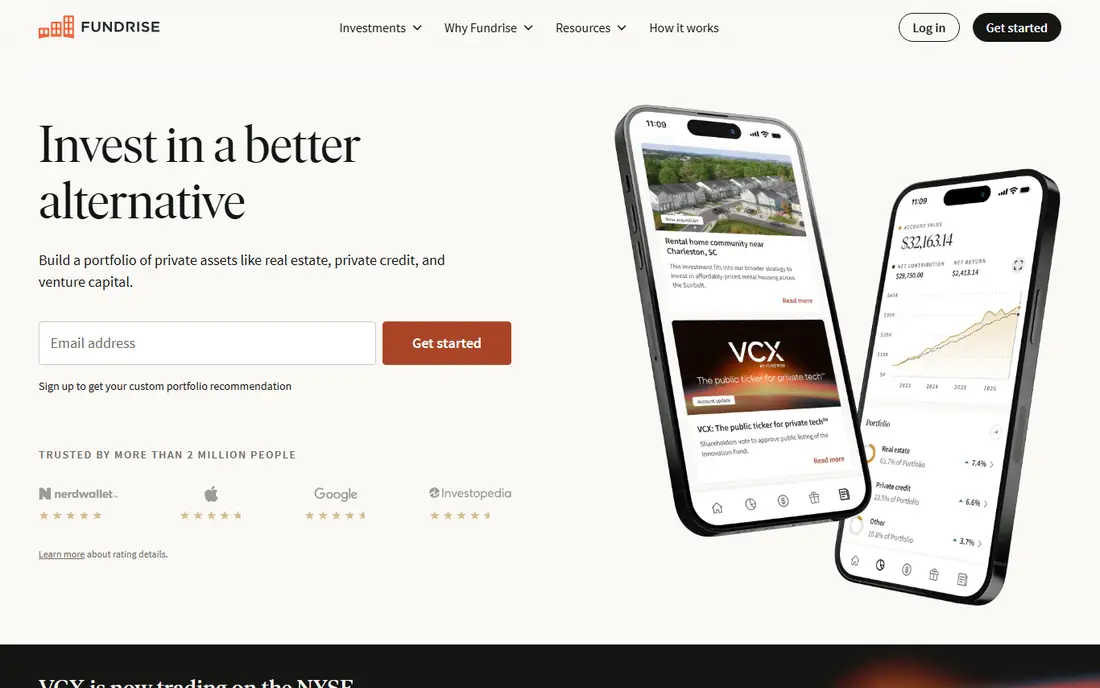
Fundrise is the most accessible starting point on this list for retail investors who want private market exposure without picking single deals. Its funds spread money across real estate, credit and venture holdings, which reduces the risk of betting everything on one property or one company. The platform model also keeps the entry point lower than a traditional private fund.
Illiquidity is the main trade. You cannot sell a private fund share as quickly as a public stock, and redemption requests may be limited or delayed. Treat any Fundrise allocation as long-term money, and read the fund offering documents for fees, strategy and redemption terms before investing.
- Broad real estate, credit and venture exposure in one account
- Lower entry point than many private funds
- Regular reporting
- Private assets are illiquid
- Values can fall
- Redemption windows are limited and not guaranteed
Yieldstreet covers a broad set of private market areas, including real estate, credit, art and other alternative assets, through individual offerings and funds. That breadth lets an accredited investor build varied private exposure in one place, rather than opening accounts across many niche platforms. Its Prism Fund is the better-known route for investors who do not meet accredited rules for single offerings.
The breadth also means homework. Each offering has its own terms, risks, fees and timeline, so a platform-level review is not enough. Read each offering document, check the fee schedule, and confirm whether you meet the eligibility rules for that specific deal.
- Wide range of private market asset classes
- Institutional-style offerings
- Prism Fund option for broader access
- Most offerings are accredited-only
- Fees and minimums vary by offering
- Private assets carry loss and illiquidity risk

Masterworks lets investors buy fractional shares in paintings by well-known artists, rather than buying a whole work. That opens an asset class that was once limited to wealthy collectors, and the platform handles storage, insurance and sale decisions for the works it holds. For art lovers, the appeal is both financial and cultural.
Art is still a risky, illiquid asset. A painting's value depends on taste, provenance and market demand, and a sale may take time or return less than expected. Treat art shares as a small, long-term part of a portfolio, not as a stable income holding.
- Fractional art ownership without buying whole paintings
- Curated blue-chip style works
- Secondary market for some shares
- Art values are subjective and can fall
- Sales depend on finding a buyer
- Fees and holding periods apply
Vinovest builds managed portfolios of fine wine and whiskey, with storage, insurance and tracking handled by the platform. That service model suits investors who like the asset class but do not want to manage cellars, provenance checks or resale logistics themselves. The platform also explains its selection approach in plain terms for new investors.
Tangible collectibles still carry market risk. Prices for specific wines and whiskeys move with demand, vintage reputation and broader luxury spending, and selling a bottle is slower than selling a stock. Confirm fees, minimums and exit terms before committing, since storage and management costs compound over time.
- Managed fine wine and whiskey portfolios
- Storage and insurance handled
- Clear portfolio tracking
- Wine and whiskey values can fall
- Selling takes time
- Management and storage costs affect net results
Percent focuses on private credit, where investors fund loans and receivables through deals with stated terms and timelines. Some deals are shorter than traditional private funds, which appeals to investors who want defined maturities rather than open-ended holdings. The platform presents deal terms, borrower information and risk notes for each offering.
Credit risk is central here. If a borrower fails to pay, investors can lose part or all of an investment, and private credit is not covered by the same protections as bank deposits. Read the deal documents, check the underwriting notes, and spread risk rather than placing a large sum in one deal.
- Access to private credit deals with varied terms
- Shorter deal lengths than many private funds
- Clear deal documents
- Credit risk if borrowers default
- Many deals are accredited-only
- Returns are not guaranteed
EquityZen gives accredited investors a route into private company shares before a public listing, through funds tied to specific companies. That appeals to investors who follow tech and growth companies closely and want exposure before an IPO, if one ever happens. The platform handles the fund structure and company access that an individual could not arrange alone.
The exit risk is large. A private company may stay private for years, may be acquired at a low value, or may fail, and there is no payout schedule while you wait. Only invest money you can leave untouched for a long period, and only after reading the fund terms and fee schedule.
- Access to shares in private companies before IPO
- Fund structure for single-company exposure
- Established secondary market
- Accredited-only for most deals
- No payout until an exit
- Company may never go public or may fall in value
Republic is a broad private fundraising platform covering startups, real estate, crypto-related offerings and other private deals. Some offerings are open to retail investors, which makes it one of the more accessible places to learn how private investing works without accredited status. The deal feed itself is educational for anyone curious about early-stage companies.
Startup risk dominates this category. Many early companies fail or return nothing, and a diversified set of small bets still carries a high chance of loss. Treat Republic as a learning and speculation allocation, not as a core retirement holding, and read each offering's risks before investing.
- Startup, real estate and other private offerings
- Some retail-accessible deals
- Broad deal discovery
- Startup failure risk is high
- Illiquidity is the norm
- Deal quality varies widely
CrowdStreet operates as a marketplace for commercial real estate, with individual deals and funds from different sponsors. Investors can compare property types, locations, sponsors and deal structures, which gives more choice than a single-manager fund. That transparency suits investors who already understand real estate basics.
Commercial property is cyclical, and values, rents and exit timing all move with local markets and interest rates. Sponsor quality matters a great deal, so review the sponsor track record, fee structure and deal documents, not just the property photos and headline terms.
- Direct commercial real estate deals and funds
- Detailed deal pages and sponsor information
- Marketplace model
- Most deals are accredited-only
- Commercial real estate cycles affect values
- Long holding periods
Arrived lets investors buy fractional shares in single-family rental homes, with rental income and potential appreciation as the return drivers. It suits people who like the idea of rental property but do not want to manage tenants, repairs or mortgages themselves. The platform handles property management and reporting.
Rental investing still carries property risk. Vacancies, repairs, local price moves and management costs all affect results, and shares cannot be sold as quickly as public stocks. Check the property details, fee schedule and holding expectations for each home before investing.
- Fractional shares in rental homes
- Rental income and appreciation potential
- Lower entry than buying a whole property
- Property values and rents can fall
- Shares are illiquid
- Management and platform fees affect net income
How we picked these
We compared public platform descriptions, offering types, eligibility rules and fee disclosures for platforms that were live and accepting investors in 2026. We favored breadth across asset classes, from real estate and credit to art, wine and pre-IPO shares, so readers can compare unlike assets side by side. We did not rank by returns, because return figures depend on the offering, timing and fees, and past results do not predict future outcomes.
What to check before you invest in alternatives
Start with eligibility and liquidity. Confirm whether you qualify as accredited where required, and ask how long your money will be locked up and how you can exit. A platform that looks attractive on asset choice can still be a poor fit if you need the money within a year or two.
Next, read the offering document for each deal or fund, not just the platform marketing page. Look for fees, minimums, sponsor or manager incentives, valuation methods and risk factors. Ask how valuations are set for illiquid assets, since private valuations can lag or smooth over real market moves.
Building a sensible alternatives allocation
Keep alternatives as a limited part of a broader plan, alongside cash, stocks and bonds, rather than as a replacement for them. Diversify across asset types and deals where possible, and avoid placing a large share of savings in a single platform, property or company. Set a clear time horizon for each holding, and check whether income, growth or diversification is the real goal, since each platform serves a different one.
Also confirm tax reporting and account support before investing. Private funds and fractional shares can produce complex tax documents, and support quality matters when a deal changes terms or a payout is delayed. If any part of the offering is unclear, pause and ask the platform or an independent adviser before committing funds.
Frequently asked questions
What are the best private investment platforms for beginners?
Fundrise and Arrived are often cited as beginner-friendly because they offer diversified or fractional real estate exposure with lower entry points than traditional private funds. Republic also offers some retail-accessible startup deals for learning. Beginners should still start small, read offering documents, and treat alternatives as long-term money.
What is the best alternative investment platform overall?
There is no single best platform, because the right choice depends on the asset you want. Fundrise suits diversified real estate, Yieldstreet suits varied private markets, Masterworks suits art, Vinovest suits wine and whiskey, and Percent suits private credit. Match the platform to the asset, eligibility and holding period first.
Do I need to be accredited to use alternative investment platforms?
Many private offerings require accredited status, which depends on income or net worth rules, but some platforms offer retail-accessible funds or deals. Fundrise, Arrived and some Republic offerings are open more broadly, while most Yieldstreet, EquityZen and CrowdStreet deals are accredited-only. Always check the eligibility for the specific offering.
Are alternative investments safe?
No alternative investment is safe in the sense of guaranteed returns or principal protection. Private assets can fall in value, become hard to sell, and in the case of startups or credit deals, lose part or all of the investment. This guide is not financial advice, and you should only invest money you can afford to leave invested and potentially lose.
How much money do I need to start?
Minimums vary widely by platform and offering, from lower fractional real estate entry points to five-figure minimums on some private deals. Check the current minimum on the platform for the exact offering, since a platform-level minimum does not always apply to every deal.
Can I sell an alternative investment quickly?
Usually not. Private funds, fractional shares and startup stakes are illiquid, with limited redemption windows or secondary markets where available. Some platforms offer periodic redemptions or secondary trading, but neither is guaranteed, and sales may occur at a discount. Plan on a multi-year holding period.
Sources
- https://www.fundrise.com
- https://www.yieldstreet.com
- https://www.masterworks.com
- https://www.vinovest.com
- https://www.percent.com
- https://www.equityzen.com
- https://www.republic.com
- https://www.crowdstreet.com
- https://www.arrived.com
- https://coincodex.com/article/33305/alternative-investment-platforms/
- https://moneywise.com/investing/alternative-investments/alternative-investment-platforms
- https://paperfree.com/en/magazine/best-alternative-investment-platforms
See where you really rank - block by block
ProMapRanker scans Google Maps across a grid of your service area. Simple monthly plans from $19, white-label on every plan.
Start freeKeep reading
 zscaler alternatives
Best Zscaler Alternatives in 2026
Looking for zscaler alternatives? We compare 9 SASE and zero trust platforms on architecture, data protection, pricing, and fit for your network and team.
Read → zapier alternatives free
Best Zapier Alternatives Free in 2026
Nine automation tools for zapier alternatives free in 2026, all with genuinely free tiers, plus free plan limits, starting prices and upgrade paths explained.
Read → which platform is best for online reputation
Which Platform Is Best for Online Reputation in 2026
Wondering which platform is best for online reputation? We compare 8 review, listing, and response tools for small and multi-location businesses and agencies.
Read →