 ProMapRanker
Best AI Voice Generation Tools in 2026

Key takeaways
- ElevenLabs leads for natural sounding voices and cloning, while Murf AI leads for scripted narration teams that need a studio workflow.
- WellSaid Labs suits consistent English brand narration, and Descript Overdub suits podcasters who need to fix audio without re-recording.
- Resemble AI and Cartesia suit developers who need cloning, watermarking, or real time voice APIs.
- Only use your own voice or licensed voices, with clear consent. Do not use these tools to impersonate another person.
Quick comparison
| Pick | Great for | Pricing starts at | Free tier | |
|---|---|---|---|---|
 ElevenLabs | Natural voices and cloning | See website | Yes | Visit |
 Murf AI | Scripted narration studio | See website | Yes | Visit |
 WellSaid Labs | Consistent English brand narration | See website | Free trial | Visit |
 Speechify Studio | Voiceovers and dubbing | See website | Yes | Visit |
 Descript Overdub | Fixing podcast audio | See website | Free trial | Visit |
 Resemble AI | Cloning with watermarking | See website | Free trial | Visit |
 Cartesia | Real time voice API | See website | Yes | Visit |
 Amazon Polly | Developer text to speech | See website | Free trial | Visit |
 Google Cloud Text-to-Speech | Developer text to speech at scale | See website | Free trial | Visit |
The best ai voice generation tools
The best ai voice generation platforms differ in voice quality, cloning rules, language coverage, and workflow. Some are built for creators making narration, others for developers building voice features into apps. The list below covers both, with a clear note on consent in each case.

ElevenLabs is our pick for most creators who care most about how the voice sounds. Its voices handle pacing and tone well, and its library offers many styles for narration, characters, and ads. A free tier with a monthly credit allowance lets new users test quality before paying.
Cloning is the feature to handle with care. Use only your own voice, or a voice you have clear licensed permission to clone, and follow the platform consent checks. For legitimate narration and character work with proper permission, ElevenLabs offers the strongest mix of quality and cloning control.
- Very natural sounding voices
- Large voice library
- Instant and professional cloning options
- Credits are shared across products
- Advanced cloning needs higher plans

Murf AI suits teams that produce scripted narration on a regular schedule, such as training videos and e-learning modules. Its studio lets editors line up voiceover with slides, add music, and adjust timing without leaving the tool. That workflow saves time compared with generating audio in one tool and editing it elsewhere.
The limit is cloning. Self serve cloning is not the main Murf strength, and teams that need custom voices should check enterprise options first. For standard narration with stock voices, Murf offers a steady, team friendly workflow.
- Studio timeline for voiceover work
- Slide sync for presentations
- Good for e-learning and corporate training
- Voice cloning is limited to higher plans
- Raw realism trails ElevenLabs for some voices
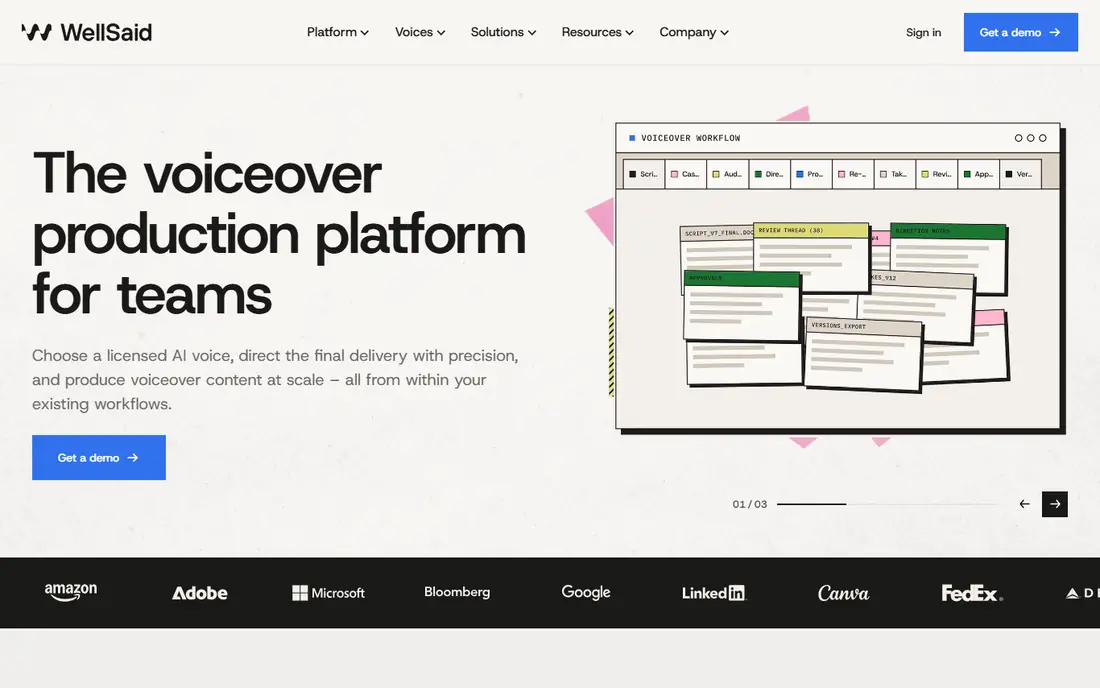
WellSaid Labs suits companies that need the same voice across many videos and training modules. Its voices are designed for clear, professional English narration, and its brand voice options help a company keep a consistent sound. That consistency matters for training, product explainers, and internal communications.
Language coverage is the trade off. Teams that need many languages should check the full list before buying, since fuller coverage sits on higher plans. For English first narration, WellSaid is a dependable, brand safe choice.
- Consistent brand voices
- Clear download based pricing on some plans
- Good for corporate narration
- Language coverage is fuller on enterprise plans
- Download limits apply on lower plans
Speechify Studio suits creators who need voiceovers and dubbing for video and audio content. It offers a range of voices and tools for turning scripts into spoken audio, with dubbing options for reaching audiences in other languages. A free tier lets users test basic voices before paying.
Check the plan carefully. Speechify Studio pricing differs from Speechify Reader pricing, and cloning features sit on higher tiers. For straightforward voiceover and dubbing, Studio is a practical option, but confirm the exact plan covers commercial use before publishing.
- Voiceover and dubbing tools
- Large voice selection
- Separate from the Speechify reading app
- Pricing can confuse, since Studio and Reader plans differ
- Cloning sits on higher tiers
Descript suits podcasters and video creators who already edit in Descript. Overdub lets you correct a word or sentence by typing the fix, using a cloned voice trained with consent from your own voice. That saves a full re-record when a small error slips through.
It is not the best standalone voice generator for long form narration from scratch. Its strength is fixing and editing existing audio within a full production workflow. For podcasters, that focused strength is often more useful than a separate voice tool.
- Edit audio by editing text
- Overdub fixes words without re-recording
- Strong podcast and video workflow
- Voice features are part of a larger editor, not a standalone voice platform
- Cloning quality varies by plan
Resemble AI suits developers and teams that need cloning with safety tooling. Its watermarking and detection features help mark synthetic audio, which matters for responsible use. Pay as you go pricing also suits teams with irregular volume, since credits do not expire on some plans.
Creators who want a polished studio may prefer Murf or ElevenLabs. For API driven cloning, custom voices, and provenance controls, Resemble offers a developer focused alternative with clear consent and safety features.
- Voice cloning with watermarking and detection tools
- Pay as you go options
- API for developers
- Dashboard is less polished for creators
- Clone seats and add ons add cost
Cartesia suits builders of voice agents, customer support bots, and interactive apps that need low latency speech. Its API is designed for real time use, where a voice must respond quickly in conversation. A free tier with monthly credits lets developers test before paying.
Non technical creators will find it harder to use than a studio tool, since it is built for code first workflows. For real time voice features in an app, Cartesia is one of the strongest current options.
- Fast real time voice generation
- API built for voice agents
- Instant cloning on paid plans
- Developer focused, so non technical users need help
- Voice library is smaller than ElevenLabs
Amazon Polly suits developers who need text to speech inside an AWS product. It offers many voices and languages, with pay as you go pricing that fits apps with variable volume. Teams already running on AWS gain a simple integration path.
For polished narration, Polly voices can sound more synthetic than leading creator tools. It is best for functional speech, such as app announcements, accessibility reading, and automated messages, rather than for character narration.
- Many voices and languages
- Pay as you go pricing
- Fits AWS workflows
- Voices can sound less natural than ElevenLabs for narration
- Setup needs AWS knowledge
Google Cloud Text-to-Speech suits developers who need speech at scale across many languages. Its neural voices improve on older robotic speech, and its Google Cloud integration suits apps already running there. A free tier lets teams test voices before committing to volume pricing.
Like Polly, it is a developer tool first. Creators who want a studio timeline and easy narration should pick ElevenLabs or Murf instead. For apps that need reliable, scalable speech, Google Cloud Text-to-Speech is a solid foundation.
- Broad language coverage
- WaveNet and neural voices
- Scales for large apps
- Developer setup required
- Voice quality varies by voice and language
How we picked these
We compared official product pages, pricing models, and voice features for the best ai voice generation platforms, best ai voice generation software, and best ai voice generation tool options in current vendor and review sources. We excluded tools that October 2026 sources report as discontinued, including PlayHT and LOVO, and we favored tools that exist and work today with clear consent controls. We did not claim hands on testing. Our picks rest on published features, pricing, and fit for narration, dubbing, or developer use.
How to choose a voice tool safely
Start with the use case. Narration teams need a studio, podcasters need editing and Overdub style fixes, and developers need an API with low latency. A tool that excels at one of those jobs may be weak at the others, so match the tool to the job before comparing voice samples.
Consent and disclosure matter
Only clone your own voice or a voice you have clear, written permission to use. Do not create audio that impersonates a real person without consent, and disclose synthetic voice use where listeners would reasonably expect a real human voice. Platforms that require consent checks and offer watermarking help, but the responsibility stays with the user.
Test voices on your own script
Voice samples on a vendor site use ideal scripts. Test each shortlisted tool with your own script, including names, numbers, and technical terms your content actually uses. Check pronunciation, pacing, and how the voice handles long sentences, then decide based on your material, not a demo.
Frequently asked questions
What is the best ai voice generation tool overall?
ElevenLabs leads for natural voices and cloning for most creators, while Murf AI leads for scripted narration teams. The best tool depends on whether you need narration, dubbing, podcast fixes, or a developer API.
Can I clone my own voice legally?
Yes, when you clone your own voice with your own consent through a platform that verifies it. Do not clone another person's voice without clear permission, and do not use cloned voices to impersonate someone.
Is PlayHT still available?
October 2026 sources report PlayHT as discontinued after its team was acquired and its platform sunset, so we do not list it as a live product. Choose a current tool from this list instead, and do not pay for PlayHT access based on older articles.
Which voice tool is best for podcasts?
Descript Overdub suits fixing podcast audio without re-recording, while ElevenLabs and Murf suit full narration. For a podcast that needs both, many creators use Descript for editing and a voice tool for intro or ad narration.
Do AI voice tools offer free plans?
Yes, several do. ElevenLabs, Murf AI, Speechify Studio, Cartesia, and developer tools like Amazon Polly and Google Cloud Text-to-Speech offer free tiers or trials, usually with limited credits or minutes. Check commercial use terms before publishing paid work.
How much does AI voice generation cost?
Costs vary from free tiers to monthly subscriptions and pay as you go API pricing. Check the vendor pricing page for the plan that covers your monthly minutes or characters, since credit and minute models differ between tools.
Sources
See where you really rank - block by block
ProMapRanker scans Google Maps across a grid of your service area. Simple monthly plans from $19, white-label on every plan.
Start freeKeep reading
 zscaler alternatives
Best Zscaler Alternatives in 2026
Looking for zscaler alternatives? We compare 9 SASE and zero trust platforms on architecture, data protection, pricing, and fit for your network and team.
Read → zapier alternatives free
Best Zapier Alternatives Free in 2026
Nine automation tools for zapier alternatives free in 2026, all with genuinely free tiers, plus free plan limits, starting prices and upgrade paths explained.
Read → which platform is best for online reputation
Which Platform Is Best for Online Reputation in 2026
Wondering which platform is best for online reputation? We compare 8 review, listing, and response tools for small and multi-location businesses and agencies.
Read →