 ProMapRanker
Best AI Visibility Service Providers in 2026

Key takeaways
- AI visibility providers differ from tracking software: they do the strategy, content, and outreach work, not just show a dashboard.
- The best provider for a firm depends on whether the gap is content, citations, technical readiness, or earned coverage.
- Ask for prompt-level reporting, source gaps, and a named owner for fixes, since a monthly score alone does not move visibility.
- Enterprise programs suit large brands with many products, while smaller agencies suit single-brand firms that need a focused program.
Quick comparison
| Pick | Great for | Pricing starts at | Free tier | |
|---|---|---|---|---|
 Brandlight | Enterprise AI search programs | See website | No | Visit |
 Omniscient Digital | B2B AI search programs | See website | No | Visit |
 Siege Media | Content-led AI visibility | See website | No | Visit |
 OneLittleWeb | AI search for SaaS and B2B | $999 per month | No | Visit |
 iPullRank | Technical AI search programs | See website | No | Visit |
 Loopex Digital | Mid-market AI search retainers | $1,500 per month | No | Visit |
 NP Digital | Broad agency AI search work | See website | No | Visit |
 First Page Sage | Single-market AI search focus | See website | No | Visit |
The best ai visibility service providers
We compared firms that provide AI visibility as a managed service, looking at whether they run strategy, content, technical fixes, and reporting for clients. These providers do work for clients, which is different from software that only tracks visibility.

Brandlight is built as an AI search program rather than a dashboard alone. Published 2026 material describes a platform plus a dedicated crew, with an AI strategist, an analyst, and a customer success lead per account, and a written split of work between the provider, the platform, and the client team. That structure suits regulated and multi-brand firms that need claims control and a clear owner for each fix.
The trade-off is scale and cost. Brandlight is an enterprise program, so a small business will find the scope larger than needed. For a large brand with many products and markets, the program model is the point: findings arrive with ranked next steps and an owner, rather than as a list of scores that no team acts on.
- Platform plus a named account crew
- Claims and legal controls for regulated firms
- Multi-brand and multi-language programs
- Enterprise pricing and scope
- Not a fit for a single small site
- Onboarding is program-led
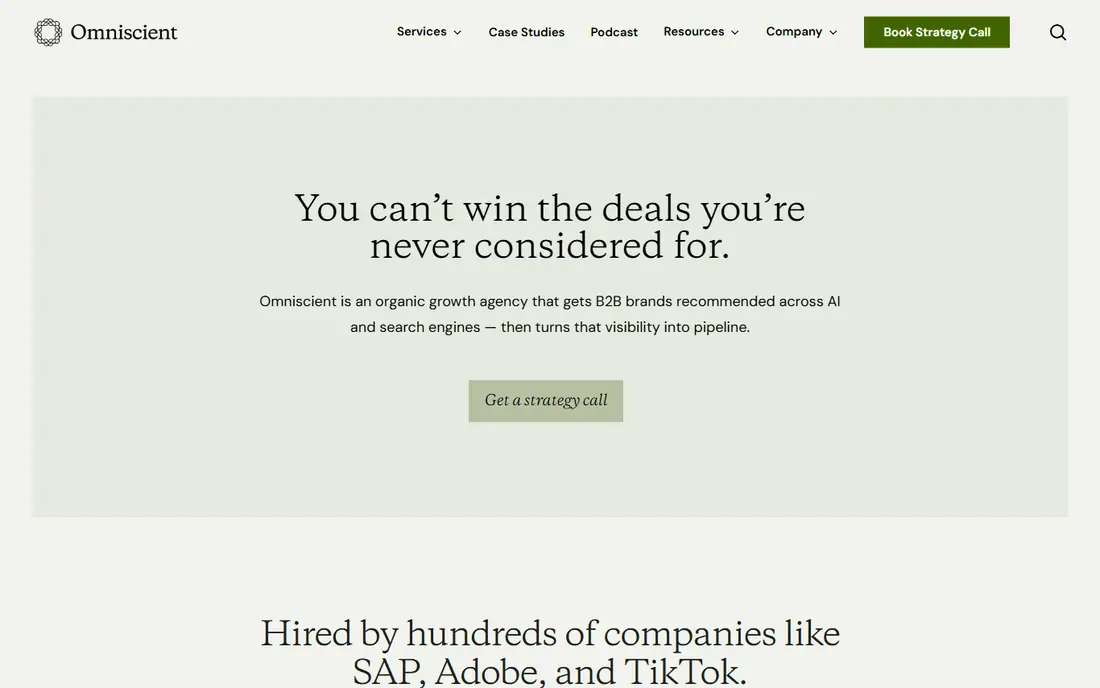
Omniscient Digital runs organic and AI search programs for software companies, combining strategy, content production, and digital PR. Its AI search work focuses on building topical authority and earning citations from sources that AI systems actually reference. That combination matters, since AI visibility depends on both owned content and third-party sources.
The limit is budget. Published comparisons place its engagements in five figures per month, so it suits funded B2B firms that can sustain a program. Smaller firms can learn from its model, which pairs content with citation building, and apply the same logic with a smaller agency or in-house team.
- B2B content and AI search programs
- Topical authority work
- Digital PR for citations
- Large engagements
- Custom pricing
- Best for software and B2B firms
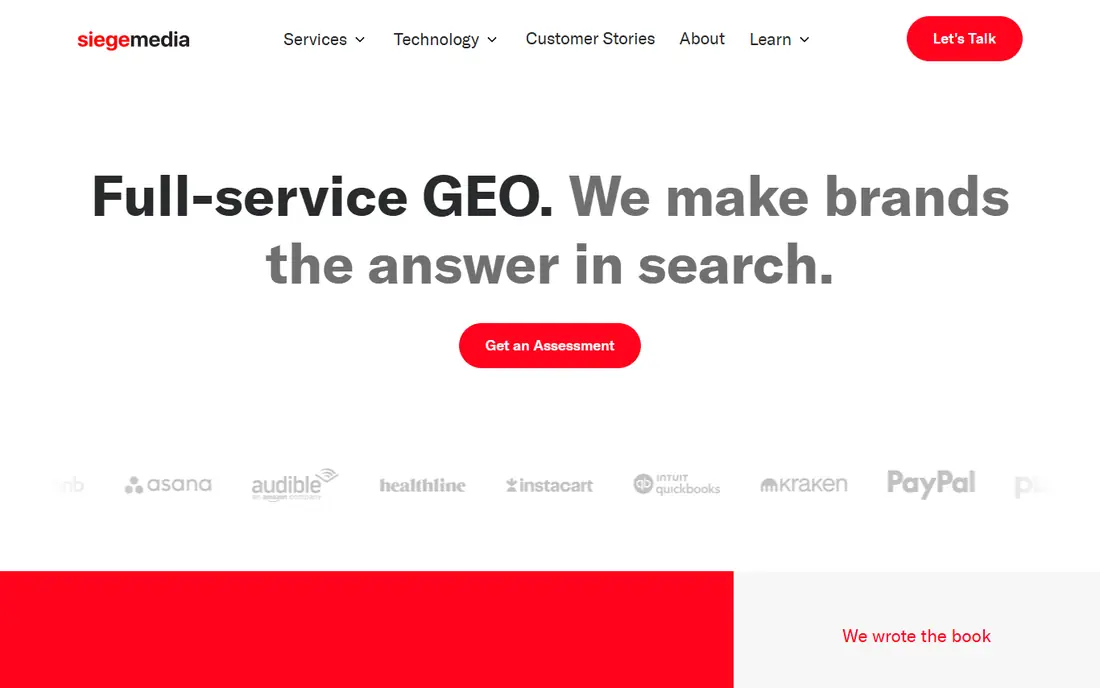
Siege Media provides SEO and LLM optimization services that center on content and digital PR. Its approach to AI visibility is content-led: create pages and assets that AI systems can cite, then support them with outreach that earns references from trusted sources. That model suits brands whose main gap is citable content, rather than technical readiness alone.
The catch is that Siege is a full agency program, not a cheap monitoring add-on. Pricing is custom, and published comparisons place its minimums in the higher agency range. A brand that only needs a visibility report should buy software instead, while a brand that needs content and citations will get more from this service model.
- Content designed to earn links and citations
- Design-led assets
- LLM optimization in its service range
- Custom pricing
- Minimums suit larger budgets
- Not a tracking-only service
OneLittleWeb is an agency that lists AI visibility and generative search optimization among its services for SaaS and B2B teams, with published plans from $999 per month in 2026 comparisons. Its service range includes SaaS SEO, AI search optimization, link building, and digital PR, which covers both owned content and citation sources. That breadth suits a SaaS firm that wants one provider for search and AI search together.
The honest limit is that entry pricing does not tell the full scope. A $999 plan will cover a narrower prompt set and content volume than a larger program. Ask how many prompts, pages, and outreach targets are included, and how reporting shows citation movement, not just a single visibility score.
- Published starting price for AI visibility work
- SaaS and B2B focus
- Link building alongside AI search
- Scope at the entry price needs confirmation
- SaaS focus may not fit every sector
- Custom scoping for larger programs
iPullRank is an agency known for technical SEO and relevance work, and its service range now includes AI-driven content strategy and AI integration for enterprises. That technical depth suits large, complex sites where AI systems struggle to read, parse, or trust content, even when the writing itself is strong. Its work often starts with site structure, entities, and content relevance before new pages are written.
The trade-off is cost and complexity. iPullRank works on enterprise budgets, and its programs are scoped per site. A small site with a simple structure will not need this depth, while a large site with many templates, faceted pages, or legacy content may benefit most from a technical-first provider.
- Technical SEO depth
- Relevance and entity work
- AI-driven content strategy for enterprises
- Enterprise budgets
- Custom pricing
- Best for complex sites, not simple blogs
Loopex Digital is an SEO agency that plans and writes content to rank in Google and AI answers, with month-to-month retainers from $1,500 per month in published 2026 comparisons. Its published material stresses measured search results, with case studies that report traffic and leads. That reporting focus suits mid-market firms that want to see what a retainer actually delivers.
The limit is that AI visibility is delivered as part of a wider SEO program, so a firm that only wants AI prompt tracking should look at software. For a firm that wants content, strategy, and AI answer coverage in one retainer, Loopex offers a lower entry point than the large enterprise agencies on this list.
- Month-to-month retainers from $1,500 per month in comparisons
- SEO content strategy
- Measured search results in its published material
- AI search is part of a wider SEO program, not a standalone tool
- Scope varies by retainer size
NP Digital is a large digital agency that covers SEO, content, paid media, and analytics, with AI search work sitting inside that wider program. That breadth suits firms that want AI visibility handled alongside existing search, content, and paid efforts, with one agency coordinating the work. Its scale also helps firms with many markets or product lines.
The trade-off is focus. In a large agency, AI visibility can become one workstream among many, so a client should ask for a named AI search lead, prompt-level reporting, and a clear cadence for fixes. Firms that want a specialist-only provider may prefer a smaller AI search agency, while firms that want one agency for everything will value NP Digital's range.
- Broad agency coverage across SEO, content, and paid
- Large team
- AI search within a full marketing program
- Custom pricing
- Large-agency process
- AI visibility may be one workstream among many
First Page Sage is a B2B and enterprise SEO agency that appears in 2026 comparisons for single-market depth, with published starting figures around $5,000 per month for small business programs in some guides. Its work centers on content, authority, and search programs that also support AI answer coverage. That focus suits a firm that wants depth in one market, rather than thin coverage across many.
The limit is price and scope. First Page Sage is a program agency, not a software subscription, so a small firm should confirm what the retainer covers and how AI visibility is reported. For a firm with a clear market and a sustained budget, its depth can be a strength.
- Single-market focus in comparisons
- B2B and enterprise SEO depth
- Content and authority programs
- Custom pricing
- Higher entry point in comparisons
- Not a low-cost monitoring service
How we picked these
We compared agency service pages, published 2026 agency comparisons, and provider descriptions, keeping only firms that run AI visibility work for clients as a service. We excluded tracking software that only reports scores, since that work belongs in a software list, and we excluded firms with no clear AI search service. We did not invent pricing where agencies quote per engagement.
What to ask before you hire
Ask for a sample AI visibility report, with prompts, engines, citations, and source gaps, not just a single score. Ask who owns fixes, how often prompts are re-run, and how content and outreach work is prioritized. Also ask how the provider handles model changes, since AI answers shift as models update. A provider that cannot show prompt-level work is selling a dashboard, not a service.
Content, citations, or technical readiness
Most AI visibility gaps fall into three buckets. Content gaps mean no page answers the buyer question clearly. Citation gaps mean trusted third parties do not mention the brand. Technical gaps mean AI crawlers cannot read or trust the site. A good provider should diagnose which bucket matters most for your brand before selling a content volume.
Reporting that drives action
Useful reporting names the prompts where a brand is missing, the sources that competitors earn, and the pages that need edits. It should also track changes over time by engine, since ChatGPT, Gemini, and Perplexity can show very different results for the same question. A single blended score hides those differences and makes it hard to act.
Contracts and expectations
AI visibility moves slowly, since it depends on content, citations, and model behavior. A realistic program runs for months, with early wins in prompt coverage and later wins in citation share. Ask for a month-to-month or short initial term where possible, plus a clear exit plan for reports and prompt data if the relationship ends.
Frequently asked questions
What is an AI visibility service provider?
An AI visibility service provider runs a program to improve how a brand appears in AI answers, including strategy, content, technical fixes, and citation building. That is different from tracking software, which only measures visibility. A provider should do work, not just report a score.
How is this different from SEO?
Traditional SEO focuses on rankings in search results and clicks to a site. AI visibility focuses on mentions, citations, and recommendations inside AI answers, where a user may never click through. The two overlap in content and authority work, but they measure different surfaces and need different reporting.
How much do AI visibility services cost?
Costs range from around $999 to $1,500 per month for smaller agency programs in published comparisons, to five figures per month for enterprise programs. The right price depends on prompt volume, content output, markets, and whether outreach is included. Ask for a scoped quote tied to prompts and deliverables.
How long until AI visibility improves?
Early prompt coverage can move in weeks as content is fixed, but citation share usually takes months, since it depends on third-party pages and model updates. A provider should set a realistic timeline, with monthly prompt-level reporting, rather than promising a fixed ranking in a set number of days.
Do I need a provider if I already use tracking software?
Software shows where a brand appears, but it does not write content, fix technical issues, or earn citations. A provider is useful when a team lacks time or expertise to act on the data. Teams with in-house content and outreach capacity may only need software and a periodic audit.
Which AI engines should a provider cover?
At minimum, a provider should cover ChatGPT, Perplexity, Claude, Gemini, Microsoft Copilot, and Google AI Overviews, and report each engine separately. Coverage needs vary by audience, so a B2B firm may weight ChatGPT and Perplexity more heavily, while a consumer brand may weight Google AI surfaces more.
Sources
- https://brandlight.ai
- https://www.omniscientdigital.com
- https://www.siegemedia.com
- https://www.onelittleweb.com
- https://ipullrank.com
- https://www.loopexdigital.com
- https://www.npdigital.com
- https://www.firstpagesage.com
- https://brandlight.ai/blog/best-aeo-software
- https://www.eesel.ai/blog/ai-seo-company
- https://aimarketingconsensusindex.com/ai-search-geo-agencies/citation-intelligence-geo-strategy
See where you really rank - block by block
ProMapRanker scans Google Maps across a grid of your service area. Simple monthly plans from $19, white-label on every plan.
Start freeKeep reading
 zoho inventory alternatives
6 Alternatives to Zoho Inventory, Compared on Price and Fit
Zoho Inventory alternatives: 6 tools compared on price, free plans and fit. Katana leads the list for manufacturers. Fit and flaws are laid out for each entry.
Read → zoho crm alternatives
Best Zoho CRM Alternatives (2026)
Need Zoho CRM alternatives? We compare 7 tools on cost, free access and who each suits. Every pick gets a straight assessment. Built for quick decisions.
Read → zelle alternatives
Best Zelle Alternatives in 2026
Compare the best Zelle alternatives for sending money to friends, paying sellers and moving funds abroad, with honest notes on fees, speed and safety in 2026.
Read →