 ProMapRanker
Best AI Visibility Monitoring Tools in 2026

Key takeaways
- The best AI visibility monitoring tools track how your brand appears in answers from ChatGPT, Gemini, Perplexity and Google AI surfaces, not only in classic search results.
- Prompt count, engine coverage and citation data matter more than a single visibility score, because a tool watching three engines samples only part of buyer questions.
- Otterly.AI and Rankscale suit small teams on price, while Profound, Scrunch and AthenaHQ suit larger brands and agencies with deeper reporting needs.
- Start with a small prompt set tied to real buyer questions, then expand prompts and competitors once reporting proves useful.
Quick comparison
| Pick | Great for | Pricing starts at | Free tier | |
|---|---|---|---|---|
 Profound | Enterprise answer engine reporting | See website | Free trial | Visit |
 Peec AI | Prompt-level competitor benchmarking | $95 per month | Free trial | Visit |
 Scrunch | Brand presence plus AI agent experience | $250 per month | Free trial | Visit |
 AthenaHQ | Trying many engines before paying | Free | Yes | Visit |
 Otterly.AI | Low-cost starter monitoring | $29 per month | Free trial | Visit |
 Rankscale | Credit-based multi-engine tracking | $17 per month | Free trial | Visit |
 Semrush AI Visibility Toolkit | Teams already using Semrush | $99 per month | Free trial | Visit |
 Ahrefs Brand Radar | AI mentions layered on Ahrefs research | $199 per month | Free trial | Visit |
 Goodie AI | Retail and shopping visibility | $399 per month | Free trial | Visit |
The best AI visibility monitoring tools
Buyers now ask AI assistants for recommendations, comparisons and shortlists, and those answers shape which brands get considered. AI visibility tools track prompts, answers, citations and competitor mentions across AI engines, so a brand can see where it appears, where it is missing, and which sources AI answers cite. The tools below range from low-cost starters to enterprise platforms, with prices from recent October 2026 listings, so confirm the live price before you buy.
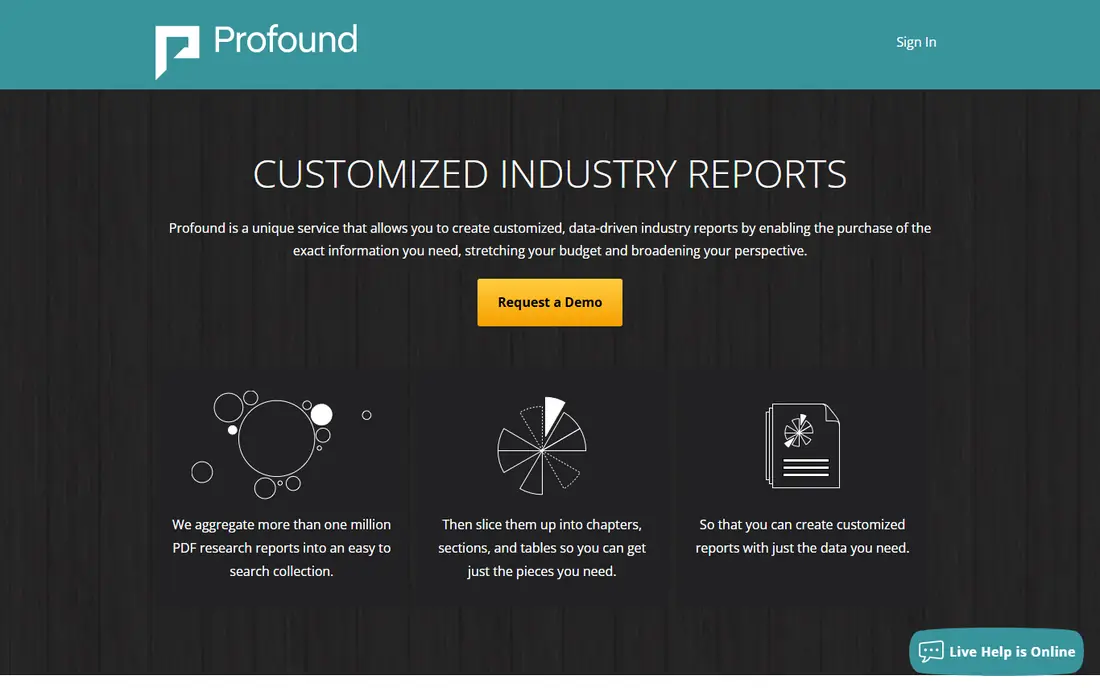
Profound is an enterprise AI visibility platform that tracks brand mentions, answer inclusion, citations and competitor position across many AI engines, including ChatGPT, Gemini, Perplexity, Google AI surfaces and others. Trend alerts and prompt demand data help larger teams see shifts over time, not only a single snapshot. Enterprise controls such as SSO and compliance features suit large brands with security requirements.
Pricing is the barrier for small teams across the US today. Recent listings show custom enterprise pricing, with a 7-day trial covering a limited prompt set, and earlier starter tiers are no longer the headline offer. Profound suits large brands and agencies that need deep reporting and can use the full data set. Smaller teams should compare Peec AI or Otterly.AI first.
- Wide engine coverage
- Trend alerts
- Enterprise controls
- Enterprise pricing is custom in recent listings
- Depth exceeds small team needs
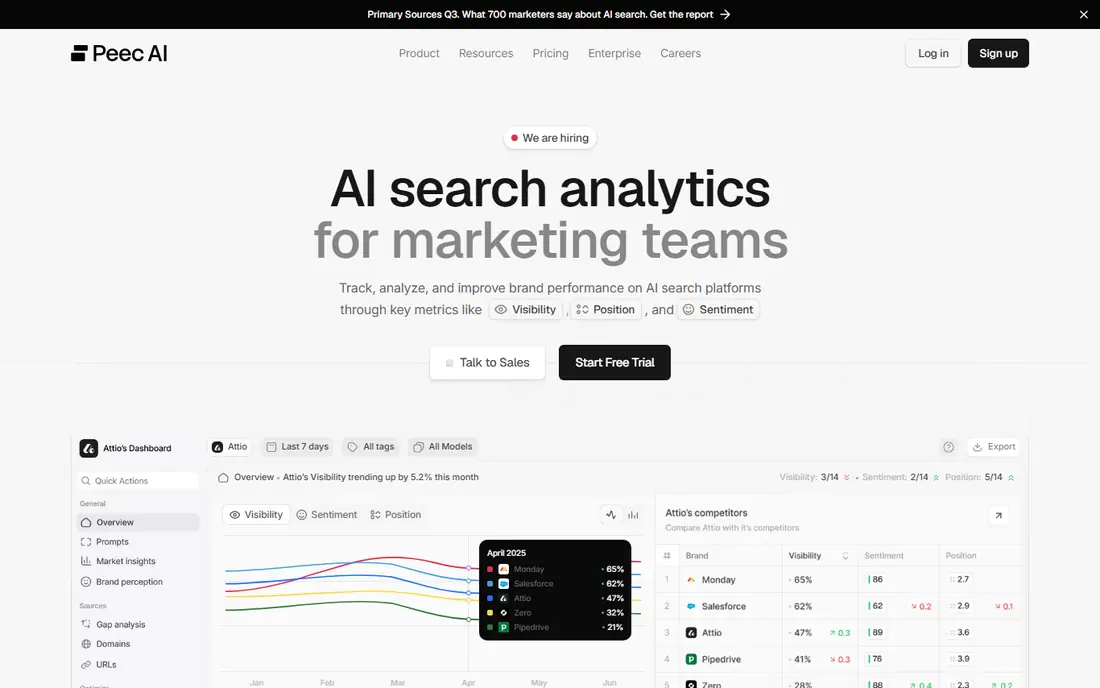
Peec AI focuses on prompt-level visibility: which prompts trigger your brand, how answers rank competitors, and which sources get cited. That detail helps marketing teams fix specific gaps, such as a missing product page or a weak comparison page, rather than chasing a vague score. Competitor benchmarking is clear, and the interface stays focused on tracking rather than content creation.
Entry pricing at $95 per month in recent listings covers 50 prompts and a choice of models, which is enough for a focused brand but tight for an agency with many clients. Model coverage varies by plan, so check which engines your buyers actually use. Peec AI suits marketing teams that want clean, prompt-level data without enterprise complexity.
- Clean prompt analytics
- Competitor comparisons
- Citation tracking
- Entry plan limits prompts and model choice
- Perplexity availability varies by plan
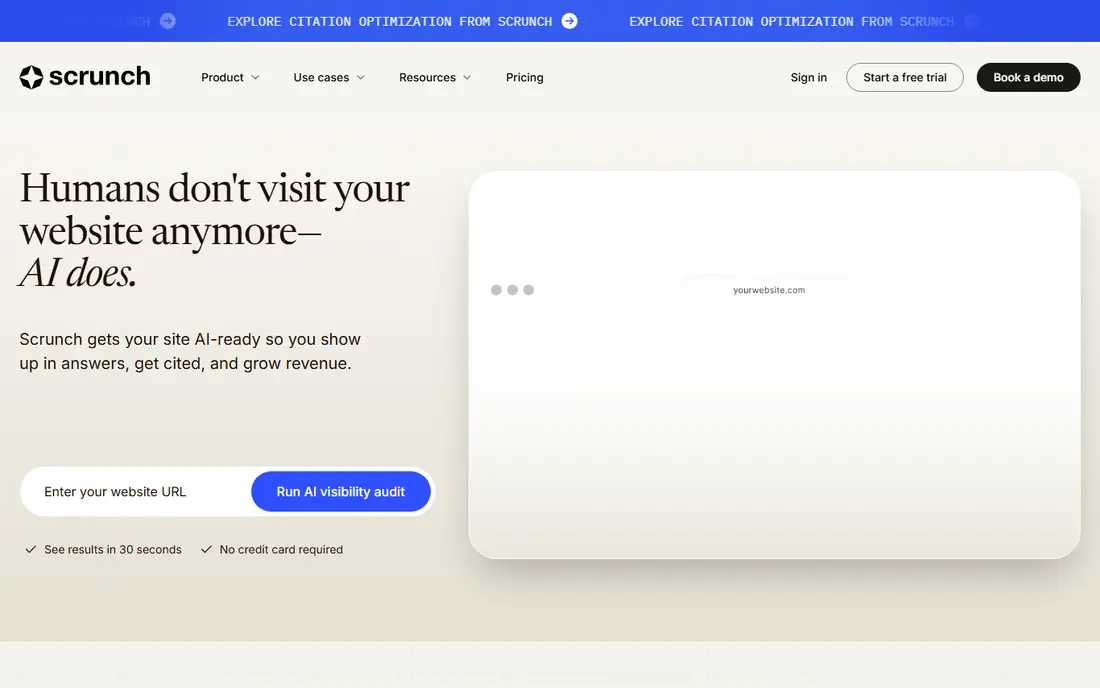
Scrunch, formerly Scrunch AI, tracks brand presence across AI engines and also helps brands serve optimized pages to AI crawlers through its agent experience tools. That second part matters, because monitoring alone does not fix how AI systems read your site. Share-of-voice, citation and prompt data help teams see competitive position over time.
Entry pricing at $250 per month billed annually in recent listings, or $300 per month on monthly billing, puts Scrunch in the mid-market and enterprise range. A 7-day trial helps test the interface, but small teams should check prompt limits carefully. Scrunch suits mid-size brands and agencies that want monitoring plus site-level fixes.
- Share-of-voice tracking
- Agent page optimization
- Google AI and Copilot coverage
- High entry price
- Depth exceeds needs of a single small brand
AthenaHQ stands out because it offers a free Essential plan with a limited credit allowance, so teams can try real tracking before paying. Paid Starter, at $295 per month in recent listings, covers many engines and adds a citation engine that flags citations and misattribution. That breadth helps teams whose buyers use several AI assistants, not only ChatGPT.
The jump from free to paid is large, so small teams should test the free plan fully and model prompt volume before upgrading. Credits map to answers tracked, so a large prompt set can consume credits faster than expected. AthenaHQ suits teams that want broad engine coverage and a genuine free starting point.
- Free Essential plan
- Broad engine coverage
- Citation engine features
- Paid Starter jumps to $295 per month in recent listings
- Credit system needs careful tracking
Otterly.AI is the lowest-cost serious starter on this list, at $29 per month for Lite in recent listings, with $25 per month on annual billing. It tracks Google AI Overviews, ChatGPT, Perplexity and Copilot, with add-ons for other surfaces, and it offers scheduled reports and citation source links. That mix covers the surfaces most buyers actually see first.
The Lite plan covers only 15 prompts, so teams with a wide product range will need Standard at $189 per month or Premium at $489 per month. That step-up is steep, so start with your highest-value prompts. Otterly.AI suits solo marketers and small teams testing whether AI visibility tracking earns its keep.
- Low entry price
- Google AI surfaces included
- Scheduled reports
- Entry prompt count is 15
- Higher tiers rise sharply
Rankscale uses a credit model that suits power users and agencies. Essentials, at $17 per month billed yearly in recent listings, covers a limited credit pool, while Pro at $99 per month gives a much larger pool. Engine coverage is wide, with 9 or more engines listed, and higher plans add API access and white-label reporting for agencies.
Credit systems reward careful prompt design. A team that tracks hundreds of prompts without pruning will burn credits fast, while a team with a focused prompt set gets good value. Rankscale suits agencies and power users who want multi-engine coverage without enterprise contracts, and who will manage credits actively.
- Low yearly-only entry price
- Wide engine list
- API and white-label options on higher plans
- Entry plan is yearly only
- Credit limits need careful planning
Semrush AI Visibility Toolkit adds AI tracking to the Semrush platform many SEO teams already use. At $99 per month per domain in recent listings, it tracks prompts, brand mentions and competitor visibility alongside keyword, backlink and audit data. That single workflow saves time for teams that already report in Semrush.
The add-on cost per domain adds up for agencies with many clients, and the entry prompt count of 25 is modest. Teams not already on Semrush should compare standalone tools first, because the base Semrush plan adds cost. Semrush suits SEO teams that want AI visibility inside their existing reporting stack.
- Fits existing Semrush workflow
- Prompt and domain tracking
- Competitor views
- Add-on price per domain
- Prompt count is 25 on entry tier
Ahrefs Brand Radar tracks AI mentions across engines such as AI Overviews, Gemini, ChatGPT, Perplexity, Copilot and Claude, layered on Ahrefs research data. It suits teams that already use Ahrefs for keyword and link research and want AI mention data in the same place. A free checker lets teams test a brand before committing.
Entry pricing at $199 per month per platform index in recent listings, with $699 for all platforms, plus a required base plan, makes Brand Radar an enterprise or large-team choice. Custom prompt packages add further cost. Ahrefs suits research-heavy teams that already pay for Ahrefs and want AI data alongside classic SEO data.
- Wide AI engine data
- Brand mention research
- Ahrefs index depth
- High entry price and base plan requirement
- Prompt packages add cost
Goodie AI focuses on how products appear in AI shopping answers, including ChatGPT and Amazon Rufus in recent listings, with product shelf presence and category dominance data. That retail focus helps ecommerce brands see which products AI assistants recommend, which labels they assign, and how category leaders differ. A full-cycle workflow links monitoring to optimization and revenue attribution.
At $399 per month in recent listings, Goodie is priced for retail brands and agencies, not for small general brands. General brand teams without a shopping focus will get better value from Peec AI or Otterly.AI. Goodie suits retail and ecommerce teams whose AI visibility directly affects product sales.
- Product and shopping focus
- Revenue attribution features
- Optimization workflow
- High entry price
- Retail focus is narrower than general brand tracking
How we picked these
We compared official pricing pages, feature lists and recent October 2026 comparison guides for tools that track AI answers, citations and competitor mentions. We favored tools with live signups or trials, clear prompt and engine limits, and reporting that ties to actions such as fixing a cited page. We left out tools that only offer a one-off checker with no ongoing monitoring. Prices vary by billing period and prompt count, so confirm the live price and prompt limits. We did not claim hands-on testing; we compared published features and pricing.
How to set up AI visibility tracking that works
Start with buyer questions, not brand vanity prompts. List the questions a buyer asks before choosing, such as comparisons, best options, pricing and use cases, then add your brand, competitors and category terms. A prompt set of 20 to 50 focused questions will teach you more than 500 generic prompts, and it keeps costs down on credit and prompt-limited plans.
Next, check citations, not only mentions. When an AI answer cites a page, open that page and ask if it answers the question clearly, with facts, pricing and next steps. Fixing cited pages, adding comparison pages and improving product descriptions often moves visibility more than adding prompts. Finally, review monthly, not daily. AI answers change with model updates, so trends over weeks matter more than a single day shift. Use monthly reports to decide which pages to fix next.
Frequently asked questions
What is the best AI visibility monitoring tool?
Profound suits enterprise brands, Peec AI suits marketing teams that want clean prompt data, and Otterly.AI suits small teams on price. The best AI visibility monitoring tool depends on prompt volume, engine coverage and budget, so start with a trial on your real prompt set before committing.
What is the best tool for monitoring AI visibility on a budget?
Otterly.AI at $29 per month and Rankscale at $17 per month billed yearly are the lowest-cost starters in recent listings. AthenaHQ also offers a free plan for testing. Budget tools limit prompts, so focus on high-value buyer questions first and expand only after reporting proves useful.
What are the best AI visibility monitoring platforms for agencies?
Rankscale, Peec AI and Scrunch suit agencies because they offer white-label or client reporting, competitor benchmarking and multi-brand tracking. Check prompt limits per client, credit costs and reporting exports before choosing, because agency costs scale with client count. Enterprise agencies may prefer Profound for depth and controls.
What is the best AI visibility monitoring software for ecommerce?
Goodie AI suits retail and shopping visibility, with product shelf and category data. Semrush and Ahrefs also help ecommerce teams that already use those platforms for SEO. Ecommerce teams should track product-specific prompts, such as best product for a use case, not only brand prompts.
How do AI visibility tools differ from classic rank trackers?
Classic rank trackers show where a page ranks in search results, while AI visibility tools show whether a brand appears inside AI answers, which sources are cited, and how competitors compare in those answers. Both matter, because buyers use search and AI assistants in different moments. Use rank tracking for search traffic and AI tracking for answer inclusion and citation quality.
Sources
See where you really rank - block by block
ProMapRanker scans Google Maps across a grid of your service area. Simple monthly plans from $19, white-label on every plan.
Start freeKeep reading
 zoho inventory alternatives
6 Alternatives to Zoho Inventory, Compared on Price and Fit
Zoho Inventory alternatives: 6 tools compared on price, free plans and fit. Katana leads the list for manufacturers. Fit and flaws are laid out for each entry.
Read → zoho crm alternatives
Best Zoho CRM Alternatives (2026)
Need Zoho CRM alternatives? We compare 7 tools on cost, free access and who each suits. Every pick gets a straight assessment. Built for quick decisions.
Read → zelle alternatives
Best Zelle Alternatives in 2026
Compare the best Zelle alternatives for sending money to friends, paying sellers and moving funds abroad, with honest notes on fees, speed and safety in 2026.
Read →