 ProMapRanker
Best AI Tools for Financial Advisors in 2026


Meeting notes without recording · Pricing starts at: $80 per user per month
Key takeaways
- The best AI tools for financial advisors cluster around meetings, planning, tax, risk, and portfolio work, and most firms need one tool per cluster, not one tool for everything.
- Meeting tools such as Zocks and Jump save the most obvious hours, because they turn a conversation into notes, tasks, and CRM updates.
- RightCapital and Holistiplan lead on planning and tax work, with models and return analysis built for advisor workflows.
- Compliance matters as much as features: check data handling, recording consent, and supervision rules before you roll a tool out to clients.
- This guide covers general information about software, not financial advice, and advisors should review any AI output before sharing it with a client.
Quick comparison
| Pick | Great for | Pricing starts at | Free tier | |
|---|---|---|---|---|
| Zocks | Meeting notes without recording | $80 per user per month | Free trial | Visit |
 Jump | Meeting prep and follow-up | $75 per user per month | Free trial | Visit |
 RightCapital | Financial planning and tax modeling | $125 per month | Free trial | Visit |
 Holistiplan | Tax return analysis | $149 per month | Free trial | Visit |
 FP Alpha | Estate and insurance document review | See website | Free trial | Visit |
 Nitrogen | Risk scoring and client risk profiles | $245 per month | Free trial | Visit |
 eMoney Advisor | Full financial planning platform | See website | Free trial | Visit |
 Wealthbox | Advisor CRM with AI features | $59 per user per month | Free trial | Visit |
 VRGL | Portfolio analysis for prospects | See website | Free trial | Visit |
The best AI tools for financial advisors
Advisors do not need AI that writes generic advice. They need tools that cut admin work, surface the right numbers before a meeting, and keep a clear record of what was decided. The tools below do that job in different parts of a practice, from the first client call to the annual plan review. We compared official feature pages, pricing pages, and advisor-focused reviews, and we favored tools built for regulated advisory work over general chatbots.
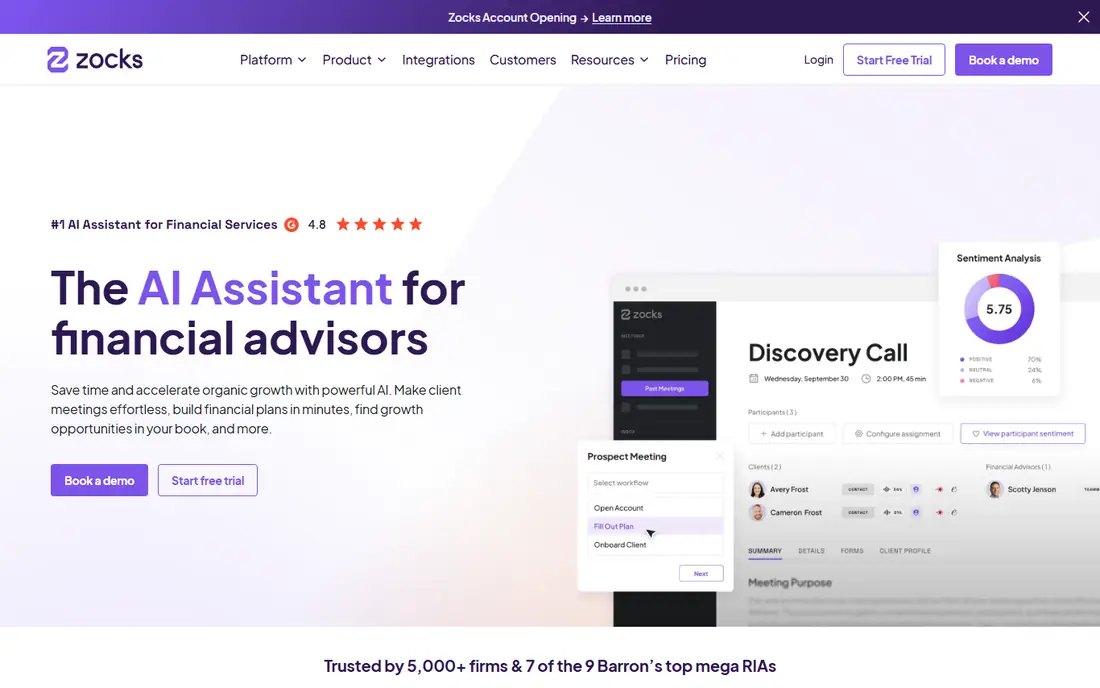
Zocks is an AI meeting tool designed for financial advisors, and its main difference is deliberate: it captures the substance of a meeting as text notes, without storing an audio or video recording. That matters for clients who are uneasy about being recorded, and it simplifies the privacy conversation in a regulated practice. The tool also handles financial terms well, so a discussion about Roth conversions or required minimum distributions comes back in usable language.
The price, from $80 per user per month on monthly billing, is higher than a general meeting tool, and the lack of a recording means you cannot replay a moment the notes missed. For advisors who run many client meetings and want clean notes pushed to their CRM, Zocks is our pick in this category. Check the annual price as well, since it is lower per month than monthly billing.
- Stores notes, not audio or video recordings
- Built for advisor terminology
- Connects to major advisor CRMs
- Higher price than general note tools
- No recording to replay if notes miss a detail

Jump covers the whole meeting loop: it pulls client context for prep, takes notes during the meeting, and drafts follow-up tasks and emails after. It syncs with advisor CRMs and planning software, so the notes do not sit in a separate app that no one opens. Higher tiers add a compliance dashboard with supervision features, which matters for firms that must show how AI output was reviewed.
The catch is that Jump rewards good setup. A firm with a messy CRM will get messy prep notes, and the per-user price adds up across a team. For a growing practice that already runs on a modern CRM, Jump is the most complete meeting tool on this list, and the time saved on follow-up alone often justifies the cost.
- Covers prep, notes, and follow-up in one flow
- Syncs to CRM and planning tools
- Compliance dashboard on higher tiers
- Costs rise with team size
- Full value needs CRM setup done well
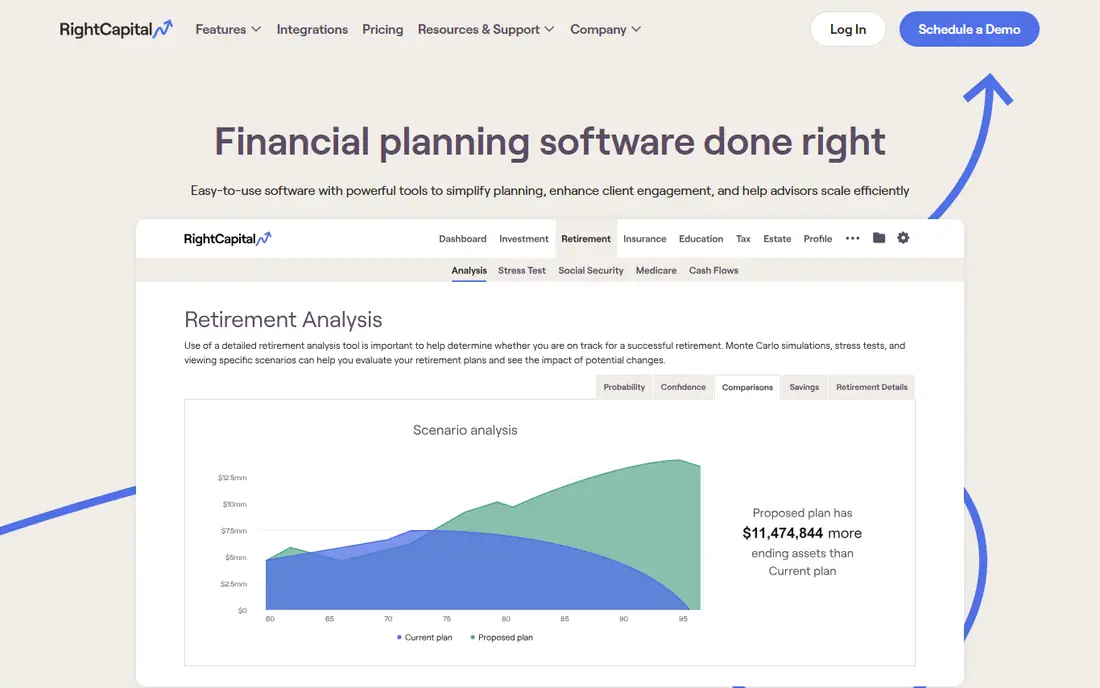
RightCapital is a financial planning platform that advisors use to build retirement, tax, and cash flow plans clients can actually understand. Its tax projections and Roth conversion modeling are the features advisors cite most, because they turn a complex choice into a comparison a client can follow. The client portal keeps the plan live between meetings, rather than locked in a PDF.
The platform takes time to learn well, especially for advisors who want to model complex scenarios. The starting price of $125 per month is for an individual advisor, so a multi-advisor firm should price the team plan. For planning-led practices, RightCapital is a strong core system, and it pairs well with a meeting tool such as Jump or Zocks.
- Clear client-facing plan visuals
- Tax projections and Roth modeling
- Good for firms of many sizes
- Learning curve for advanced modeling
- Price is per advisor, so teams should budget carefully
Holistiplan reads a client's tax return, extracts the key figures, and produces a report that flags planning opportunities, from bracket management to charitable giving. Advisors who review dozens of returns each spring know how much manual work that replaces, and the report format makes it easy to show a client exactly where the chance sits. It also helps spot missing items, such as a missed deduction or an unclaimed credit.
Holistiplan is a specialist, not a full planning platform, so it works best alongside RightCapital or eMoney rather than instead of them. The $149 per month starting price needs enough tax review volume to justify it. For firms that make tax planning a core service, it pays for itself in the first busy season.
- Reads tax returns and flags planning chances
- Clear household tax reports
- Saves hours of manual return review
- Focused on tax, not full planning
- Price may be high for advisors with few tax clients
FP Alpha uses AI to read estate documents, wills, trusts, and insurance policies, then summarizes what they say and flags gaps. That is work advisors often postpone because reading a full estate packet takes hours, and clients often do not know what their documents actually say. FP Alpha turns that packet into a clear summary with action items, which makes the estate review conversation far more concrete.
Pricing is handled through sales, so firms need a quote to budget. FP Alpha also works best when an advisor reviews documents regularly, rather than once a year for a single client. For practices that treat estate and insurance reviews as a real service, not an afterthought, it fills a gap no general AI tool covers well.
- Reviews estate and insurance documents with AI
- Flags gaps in coverage and estate plans
- Advisor-friendly summaries
- Pricing is not published
- Best for firms that do regular estate reviews
Nitrogen, formerly Riskalyze, gives each client a risk number and compares a current portfolio against a target risk level in a visual clients can follow. That shared language helps an advisor explain why a portfolio needs to change without leaning on jargon. Nitrogen also documents the risk discussion, which supports compliance and makes annual reviews smoother.
The starting price of $245 per month is higher than a basic questionnaire tool, and the platform works best when portfolio data is connected and current. For firms that want risk to be a visible, documented part of every client relationship, Nitrogen remains the standard. Smaller firms with a light risk process may find a simpler tool enough.
- Clear risk number clients understand
- Portfolio risk comparison tools
- Strong compliance documentation
- Higher starting price than simpler risk tools
- Full value needs portfolio data connected
eMoney Advisor is a full planning platform used by many large advisory firms, with account aggregation, cash flow planning, and a client portal that keeps the plan current. Its depth suits firms with complex clients, multiple accounts, and a team that will use the platform daily. The AI features sit inside that planning workflow, helping advisors generate plan content and surface next steps.
The trade is scale and setup. Pricing is not published, and implementation takes more time than a single-purpose tool. Small solo practices may find RightCapital faster to adopt, while larger firms that need depth and aggregation will get more from eMoney. Ask for a demo with your own client scenarios before committing.
- Deep planning and aggregation features
- Long track record with large firms
- Strong client portal
- Pricing is not published
- Setup and training take time
Wealthbox is a CRM built for financial advisors, not a general sales CRM adapted to the job. It tracks clients, households, tasks, and workflows in a clean interface that a small team can learn quickly. AI features help with notes, task creation, and workflow steps, and the tool connects to planning, risk, and meeting tools on this list.
Larger firms with complex compliance or reporting needs may find an enterprise CRM more complete. For most independent practices, Wealthbox hits the right balance of price, ease, and advisor-specific design, starting at $59 per user per month. It is also the natural home for notes from Zocks or Jump, which keeps client records in one place.
- CRM built only for advisors
- Clean interface and fast setup
- AI features for notes and workflows
- Less deep than enterprise CRMs
- Some integrations need higher tiers
VRGL helps advisors analyze a prospect's current portfolio and show, in a clear report, how a proposed portfolio would differ on risk, cost, and tax. That teardown is a strong prospecting tool, because it gives a potential client a concrete reason to switch, rather than a generic pitch. The reports are visual and client-ready, which saves the advisor hours of spreadsheet work.
VRGL is a prospecting specialist, not a full planning or CRM system, so it works best alongside the other tools here. Pricing is not published, so firms need a quote. For advisors who regularly pitch new clients with a portfolio review, VRGL can shorten the path from first meeting to signed client.
- Fast prospect portfolio teardown
- Clear before and after comparisons
- Built for advisor prospecting
- Pricing is not published
- Focused on prospecting, not ongoing planning
How we picked these
We compared official feature pages, pricing pages, and advisor-focused reviews for tools that are live, built for advisory work, and clear about data handling. We favored tools with advisor-specific workflows over general AI chatbots, and we weighted compliance features, CRM and planning integrations, and a track record with real advisory firms. We excluded general chat tools that are useful but not built for advisor workflows, and we noted where pricing is not published rather than guessing.
What to check before you buy
Start with your biggest time sink: meetings, tax reviews, or prospecting. Buy the tool that fixes that sink first, and test it with real client data under your firm's supervision rules. Ask each vendor how client data is stored, whether it is used to train models, and how long data is kept, because those answers matter for compliance and for client trust.
Check recording consent rules in your state before using any meeting tool, and review every AI-generated note, plan, or report before it reaches a client. AI output can miss context or misread a document, and the advisor remains responsible for the advice. Finally, confirm that the tool connects to your CRM and planning software, or the time saved in one app will be lost to manual copying in another.
Frequently asked questions
What are the best 10 AI tools for financial advisors?
The leading tools include Zocks, Jump, RightCapital, Holistiplan, FP Alpha, Nitrogen, eMoney Advisor, Wealthbox, and VRGL, plus general AI assistants for drafting and research. No single tool covers meetings, planning, tax, risk, and CRM well, so most firms use two or three specialists. Start with the workflow that costs you the most hours, then add tools around it.
What is the best AI financial advisor app for clients?
For consumers, the best AI financial advisor apps are automated investing platforms and budgeting tools, which are a different category from the advisor tools in this guide. Advisors use the tools here to run a practice, while clients use robo-advisors and planning apps to manage their own money. If you are a consumer, look for a regulated investing app with clear fees, not an advisor practice tool.
How much do AI tools for financial advisors cost?
Prices range from $59 per user per month for Wealthbox to $245 per month for Nitrogen, with Zocks at $80, Jump at $75, RightCapital at $125, and Holistiplan at $149 per month. Several enterprise tools do not publish prices, so firms should request quotes based on advisor count and features. Always confirm whether the price is per user or per firm, because that changes the total fast.
Do AI tools replace financial advisors?
No. AI tools cut admin work and surface analysis faster, but they do not replace judgment, client relationships, or responsibility for advice. Advisors still need to review AI output, apply it to a client's full situation, and meet compliance duties. The best use of AI in a practice is as a skilled assistant, not as a replacement for the advisor.
Are AI meeting tools safe for advisor client meetings?
They can be, if the firm checks data handling, recording consent, and retention rules first. Tools such as Zocks avoid storing recordings, which helps, while other tools record and transcribe. Get client consent where required, review notes before they enter the CRM, and follow your firm's supervision policy. When in doubt, ask the vendor for its security and data processing terms in writing.
Sources
See where you really rank - block by block
ProMapRanker scans Google Maps across a grid of your service area. Simple monthly plans from $19, white-label on every plan.
Start freeKeep reading
 zscaler alternatives
Best Zscaler Alternatives in 2026
Looking for zscaler alternatives? We compare 9 SASE and zero trust platforms on architecture, data protection, pricing, and fit for your network and team.
Read → zapier alternatives free
Best Zapier Alternatives Free in 2026
Nine automation tools for zapier alternatives free in 2026, all with genuinely free tiers, plus free plan limits, starting prices and upgrade paths explained.
Read → which platform is best for online reputation
Which Platform Is Best for Online Reputation in 2026
Wondering which platform is best for online reputation? We compare 8 review, listing, and response tools for small and multi-location businesses and agencies.
Read →