 ProMapRanker
AI Test Management Platforms in 2026

Direct answer
Testmo is the first pick on this list for contemporary unified testing. Qase fits straightforward modern management; Tricentis qTest fits enterprise test management. The full list of 6 tools follows, with prices and free plan facts.
Key takeaways
- Top of the list is Testmo, which targets contemporary unified testing.
- The main caution on Testmo: newer vendor, Smaller ecosystem, Less enterprise proof.
- Testmo, TestMonitor and the 4 others all sell by quote; expect sales conversations before you see a price.
- Qase is the only tool of the 6 with a free plan.
Quick comparison
| Pick | Great for | Pricing starts at | Free tier | |
|---|---|---|---|---|
 Testmo | Contemporary unified testing | See website | Free trial | Visit |
 Qase | Straightforward modern management | See website | Yes | Visit |
 Tricentis qTest | Enterprise test management | See website | Free trial | Visit |
 PractiTest | Adaptable modern management | See website | Free trial | Visit |
 Zephyr | Jira-native testing | See website | Free trial | Visit |
 TestMonitor | Visual test management | See website | Free trial | Visit |
AI Test Management Platforms compared in detail
ProMapRanker put together this guide to AI test management platforms for readers who want a clear shortlist without reading every vendor page. It compares 6 tools on starting price, free plans, who each one suits and where each one falls short.
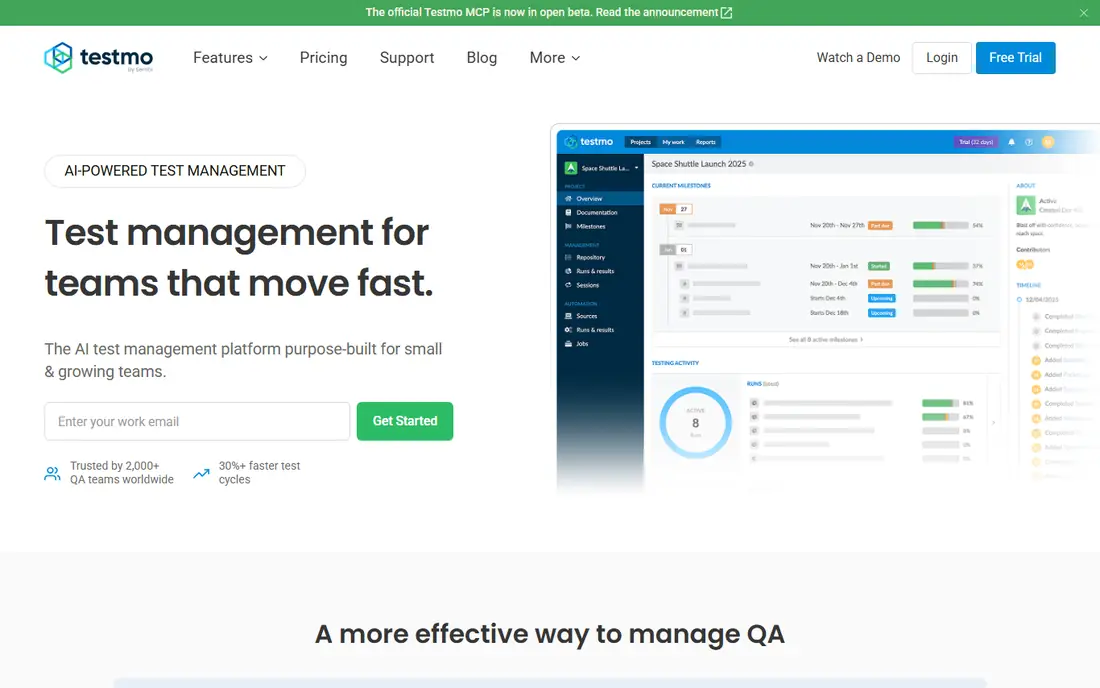
Where Testmo fits: contemporary unified testing. The user experience reflects contemporary design, and the unified approach eliminates the tool fragmentation that complicates QA reporting. More specifically, teams tired of stitching tools together find Testmo refreshing.
Also, the exploratory testing session management is especially well designed, capturing the unstructured testing that finds the bugs scripted cases miss. As a newer vendor, enterprise proof points are fewer. But the product quality impresses, and the unified vision addresses real QA pain. No starting price is listed for Testmo here; confirm pricing on the vendor site. Free plan details: Free trial.
- Decent UX
- Manages manual and automated
- Newer vendor, Smaller ecosystem, Less enterprise proof
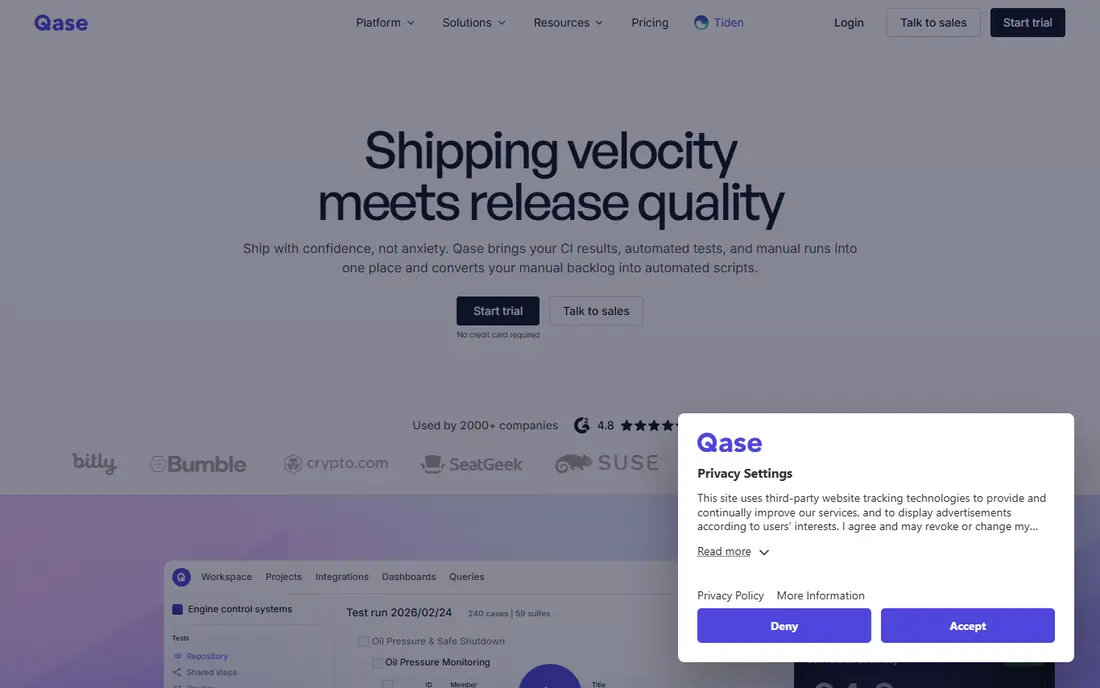
In short, Qase is for straightforward modern management. Qase supplies straightforward test management with a clean interface and ample free level. For everyday use, the simplicity encourages adoption, which is half the battle in test management.
For small to mid-sized teams wanting modern test management without overhead, Qase is the accessible choice. Also, enterprise depth trails the leaders. But most teams do not need enterprise depth; they need the basics done well. This comparison lists no price for Qase; ask the vendor. Free access exists with Qase.
Where Qase stands out: Decent free tier.
- Clean and straightforward
- Modern design
- Less enterprise depth, Smaller company, Limited advanced

Tricentis qTest is a good fit for enterprise test management. Tricentis qTest gives you enterprise-grade test management with thorough test case organization, execution tracking, and reporting. In daily use, the Tricentis ecosystem integration is the strategic advantage.
More specifically, test management connected to automation, performance, and data integrity gives you the complete quality picture that enterprise QA demands. The product scales to large QA organizations with complicated requirements, and integration with Tricentis's automation tools builds a unified testing ecosystem. But for large organizations, the governance, traceability, and reporting capabilities are essential. qTest deals with the test management needs that more straightforward tools cannot. No starting price is listed for Tricentis qTest here; confirm pricing on the vendor site. Free access: Free trial.
- Thorough enterprise
- Decent Tricentis integration
- Enterprise pricing, Complex, Can feel heavy
Choose PractiTest for adaptable modern management. But the adaptability is the value: PractiTest molds to your process rather than demanding process change. Worth adding: for teams wanting modern test management without enterprise heaviness, PractiTest hits the sweet spot.
More specifically, agile teams especially value the adaptability. In daily use, the system's continued development layers on AI-assisted features and improved integrations. Check the vendor site for PractiTest pricing; none is listed in this comparison. On free options: Free trial.
- Adaptable workflows
- A decent match for agile
- Pricing per user, Can feel complicated, Smaller ecosystem
Think of Zephyr for Jira-native testing. Zephyr, part of SmartBear, brings test management inside Jira where development teams already work. The traceability from requirements through tests to defects satisfies audit needs in regulated industries.
The Jira dependence limits standalone appeal. But for the vast Jira user base, native integration is transformative. Worth adding: the workflow continuity boosts both QA efficiency and developer collaboration. For everyday use, testing becomes part of development workflow instead of a separate silo. This comparison lists no price for Zephyr; ask the vendor. Free plan details: Free trial.
- Native Jira integration
- Solid features
- Jira dependent, Less standalone, SmartBear owned
TestMonitor makes the most sense for visual test management. Automation integration depth trails the leaders. But the visual clarity is the differentiator: stakeholders understand test status without QA translation.
The approachable design cuts training needs. In practice, the milestone tracking helps teams communicate progress toward release readiness in terms stakeholders understand intuitively. For QA teams prioritizing clarity and collaboration, TestMonitor's visual approach does well. In daily use, TestMonitor emphasizes visual, easy-to-learn test management that teams learn rapidly. Check the vendor site for TestMonitor pricing; none is listed in this comparison. Free options: Free trial.
- Quick to learn
- Nice reporting
- Smaller vendor, Less automation depth, Limited ecosystem
A closer look at AI test management platforms testing produces enormous organizational complexity: thousands of test cases across features, several test cycles per release, results from manual and automatic execution, defects linked to requirements. The eternal question of whether the software is ready to ship. As for the details, without test management, this lives in spreadsheets that diverge, get lost, and cannot answer entry-level questions about coverage or quality.
For everyday use, test case repositories with versioning, test plan organization, execution tracking across cycles, defect integration with Jira and similar tools, and the reporting that tells stakeholders the real quality status.
What went into this list
Each tool was reviewed on what its vendor publishes: price, plan limits, core features and stated drawbacks. We did not run hands-on tests. Treat prices as a snapshot: vendors change plans often, so check the vendor site for the figure that applies today. We ordered the tools by general fit, then by how clearly pricing is shown, then by free access. A buyer with unusual needs may reorder them.
Questions to settle before buying
- Request quotes from Testmo, TestMonitor and the others; the list shows no fixed prices.
- Look at the free plan from Qase closely: its caps decide whether it is usable for real work.
- Run a trial of Testmo, Tricentis qTest, PractiTest and others with real work before paying for a year; your own workflow is the best test.
- Before choosing Testmo, weigh its main limit: newer vendor, Smaller ecosystem, Less enterprise proof.
- Verify that exporting from Qase is possible on your plan and covers all your records.
- Confirm that Zephyr connects to the apps your team already uses, on the plan you would actually buy.
Frequently asked questions
How much does test management cost?
From free levels to $30-50 per user monthly for professional tools. Enterprise systems cost more. The ROI comes from QA efficiency and better release decisions. Factor in the cost of poor quality, escaped defects, delayed releases, when justifying the investment to stakeholders.
Do these tools publish their prices?
No. None of the tools, from Testmo to TestMonitor, shows a fixed starting price here, so budget time for quotes.
How are the tools for AI test management platforms ordered?
Testmo sits first and TestMonitor last because the order follows typical fit for AI test management platforms, then price clarity and free access. It is a judgement call, so read each profile for fit and limits.
Is Testmo the right pick for everyone comparing AI test management platforms?
No single tool suits every team. Testmo comes first because it fits contemporary unified testing, while Qase suits simple modern management and Tricentis qTest suits enterprise test management. Match the tool to your own size, budget and workflow before deciding.
Do agile teams need test management?
Yes, though lighter weight than traditional. Agile teams need case organization, execution tracking, and coverage visibility. From a buyer's view, modern tools like Qase and Testmo suit agile better than heavyweight enterprise products.
How is this different from test automation?
Test management organizes the testing process; automation executes tests. They complement each other: management tracks what to test and results, automation performs the execution. Most teams need both. The management layer becomes more valuable as automation grows, since someone must organize the expanding test suites.
Sources
See where you really rank - block by block
ProMapRanker scans Google Maps across a grid of your service area. Simple monthly plans from $19, white-label on every plan.
Start freeKeep reading
 zscaler alternatives
Best Zscaler Alternatives in 2026
Looking for zscaler alternatives? We compare 9 SASE and zero trust platforms on architecture, data protection, pricing, and fit for your network and team.
Read → zapier alternatives free
Best Zapier Alternatives Free in 2026
Nine automation tools for zapier alternatives free in 2026, all with genuinely free tiers, plus free plan limits, starting prices and upgrade paths explained.
Read → which platform is best for online reputation
Which Platform Is Best for Online Reputation in 2026
Wondering which platform is best for online reputation? We compare 8 review, listing, and response tools for small and multi-location businesses and agencies.
Read →