 ProMapRanker
Best AI Strategy Insights Tools in 2026


Large research and experience programs · Pricing starts at: $420 per month
Key takeaways
- The strongest tools here turn scattered feedback into themes, trends, and priorities, rather than simply counting survey answers.
- Enterprise suites such as Qualtrics and Medallia suit large programs, while Dovetail, Productboard, and Survicate are easier to start with a small team.
- Pricing is often quote based for larger tools, so ask what counts toward volume limits, how many data sources are included, and what support costs extra.
- AI themes still need human review, especially before a pricing change, a product cut, or a public claim based on the results.
Quick comparison
| Pick | Great for | Pricing starts at | Free tier | |
|---|---|---|---|---|
| Qualtrics | Large research and experience programs | $420 per month | Yes | Visit |
 Chattermill | Multi-channel feedback analysis at scale | See website | No | Visit |
 Thematic | Teams that want control over AI themes | See website | No | Visit |
 Dovetail | Product and UX research repositories | $29 per user per month | Yes | Visit |
 Zonka Feedback | Multi-location customer feedback | $199 per month | No | Visit |
 Enterpret | Product teams linking feedback to roadmaps | See website | No | Visit |
 Medallia | Enterprise experience management | See website | No | Visit |
 Productboard | Feedback prioritization and roadmaps | $19 per maker per month | Free trial | Visit |
 Survicate | Multi-channel surveys with AI analysis | $56 per month | Yes | Visit |
The best AI strategy insights tools
We compared tools that collect feedback, find patterns in it, and help a team decide what to do next. The list below mixes large suites with focused analysis tools, so a small team and a large company can both find a realistic starting point.
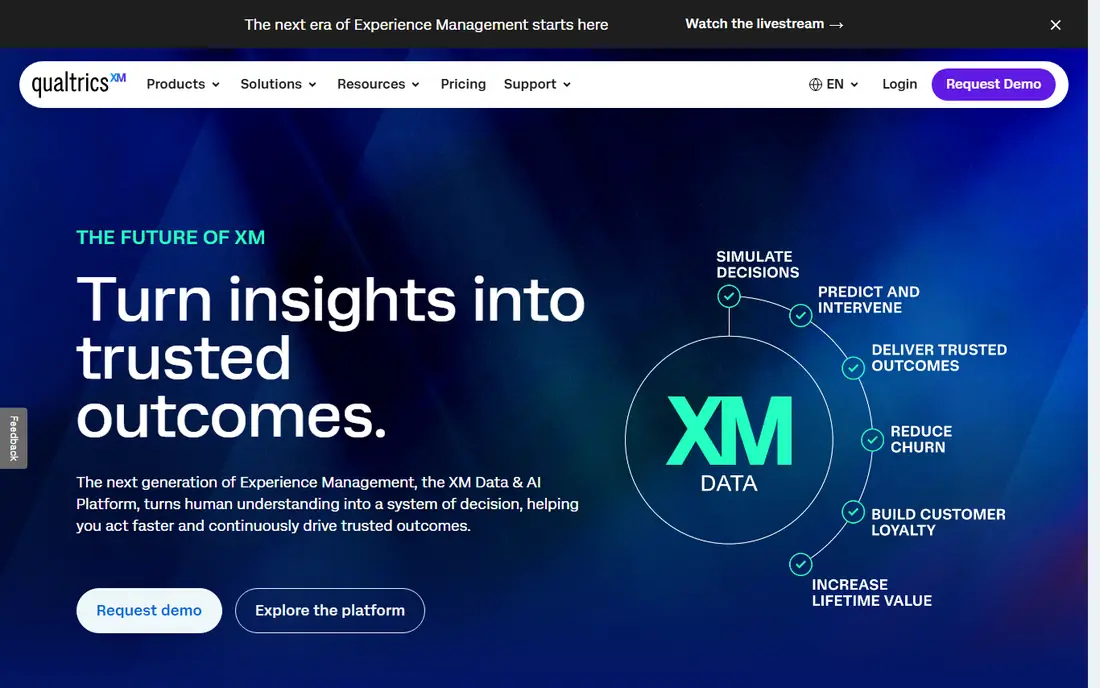
Qualtrics is the most complete research platform on this list, and it fits teams that run surveys, interviews, and experience programs in one place. Its AI features help summarize open text, video feedback, and large survey sets, which saves time when a strategy question depends on thousands of responses. The dashboards also make it easier to compare results by segment, time period, or location.
The catch is scope. A small team that only needs theme detection will find much of the platform unnecessary, and the published self-serve price covers a limited response total. Before signing, confirm response limits, user seats, and whether the experience suites you need are included or quoted separately.
- Broad survey and analysis features
- AI summaries for qualitative answers
- Dashboards that can be shared across teams
- Enterprise pricing can rise quickly
- Setup takes time for complex programs
- Smaller teams may not use the full suite
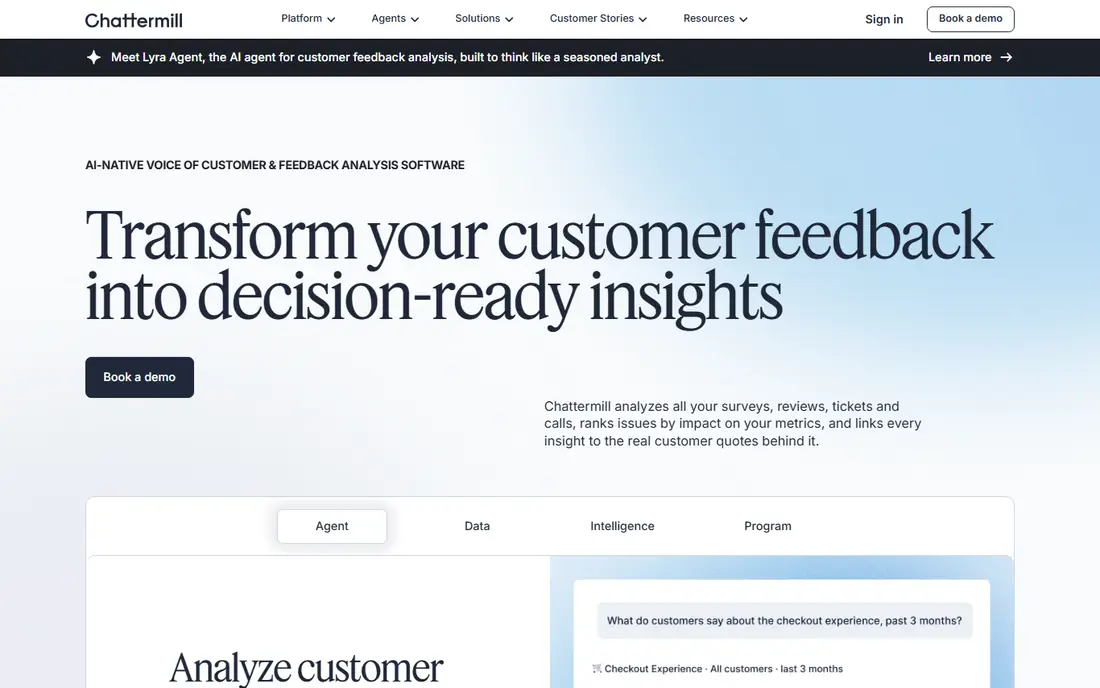
Chattermill is built for companies that already collect feedback in many places and need one view of what customers keep saying. Its AI groups similar comments into themes, scores sentiment, and flags unusual shifts, so a strategy team can spot a rising complaint before it becomes a pattern in churn data. Multilingual support is also useful for global brands.
The main trade-off is that it is an analysis platform, not a simple survey tool. Teams with only a few hundred comments a month may get similar value from a cheaper survey tool with basic AI summaries. Ask for a trial on your own data, because theme quality depends heavily on the quality of the feedback you feed it.
- Unifies surveys, reviews, tickets, and calls
- AI theme and sentiment tagging
- Anomaly alerts for sudden changes
- Pricing is quote based
- Smaller feedback volumes may not justify the cost
- Setup depends on clean source data
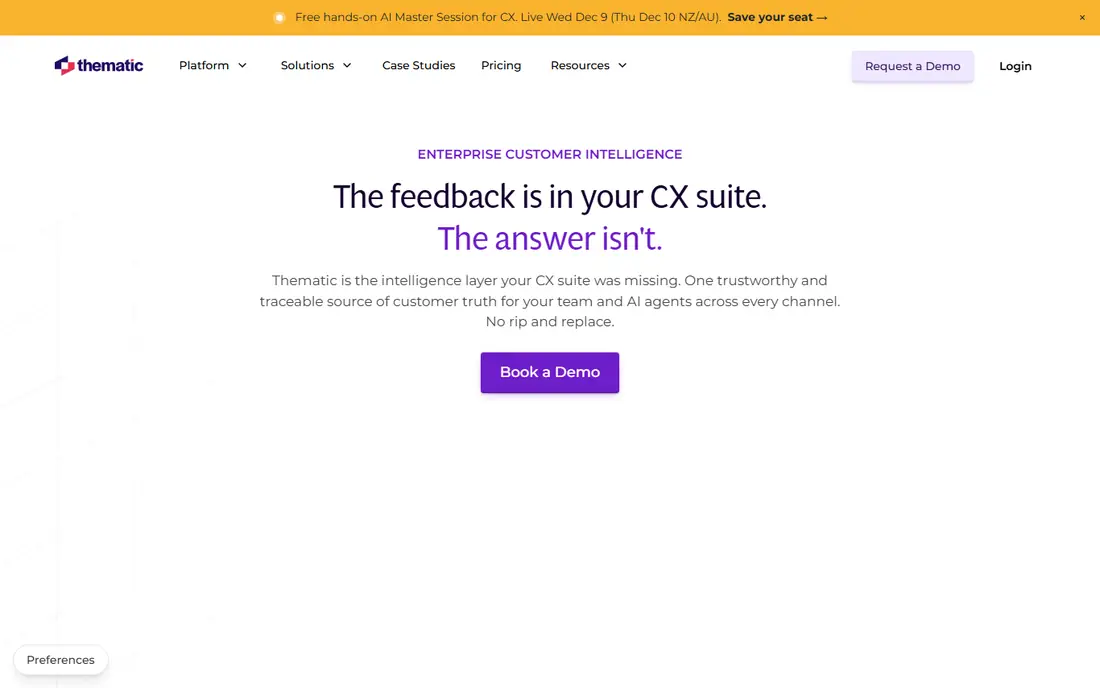
Thematic stands out when a team does not want to accept AI labels without question. You can edit themes, build a hierarchy that matches your product areas, and trace a theme back to the comments behind it. That control matters for strategy work, where a vague theme such as service issues is not enough to decide what to fix first.
That control also creates work. Someone has to maintain the taxonomy as products change, or themes drift and comparisons over time lose meaning. Thematic is best for insights teams that will own that work, rather than teams looking for a fully automatic answer.
- Editable AI themes and hierarchies
- Clear sentiment and trend views
- Works across surveys, tickets, and reviews
- Pricing is quote based
- Analysis focus means limited closed-loop workflows
- Needs a person to curate themes well
Dovetail is the easiest pick here for a team that runs interviews and usability tests and then loses the findings in slide decks. Notes, transcripts, video clips, and tags live in one searchable place, so a later strategy discussion can reuse earlier research instead of repeating it. AI tagging speeds up the first pass through a transcript, and highlights make findings easier to share.
It is less suited to always-on feedback monitoring. If your main input is a constant stream of support tickets and reviews, a dedicated feedback analytics tool will track trends more directly. For product and design teams, though, the repository habit Dovetail encourages is often the real value.
- Searchable research repository
- AI tagging and transcription
- Clean collaboration for product teams
- Built around research projects, not continuous monitoring
- Advanced analysis is less deep than specialist tools
- Paid seats add up for large teams
Zonka Feedback fits businesses with many sites, stores, or service teams, where the strategy question is often which location or process is falling behind. It collects surveys, reviews, and other feedback, then links results to a specific site or team so leaders can compare performance fairly. AI analysis helps surface recurring themes without reading every response by hand.
Check the tier carefully, because the most useful AI features are not on the entry plan. A single-location business may do just as well with a simpler survey tool, but a multi-location operator will value the entity level reporting and follow-up workflows.
- Feedback across locations and channels
- AI thematic analysis and impact scoring
- Closed-loop follow-up tools
- AI features sit on higher tiers
- Pricing rises with scale
- Smaller single-site teams may find it more than they need
Enterpret takes feedback from support, surveys, reviews, and calls and organizes it around product themes that a team can act on. Its models are tuned to each customer, which can improve accuracy for product-specific language that generic tools miss. When a theme is tied to a roadmap item, product managers can see how much feedback supports a change and what customers actually asked for.
The focus is also the limit. Enterpret is not a general survey platform or a full experience suite, so teams that need those jobs will still need another tool. It works best when a product team already has feedback flowing in and needs a clearer path from comments to priorities.
- Custom models tuned to a product
- Feedback linked to roadmap items
- Alerts through common team tools
- Pricing is quote based
- Best for product-led teams, not general research
- Value depends on keeping integrations current
Medallia is a long-established enterprise platform for companies that need surveys, digital feedback, social listening, and contact center signals in one system. Its AI analysis helps large teams find themes in very large volumes of text and speech, and its reporting is built for executives who need consistent metrics across regions. For a global company with a mature experience program, that breadth is hard to match with a smaller tool.
For most small and mid-size teams, Medallia will be too much platform and too much procurement work. Treat it as a shortlist candidate only when feedback volume, governance needs, and integration demands already justify an enterprise contract.
- Broad signal capture across channels
- AI text and speech analytics
- Strong enterprise reporting
- Pricing is quote based
- Implementation can be long
- Overkill for small feedback programs
Productboard answers a different strategy question from most tools here: not just what customers are saying, but what should we build next. Feedback can be captured, grouped, scored, and linked to roadmap items, so a team can explain why one request moved ahead of another. That transparency helps in planning meetings and with stakeholders who ask for evidence behind a decision.
It does not replace a deep text analytics tool. If you need detailed theme hierarchies across millions of comments, pair Productboard with an analysis tool or accept its lighter analysis. For product teams that already collect feedback elsewhere, it is a practical bridge to planning.
- Feedback flows into prioritization
- Roadmaps are easy to share
- Clear link between requests and planned work
- AI insight depth is narrower than specialist analytics tools
- Pricing is per maker, so costs grow with the team
- Not a survey platform
Survicate is a good starting point for teams that want both collection and analysis without an enterprise sales process. You can run surveys in several channels, then use AI features to summarize open text and spot themes. The published pricing makes budgeting easier than with quote-only rivals, and the free plan lets a small team test the basics.
The trade-off is depth. Very large or complex feedback programs will outgrow its analysis features sooner than they would outgrow Chattermill or Thematic. For a growing team that needs strategy input now, rather than a perfect enterprise system later, Survicate is a sensible middle step.
- Surveys on web, email, and in product
- AI analysis of open answers
- Transparent published pricing tiers
- Analysis depth is below specialist platforms
- Higher tiers needed for larger volumes
- Some advanced features require setup time
How we picked these
We compared official feature pages, pricing pages, and public reviews, and we favored tools that clearly explain how feedback becomes a theme, a trend, or a priority. We left out tools that only collect surveys without analysis, and tools that only generate content without working from real customer or market input. Where a vendor does not publish a price, we wrote See website rather than repeating a third-party estimate as fact. We did not claim hands-on testing, and readers should still run a trial on their own data before committing.
What to check before you buy
Start with the decision you need to make, not the feature list. A team choosing between product directions needs theme quality and traceability to source comments. A team tracking brand health needs consistent tracking over time and alerts when sentiment shifts. A team serving many locations needs reporting by site and a way to follow up with unhappy customers. Write that decision down before demos, and score each tool against it.
Next, test theme quality on your own messy data. Vendor demos use clean examples, so upload real tickets, reviews, and survey answers, including short, vague, and misspelled comments. Check whether themes match how your team talks about the product, whether sentiment is right on sarcastic or mixed comments, and whether you can drill into the comments behind a number. If a theme cannot be traced back to evidence, do not use it to justify a strategy change.
Then confirm the total cost and the data rules. Ask how volume is counted, what happens when you pass a limit, which integrations are included, and how long historical data is kept. Check data residency, access controls, and deletion options, especially when feedback includes personal details. A tool that produces clear insights but creates a privacy headache is not a good strategy choice.
Frequently asked questions
What is the best AI strategy insights tool?
There is no single best tool, because the job differs by team. Qualtrics and Medallia suit large enterprise programs, Chattermill and Thematic suit deep feedback analysis, and Dovetail and Productboard suit product teams turning research into plans. Pick the tool that matches your main decision and your feedback volume.
What is the best AI strategy insights platform for a small team?
Dovetail, Productboard, and Survicate are the easiest starts here, because they publish prices and offer a free plan or a free trial. A small team should start with one clear use case, such as grouping support feedback each month, and add a larger platform only when volume or reporting needs grow.
How do AI strategy insights tools work?
Most tools pull feedback from surveys, reviews, tickets, calls, and other channels, then use AI to group similar comments, score sentiment, and track changes over time. Good tools let you edit themes and read the original comments, so the insight can be checked before it shapes a decision.
Are AI insights reliable enough for strategy decisions?
They are a strong starting point, but not a final answer on their own. Use AI themes to find patterns and questions, then check them against sales data, support volumes, and direct customer conversations. Human review matters most when a decision is costly or hard to reverse.
How much do these tools cost?
Prices range from a free plan or a low monthly fee for smaller tools to quote-only enterprise contracts for large suites. The published prices in this guide are entry points, and total cost often depends on feedback volume, data sources, seats, and support. Ask for the full quote in writing before you compare totals.
Sources
- https://www.qualtrics.com/buy-online/?utm_lp=role-market-research
- https://www.zonkafeedback.com/blog/chattermill-alternatives-and-competitors
- https://rankite.com/blog/best-customer-insights-software
- https://chattermill.com/blog/best-customer-insights-software
- https://www.sentisum.com/library/thematic-vs-chattermill
See where you really rank - block by block
ProMapRanker scans Google Maps across a grid of your service area. Simple monthly plans from $19, white-label on every plan.
Start freeKeep reading
 zscaler alternatives
Best Zscaler Alternatives in 2026
Looking for zscaler alternatives? We compare 9 SASE and zero trust platforms on architecture, data protection, pricing, and fit for your network and team.
Read → zapier alternatives free
Best Zapier Alternatives Free in 2026
Nine automation tools for zapier alternatives free in 2026, all with genuinely free tiers, plus free plan limits, starting prices and upgrade paths explained.
Read → which platform is best for online reputation
Which Platform Is Best for Online Reputation in 2026
Wondering which platform is best for online reputation? We compare 8 review, listing, and response tools for small and multi-location businesses and agencies.
Read →