 ProMapRanker
Best AI Security Platforms in 2026


Endpoint-led AI detection · Pricing starts at: See website
Key takeaways
- CrowdStrike Falcon and SentinelOne lead for AI-led endpoint detection and response, with different strengths in automation and rollback.
- Wiz and Orca lead for agentless cloud security, with attack-path views that help teams fix the riskiest issues first.
- Darktrace and Vectra AI suit network-led detection, where behaviour models catch threats that signatures miss.
- Most enterprise platforms are quote-based, so budget from a sales quote, not a headline price, and check data ingestion costs.
- AI security also means securing your own AI tools, so look for AI posture features alongside threat detection.
Quick comparison
| Pick | Great for | Pricing starts at | Free tier | |
|---|---|---|---|---|
| CrowdStrike Falcon | Endpoint-led AI detection | See website | No | Visit |
 SentinelOne Singularity | Autonomous endpoint response | See website | No | Visit |
 Wiz | Cloud attack-path security | See website | No | Visit |
 Darktrace | Network behaviour detection | See website | No | Visit |
 Vectra AI | Hybrid network and identity detection | See website | No | Visit |
 Palo Alto Cortex XSIAM | AI-native SOC consolidation | See website | No | Visit |
 Microsoft Defender XDR | Microsoft-centred estates | See website | No | Visit |
 Orca Security | Agentless cloud coverage | See website | No | Visit |
The best ai security platforms
AI security platforms use machine learning and behaviour models to detect, prioritise, and respond to threats faster than rule-based tools alone. Some focus on endpoints, some on networks, and some on cloud and AI workloads. The best platform depends on where your risk sits and which stack you already run.
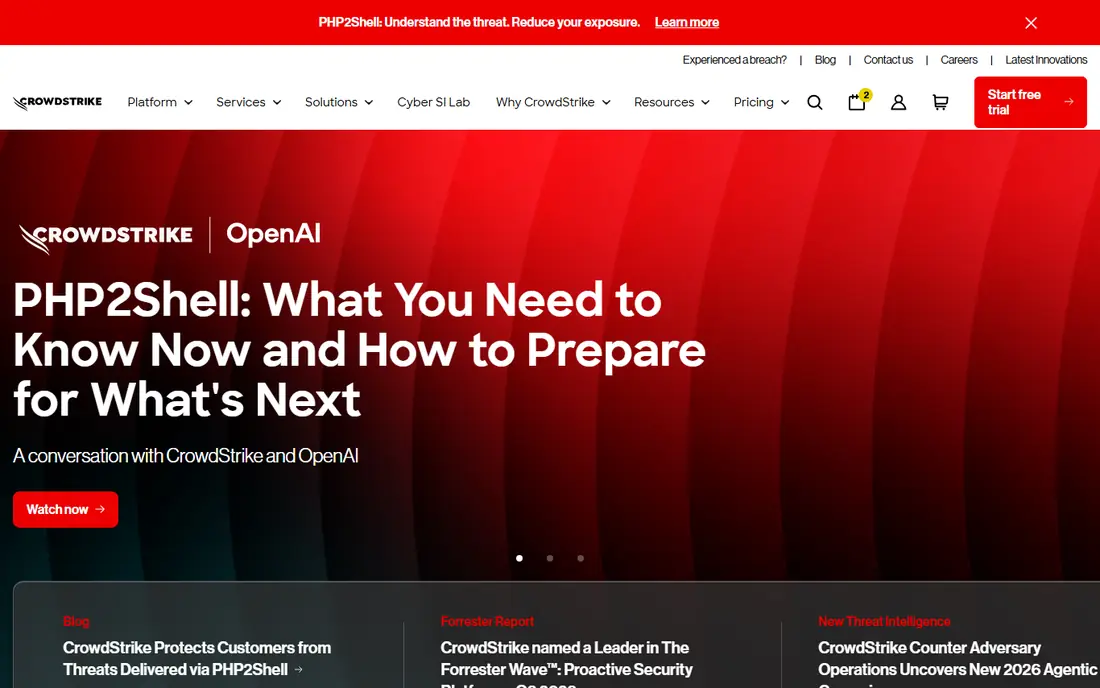
CrowdStrike Falcon is our pick for endpoint-led AI security. Its cloud-native agent uses behavioural models to spot ransomware, fileless attacks, and novel malware, while Charlotte AI helps analysts triage detections and ask questions in plain language. Threat intelligence from real incidents feeds back into detection, which helps teams stay ahead of common attack patterns.
Pricing is module-based and quoted, so a small endpoint-only deployment costs far less than a full XDR, identity, and cloud rollout. Teams should price the modules they actually need, and check whether Charlotte AI is included or an add-on on their plan.
- AI-led behavioural detection
- Charlotte AI assistant for analysts
- Deep threat intelligence
- Pricing varies widely by module
- Full platform needs several modules
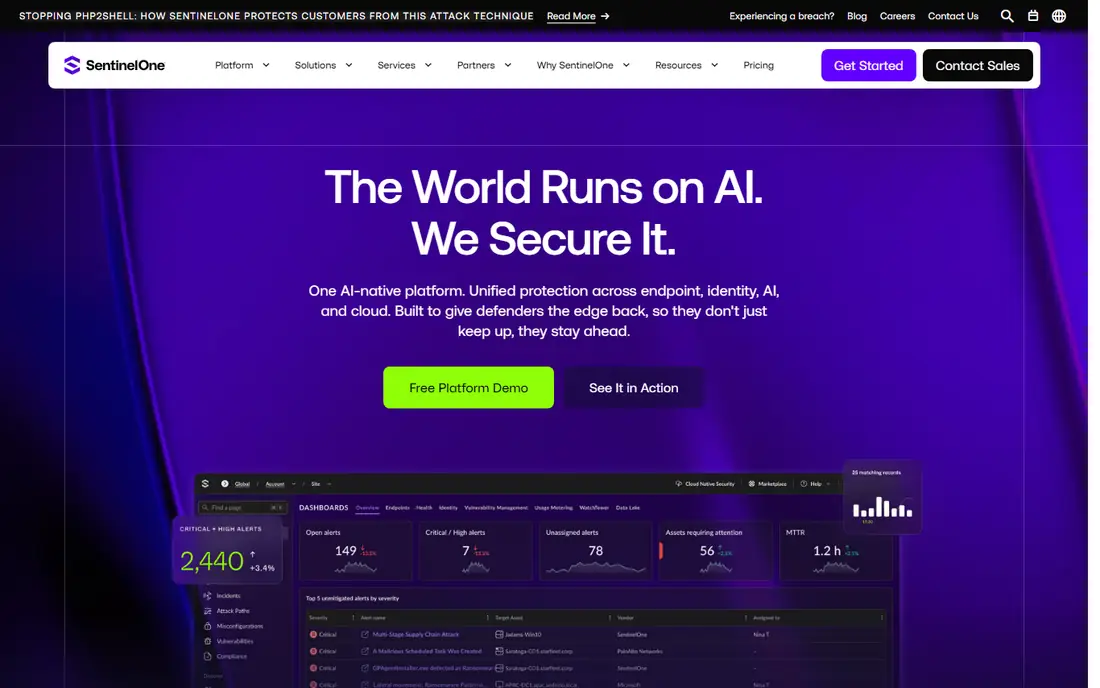
SentinelOne Singularity suits teams that want fast, autonomous response. When it detects ransomware or malicious behaviour, it can kill processes, isolate the device, and roll back affected files, which limits damage before an analyst responds. Purple AI helps analysts investigate and hunt across endpoint, cloud, and identity data.
The platform also offers a unified XDR and SIEM option, which can replace separate tools for some teams. Pricing varies by tier and is quoted for larger deployments, so get a figure for your endpoint count and data volume before comparing it with CrowdStrike.
- Autonomous response with rollback
- Purple AI assistant
- Unified XDR and SIEM option
- Pricing varies by tier
- Enterprise features need higher plans
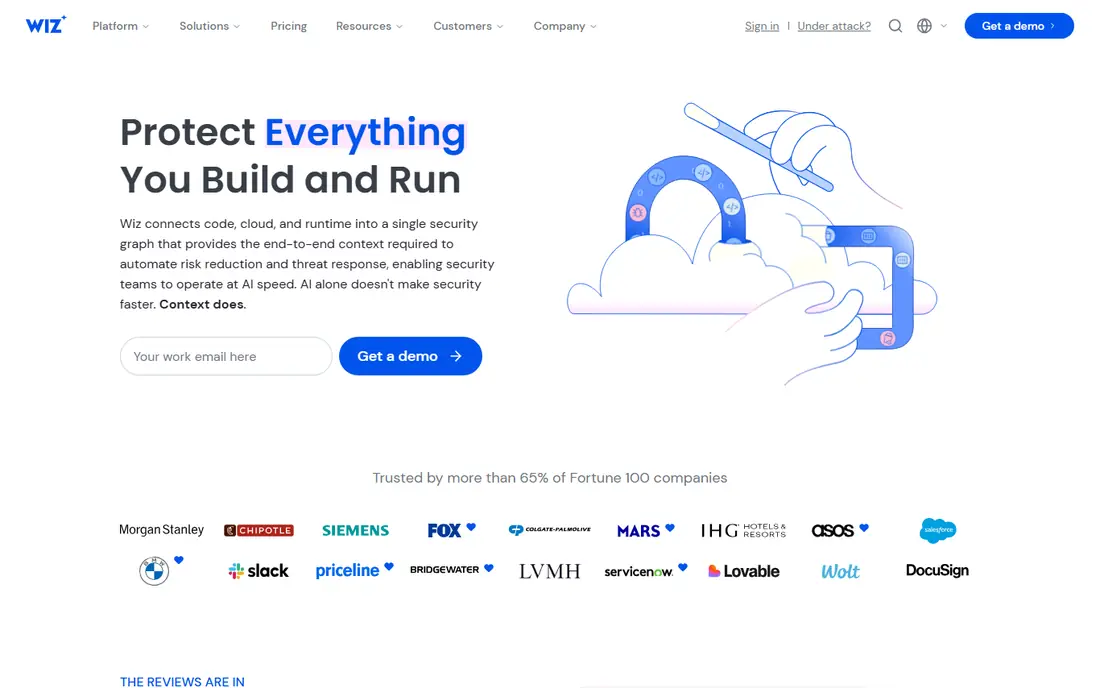
Wiz leads for cloud security teams that need to prioritise fixes. Its agentless approach scans cloud workloads, containers, and configurations, then maps attack paths that connect a vulnerability, a misconfiguration, and an exposed resource. That view helps teams fix the few issues that actually lead to a breach, rather than chasing every alert.
Wiz also covers AI security posture, including discovery of AI models, agents, and related cloud resources, plus AI attack-path analysis. It does not replace endpoint detection, so pair it with Falcon or SentinelOne for full coverage. Pricing is quoted by workload, so budget from a formal quote.
- Agentless cloud coverage
- Security Graph attack paths
- AI posture features
- Quote-based pricing
- Cloud-only focus means endpoint gaps remain
Darktrace suits complex networks where novel threats matter more than known signatures. Its self-learning models build a picture of normal behaviour for each device and user, then flag deviations that suggest an attack, insider misuse, or a compromised device. Autonomous response can contain a threat by limiting device behaviour while analysts investigate.
Pricing is quote-only and module-based, and it varies with network size. Tuning takes time, since the model must learn normal patterns before alerts become reliable. For networks with operational technology or many connected devices, Darktrace offers coverage that endpoint tools alone miss.
- Self-learning behaviour models
- Autonomous containment
- Covers IT and OT networks
- Quote-only, module-based pricing
- Needs tuning for each network
Vectra AI helps SOC teams cut alert fatigue. Its Attack Signal Intelligence maps behaviour to attacker progress, so analysts see the few signals that show a real attack moving through the network, identity, and cloud, rather than hundreds of low-value alerts. That prioritisation matters for small SOC teams with limited analyst time.
It is not a full endpoint replacement, so pair it with an endpoint platform for device-level response. Pricing is quoted, and deployment scope depends on whether you cover network, identity, cloud, or all three.
- Attack Signal Intelligence prioritises real attacker progress
- Covers network, identity, and cloud
- Quote-only pricing
- Less endpoint depth than Falcon or SentinelOne
Palo Alto Cortex XSIAM suits large enterprises that want to consolidate a fragmented security stack. It brings SIEM, SOAR, and endpoint data into one AI-native SOC platform, with machine learning triage that groups related alerts into incidents. That consolidation can cut tool sprawl and speed up investigation for large SOC teams.
Pricing is enterprise and quoted, and moving from an existing SIEM needs careful planning for data ingestion and detection rules. For large firms already using Palo Alto tools, XSIAM offers the cleanest consolidation path.
- Consolidates SIEM, SOAR, and EDR data
- AI-led triage
- Strong for large enterprises
- Quote-based enterprise pricing
- Migration from existing SIEM takes planning
Microsoft Defender XDR suits organisations already centred on Microsoft 365 and Azure. Endpoint, identity, email, and cloud app signals combine in one console, with AI-led detection and automated investigation across those sources. For teams that already pay for Microsoft security licensing, the incremental cost can be lower than a separate platform.
Outside Microsoft estates, coverage is thinner, so mixed environments may still need a separate cloud or network tool. Check which Defender plan includes XDR, identity protection, and cloud app security, since licensing tiers change what is included.
- Deep integration with Microsoft 365 and Azure
- Unified endpoint, identity, and email detection
- Familiar admin experience
- Best value inside Microsoft licensing
- Less depth outside Microsoft estates
Orca Security suits multi-cloud teams that want fast, agentless coverage without deploying agents on every workload. SideScanning inspects cloud workloads, containers, and data from outside the workload, which speeds up onboarding and avoids agent maintenance. Coverage spans AWS, Azure, and Google Cloud, with risk prioritisation for misconfigurations and vulnerabilities.
As with Wiz, Orca is cloud-focused, so endpoint and network detection still need separate tools. Pricing is quoted by workload, so compare Orca and Wiz on the same workload count and cloud mix before choosing.
- Fast agentless coverage
- SideScanning for workloads and data
- Good for multi-cloud estates
- Quote-based pricing
- Endpoint and network gaps need other tools
How we picked these
We compared official vendor pages, pricing models, and feature pages, plus 2026 AI security platform comparisons. We looked for platforms that use AI or machine learning as a core detection method, not just as a marketing label, and that are available to enterprise and mid-market buyers in October 2026. We kept a mix of endpoint, network, cloud, and SOC platforms, rather than listing only one category.
How to choose an AI security platform
Start with where attacks would hurt most. Endpoint-led teams should shortlist CrowdStrike and SentinelOne. Cloud-led teams should shortlist Wiz and Orca. Network-led teams should shortlist Darktrace and Vectra AI. SOC consolidation teams should shortlist Cortex XSIAM and Defender XDR. A platform that excels in one area rarely covers all areas equally well.
Next, check data and pricing in detail. SIEM and XDR costs often scale with data ingestion, endpoint count, or workload count, so a low headline price can grow fast. Ask for a quote based on your real endpoint, workload, and log volume, and check whether AI assistants and advanced modules are included or add-ons.
Also test detection quality on your own traffic, not just on vendor demos. Run a proof of concept with real endpoints and cloud accounts, and measure false positives, triage time, and response speed. A tool that floods analysts with alerts, even accurate ones, will slow response rather than speed it up.
Finally, cover AI risk itself. If your company builds or uses AI models, agents, or chat tools, check AI posture features, such as discovery of AI assets, data exposure checks, and model risk scoring. Threat detection and AI posture are different jobs, and the best platform for your team may need to cover both, or pair two tools that each cover one side well.
Frequently asked questions
What is the best ai security platform overall?
CrowdStrike Falcon leads for endpoint-led AI detection, while Wiz leads for cloud security. The best overall choice depends on whether your main risk sits on devices, in the cloud, or on the network, so most large teams run more than one platform.
What are the best ai security tools for threat detection?
CrowdStrike Falcon, SentinelOne Singularity, Darktrace, and Vectra AI all offer AI-led threat detection, with different focuses on endpoints, networks, and identity. Choose by the environment you need to protect, not by a single vendor ranking.
What is the best ai application security platform?
Wiz offers AI security posture features for AI models, agents, and cloud resources, including AI attack-path analysis. Orca and Palo Alto tools also cover cloud and application risk, so compare AI posture features separately from general threat detection.
How much do AI security platforms cost?
Most enterprise platforms on this list are quote-based, with pricing by endpoint, workload, or data volume. Endpoint tools may publish entry prices per device per year, while cloud and SOC platforms usually need a formal quote for your estate size.
Do AI security platforms replace a SOC team?
No, they help analysts triage faster, prioritise real threats, and automate containment, but they do not replace human judgment, incident response planning, or governance. Small teams still need a clear response plan and an escalation path for serious incidents.
Can small businesses use these platforms?
Small businesses can use endpoint-led tools such as CrowdStrike Falcon and SentinelOne at smaller scale, and Microsoft Defender XDR when already licensed. Large cloud and SOC platforms suit mid-market and enterprise teams better, due to price and setup effort.
Sources
See where you really rank - block by block
ProMapRanker scans Google Maps across a grid of your service area. Simple monthly plans from $19, white-label on every plan.
Start freeKeep reading
 zendesk alternatives
Best Zendesk Alternatives in 2026
Compare the best Zendesk alternatives in 2026, from budget help desks to AI-first support tools, with current pricing, free plans, and honest trade-offs.
Read → wordpress alternatives
Best WordPress Alternatives in 2026
Looking for the best WordPress alternatives? We compare 8 free and paid options for blogs, business sites, stores, and developer-led projects in 2026.
Read → which real estate company has the best training
Best Real Estate Company Training in 2026
Compare which real estate company has the best training, from Keller Williams and eXp to Compass and Coldwell Banker, by program, mentor, and fit in 2026.
Read →