 ProMapRanker
Best AI Search Performance Monitoring Tools in 2026

Key takeaways
- Otterly.AI and Rankscale are the lowest-priced entry points, while AthenaHQ and Profound add depth for larger teams.
- Peec AI keeps monitoring clean and daily, while Semrush and Ahrefs suit teams that want AI data inside a wider SEO suite.
- Check frequency, prompt limits and engine coverage before you buy, since those three settings decide what the reports can actually show.
- Treat AI search scores as trends, since answers vary by prompt, model version and time of day.
Quick comparison
| Pick | Great for | Pricing starts at | Free tier | |
|---|---|---|---|---|
 Profound | Enterprise AI search monitoring | See website | Free trial | Visit |
 Otterly.AI | Small teams monitoring AI search | $29 per month | Free trial | Visit |
 Peec AI | Daily monitoring for agencies | $95 per month | Free trial | Visit |
 AthenaHQ | High-volume monitoring with actions | $295 per month | Yes | Visit |
 Rankscale | Share of voice monitoring on a budget | $20 per month | Free trial | Visit |
 Semrush | AI monitoring inside an SEO suite | $99 per month | Free trial | Visit |
 Ahrefs Brand Radar | AI monitoring for Ahrefs users | See website | No | Visit |
 Goodie AI | Monitoring linked to optimisation | $399 per month | Free trial | Visit |
 Nightwatch | SEO plus AI monitoring in one tool | See website | Free trial | Visit |
The best AI search performance monitoring tools
AI search performance monitoring tools track how a brand performs in AI answers over time, not just in one snapshot. They run the same prompts on a schedule, record mentions, citations and competitor share, and show whether performance is rising or falling. We compared tools live in October 2026 that focus on that ongoing monitoring job.
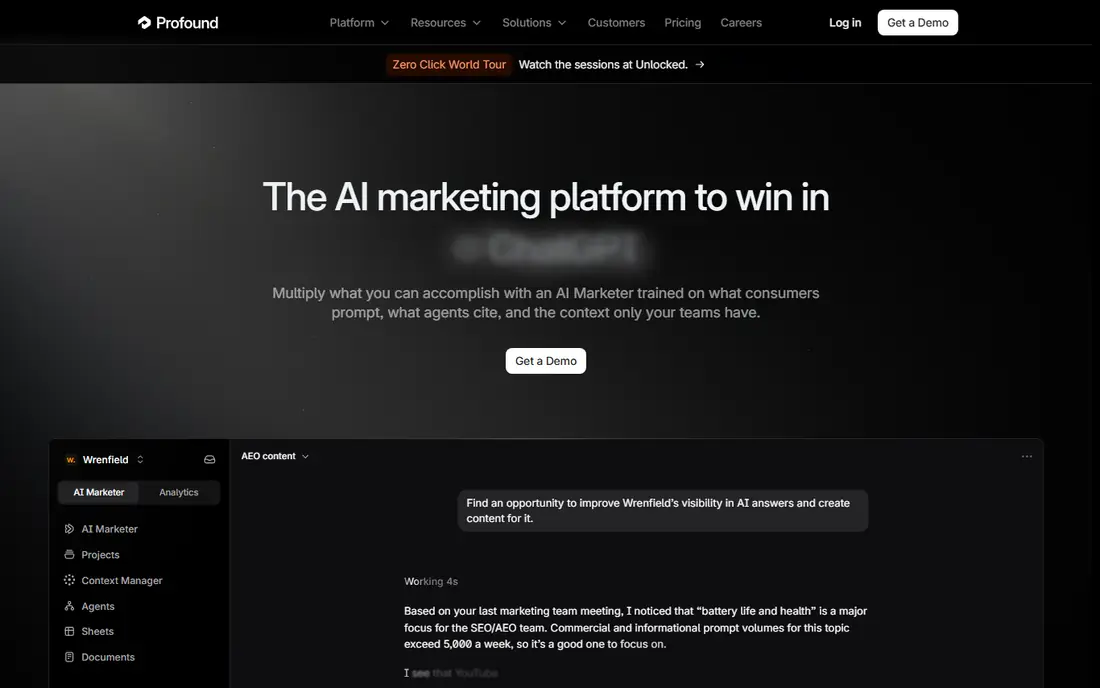
For teams that want a clear starting point, Profound is built for enterprise ai search monitoring. Profound monitors brand mentions and citations across several answer engines, with agent analytics that track how AI traffic reaches your site. It suits a large team that needs deep, regular reporting and can work through a sales-led contract.
The honest catch is no published paid price. Before you pay, test it on your real workload during any trial or free tier and check whether the limits fit what you actually do each week. If the coverage fits your main work, it is worth keeping; if it only covers a narrow set, try a cheaper option first.
- Multi-engine monitoring
- Agent analytics
- Deep prompt and citation data
- No published paid price
- Enterprise focus can be heavy for small teams
This one suits teams that need steady reporting more than a one-off check, Otterly.AI is built for small teams monitoring ai search. Otterly.AI tracks brand mentions and citations across ChatGPT, Perplexity, Google AI Overviews and other engines, and it adds page audits that explain why some pages are not cited. That combination helps a small team move from watching a score to fixing a page.
The honest catch is lite plan covers a small prompt set. Before you pay, test it on your real workload during any trial or free tier and check whether the limits fit what you actually do each week. If the coverage fits your main work, it is worth keeping; if it only covers a narrow set, try a cheaper option first.
- Low entry price
- Citation tracking across major engines
- Content audits
- Lite plan covers a small prompt set
- Some engines are add-ons
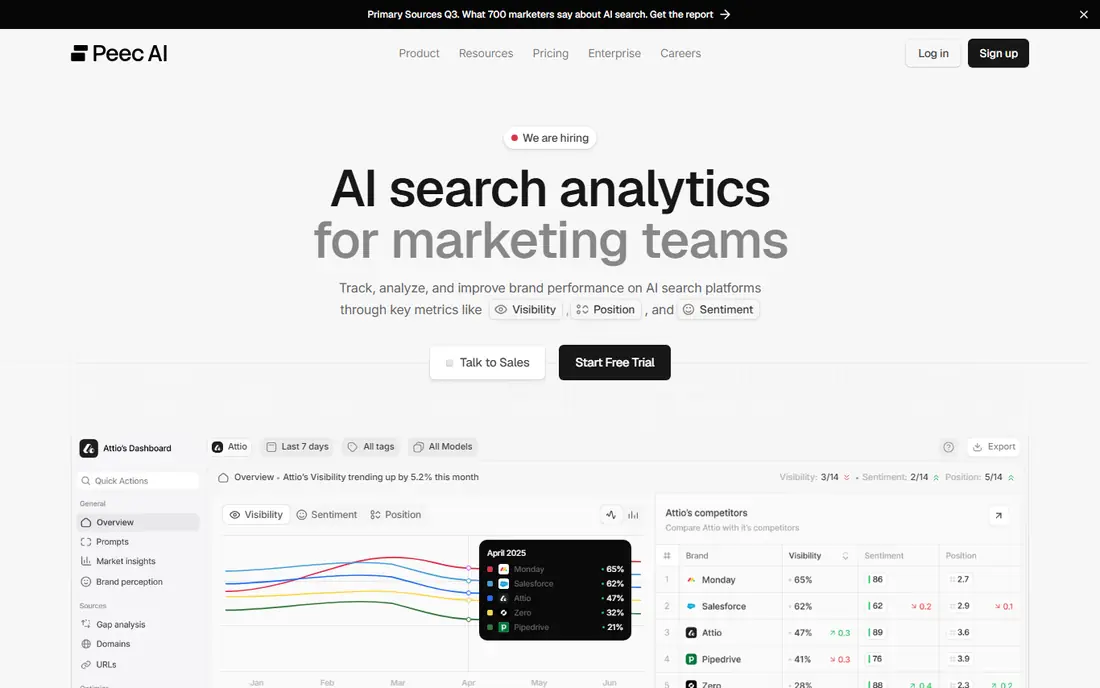
If your main problem is missed mentions, Peec AI is built for daily monitoring for agencies. Peec AI runs daily checks on the prompts you choose, with sentiment, sources and competitor share of voice in a clean dashboard. Unlimited seats make it practical for agencies that share reports across clients and team members.
The honest catch is starter covers 50 prompts and three models. Before you pay, test it on your real workload during any trial or free tier and check whether the limits fit what you actually do each week. If the coverage fits your main work, it is worth keeping; if it only covers a narrow set, try a cheaper option first.
- Daily prompt tracking
- Sentiment and source views
- Unlimited seats
- Starter covers 50 prompts and three models
- Extra models cost more
A good fit for larger teams with several brands to watch, AthenaHQ is built for high-volume monitoring with actions. AthenaHQ monitors a wide set of models and turns citation gaps into prioritised actions, so a team can act on the same data it reports. The credit model rewards teams that plan prompt volume carefully, since unused or overused credits change the real monthly cost.
The honest catch is credit model needs careful planning. Before you pay, test it on your real workload during any trial or free tier and check whether the limits fit what you actually do each week. If the coverage fits your main work, it is worth keeping; if it only covers a narrow set, try a cheaper option first.
- Wide engine coverage
- Credit-based tracking
- Action Center fixes
- Credit model needs careful planning
- Price is high for small teams
For smaller teams working to a tight budget, Rankscale is built for share of voice monitoring on a budget. Rankscale benchmarks share of voice against competitors on the same prompts and shows trends over time. The low entry price makes it a good first monitoring tool for a team that only needs a small prompt set checked regularly.
The honest catch is credit allowances need planning. Before you pay, test it on your real workload during any trial or free tier and check whether the limits fit what you actually do each week. If the coverage fits your main work, it is worth keeping; if it only covers a narrow set, try a cheaper option first.
- Low entry price
- Share of voice benchmarking
- Trend views
- Credit allowances need planning
- Higher tiers rise sharply
This option works best when you already use related tools in the same suite, Semrush is built for ai monitoring inside an seo suite. Semrush adds AI search monitoring to its SEO suite, tracking prompts for a domain alongside classic rankings. It suits teams that already use Semrush and want AI performance in the same reports as keyword and backlink data.
The honest catch is per-domain pricing adds up for agencies. Before you pay, test it on your real workload during any trial or free tier and check whether the limits fit what you actually do each week. If the coverage fits your main work, it is worth keeping; if it only covers a narrow set, try a cheaper option first.
- AI visibility toolkit
- Prompt tracking per domain
- Wider SEO data
- Per-domain pricing adds up for agencies
- AI depth varies by plan
If you need depth on a single question, Ahrefs Brand Radar is built for ai monitoring for ahrefs users. Ahrefs Brand Radar measures AI visibility with a large prompt index and competitor benchmarking, inside the Ahrefs suite. It makes sense for teams that already trust Ahrefs data and want AI monitoring without learning a separate platform.
The honest catch is pricing is not a simple flat figure. Before you pay, test it on your real workload during any trial or free tier and check whether the limits fit what you actually do each week. If the coverage fits your main work, it is worth keeping; if it only covers a narrow set, try a cheaper option first.
- Large prompt index
- Competitor benchmarking
- Citation views
- Pricing is not a simple flat figure
- Newer product inside a large suite
For teams that want action steps alongside the charts, Goodie AI is built for monitoring linked to optimisation. Goodie AI links monitoring to optimisation and attribution, so a team can follow a prompt from mention to fix to result. It fits brands that already invest in content and want AI search performance tied to site outcomes, not just a score.
The honest catch is high starting price. Before you pay, test it on your real workload during any trial or free tier and check whether the limits fit what you actually do each week. If the coverage fits your main work, it is worth keeping; if it only covers a narrow set, try a cheaper option first.
- Broad engine coverage
- Optimisation guidance
- Attribution features
- High starting price
- More than a small monitoring-only team needs
This is the pick to shortlist when reporting matters as much as tracking, Nightwatch is built for seo plus ai monitoring in one tool. Nightwatch combines classic rank tracking with AI search monitoring, so a team can watch both kinds of search in one dashboard. It suits smaller teams that want one reporting tool, provided the chosen plan covers the AI engines and prompt volume they need.
The honest catch is ai monitoring features vary by plan. Before you pay, test it on your real workload during any trial or free tier and check whether the limits fit what you actually do each week. If the coverage fits your main work, it is worth keeping; if it only covers a narrow set, try a cheaper option first.
- SEO rank tracking plus AI monitoring
- Clear dashboards
- Reporting tools
- AI monitoring features vary by plan
- Check the current plan before buying for this job
How we picked these
We compared official feature and pricing pages and public product descriptions for tools live in October 2026. We kept tools that run scheduled prompt checks and report mentions, citations or share of voice over time, and we noted where pricing was custom, credit-based or per domain. We did not claim hands-on testing, and we did not treat a single snapshot score as proof of long-term performance.
How to set up AI search monitoring that stays useful
Choose prompts that match buying intent
Track the questions buyers ask before they choose, plus brand and competitor names, and keep the list stable for several months. Changing the prompt list every week makes trend data hard to read, so add new prompts as a separate group.
Set a check rhythm you can act on
Weekly checks suit most teams, while daily checks suit fast-moving categories with frequent product news. More frequent checks cost more credits, so match the rhythm to how often your team actually reviews and acts on the reports.
Report trends, not single answers
Show share of voice and citation trends over time, and note which pages were cited for each strong answer. A single answer can vary by model version, so a trend across many prompts gives a fairer picture than one good or bad result.
Frequently asked questions
What is AI search performance monitoring?
It is the ongoing tracking of how a brand appears in AI-generated answers, using scheduled prompts across engines such as ChatGPT, Perplexity, Gemini and Google AI Overviews. Reports cover mentions, citations, sentiment and competitor share over time.
How is this different from classic rank tracking?
Classic rank tracking records a position on a results page, while AI monitoring records whether and how a brand is mentioned inside a generated answer. The two views complement each other, since a brand can rank well in classic search and still be absent from AI answers.
How often should I check AI search performance?
Weekly checks work for most teams, while daily checks suit categories where answers change fast. The right rhythm is the one your team can review and act on, since unchecked daily data adds cost without value.
Why do AI search results vary between checks?
Answers vary by prompt wording, model version, time and available sources, so two checks of the same question can differ. That is why trend reports across many prompts are more useful than a single result.
Can monitoring alone improve my AI visibility?
No, monitoring shows where you stand and which pages are cited, but content fixes, clear facts and source coverage do the improving. Use the reports to prioritise page updates, then watch the trend change over following weeks.
Sources
See where you really rank - block by block
ProMapRanker scans Google Maps across a grid of your service area. Simple monthly plans from $19, white-label on every plan.
Start freeKeep reading
 zscaler alternatives
Best Zscaler Alternatives in 2026
Looking for zscaler alternatives? We compare 9 SASE and zero trust platforms on architecture, data protection, pricing, and fit for your network and team.
Read → zapier alternatives free
Best Zapier Alternatives Free in 2026
Nine automation tools for zapier alternatives free in 2026, all with genuinely free tiers, plus free plan limits, starting prices and upgrade paths explained.
Read → which platform is best for online reputation
Which Platform Is Best for Online Reputation in 2026
Wondering which platform is best for online reputation? We compare 8 review, listing, and response tools for small and multi-location businesses and agencies.
Read →