 ProMapRanker
Best AI Search Checking Tools in 2026

Key takeaways
- Profound is the reference enterprise pick for AI search tracking, while Otterly.ai and Peec AI give smaller teams a cheaper first step.
- No single score is standard yet, so compare trends over time rather than treating one daily figure as a fixed ranking.
- ChatGPT-only plans can mislead, since a brand can appear in one engine and stay absent in another.
- Teams already on Semrush or Ahrefs should test those AI add-ons before buying a separate platform.
Quick comparison
| Pick | Great for | Pricing starts at | Free tier | |
|---|---|---|---|---|
 Profound | Enterprise AI search tracking | See website | Free trial | Visit |
 Brandlight | Brand intelligence across AI and web | See website | Free trial | Visit |
 Peec AI | Clean daily tracking for lean teams | See website | No | Visit |
 Otterly.ai | Low-cost first AI visibility read | $29 per month | No | Visit |
 Semrush AI Visibility Toolkit | SEO teams adding AI tracking | See website | Free trial | Visit |
 Ahrefs Brand Radar | Ahrefs users adding AI mentions | See website | No | Visit |
 Goodie AI | Small full-stack AI visibility teams | See website | Free trial | Visit |
 Scrunch AI | Mid-market teams wanting an optimized layer | $250 per month | Free trial | Visit |
 AthenaHQ | Self-serve teams wanting attribution | $295 per month | Yes | Visit |
The best AI search checking tools
An AI search checking tool answers a new question: when someone asks ChatGPT, Gemini, Perplexity or Google AI about your category, does your brand appear, what does the answer say, and which pages get cited? Traditional rank tracking does not answer that, because AI answers blend many sources into one response. The tools below track prompts, mentions, citations and sentiment across AI engines, and each suits a different budget and team size.
Profound is built for the core AI search question, and it is the name most enterprise teams meet first. It runs prompts across major AI platforms, measures share of voice, tracks citations and sentiment, and points to content changes that could improve how a brand is presented. For a large brand with many competitors, that depth matters.
The trade-off is price and scope by tier. Lower tiers have been reported with narrower engine coverage, so a buyer should confirm exactly which engines, prompt counts and regions are included before signing. Profound is the right pick when AI search is a board-level metric, not a side experiment.
- Broad engine coverage
- Prompt, citation and sentiment tracking
- Enterprise reporting
- Premium pricing
- Entry tiers may cover fewer engines than larger plans

Brandlight tracks how AI engines present a brand, and it adds a useful angle for product companies: which retailer pages and products appear in shopping answers. That SKU and retailer view helps ecommerce teams see whether a specific product, not just a brand name, wins a recommendation. Review and traditional brand signals sit alongside AI data.
Pricing is custom, which makes early comparison harder. Brandlight suits brands and agencies that need both brand intelligence and shopping visibility, and that can work through a sales-led trial. Smaller teams should ask for a live demo on their own category prompts before committing.
- Brand and ecommerce tracking
- Retailer and SKU views for product brands
- Agency-friendly views
- Pricing is quote-based
- Newer platform with fewer public reviews than older SEO tools
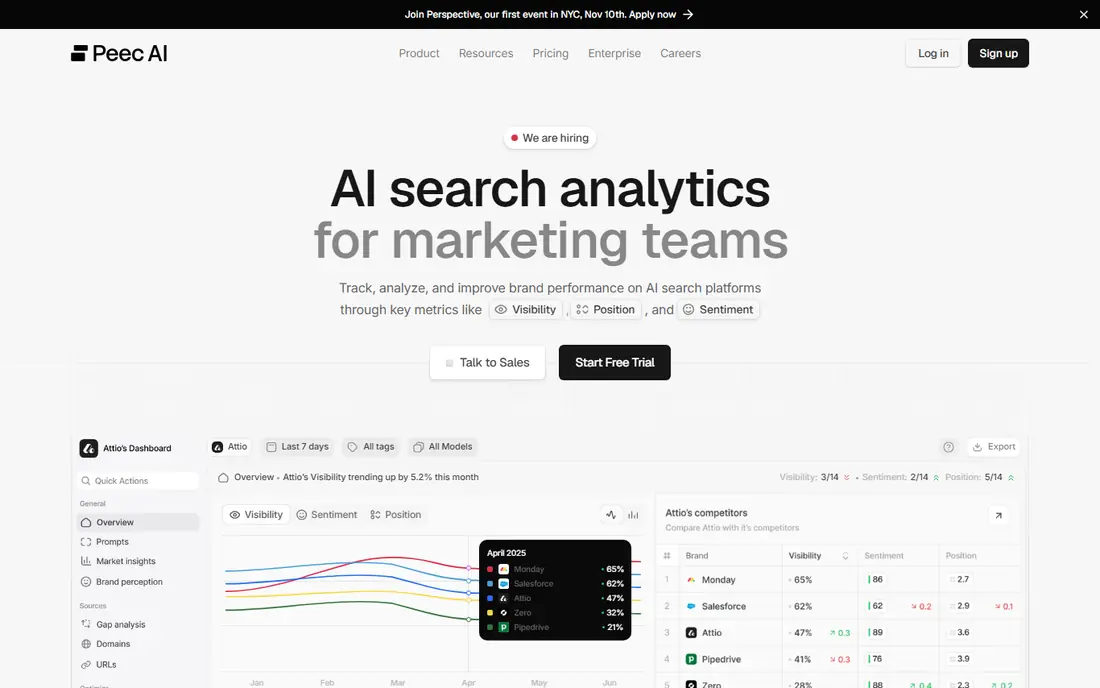
Peec AI appeals to marketing teams that want a clean daily read without enterprise overhead. It tracks brand mentions across AI engines, supports multiple countries, and keeps the dashboard focused on what changed. Agencies also use it to track several clients without a heavy enterprise contract.
Peec AI is deliberately monitoring-focused, so teams must do the content fixes themselves after the tool reports a gap. Entry pricing has been reported around 89 euros per month, but plan details change, so we list See website for the current figure. Confirm which engines are included on the tier you buy, since plans let users pick a subset of models.
- Clear daily tracking
- Multi-country support
- Monitoring-focused design
- Monitoring only, with no built-in remediation
- Engine choice varies by plan
Otterly.ai is the cheapest credible starting point in this guide, at $29 per month for a small prompt set. It tracks brand mentions in AI answers and gives small teams and agencies a presentable dashboard without an enterprise budget. White-label support also helps agencies report to clients under their own brand.
The limits are clear at this price. Entry plans cover fewer prompts, and extra engines such as Claude, Google AI Mode and Gemini can cost more. Otterly.ai is best as a first 30 to 90 day read, or as a low-cost multi-client tracker, rather than as a deep enterprise analytics suite.
- Low entry price
- Simple setup
- White-label options for agencies
- Entry plan covers fewer prompts and engines
- Some engines cost extra
Semrush suits teams that already live in Semrush for keyword research, site audits and rank tracking. Its AI Visibility Toolkit adds prompt tracking, brand performance, mentions and citations across ChatGPT, Gemini, Google AI Mode, Google AI Overviews and Perplexity through related reports. Keeping SEO and AI data in one login saves a second workflow.
The catch is comparability. Different Semrush reports can use different datasets and refresh schedules, so a team should not treat every metric as directly comparable. Semrush AI pricing has been reported as bundled from $199 per month for a Starter tier, but current bundling varies, so check the Semrush pricing page for the exact add-on cost.
- Sits inside a familiar SEO suite
- Prompt research and tracking
- Competitor views
- Different reports use different datasets
- AI add-on sits on top of a Semrush plan
Ahrefs Brand Radar fits teams that already pay for Ahrefs and want AI mention data without a new vendor. It tracks how AI chatbots mention a brand and links that view to Ahrefs content and link data. For SEO-led teams, that context helps decide which pages to improve.
The cost warning matters. Brand Radar has been reported at about $199 per index on top of an Ahrefs plan, so the all-in cost can be much higher than the headline figure suggests. It is a good add-on for Ahrefs shops, but a poor first choice for a team that does not already use Ahrefs.
- Strong backlink and content data behind it
- Useful for existing Ahrefs users
- Brand mention tracking
- Real all-in cost can be high
- AI coverage is narrower than dedicated platforms
Goodie AI positions itself as a full-stack option for teams that want tracking and action in one place, not just a dashboard. It covers AI-era brand visibility and optimization, and it is often named as a closer small-vendor alternative to enterprise suites. Attribution features help teams link visibility work to outcomes, at least in part.
Pricing is quote-only, which makes it hard to compare without a demo. Goodie suits a team that wants vendor guidance on fixes and can accept a smaller vendor in exchange for a more hands-on service. Ask for engine coverage, prompt counts and attribution limits in writing before signing.
- Tracking plus optimization guidance
- Small-team friendly
- Attribution features reported
- Quote-only pricing
- Smaller vendor with less public track record than Profound or Semrush
Scrunch AI goes beyond tracking by serving an optimized layer to AI agents, which suits mid-market teams that want both measurement and delivery. Core pricing has been reported at $250 per month, with enterprise plans custom. A trial helps teams test whether that delivery layer fits their site setup.
The trade-off is complexity. A pure tracker is easier to explain to a client or a manager, while Scrunch AI asks a team to understand how its optimized layer works. For teams that already accept that model, Scrunch AI can be a strong mid-market pick. For teams that only want a daily mention report, Peec AI or Otterly.ai is simpler.
- Agent-delivery approach
- Mid-market focus
- Trial available
- More than a pure tracker
- Enterprise needs custom pricing
AthenaHQ stands out for self-serve teams that want attribution alongside tracking. A free tier lets a team test the product, and the Starter tier has been reported at $295 per month. Revenue attribution is rare in this category, and it helps a team show whether AI visibility work connects to real outcomes.
The limit is that execution stays with the customer. AthenaHQ measures and attributes, but content fixes, site changes and outreach remain the team's job. That is fine for a capable marketing team, but a team that wants done-for-you fixes should look at Goodie AI or an agency service instead.
- Free tier available
- Revenue attribution features
- Broad engine tracking on paid plans
- Execution stays with the customer
- Enterprise plans are custom
How we picked these
We compared current 2026 comparison guides and vendor pages for AI visibility and AI search tracking, and kept only tools that run prompts through AI engines and report brand mentions, citations or share of voice. We favored tools with clear engine coverage and prompt tracking, and we used See website where pricing was quote-based or varied by plan. We did not run hands-on trials, and we note that AI answer methodology is still standardizing, so trends matter more than single-day scores.
How to choose an AI search checking tool
Start with 25 to 50 unbranded buyer prompts that reflect how customers actually ask about your category, not just your brand name. Run those prompts for 30 days before judging a tool, since AI answers change from run to run. A tool that only tracks branded prompts will miss the discovery questions where new customers first meet your competitors.
Engines, prompts and citations
Check which engines are included on the exact tier you will buy, how many prompts you can track, and whether citation URLs are shown. A brand can rank well in ChatGPT and poorly in Perplexity or Gemini, so single-engine tracking gives a partial picture. Citation data matters because it shows which pages an engine trusts, and that points to the content work that may help.
Scores, sentiment and reporting
Ask how each vendor builds its visibility score, how often prompts refresh, and whether sentiment is measured. Proprietary scores are useful for trends, but they are not comparable across vendors. For agencies, also check multi-client dashboards, white-label reports and country coverage before signing a yearly plan.
From tracking to fixes
Tracking alone does not improve visibility. Decide who will act on the findings: your team, your agency, or the vendor. If you need fixes handled for you, favor a full-stack vendor or a managed service. If your team can act fast, a lean tracker plus a clear content plan will give better value.
Frequently asked questions
What is the best AI search checking tool?
Profound is the strongest enterprise pick, while Peec AI and Otterly.ai suit smaller teams. The best tool depends on budget, engine coverage and whether you need fixes or only tracking. Test two tools on the same prompt set for a month before choosing a yearly plan.
What are the best AI search checking tools for agencies?
Otterly.ai, Peec AI and Brandlight all support agency workflows, with white-label or multi-client views. Profound suits agencies with large enterprise clients. Compare prompt allowances per client, since a low per-client prompt count can force an upgrade quickly.
How do AI search checking tools work?
They run a set of prompts through AI engines, then record whether your brand appears, how it is described, which sources are cited, and how competitors compare. Most tools repeat prompts over time and report trends, share of voice and sentiment. Results vary by run, so trends over weeks are more reliable than one day.
Can a free AI search checking tool be enough?
A free tier, such as AthenaHQ's, can be enough for a first test with a small prompt set. For regular tracking across several engines, a paid plan is usually needed. Free tiers often limit prompts, engines or history, which makes trend reporting harder.
Does AI search tracking replace SEO rank tracking?
No. AI search checking complements traditional SEO, because AI answers draw on search results, reviews, articles and brand pages. Keep rank tracking for Google results, and add AI tracking for ChatGPT, Gemini, Perplexity and Google AI answers. Together they show both halves of how buyers find a brand.
Sources
- https://www.allaboutai.com/geo/ai-answer-tracker/best-ai-search-visibility-for-agencies/
- https://brandlight.ai/blog/best-ai-visibility-tools-for-ecommerce
- https://rankite.com/blog/best-ai-brand-visibility-tracking-software
- https://airpulse.ai/compare
- https://www.contentmarketing.ai/blog/ai-in-action/ai-visibility-tracking/
- https://growthner.com/blog/ai-search-visibility-tools-to-track-your-brand-mentions-in-llms/
- https://www.profound.ai
- https://brandlight.ai
- https://peec.ai
- https://otterly.ai
- https://www.semrush.com
- https://ahrefs.com
- https://www.goodie.ai
- https://scrunchai.com
- https://athenahq.ai
See where you really rank - block by block
ProMapRanker scans Google Maps across a grid of your service area. Simple monthly plans from $19, white-label on every plan.
Start freeKeep reading
 outreach alternatives
Outreach Alternatives in 2026
Compare outreach alternatives for 2026, from Salesloft and Apollo to HubSpot and Lemlist, with pricing, channels, features, limits, and honest trade-offs.
Read → best web conference tools
Best Web Conference Tools in 2026
Compare the best web conference tools for meetings, webinars and team calls, with current pricing, free plans and honest limits for each option here today.
Read → best voice cloning tools
Best Voice Cloning Tools in 2026
Compare the best voice cloning tools in 2026, from ElevenLabs and Descript to Resemble and Cartesia, with consent rules, pricing, licenses, and limits.
Read →