 ProMapRanker
AI RFP Software Buyer's Guide


Quick AI drafting with transparent pricing · Pricing starts at: $899/month
Key takeaways
- AutoRFP.ai takes the first slot, best suited to quick AI drafting with transparent pricing.
- Only 1up offers a free plan among these 5 tools.
- 1up suits teams wanting AI answers from live company knowledge.
- What to know about AutoRFP.ai first: single published price point with less plan adaptability.
Direct answer
AutoRFP.ai is the first pick on this list for quick AI drafting with transparent pricing. Loopio is better for mature proposal teams needing workflow control, and Arphie is better for startups and lean teams automating RFPs rapidly. The remaining 2 options are covered below with prices and limits.
Quick comparison
| Pick | Great for | Pricing starts at | Free tier | |
|---|---|---|---|---|
| AutoRFP.ai | Quick AI drafting with transparent pricing | $899/month | Free trial | Visit |
 Loopio | Mature proposal teams needing workflow control | See website | No | Visit |
 Arphie | Startups and lean teams automating RFPs rapidly | See website | No | Visit |
 Responsive | Enterprise teams running high-volume responses | See website | No | Visit |
 1up | Teams wanting AI answers from live company knowledge | See website | Yes | Visit |
AI RFP Software compared in detail
ProMapRanker compared 5 tools for AI RFP software. The goal is a practical shortlist: published prices, free plan facts, best-fit use cases and honest limits for every entry.
AutoRFP.ai is designed for quick AI drafting with transparent pricing. The AI drafts answers from your content, supports several languages, and plugs into the questionnaire formats teams actually receive.
Honest limits: Single published price point with less plan adaptability.
For mid-market teams that want AI drafting without an enterprise sales cycle, that trade is simple to accept. What you pay to start with AutoRFP.ai: $899/month. As for free access: Free trial.
- Rare in this category
- Free two-week proof of concept before committing
- Newer vendor with a smaller customer base than the incumbents

Think of Loopio for mature proposal teams needing workflow control. AI features help draft from the library, import questions from any format, and route work to the right contributors. On top of that, the content library keeps approved answers with owners, review dates, and expiry, so nothing stale slips into a proposal.
Worth adding: Loopio fits organizations with a real proposal function: dedicated staff, recurring RFP volume, and stakeholders across departments. More specifically, firms that answer a handful of RFPs per year will not use enough of the workflow machinery to justify it. Check the vendor site for Loopio pricing; none is listed in this comparison. Loopio does not include a free plan.
Downsides: Most useful for teams with dedicated proposal staff.
- Project management made for multi-contributor RFPs
- Solid content library with review and expiry controls
- No public pricing
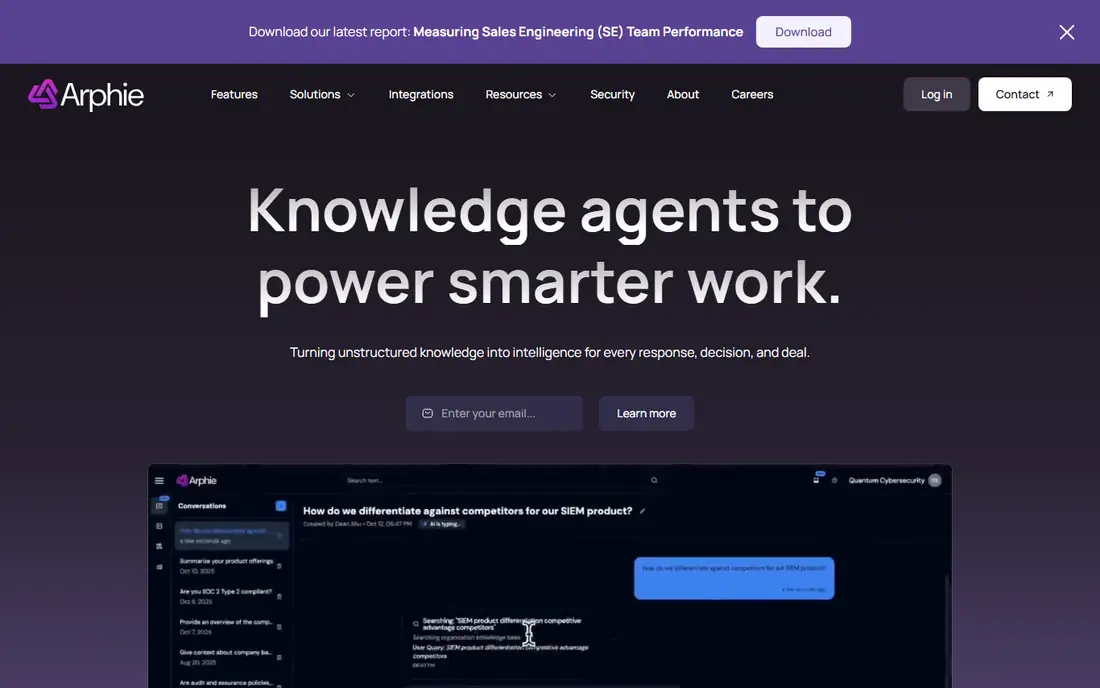
Arphie is a good fit for startups and lean teams automating RFPs rapidly. Setup is quick: link your documents and website, and the AI starts drafting answers to incoming questionnaires. It includes the core document types, RFPs, RFIs, and security questionnaires, without asking a five-person team to run an enterprise workflow.
If your RFP volume grows into that territory later, plan for a migration. If it stays at a handful of per month, Arphie may be all you ever need. As for the details, Arphie gets you from zero to drafted answers rapidly, which is exactly what a lean team needs. It does not supply the approval chains, content expiry management, and deep CRM integrations that a 50-person proposal operation depends on. Arphie does not show a starting price in this comparison, so check the vendor site for current pricing. Arphie has no free tier.
Where it is weaker: Smaller integration catalog than the incumbents.
- Handles RFPs, RFIs
- AI drafts from your existing documents and website
- Lighter content governance than enterprise systems
Responsive is built with enterprise teams running high-volume responses in mind. Responsive, formerly RFPIO, is the category-defining enterprise system. It handles the whole response process: intake and triage, AI-assisted drafting from an approved content library, collaboration and approval workflows, and analytics on what wins.
Beyond that, the AI layer drafts answers, flags content that needs review, and helps keep the library current as products change. Also, the cost of that depth is a genuine implementation project: migrating content, configuring workflows, and training a team of contributors takes weeks. Smaller teams that just need quicker drafting will find the newer AI-native tools lighter to adopt. Pricing for Responsive is not stated here, so ask the vendor for current figures. Responsive does not include a free plan.
Points against: Implementation and content migration take real effort.
Upsides: Purpose-built for RFP, RFI, DDQ.
- AI agents plus automation across the response lifecycle
- Deep integrations with Salesforce, Slack, Teams
- Quote-based enterprise pricing with no public numbers
Think of 1up for teams wanting AI answers from live company knowledge. 1up positions itself as an AI knowledge product instead of just an RFP tool, which turns out to be a sensible design. It links to your documentation, help center, website, and Slack, keeps the knowledge base fresh automatically, and then answers RFPs, security questionnaires, and internal questions from that same source of truth.
In daily use, AI that cites its sources earns trust quick, and 1up's model is built around that verification loop. Traditional RFP libraries decay since updating them is manual work; a system that re-syncs from live sources stays current with less effort. The practical benefit is maintenance. 1up does not show a starting price in this comparison, so check the vendor site for current pricing. 1up has a free plan.
Upsides: Handles RFPs; help center, Slack.
Trade-offs to know: Public pricing details are thin beyond the free level.
- Knowledge base syncs from docs
- Security questionnaires
- Answer quality relies on the sources you link
What went into this list
For each of the 5 tools we noted price, free plan or trial, fit for AI RFP software and the main limit, using vendor pages and documentation. Figures are shown as the vendors publish them. Billing terms, seat minimums and add-ons can change the real cost. The ranking is editorial: typical fit first, then clear pricing, then free access. If your needs are unusual, read the profiles rather than relying on position.
Pre-purchase checklist
- Confirm the entry price on the vendor page. For Loopio, Arphie, Responsive and 1up that means a quote rather than a fixed price.
- Look at the free plan from 1up closely: its caps decide whether it is usable for real work.
- Use real work to test the free trial from AutoRFP.ai, rather than a demo project.
- Read the limits listed for AutoRFP.ai first: single published price point with less plan adaptability.
- Ask Responsive whether prices are locked for the first term and what happens at renewal.
- Look at the help docs and support options for 1up before you commit.
Frequently asked questions
Do these tools publish their prices?
Not all of them. Loopio, Arphie, Responsive and 1up publish no starting price, so expect a quote request for those. The rest, AutoRFP.ai included, show a starting price, though seats and billing terms still change the final cost.
Will AI answers be accurate enough to send to customers?
They are accurate enough to accelerate your process, not to skip review. Treat AI drafts as a solid first pass: expect your team to verify technical claims, pricing, and anything legally sensitive.
Is AutoRFP.ai the right pick for everyone comparing AI RFP software?
No single tool suits every team. AutoRFP.ai comes first because it fits fast AI drafting with transparent pricing, while Loopio suits mature proposal teams needing workflow control and Arphie suits startups and lean teams automating RFPs quickly. Match the tool to your own size, budget and workflow before deciding.
How are the tools for AI RFP software ordered?
The order follows typical fit for AI RFP software, with AutoRFP.ai first and 1up last, then price clarity and free access. It is editorial judgement, not a score, so another team could rank the tools differently.
How long does implementation take?
AI-native tools can be productive within days of connecting your documents. The content work is the long pole; the software itself is seldom the bottleneck.
Which options for AI RFP software have a free plan?
1up is the only tool in this list with a free plan. Free plans usually cap users, projects or features, so check the limits on the vendor page. One other tool offers a trial instead.
Sources
See where you really rank - block by block
ProMapRanker scans Google Maps across a grid of your service area. Simple monthly plans from $19, white-label on every plan.
Start freeKeep reading
 zscaler alternatives
Best Zscaler Alternatives in 2026
Looking for zscaler alternatives? We compare 9 SASE and zero trust platforms on architecture, data protection, pricing, and fit for your network and team.
Read → zapier alternatives free
Best Zapier Alternatives Free in 2026
Nine automation tools for zapier alternatives free in 2026, all with genuinely free tiers, plus free plan limits, starting prices and upgrade paths explained.
Read → which platform is best for online reputation
Which Platform Is Best for Online Reputation in 2026
Wondering which platform is best for online reputation? We compare 8 review, listing, and response tools for small and multi-location businesses and agencies.
Read →