 ProMapRanker
Best AI Rank Tracker Software in 2026

Agencies tracking AI and classic ranks · Pricing starts at: $9.80 per month
Key takeaways
- Keyword.com is our pick for agencies that want AI rank tracking plus classic rank tracking, with screenshots and low entry pricing.
- Rankscale is the best budget AI rank tracker, with entry pricing from $20 per month and coverage across many AI engines.
- Otterly.AI is the best small-team AI rank tracker for daily checks, with a clear share of voice view from $29 per month.
- Rank Prompt suits teams that want credit-based tracking across many engines without a large monthly contract.
- An AI rank is not a classic rank, so favor tools that show position, citation, and answer wording over time for the same prompt.
Quick comparison
| Pick | Great for | Pricing starts at | Free tier | |
|---|---|---|---|---|
| Keyword.com | Agencies tracking AI and classic ranks | $9.80 per month | Free trial | Visit |
 Rankscale | Budget AI rank tracking | $20 per month | Free trial | Visit |
 Otterly.AI | Small-team daily AI ranks | $29 per month | Free trial | Visit |
 Rank Prompt | Credit-based multi-engine ranks | $49 per month | Free trial | Visit |
 Peec AI | AI ranks with competitor context | $95 per month | Free trial | Visit |
 Writesonic GEO | AI ranks next to content tools | $79 per month | Free trial | Visit |
 Nightwatch | Hybrid classic and AI rank tracking | See website | Free trial | Visit |
 Profound | Enterprise AI rank tracking | See website | Free trial | Visit |
The best AI rank tracker software
An AI rank tracker answers a different question from a classic rank tracker. Instead of asking where your page ranks in a list of blue links, it asks where your brand appears inside an AI-generated answer: are you mentioned first, cited as a source, mentioned without a citation, or missing entirely. The tools below track that position over time for a fixed prompt set, so you can see whether content changes move your AI rank up, down, or not at all.
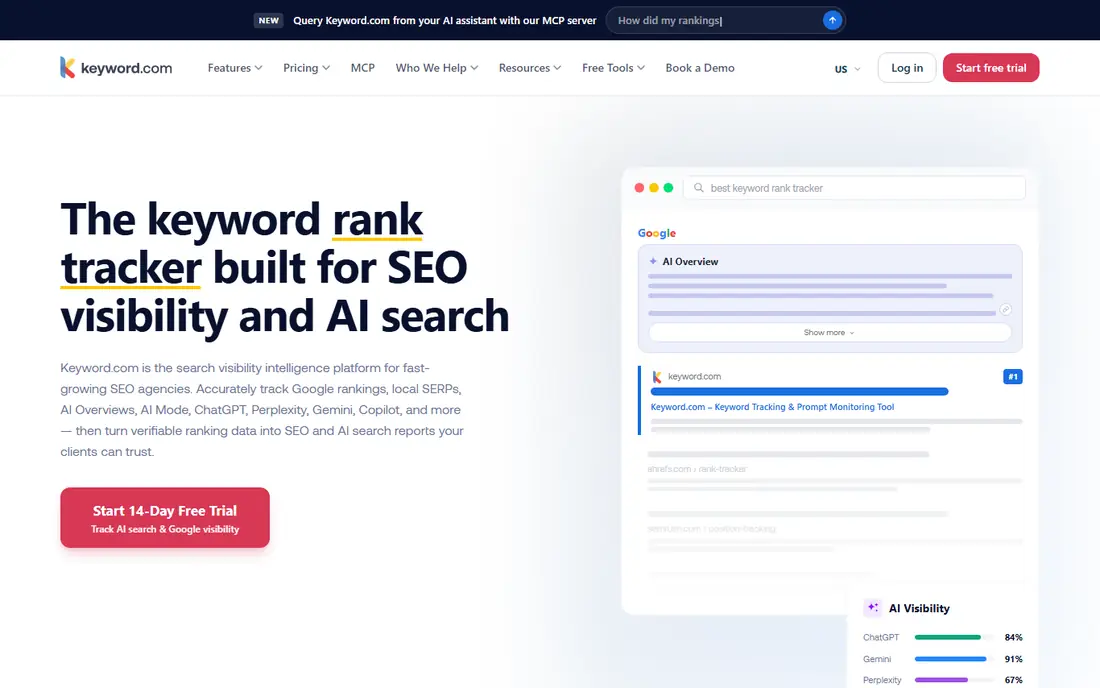
Keyword.com is a dedicated rank tracker that added AI visibility tracking, and that combination is its main advantage. You can track classic Google rankings and AI answer presence in one account, with AI Visibility starting at $9.80 per month for 20 credits in recent vendor guides, and a 14-day free trial. SERP screenshots help agencies prove a classic rank to a client, while AI reports show brand mentions, citations, and presence across ChatGPT, Perplexity, Gemini, and Google AI features.
The credit model is the limit to watch. AI checks consume credits, and a broad prompt set checked daily can use them faster than a small set checked weekly. Keyword.com also offers a 360 degree plan that bundles classic and AI tracking, which may be simpler for agencies than buying AI credits separately. For agencies that already report ranks, Keyword.com adds AI ranks with the least workflow change.
- AI visibility tracking alongside classic rank tracking
- SERP screenshots for verification
- Unlimited users and projects on many plans
- AI tracking uses credits, so costs rise with volume
- AI Visibility entry price differs from classic rank price
- Credit math needs monitoring
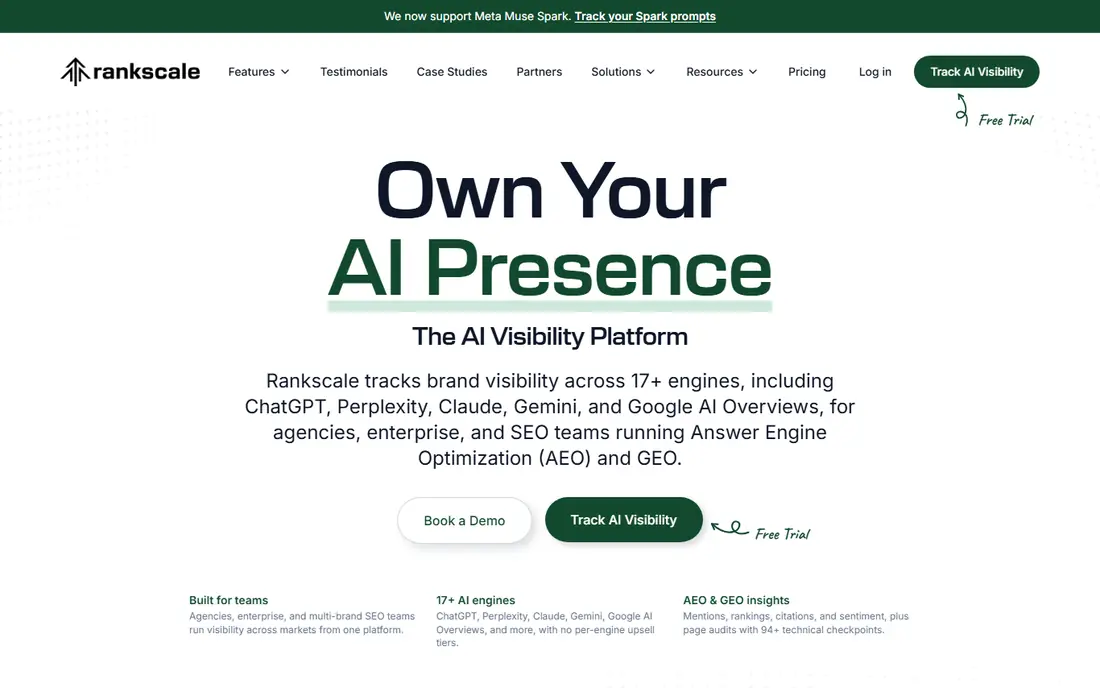
Rankscale, built in Vienna, tracks how a brand appears across more than ten AI engines, including ChatGPT, Perplexity, Claude, Gemini, Google AI Overviews, Google AI Mode, DeepSeek, Grok, and Copilot, with model variants counted separately in some listings. Essentials, listed at $20 per month in recent guides, uses a credit top-up model, while Pro and higher tiers add more credits and unlimited seats. That breadth at a low entry price makes Rankscale the best budget AI rank tracker in this list.
Rankscale is measurement and diagnostics only. It tells you where you lack AI visibility and which pages to fix, but it does not write or publish content for you. Teams that want a pure tracker, and that already have a content workflow, will value that focus. Teams that want content help should pair Rankscale with a writing tool or choose a bundled platform such as Writesonic GEO.
- Low entry price
- Coverage across many AI engines
- AI rank, competitor, sentiment, and citation analysis
- Measurement only, no content generation
- Interface is more technical than some rivals
- Credit top-ups add cost at scale
Otterly.AI tracks AI ranks daily for a small prompt set, which is the right cadence for a core category. Lite, at $29 per month, covers ChatGPT, Google AI Overviews, Perplexity, and Copilot, and reports mentions, citations, and share of voice against competitors. A built-in GEO audit checks whether tracked pages are ready to be cited, which helps small teams turn a rank drop into a specific page fix.
The constraint is prompt count. Fifteen daily prompts cover a main product line, but not a full catalog, and adding engines costs more. Otterly is best when you track the prompts that drive revenue, fix the pages behind them, and recheck daily. For a free AI rank tracker alternative, Otterly trial plus a manual spreadsheet can work for a week, but daily paid tracking is far more reliable for trend data.
- Daily AI rank checks on core engines
- Share of voice reporting
- GEO audit for page readiness
- Low entry price
- Lite covers only 15 prompts
- Gemini, AI Mode, and Claude are add-ons
- No API on Lite
Rank Prompt tracks AI ranks across ChatGPT, Claude, Gemini, Grok, Perplexity, and Google AI Mode or AI Overviews, using a credit model. Starter, at $49 per month, includes a credit allowance that covers a focused prompt set, with higher tiers for agencies. The appeal is breadth: a team can see AI rank across many engines for the same prompt, rather than guessing from one engine alone.
Credit use needs planning, since a prompt checked across four to six engines can cost more than a single-engine check. Rank Prompt suits teams that track a defined set of buyer prompts across many engines and review credits weekly. For teams that need deep optimization recommendations, a platform such as Scrunch or Profound may add more, but for rank tracking alone, Rank Prompt is efficient.
- Multi-engine AI rank tracking
- Credit-based pricing
- Simple dashboards and free first report options
- Multi-engine prompts consume more credits
- Fewer advanced analytics than enterprise tools
- Agency reporting is thinner
Peec AI tracks AI ranks daily and puts competitor ranks beside your own for the same prompts, which is the context that makes a rank meaningful. Starter, at $95 per month in recent US guides, includes 50 prompts and three selected models, with unlimited users. Models include ChatGPT, Google AI Mode, AI Overviews, Gemini, and Copilot, with add-ons for Claude, Perplexity, and others.
Peec also separates citation rate from retrieval rate, so a rank change can be traced to whether the model retrieved your page at all, or mentioned you without citing it. That diagnostic helps teams decide whether to fix page structure, content coverage, or third-party citations. Peec is less prescriptive than optimization platforms, but for rank tracking with competitor context, it is one of the clearest tools available.
- Daily AI rank checks
- Competitor rank comparison
- Citation versus retrieval analysis
- Multi-country reporting
- Starter limits prompts to 50 and models to three
- Prices often shown in euros
- Optimization actions are analytical rather than prescriptive
Writesonic GEO, listed at $79 per month billed annually in recent pricing comparisons, adds AI rank tracking to the Writesonic content platform. It tracks brand presence across AI engines, including AI Overviews and, on Enterprise, AI Mode, plus ChatGPT, Gemini, Perplexity, Claude, Grok, and Copilot. Sentiment analysis and competitor benchmarking sit next to content creation tools, so a team can track a rank drop and draft a fix in the same account.
The trade-off is focus. Writesonic GEO is part of a broader content suite, so pure rank tracking teams may find extra features they do not need, and the annual billing basis means the monthly figure is not a month-to-month price. For content teams that already use Writesonic, GEO adds AI ranks without a separate vendor. For agencies that only need ranks, a dedicated tracker may be cheaper.
- AI rank tracking alongside writing and content tools
- Sentiment and competitor benchmarking
- Multi-engine coverage on higher tiers
- Annual billing affects the headline monthly price
- AI rank features are part of a larger content platform
- Accuracy depends on broad sampling
Nightwatch extends its traditional rank tracker with LLM tracking, covering ChatGPT and Claude alongside classic Google rankings. That hybrid approach suits agencies and SEO teams that already track classic ranks in Nightwatch and want a first AI rank view without migrating. Reports show AI presence next to classic positions, which helps explain why traffic and AI visibility can move in different directions.
AI coverage is narrower than dedicated platforms such as Rankscale or Profound, and pricing in recent guides varies by currency, with annual billing in euros on some plans, so we list See website. Nightwatch is best as a bridge: use it to add AI ranks to existing classic rank reports, and move to a dedicated AI tracker if AI rank becomes your main reporting job.
- Classic rank tracking extended with LLM tracking
- ChatGPT and Claude coverage
- Agency-friendly reporting
- AI coverage is narrower than dedicated AI trackers
- Pricing varies by currency and billing
- AI features are an extension, not the core product
Profound tracks AI ranks across up to nine answer engines on Enterprise, including ChatGPT, Perplexity, Gemini, Copilot, Claude, Google AI Overviews, Google AI Mode, and others, with daily tracking and prompt-level analytics. That breadth and depth make it the enterprise AI rank tracker in this list, especially for brands that need to report AI rank by market, product, and competitor set.
The cost and process reflect that scale. Beyond a trial, pricing is often custom, and small teams may find the platform heavy for a simple rank check. Profound also offers ChatGPT Shopping placement tracking on higher tiers, which matters for ecommerce brands. For large brands that treat AI rank as a board-level metric, Profound is the most complete tracker available.
- Broad engine coverage on Enterprise
- Deep prompt-level rank analytics
- Crawler insights
- Enterprise security and controls
- Sales-led pricing
- Trial limits custom prompts
- Dashboard complexity for small teams
How we picked these
We compared vendor pages and independent AI rank tracker comparisons for tools that track brand position inside AI answers over time in October 2026. We required repeatable rank data, not a one-time audit, plus mention, citation, or position reporting. We favored different budgets and models, from $20 per month entry plans to enterprise platforms, and we used See website where pricing was custom or varied by currency and billing.
How to read an AI rank correctly
An AI rank is less stable than a classic rank. The same prompt can produce a different answer on a second run, with different wording, order, and citations, even when nothing on your site changed. That is why good trackers check the same prompt set on a schedule and report trends, not single answers. Look for a tool that keeps answer history, shows citation position, and lets you compare your rank with competitors for the same prompt.
Set up a rank tracker that stays useful
Start with 20 to 50 prompts that cover your core category, including non-branded comparison and pricing questions. Add your brand prompts separately, so a branded rank gain does not hide a category rank loss. Log content changes with dates, and review rank trends weekly, not daily, unless a core prompt drops sharply. A free AI rank tracker trial can test setup, but paid daily tracking gives the trend data that makes rank changes trustworthy.
Frequently asked questions
What is the best AI rank tracker software?
Keyword.com is best for agencies that want AI ranks plus classic ranks in one account. Rankscale is best for budget multi-engine tracking, and Otterly.AI is best for small teams that need daily checks. Profound is best for enterprises that need wide coverage and deep analytics.
What is the best free AI rank tracker tool?
There is no full-featured free AI rank tracker that matches paid daily tracking, but AthenaHQ offers a free Essential tier with limited credits, and several tools in this list offer free trials. A free trial plus a manual check of core prompts can work for a short audit, but ongoing rank trends need a paid plan with scheduled checks.
How is AI rank tracking different from classic rank tracking?
Classic rank tracking records where a page appears in a list of search results. AI rank tracking records where a brand appears inside a generated answer, including mention order, citation presence, and answer wording. A page can rank first classically and still be missing from an AI answer, which is why teams now track both.
How often should AI ranks be checked?
Daily checks are best for core commercial prompts, because AI answers change frequently. Weekly checks can work for a broader, lower-priority prompt set. Choose a tracker whose credit or prompt allowance supports your check frequency, since daily checks across many engines consume credits faster than weekly checks.
Which engines should an AI rank tracker cover?
Cover the engines your buyers use, which usually means ChatGPT, Google AI Overviews, Google AI Mode, Perplexity, and Gemini, plus Copilot or Claude where relevant. Do not pay for every engine by default. Confirm engine coverage on the exact plan you will buy, since entry tiers often cover fewer engines than higher tiers.
Can AI rank trackers improve my AI rank?
A tracker alone does not improve rank. It shows where you stand, which prompts you lose, and which pages are cited, so your team can fix content, structure, and citations. Improvement comes from acting on that data over weeks, then rechecking the same prompt set to see if the rank moved.
Sources
See where you really rank - block by block
ProMapRanker scans Google Maps across a grid of your service area. Simple monthly plans from $19, white-label on every plan.
Start freeKeep reading
 zendesk alternatives
Best Zendesk Alternatives in 2026
Compare the best Zendesk alternatives in 2026, from budget help desks to AI-first support tools, with current pricing, free plans, and honest trade-offs.
Read → wordpress alternatives
Best WordPress Alternatives in 2026
Looking for the best WordPress alternatives? We compare 8 free and paid options for blogs, business sites, stores, and developer-led projects in 2026.
Read → which real estate company has the best training
Best Real Estate Company Training in 2026
Compare which real estate company has the best training, from Keller Williams and eXp to Compass and Coldwell Banker, by program, mentor, and fit in 2026.
Read →