 ProMapRanker
Best AI Pricing Solutions for D2C Companies in 2026

Key takeaways
- For Shopify-based D2C brands, Intelligems is the most direct fit, since it tests prices, discounts, shipping, and bundles inside the store.
- Prisync and Pricefy suit brands that need competitor price tracking first, with repricing as a later step, and both publish entry prices.
- Omnia Retail, Competera, Yieldigo, and Revionics suit larger catalogues and teams that need demand science, promotion planning, or enterprise controls.
- Every tool here needs margin guardrails, such as minimum prices and approval rules, since automated repricing without limits can erode profit quickly.
- We compared Shopify fit, competitor coverage, testing features, and published pricing, and we excluded rental-only pricing tools that do not fit D2C stores.
Quick comparison
| Pick | Great for | Pricing starts at | Free tier | |
|---|---|---|---|---|
 Intelligems | Shopify price testing | $69 per month | Free trial | Visit |
 Prisync | Competitor tracking and repricing | $99 per month | Free trial | Visit |
 Pricefy | Low-cost competitor monitoring | $49 per month | Yes | Visit |
 Omnia Retail | Conversational pricing analytics | See website | No | Visit |
 Competera | Enterprise price optimisation | See website | No | Visit |
 Yieldigo | Promotion and markdown planning | See website | No | Visit |
 Revionics | Large catalogue price optimisation | See website | No | Visit |
 BlackCurve | Fast e-commerce deployment | See website | No | Visit |
 Intelligence Node | Product matching and price intelligence | See website | No | Visit |
The best AI pricing solutions for D2C companies
We shortlisted tools that serve direct-to-consumer brands, meaning brands selling through their own storefront rather than only through marketplaces. The nine solutions below cover price testing, competitor tracking, dynamic repricing, and enterprise optimisation, with different levels of implementation effort.
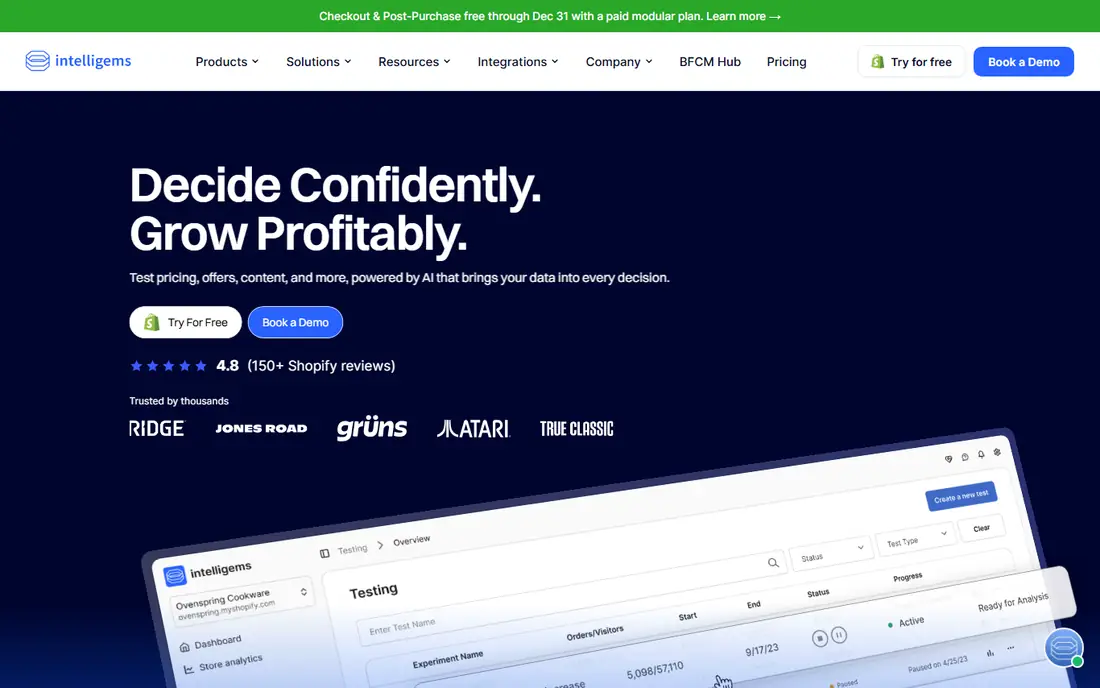
Intelligems is the clearest fit for a D2C brand on Shopify that wants evidence before changing prices. Its 2026 coverage describes testing for prices, discounts, shipping rates, and post-purchase offers, with results framed around conversion rate, average order value, revenue per visitor, and gross profit per visitor. That profit framing matters, since a price test that lifts revenue while cutting margin is a failure, not a win.
The limits are platform and plan. Intelligems is built for Shopify, so brands on other platforms need a different tool, and checkout testing requires Shopify Plus in coverage. Pricing is described as starting at $69 per month at the lowest order volume tier, with no per-visitor charges or overages. We would pick Intelligems first for Shopify D2C brands that want to test prices with control groups before automating them.
- Shopify-native price, discount, shipping, and bundle testing in coverage
- Profit reporting with cost assumptions
- Order-based pricing without per-visitor charges in coverage
- Shopify-only focus
- Checkout testing needs Shopify Plus in coverage
- Unlimited plan carries a three-month minimum in coverage
Prisync suits D2C brands that compete on price against identifiable rivals. Its 2026 coverage puts URL-based Professional pricing at $99 per month for up to 100 products, with Premium at $199 and Platinum at $399, and describes a dynamic pricing engine from the Premium tier. The platform tracks competitor prices, stock availability, and price position, and can adjust prices under rules the brand sets, such as staying near a market average while respecting minimum advertised price rules.
The entry tier is a monitoring tier first. Price updates three times a day in coverage, and the dynamic engine, marketplace tracking, and API access sit on higher tiers, so the $99 figure is not the full repricing cost. A Shopify app listing also shows a lower starting price, which reflects a different packaging, so confirm which plan matches your catalogue size. We would pick Prisync when competitor visibility is the main gap and repricing is the next step.
- URL-based plans from $99 per month in 2026 coverage
- Dynamic pricing engine from the Premium tier in coverage
- Shopify app with a lower app store starting price in coverage
- Entry tier updates only three times a day in coverage
- Full channel and hybrid plans cost more
- Matching quality varies by product type
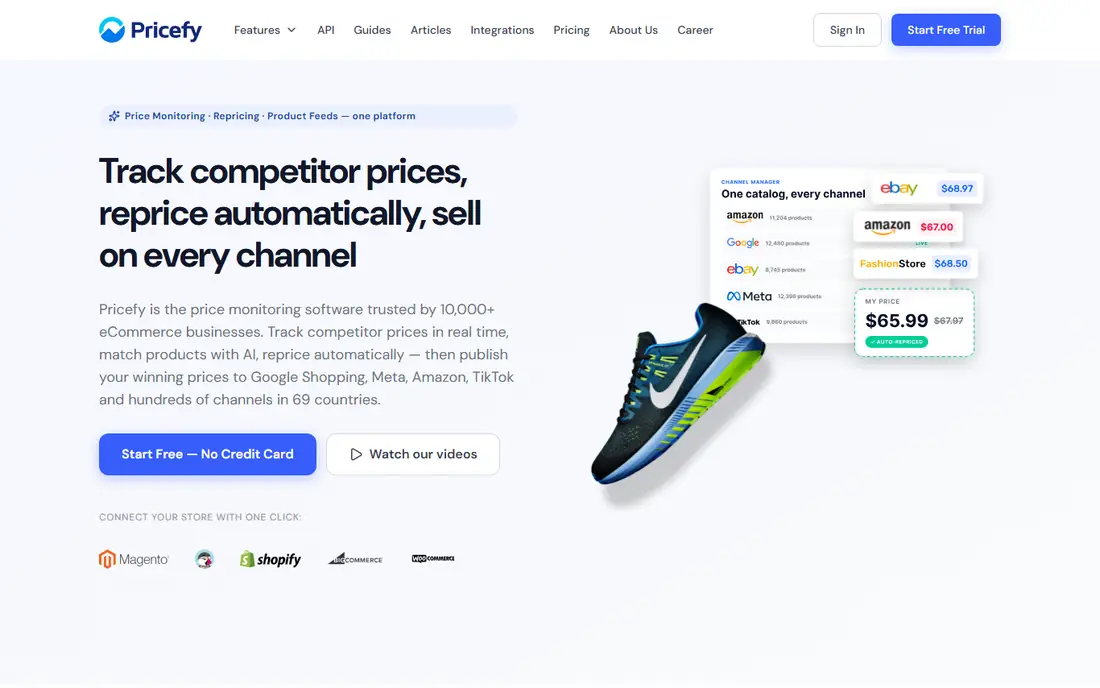
Pricefy is the low-cost entry point for a D2C brand that wants to try competitor monitoring before paying for automation. Its 2026 coverage describes a free tier covering 50 SKUs checked once a day, paid plans from $49 per month for 100 SKUs checked twice a day, repricing from the $99 Pro plan, and MAP monitoring from the $189 Business plan. That ladder lets a small brand start free, prove the value of tracking, and upgrade only when the catalogue or refresh needs grow.
Daily checks on the free tier will miss intraday price moves, and the most useful enforcement features sit higher up the ladder. Pricefy is also a smaller vendor, so integration depth and support should be tested during a trial. We would pick Pricefy when budget is tight, the catalogue is modest, and a free start with a clear upgrade path matters more than enterprise depth.
- Free tier with 50 SKUs checked once a day in 2026 coverage
- Paid plans from $49 per month in coverage
- Repricing from the $99 Pro plan in coverage
- Free tier refresh is daily only
- MAP monitoring sits on a higher tier in coverage
- Smaller vendor footprint than Prisync or Omnia
Omnia Retail stands out for teams that want pricing answers without a data science team. Its vendor coverage describes real-time competitor monitoring, a rule engine that non-technical staff can edit, and a conversational AI assistant that builds reports and dashboards from a chat prompt. For a D2C brand with a pricing manager rather than an analytics department, asking for a margin, competitor, or assortment view in plain language can shorten the path from question to decision.
The assistant is only as good as the data behind it. Product matching, cost data, and competitor coverage must be clean, or the answers will look confident while resting on weak inputs. Pricing is quoted, and implementation is described in weeks, so this is a considered purchase, not a quick app install. We would pick Omnia when a mid-size D2C brand wants pricing analytics and automation without hiring data specialists.
- Real-time competitor monitoring in vendor coverage
- Conversational AI assistant for reports in coverage
- Rule engine editable by non-technical staff in coverage
- Pricing is quoted on scope
- Conversational features need clean product data
- Enterprise implementation takes weeks in coverage
Competera fits D2C brands that have grown past simple competitor matching into true price optimisation. Its 2026 coverage places it among dynamic pricing tools that analyse demand, competitor positioning, and market trends to recommend optimal price points, with elasticity analysis as a core method. For a brand with thousands of SKUs, seasonal demand shifts, and margin targets by category, that demand science can find prices that a rule such as always match the cheapest rival would miss.
The cost is effort and data. Competera needs clean historical sales, cost, and competitor data, and implementation is an enterprise project rather than a plugin install. Smaller brands may find the same budget better spent on testing with Intelligems and monitoring with Prisync. We would pick Competera when catalogue size, demand variation, and margin complexity justify a demand-based optimisation platform.
- Demand and elasticity analysis in 2026 coverage
- Competitor and market data integration
- Suits large catalogues and multi-market brands
- Pricing is quoted on scope
- Implementation effort is higher than a Shopify app
- Needs substantial historical data to perform well
Yieldigo is the promotion specialist in this list. Its coverage describes AI-driven dynamic pricing for retailers and consumer goods companies, with scenario simulation that lets teams model price and promotion changes before publishing them, and automated multibuy rules such as buy-two-get-one-free offers managed across large assortments. For a D2C brand whose pricing problem is really a promotion problem, with frequent discounts, bundles, and markdowns, that planning layer matters more than raw repricing speed.
Simulation only helps if margin and cost data are accurate, and Yieldigo's retail focus means a small D2C startup may find the platform heavier than needed. Pricing is quoted, so budget discussions require a demo and a scope conversation. We would pick Yieldigo when promotions, markdowns, and multibuy offers drive a large share of D2C revenue and need coordinated planning.
- AI-driven price optimisation for retailers and consumer goods in coverage
- Scenario simulation before deployment
- Automated multibuy pricing rules in coverage
- Pricing is quoted on scope
- Retail and consumer goods focus may suit brands more than pure D2C startups
- Promotion depth needs clean margin data
Revionics is the enterprise end of this list, built for large retailers and consumer brands with complex assortments. Its vendor coverage describes demand-based science and predictive analytics across full assortments, coordinating base prices, promotions, markdowns, and inventory considerations. For a D2C brand that has scaled into a large catalogue with many price zones, channels, and margin structures, that coordination prevents the common failure where a promotion, a markdown, and a base price change work against each other.
The implementation burden is the honest catch. Coverage describes implementations taking several months, with deep integration into pricing, inventory, and sales data, and the platform needs substantial historical data to perform. That rules out most early-stage D2C brands. We would pick Revionics when scale, assortment complexity, and a dedicated pricing team justify an enterprise optimisation platform.
- Demand-based science across full assortments in vendor coverage
- Coordinated promotion, markdown, and inventory decisions
- Enterprise-grade controls
- Pricing is quoted on scope
- Implementation takes months in coverage
- Needs substantial transaction and inventory data
BlackCurve suits mid-market e-commerce brands that want pricing automation quickly, without a long enterprise project. Its vendor coverage describes pre-built e-commerce integrations, built-in competitor and market data feeds, and deployment in days to a few weeks. For a D2C brand that needs competitor-aware pricing live before a seasonal peak, that speed is a practical advantage over a months-long implementation.
The trade-off is depth. BlackCurve is described as rule-based automation with data feeds, rather than a full demand-science engine, so brands that need elasticity modelling should look at Competera or Revionics instead. Pricing is quoted and varies with catalogue and market scope. We would pick BlackCurve when fast deployment and competitor-aware automation matter more than deep demand science.
- Pre-built e-commerce integrations in vendor coverage
- Deployment in days to weeks in coverage
- Competitor and market data feeds built in
- Pricing is quoted on scope
- Rule-based automation is less demand-scientific than Competera or Revionics
- Catalogue and market scope affect cost
Intelligence Node earns its place through matching quality. Its 2026 coverage describes AI that identifies the same product across competitor websites even when titles, images, or descriptions differ, which is essential when comparing like with like. Without accurate matching, competitor pricing data is noise, and repricing rules built on it will misfire. The platform also offers pricing optimisation based on elasticity, competitor positioning, and demand forecasting.
As an enterprise-level solution, Intelligence Node quotes on catalogue size and scope, which puts it out of reach for many small D2C brands. Matching should also be validated on your own products during a trial, since accuracy varies by category and listing quality. We would pick Intelligence Node when catalogue matching accuracy and enterprise price intelligence are the main gaps, and the budget fits an enterprise platform.
- AI product matching across competitor listings in 2026 coverage
- Pricing optimisation with elasticity and demand analysis in coverage
- Enterprise-scale intelligence
- Pricing is quoted on scope
- Enterprise positioning may price out small D2C brands
- Matching quality needs validation on your own catalogue
How we picked these
We compared vendor pages, Shopify app listings, and 2026 pricing coverage, and we kept only tools that serve D2C or e-commerce brands with live pricing, testing, or competitor intelligence features. We favoured tools with published pricing where available, a clear Shopify or e-commerce integration path, and a distinct role, whether testing, tracking, repricing, or optimisation. We excluded rental-only pricing tools, marketplace-only repricers, and tools whose pricing features are a minor add-on to a wider platform. Where sources disagreed on a price, we used the vendor or app store figure reported in the most recent 2026 coverage and marked it as such.
How to run pricing automation without hurting margins
Start with guardrails, not automation. Set a minimum price per product based on true cost, including shipping, payment fees, returns, and discounts, and set a maximum price that protects brand positioning. Require approval for any price change beyond a set band, and log every automated change with its reason, so a bad week can be traced to a rule rather than a mystery. A tool that cannot enforce minimums and approvals is not ready for live repricing.
Next, test before you automate. Run price tests with control groups on a small set of products, measure profit per visitor rather than revenue alone, and keep tests running long enough to cover weekday and weekend traffic. Only automate the rules that won in testing, and review them monthly as costs, competitors, and demand change. Finally, watch for price wars: matching the cheapest rival on every product trains customers to wait for discounts and erodes the margin that funds service, content, and product development.
Frequently asked questions
What is an AI pricing solution for a D2C brand?
It is software that uses sales, competitor, inventory, and demand data to recommend or apply prices for products sold through a brand's own store. Some tools focus on testing prices, others on tracking competitors, and others on automating price changes under rules and guardrails. The right type depends on whether your main problem is evidence, visibility, or automation.
Should a small D2C brand automate prices?
Not immediately. Start with competitor tracking and price testing, so you learn what customers will pay and where your margins actually sit. Automate only after you have guardrails, clean cost data, and test results that show which rules protect profit. Automating from day one risks a price war or a margin leak that is hard to spot until the month ends.
How does Intelligems differ from Prisync?
Intelligems tests prices inside a Shopify store with control groups and profit reporting, so it answers what price works best for your own customers. Prisync tracks competitor prices and can reprice under rules, so it answers how your prices compare with the market. Many growing brands use both: testing to find the right price, and tracking to stay competitive.
Do AI pricing tools work for brands that rarely discount?
Yes, but the value shifts from repricing speed to price architecture. A brand that rarely discounts still needs to know competitor prices, test bundle and shipping thresholds, and set prices for new products with evidence. Testing and intelligence tools suit that model better than aggressive dynamic repricing.
What data does a pricing tool need from my store?
At minimum, it needs product prices, costs, sales history, and inventory levels, plus competitor URLs or product identifiers for tracking. Demand-based tools also need longer sales history and, ideally, promotion and traffic data. Clean cost data matters most, since a pricing recommendation built on incomplete costs can look profitable while losing money.
Can AI pricing break minimum advertised price rules?
Yes, if guardrails are missing. A repricing rule that always undercuts the cheapest rival can breach a manufacturer's minimum advertised price policy and damage supplier relationships. Set MAP floors per product, test them, and confirm how the tool enforces them before turning automation on.
Sources
- https://ecommerceparadise.com/best-ai-pricing-tools-ecommerce-2026/
- https://www.yieldigo.com/blog/best-dynamic-pricing-software/
- https://www.omniaretail.com/blog/best-ai-pricing-analytics-software-top-solutions-compared
- https://gitnux.org/best/dynamic-pricing-software/
- https://pricesense.ai/blog/competitor-price-monitoring-tools
- https://www.itechguides.com/10-best-competitor-price-monitoring-tools-for-businesses-2026-guide/
- https://commercegeek.com/articles/a-b-testing-tools-for-shopify-compared-2026-10
See where you really rank - block by block
ProMapRanker scans Google Maps across a grid of your service area. Simple monthly plans from $19, white-label on every plan.
Start freeKeep reading
 worlds best local seo company
8 Worlds Best Local SEO Companies for Map Pack Growth in 2026
Compare the worlds best local seo company options for Google Business Profile work, citations, reviews, and multi-location rankings and reporting in 2026.
Read → world's best web hosting company
World's Best Web Hosting Company in 2026
Searching for the world's best web hosting company? We compared 10 hosts on price, renewal rates, speed, and support to help you choose well today in 2026.
Read → who's got the best nanny tax services
Who's Got the Best Nanny Tax Services in 2026
We answer who's got the best nanny tax services, comparing full filing, back taxes, software, and pricing so families can handle nanny taxes correctly.
Read →