 ProMapRanker
Best AI-Powered CRM Platforms in 2026


Enterprise AI CRM · Pricing starts at: $25 per user per month
Key takeaways
- AI in a CRM is most useful when it scores leads, drafts messages, summarizes calls, and suggests next steps from clean data.
- Salesforce and HubSpot offer the deepest AI toolsets, but their full AI tiers are priced for larger teams.
- Zoho CRM and Pipedrive give smaller teams usable AI at a lower entry price, though the best AI features sit on higher tiers.
- Freshsales and Close are strong for teams that live on calls and email, while Dynamics 365 suits Microsoft-centered organizations.
- Test AI on your own pipeline data during a trial, and check whether AI features are included or sold as an add-on.
Quick comparison
| Pick | Great for | Pricing starts at | Free tier | |
|---|---|---|---|---|
| Salesforce Sales Cloud | Enterprise AI CRM | $25 per user per month | No | Visit |
 HubSpot | All-in-one AI CRM | Free | Yes | Visit |
 Zoho CRM | Value AI CRM | $14 per user per month | Yes | Visit |
 Pipedrive | Pipeline-focused AI | $14 per user per month | No | Visit |
 Freshsales | Budget AI CRM | $9 per user per month | Yes | Visit |
 Microsoft Dynamics 365 Sales | Microsoft shops | See website | No | Visit |
 monday CRM | Work-first AI CRM | $12 per seat per month | Yes | Visit |
 Close | Inside sales AI | See website | No | Visit |
 Folk | Relationship AI CRM | $20 per user per month | No | Visit |
The best AI-powered CRM platforms
An AI-powered CRM should do more than store contacts. The useful AI features are lead scoring, deal forecasting, email and call summaries, next-step suggestions, and data enrichment, all tied to a pipeline your team actually uses. We compared official pricing pages, AI feature tiers, and add-on rules, and we favored platforms where AI is built into daily sales work rather than sold only as a separate product. Prices below are entry prices; AI features often require a higher tier, and we note that where it matters.
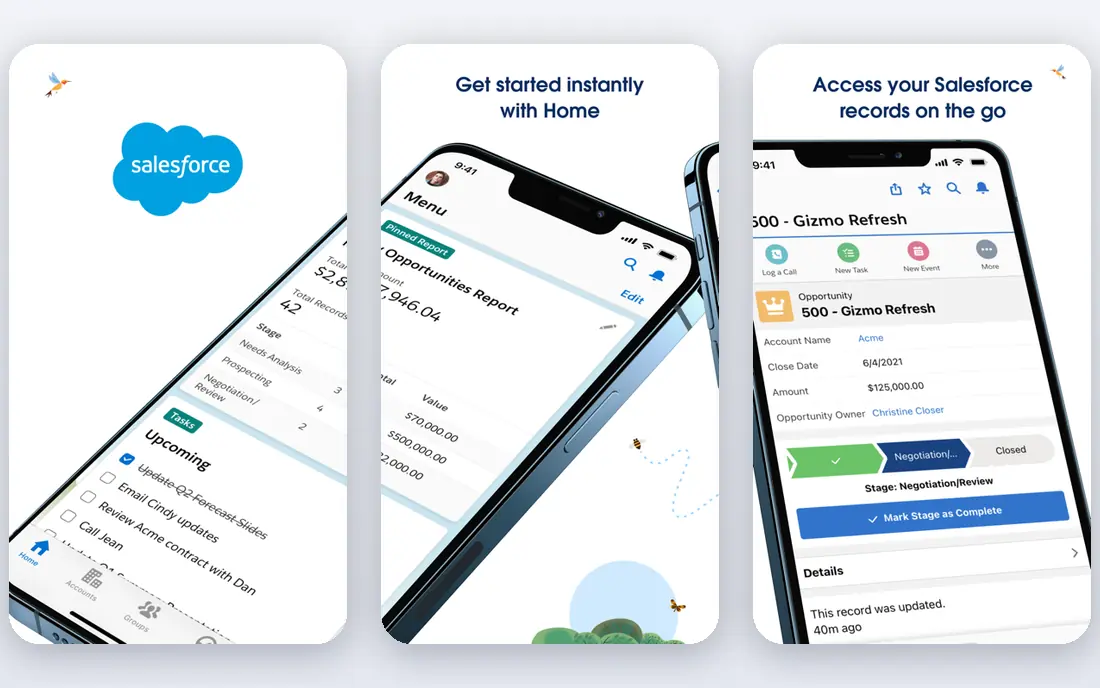
Salesforce Sales Cloud with Einstein is the most capable AI CRM on this list, and the most expensive to use well. Einstein can score leads, predict deal outcomes, summarize calls and emails, and suggest next steps, while Agentforce agents can handle routine tasks such as qualifying leads or answering common questions. Entry pricing starts at 25 dollars per user per month, but advanced AI features sit on Enterprise at 150 dollars or higher, with some AI packages sold as add-ons, so the real AI price is far above the entry tier.
The ecosystem is a second strength. The trade is complexity: Salesforce rewards teams with an admin or a partner, and small teams without that support often use only a fraction of what they pay for. Salesforce suits mid-size and large teams that need deep AI, custom workflows, and scale, and that can fund implementation properly.
- Deepest AI and automation toolset
- Einstein scoring, forecasting, and summaries
- Huge app ecosystem
- Full AI requires higher editions or add-ons
- Implementation can be complex
- Total cost rises fast

HubSpot pairs a free CRM with Breeze AI, which drafts emails, summarizes calls, enriches contacts, scores leads, and builds reports across marketing, sales, and service hubs. The free tier covers contact and deal management, while paid Starter seats list at 20 dollars per seat per month, with Professional seats at 90 to 100 dollars per seat per month depending on billing.
The catch is tiering. The most useful AI agents, predictive tools, and advanced automation appear on Professional and Enterprise, and Professional also carries onboarding fees. HubSpot suits teams that want CRM, marketing, and service AI in one system and are willing to pay for the higher tiers as they grow.
- Free CRM tier
- Breeze AI across marketing, sales, and service
- Strong automation and reporting
- Full AI and automation sit on Professional and Enterprise
- Price jumps sharply
- Onboarding fees on higher tiers
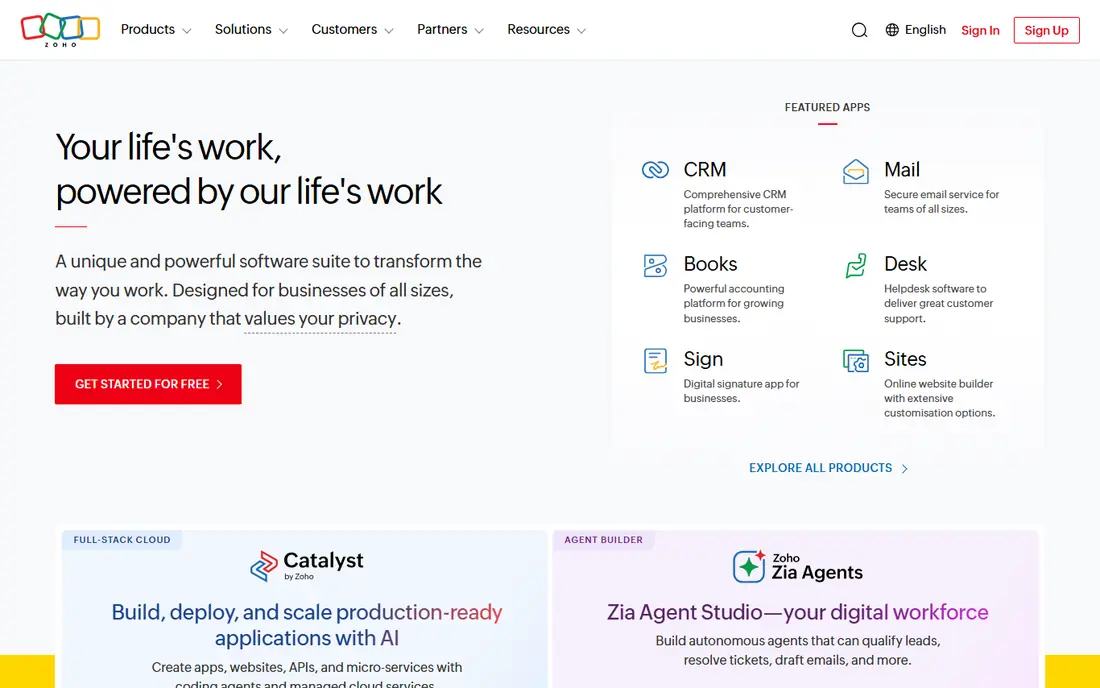
Zoho CRM offers one of the best value paths into AI, through Zia, its AI assistant. Zia can predict deal outcomes, flag anomalies, suggest best times to contact, and surface insights from sales data, and Zoho also offers workflow automation and a large app ecosystem at a lower price than Salesforce or HubSpot. Standard pricing starts at 14 dollars per user per month, with a free tier for up to three users, which makes it easy for a small team to start.
The honest limit is tiering. Zia's fuller predictive features appear on Enterprise at 40 dollars per user per month, so a team on Standard will see a lighter version of the AI story. Zoho suits budget-conscious teams that want customization and usable AI without enterprise pricing, and that can accept a less polished interface.
- Zia AI for predictions and anomaly detection
- Low entry price
- Wide customization and app ecosystem
- Full Zia features require Enterprise at 40 dollars per user per month
- Interface feels dated
- Support varies by tier
Pipedrive is built around a visual pipeline that sales reps actually update, and its AI sales assistant builds on that simplicity. The assistant can summarize emails, draft follow-ups, suggest next actions, and surface deal insights, while automation handles routine moves such as assigning deals and sending reminders. Paid plans start at 14 dollars per user per month, with a trial rather than a permanent free tier, and Professional at around 59 dollars per user per month adds fuller AI and reporting.
Pipedrive will not match Salesforce for forecasting depth or HubSpot for marketing automation, and teams that need deep marketing tools will need a separate platform. Its strength is adoption: reps open it, update deals, and act on AI suggestions because the interface stays simple. Pipedrive suits small and mid-size sales teams that want a pipeline-first CRM with practical AI, rather than an enterprise platform they must be trained to use.
- Clear visual pipeline
- AI sales assistant on paid plans
- Easy adoption for sales reps
- No permanent free plan
- AI depth is lighter than Salesforce or HubSpot
- Marketing tools are limited
Freshsales, from Freshworks, is a budget-friendly AI CRM with Freddy AI handling lead scoring, deal insights, forecasting, and conversation summaries. The free tier covers basic contact and deal management, and paid plans start at 9 dollars per user per month, with Pro around 39 dollars per user per month adding fuller AI features. Built-in phone, email, and chat keep outreach inside the CRM, which suits small teams that do not want a separate dialer.
The trade is depth. Freshsales is easier to set up than Salesforce or Zoho, but it offers less customization and less advanced reporting, and some AI features are gated by tier. Teams with complex approval workflows or multi-product pipelines may outgrow it. Freshsales suits startups and small sales teams that want a low-cost CRM with usable AI, phone, and email in one place, without a long implementation.
- Freddy AI for insights and forecasting
- Free tier
- Built-in phone and email
- AI depth grows with tier
- Customization is lighter than Zoho or Salesforce
- Advanced reporting needs higher plans
Dynamics 365 Sales brings Microsoft Copilot into the CRM, with AI summaries of leads and opportunities, email drafting, meeting preparation, and next-step suggestions drawn from Outlook, Teams, and sales data. Enterprise controls, security, and reporting also suit larger organizations.
The drawbacks are price transparency and setup effort. Many Dynamics deals are quoted rather than bought from a simple price list, and implementation benefits from Microsoft expertise, which adds cost for smaller teams. Outside a Microsoft-centered stack, the integration advantage fades, and a simpler CRM may serve better. Dynamics 365 Sales suits mid-size and large organizations already committed to Microsoft 365 that want AI inside that ecosystem.
- Copilot AI for summaries and email drafting
- Deep Microsoft 365 and Teams integration
- Strong enterprise controls
- Pricing is quote-driven for many deals
- Setup needs Microsoft expertise
- Lighter appeal outside Microsoft shops
monday CRM turns sales work into visual boards, where deals, tasks, and timelines sit in one view that non-sales teams can also use. Its AI features include AI columns that summarize, categorize, or extract information, plus automations that move deals, send reminders, and update statuses. Pricing starts at 12 dollars per seat per month for Basic, with Pro around 28 dollars per seat adding fuller AI and automation, and a free tier for small use.
The AI here is practical rather than deep. You get helpful summaries and automations, but not the predictive forecasting depth of Salesforce or Zoho Enterprise. Per-seat pricing also adds up as the team grows, and advanced reporting sits on higher tiers. monday CRM suits teams that want CRM and project work in one visual system, with AI that speeds up routine tasks, rather than teams that need advanced sales forecasting as the core job.
- Visual boards that teams adopt fast
- AI columns and automations
- Strong project and CRM blend
- AI features are lighter than dedicated AI CRMs
- Per-seat costs grow with team size
- Advanced CRM reporting needs higher tiers
Close is built for inside sales teams that live on the phone and in email. It combines calling, SMS, and email in one CRM, with AI call summaries, transcription, and email assistance that cut the time reps spend on notes after each conversation. That focus makes Close fast for high-volume outreach, follow-up sequences, and small teams that measure success in calls and replies rather than in complex reports.
The trade is scope. Close is not a full marketing automation platform, and its pricing sits above budget CRMs, with Growth around 99 dollars per user per month in published comparisons. Teams that need deep marketing journeys or enterprise approval workflows will need other tools alongside it. Close suits inside sales and outreach teams that want AI to handle call notes and follow-ups, and that value speed over breadth.
- Built-in calling, SMS, and email
- AI call summaries and email assistance
- Fast for high-volume outreach
- Pricing is higher than budget CRMs
- Marketing automation is limited
- Less suited to complex enterprise workflows
Folk takes a relationship-first approach to CRM, focusing on people and companies rather than only on deals. Its AI features include contact enrichment, Magic Fields that fill in data from prompts, and AI-drafted icebreakers and follow-ups for outreach. Pricing starts at 20 dollars per user per month for Standard, with Premium at 40 dollars adding deals, dashboards, and sequences. That design suits founders, partnerships teams, and agencies that manage many relationships.
The limit is pipeline depth. Folk is lighter on complex deal management, forecasting, and enterprise workflow than Salesforce, HubSpot, or Pipedrive, so a large sales organization may outgrow it. Folk suits small teams that need a smart contact system with AI enrichment and outreach help, and that value a clean, people-centered view over a heavy enterprise CRM.
- AI enrichment and Magic Fields
- Relationship-focused design
- Good for outreach and partnerships
- Less suited to complex enterprise pipelines
- Deal management is lighter than Pipedrive or Salesforce
- Pricing rises on higher tiers
How we picked these
We compared official pricing pages, AI feature tiers, and add-on rules, and we favored platforms where AI appears in daily sales work, such as scoring, summaries, drafting, and forecasting, rather than only in marketing copy. We included enterprise, mid-market, and budget options, and we noted where AI requires a higher tier or a paid add-on, since that changes the real price. We excluded CRMs with no clear AI features and tools that are only AI add-ons for another CRM.
How to choose an AI CRM
Check what AI is included, not just advertised
Open the pricing page and confirm whether scoring, summaries, and forecasting are included in the tier you can afford, or sold as an add-on. A CRM that advertises AI on its homepage but gates it behind an enterprise tier can cost three times the entry price once AI is added.
Test AI on your own data
Use a trial with real deals, emails, and call notes, not demo data. Check whether summaries are accurate, whether scores match your judgment of good leads, and whether drafted emails sound like your team. AI that looks impressive on clean demo data can disappoint on messy, real pipeline data.
Fix data quality first
AI predictions are only as good as the contacts, activities, and deal stages you feed them. Before you buy, agree on stage definitions, required fields, and who updates deals. A simple CRM with clean data will outperform an advanced AI CRM with stale, incomplete records.
Count seats and add-ons for a year
Model the full bill: seats, AI add-ons, onboarding fees, and any required higher tier. A 14 dollar entry plan that needs a 59 dollar tier for AI is not a 14 dollar AI CRM. Compare the AI tier price across vendors, not the entry price, when AI is the reason you are buying.
Frequently asked questions
What is the best AI-powered CRM software?
Salesforce Sales Cloud offers the deepest AI toolset, while HubSpot offers the broadest AI across marketing, sales, and service. For smaller teams, Zoho CRM and Pipedrive offer usable AI at a lower price, and Freshsales is a strong budget option. The best choice depends on team size, budget, and whether you need deep forecasting or practical daily AI help.
What are the top AI-powered CRM tools?
The top tools include Salesforce, HubSpot, Zoho CRM, Pipedrive, Freshsales, Microsoft Dynamics 365 Sales, monday CRM, Close, and Folk. Salesforce and HubSpot lead on depth, Zoho and Pipedrive lead on value, and Close and Folk lead for specific jobs such as inside sales and relationship outreach. Compare AI tier pricing, not just entry pricing, before you choose.
Is AI included in the entry price of these CRMs?
Not always. Many CRMs advertise AI but place scoring, forecasting, and advanced summaries on higher tiers or paid add-ons. Zoho places fuller Zia features on Enterprise, Salesforce places advanced Einstein features on Enterprise and above, and HubSpot places fuller Breeze agents on Professional and Enterprise. Always check the pricing page for the tier you plan to buy.
Which AI CRM is best for small businesses?
Zoho CRM, Pipedrive, and Freshsales are the strongest small-business picks. Zoho offers the most customization for the price, Pipedrive offers the simplest pipeline with practical AI, and Freshsales offers the lowest entry price with phone and email built in. Start with a trial, test AI on your own deals, and choose the interface your reps will actually update.
Can an AI CRM replace sales reps?
No. AI can score leads, draft messages, summarize calls, and suggest next steps, but it does not replace judgment, relationships, or closing conversations. The best use of AI in a CRM is to cut admin work and surface the right next action, so reps spend more time talking to customers and less time updating records.
How do I keep AI suggestions trustworthy?
Feed the CRM clean, complete data, review AI summaries before sending them to customers, and track whether scored leads actually convert. Set clear rules for when a rep should override a score or a suggested next step, and review AI output monthly. Trust grows when AI suggestions are checked against real outcomes, not accepted blindly.
Sources
See where you really rank - block by block
ProMapRanker scans Google Maps across a grid of your service area. Simple monthly plans from $19, white-label on every plan.
Start freeKeep reading
 zscaler alternatives
Best Zscaler Alternatives in 2026
Looking for zscaler alternatives? We compare 9 SASE and zero trust platforms on architecture, data protection, pricing, and fit for your network and team.
Read → zapier alternatives free
Best Zapier Alternatives Free in 2026
Nine automation tools for zapier alternatives free in 2026, all with genuinely free tiers, plus free plan limits, starting prices and upgrade paths explained.
Read → which platform is best for online reputation
Which Platform Is Best for Online Reputation in 2026
Wondering which platform is best for online reputation? We compare 8 review, listing, and response tools for small and multi-location businesses and agencies.
Read →