 ProMapRanker
Best AI Platforms for Industrial Engineering in 2026


Siemens-heavy plants and digital twins · Pricing starts at: See website
Key takeaways
- Siemens Insights Hub suits plants already running Siemens automation, where native integration shortens the path to value.
- Cognite Data Fusion suits asset-heavy operations where engineering documents, 3D models, and sensor data must be linked before AI can help.
- Litmus Edge suits teams whose first problem is connecting old machines and standardising data across sites.
- Almost every industrial AI platform is priced by quote, so a pilot with a clear success measure matters more than a feature list.
Quick comparison
| Pick | Great for | Pricing starts at | Free tier | |
|---|---|---|---|---|
| Siemens Insights Hub | Siemens-heavy plants and digital twins | See website | No | Visit |
 Cognite Data Fusion | Asset-heavy operations and knowledge graphs | See website | No | Visit |
 PTC ThingWorx | Custom industrial apps and AR | See website | No | Visit |
 AVEVA PI System | Process historian and time-series data | See website | No | Visit |
 Litmus Edge | Legacy connectivity and data standardisation | Free | Yes | Visit |
 Rockwell FactoryTalk | Allen-Bradley plants and MES | See website | No | Visit |
 AspenTech | Process optimisation and asset performance | See website | No | Visit |
 Braincube | AI apps for quality and operations | See website | No | Visit |
 Tulip | No-code frontline operations apps | See website | Free trial | Visit |
The best ai platforms for industrial engineering
We compared these platforms on data foundations, edge support, application depth, and how they fit existing automation estates. Industrial AI is not one product: some platforms govern operational data, some build applications on top of it, and some extend control systems upward. The right pick depends on which of those jobs your plant needs first, and on the equipment already on the floor.
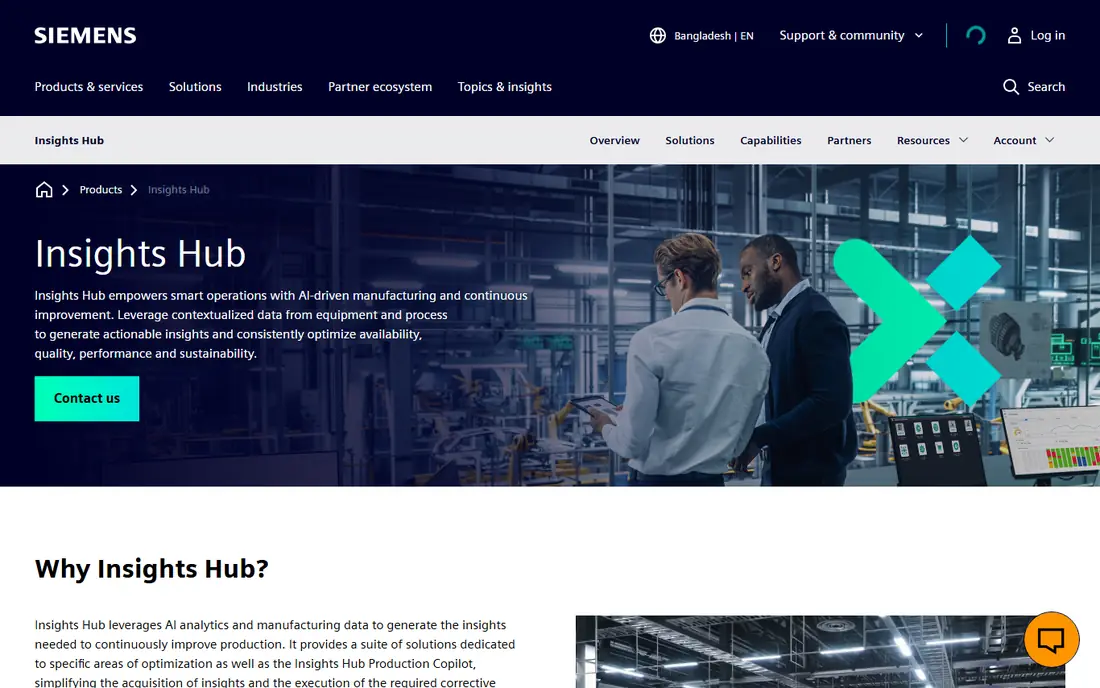
Siemens Insights Hub, the evolution of MindSphere, is the industrial IoT and AI platform at the centre of Siemens Xcelerator. It connects machines, assets, and sensors, feeds analytics and digital twin models, and supports edge computing for work that must run inside the plant. Siemens Industrial Copilot tools, built with Microsoft, add generative AI help for engineering and shop-floor troubleshooting on top of that data.
The strength is vertical integration. A plant already running Siemens PLCs, Teamcenter, and Opcenter gets native connections and a shared data model that a generic platform would need custom work to match. The weakness is the mirror image: plants with mixed vendors face more integration work, and pricing is quote-only through Siemens and its partners. For a Siemens-heavy operation planning a digital twin programme, Insights Hub is the natural starting point.
- Deep integration with Siemens PLCs and software
- Digital twin and edge options
- Large device ecosystem
- Quote-only pricing
- Steep learning curve outside Siemens estates
- Implementation can be long
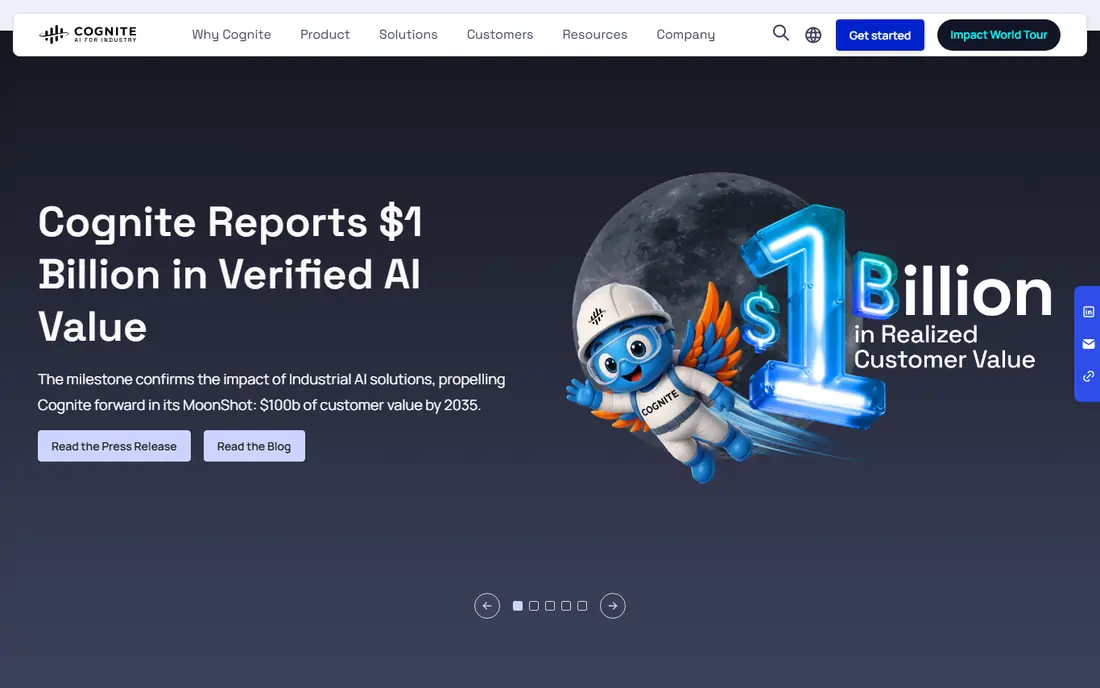
Cognite Data Fusion structures operational, engineering, and IT data around an industrial knowledge graph, linking time-series readings, events, documents, and 3D models to the same assets. Cognite Atlas AI then gives teams a low-code workbench for building AI agents on that governed data, for jobs such as root cause analysis and equipment troubleshooting. That data-first approach suits refineries, mines, and utilities where the hardest problem is finding trustworthy context for a sensor reading.
The cost is governance work. A knowledge graph only helps if asset models, documents, and data sources are cleaned and linked, and that effort should be budgeted alongside licences. Pricing is quote-only, and Schneider Electric agreed in June 2026 to acquire Cognite, so buyers should ask about the AVEVA integration roadmap. For asset-intensive operations, though, Cognite remains one of the strongest data foundations for industrial AI.
- Industrial knowledge graph linking documents, 3D, and time-series
- Atlas AI agent workbench
- Strong in energy and heavy industry
- Quote-only pricing
- Needs data governance effort
- Schneider Electric acquisition may change roadmap
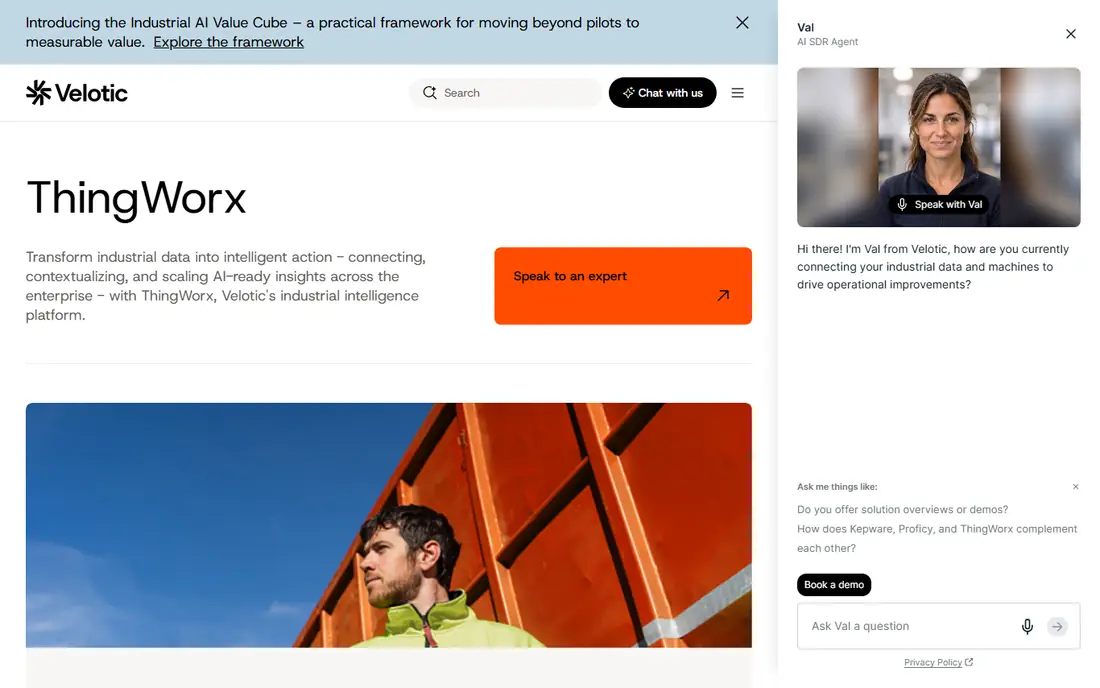
ThingWorx is the platform to pick when the goal is a custom industrial application rather than a packaged dashboard. Teams can build monitoring, analytics, and operator apps, connect a wide range of machines through Kepware protocols, and add augmented reality guidance through Vuforia. That flexibility suits manufacturers with unusual processes or mixed equipment that packaged apps do not cover well.
Flexibility has a price in skills. ThingWorx rewards a team with developers or a capable partner, and a thin team may get less from it than from a packaged application. Pricing is quote-only, and the total depends on users, connections, and modules. For an engineering team that wants to build its own industrial apps and keep control of the result, ThingWorx is a strong and proven choice.
- Rapid industrial app building
- Broad protocol connectivity through Kepware
- AR through Vuforia
- Needs development resources for full value
- Quote-only pricing
- App quality depends on the build team
AVEVA PI System is the historian backbone of many process plants, collecting high-fidelity time-series data from control systems and giving it asset context through its asset framework. That history is the raw material for AI work on quality, energy, and asset performance, and its broad interface library covers a wide range of control systems. For a process operation, PI is often already there before any AI conversation starts.
The honest limit is scope. PI is a data foundation first, and packaged AI applications live in adjacent AVEVA and partner tools rather than in the historian alone. Buyers should therefore price the whole stack, not just PI, and confirm which AI use cases are included. For a plant that needs trustworthy time-series data before anything else, PI remains the benchmark.
- High-fidelity time-series historian
- Asset framework for context
- Broad interface library
- More data foundation than full AI suite
- Quote-only pricing
- Newer AI features sit in adjacent AVEVA tools
Litmus Edge tackles the unglamorous problem that stalls many industrial AI projects: getting data off old machines in a consistent form. Its developer edition is free and self-serve, so a team can connect an old machine and test the connectivity claim before any sales conversation. Template-based rollout then helps the same data model repeat across many sites, which is where multi-plant programmes usually fail.
Litmus is clear about its scope: it supplies the data foundation that AI applications run on, rather than packaged AI apps themselves. Teams that want ready-made quality or maintenance apps will need another layer on top. Enterprise pricing is quote-only. For a manufacturer whose plants run different machines and different data models, Litmus is the most practical first step on this list.
- Free developer edition for testing connectivity
- Template-based rollout across sites
- Edge and air-gapped options
- Supplies the foundation, not packaged AI apps
- Enterprise pricing is quote-only
- Needs OT skills for rollout
Rockwell FactoryTalk suits plants built on Allen-Bradley control systems, where native EtherNet/IP integration and a shared Rockwell data model shorten deployment. The suite covers manufacturing execution, analytics, and operations management, with cloud options alongside on-premise deployment. For a discrete manufacturer already standardised on Rockwell, that fit is hard to match with a generic platform.
The limit is multi-vendor flexibility. Plants with a mix of Siemens, Mitsubishi, and Rockwell equipment will need more integration work, and the total still runs through Rockwell pricing and partners. IT and OT teams must also coordinate closely, since FactoryTalk touches both networks. For an Allen-Bradley plant planning MES and analytics together, FactoryTalk is a natural and strong pick.
- Native Allen-Bradley and EtherNet/IP integration
- Strong MES and analytics options
- Cloud and on-premise choices
- Less flexible with multi-vendor equipment
- Quote-only pricing
- Implementation needs IT and OT coordination
AspenTech, now part of Emerson, is built for process industries such as refining, chemicals, and energy, where optimisation models and asset performance matter more than generic dashboards. Its tools model processes, predict equipment failure, and optimise production against constraints, drawing on decades of process engineering knowledge. That depth is why it appears in so many process plant shortlists.
The focus is also the limit. Discrete manufacturers will find less here than in a Siemens or PTC platform, and deployment needs specialists who understand both the software and the process. Pricing is quote-only and enterprise in scale. For a process operation that wants AI grounded in real process models, AspenTech is a serious contender.
- Deep process modelling and optimisation
- Asset performance management
- Strong in refining and chemicals
- Quote-only pricing
- Process-industry focus
- Deployment needs specialist skills
Braincube takes a different route from the data-foundation platforms: it offers packaged AI applications for quality, process control, and operations, built on a digital twin of the plant. That application-first shape suits teams that want a working quality or yield use case quickly, rather than a long platform build. It also works across equipment vendors, which helps mixed plants.
The catch is data readiness. Packaged apps still need clean, contextualised operational data, and a plant with poor data governance will not get full value on day one. Pricing is quote-only, and the ecosystem is smaller than the big automation vendors. For a manufacturer that wants AI apps for quality and operations without building them from scratch, Braincube deserves a pilot.
- Packaged AI apps for quality and process control
- Digital twin of operations
- Works across equipment vendors
- Quote-only pricing
- Needs clean operational data
- Smaller ecosystem than Siemens or PTC
Tulip digitises the work operators do by hand: quality checks, assembly guidance, training, and traceability, built as no-code apps that a process engineer can create without a software team. That speed is its main advantage. A plant can replace paper forms and spreadsheets on a line in weeks, with guided work instructions and data capture that feed quality records directly.
Tulip is lighter on deep machine-level control than a full IIoT platform, so it pairs better with a data platform than replacing one. Per-user pricing can also grow as frontline adoption spreads, so buyers should model the full operator count. For a plant whose biggest losses sit in manual processes, rework, and training, Tulip is often the fastest route to a visible result.
- Fast no-code apps for operators
- Quality, training, and traceability flows
- Quick return on manual processes
- Lighter on deep machine-level control
- Per-user pricing can grow
- Needs process design care
How we picked these
We compared official product pages, vendor documentation, and 2026 industry evaluations of industrial AI platforms, and we favoured platforms that are live, supported, and used in production plants. We covered data foundations, application platforms, and frontline tools, because industrial engineering needs all three, and no single vendor covers every job well. We did not list platforms that have been discontinued or folded into another product under a different name, and we treated quote-only pricing honestly rather than guessing a figure.
How to choose an industrial AI platform
Start with the constraint, not the catalogue. If machines cannot be connected or data models differ by site, a connectivity and standardisation platform such as Litmus Edge comes first. If data exists but lacks context, a knowledge graph platform such as Cognite comes first. If operators still work on paper, a frontline tool such as Tulip may deliver the fastest return.
Next, run a pilot on one line with a clear success measure, such as scrap reduction, downtime reduction, or first-pass yield. A pilot that cannot show a number will not survive a plant-wide rollout, however good the demo looked. Include IT and OT staff from the start, since network access, security, and data ownership decide more industrial AI projects than model quality does.
Finally, price the whole stack and the rollout. Licences, edge hardware, integration, governance, and training are separate lines, and multi-site rollout multiplies the integration cost. Ask each vendor what a second and third site costs, not just the first, and confirm edge and air-gapped support if the plant cannot rely on cloud connectivity.
Frequently asked questions
What is the best ai platform for industrial engineering for a small manufacturer?
For a small manufacturer, start narrow. Tulip suits frontline digitisation, Litmus Edge Developer Edition suits testing connectivity for free, and Braincube suits a focused quality pilot. A full enterprise platform is rarely the right first step for a single plant, since the integration cost outweighs the benefit until the use case is proven.
What are the best ai platforms for industrial engineering across many factories?
Platforms that standardise data models and support template rollout score best across sites, including Litmus Edge, Siemens Insights Hub, and Cognite Data Fusion. The constraint at multi-site scale is repeatability, not model capability, so ask each vendor to show a second-site rollout, not just a first-site demo.
Do industrial AI platforms work with our existing machines?
Most do, but the effort varies. Siemens and Rockwell integrate best inside their own estates, while Litmus, PTC ThingWorx, and Braincube are built for mixed equipment. Check your exact machine models and protocols against the vendor's compatibility list before signing, and test connectivity in a pilot.
How much does an industrial AI platform cost?
Almost every platform on this list is priced by quote, based on sites, users, connections, and modules. Litmus Edge Developer Edition is free for testing, and Tulip offers a free trial, but enterprise pricing requires a vendor conversation. Budget separately for integration, edge hardware, data governance, and training.
Is edge AI needed for industrial engineering?
It depends on latency and connectivity. Work such as real-time quality inspection or closed-loop control needs inference inside the plant, while planning and reporting can run in the cloud. Several platforms on this list, including Siemens Industrial Edge and Litmus Edge, support local and air-gapped operation, so confirm which model types run locally before choosing.
Sources
- https://www.siemens.com/global/en/products/software/insights-hub.html
- https://www.cognite.com
- https://www.ptc.com/en/products/thingworx
- https://www.aveva.com/en/products/pi-system/
- https://litmus.io
- https://www.rockwellautomation.com/en-us/products/software/factorytalk.html
- https://www.aspentech.com
- https://www.braincube.com
- https://tulip.co
- https://litmus.io/blog/compare-best-industrial-ai-platforms
- https://litmus.io/blog/compare-best-industrial-ai-software
See where you really rank - block by block
ProMapRanker scans Google Maps across a grid of your service area. Simple monthly plans from $19, white-label on every plan.
Start freeKeep reading
 outreach alternatives
Outreach Alternatives in 2026
Compare outreach alternatives for 2026, from Salesloft and Apollo to HubSpot and Lemlist, with pricing, channels, features, limits, and honest trade-offs.
Read → best web conference tools
Best Web Conference Tools in 2026
Compare the best web conference tools for meetings, webinars and team calls, with current pricing, free plans and honest limits for each option here today.
Read → best voice cloning tools
Best Voice Cloning Tools in 2026
Compare the best voice cloning tools in 2026, from ElevenLabs and Descript to Resemble and Cartesia, with consent rules, pricing, licenses, and limits.
Read →