 ProMapRanker
Best AI Patent Drafting Services in 2026


Claim-first specification drafting · Pricing starts at: See website
Key takeaways
- Claim-first tools such as PatentPal and Specifio suit draft-first workflows, while Word-native tools such as DeepIP and ClaimMaster suit attorneys who live in Word.
- Full platforms such as Patlytics and Solve Intelligence cover drafting plus prosecution tasks, but they price by quote and suit firms, not solo inventors.
- ClaimMaster is the cheapest transparent entry here, while most other tools require a demo or quote before you see a price.
- Every AI draft needs human lawyer review before filing, and an AI draft does not guarantee a granted patent.
- This article is general information only, not legal advice, and patent strategy should be confirmed with a qualified patent attorney.
Quick comparison
| Pick | Great for | Pricing starts at | Free tier | |
|---|---|---|---|---|
| PatentPal | Claim-first specification drafting | See website | Free trial | Visit |
 Specifio | Figure and specification drafting | See website | Free trial | Visit |
 Patlytics | Full patent lifecycle platform | See website | No | Visit |
 ClaimMaster | Word proofreading and formalities | $30 per user per month | Free trial | Visit |
 DeepIP | Word-native AI drafting copilot | See website | No | Visit |
 Solve Intelligence | Firm-wide drafting and charting | See website | No | Visit |
 Rowan Patents | Standardised firm drafting | See website | No | Visit |
 Qatent | Multilingual claim generation | See website | No | Visit |
 IP.com AI Drafting | Lower-cost drafting entry | See website | No | Visit |
The best AI patent drafting services
AI patent drafting tools turn an invention disclosure or a set of claims into a structured draft specification, with figures, descriptions, and claim support. They save time on first drafts and formalities, but they do not replace a patent attorney. This article is general information only, not legal advice, and every draft here should receive lawyer review before filing. An AI draft does not guarantee a granted patent.
PatentPal is built around a simple idea: start with claims, and let the tool generate the specification and figures from them. That claim-first workflow suits attorneys and inventors who already think in claim language, since the draft stays anchored to the scope they intend to protect. Automatic figure generation saves hours on straightforward mechanical and software inventions.
The main drawback is pricing opacity. PatentPal does not publish a pricing table, and third-party estimates vary, so budget planning requires a direct conversation and a trial. The tool also works best when claims are already well structured, so a vague disclosure will still need substantial attorney shaping before it becomes a filing-ready draft.
- One-click claim-to-draft workflow
- Automatic figures and descriptions
- Free trial to test
- No public pricing page
- Claim-first model needs well-formed claims to work well
Specifio, previously known in some listings under the Edge name, focuses on turning an early-stage disclosure into a structured draft with figures. That focus helps inventors and small firms whose inventions are visual or mechanical, since figures often carry as much meaning as text. The workflow guides users through disclosure details rather than assuming they already write in patent style.
Specifio is less of a full prosecution platform than Patlytics or Solve Intelligence, so firms needing office action responses, claim charting, and portfolio analytics will need additional tools. Pricing is quote-based, so use the trial to judge whether the figure output matches your invention type before committing.
- Figure-heavy drafting support
- Structured specification output
- Inventor-friendly workflow
- Quote-based pricing
- Narrower prosecution feature set than full platforms
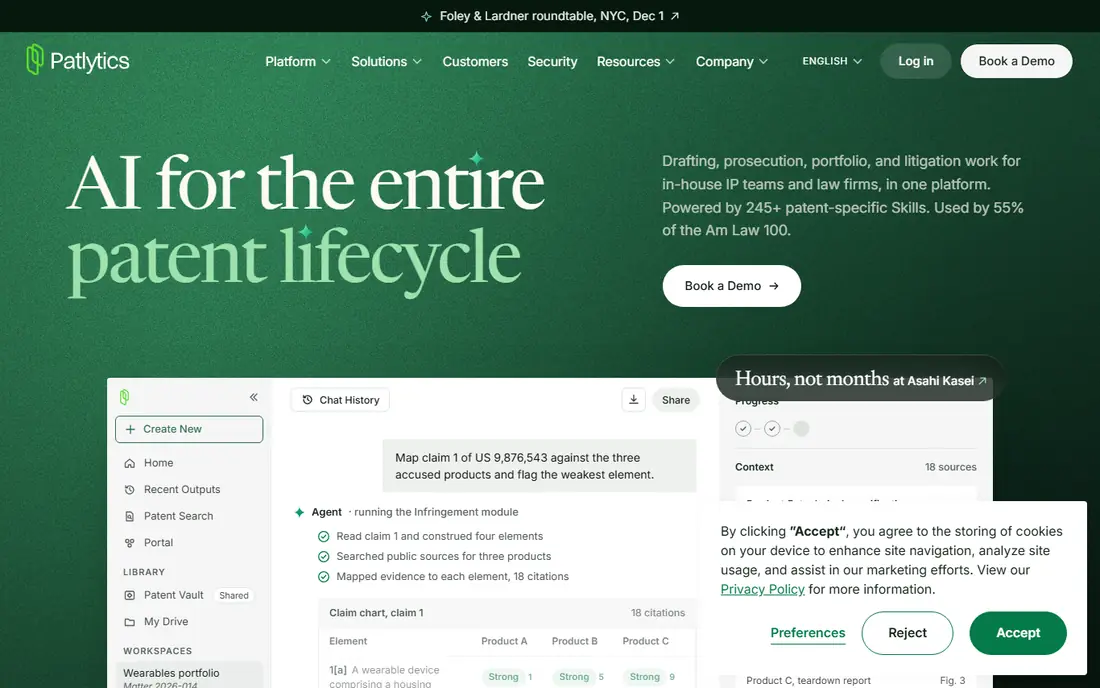
Patlytics aims to cover the patent lifecycle in one platform, from drafting through invalidity analysis, claim charting, and office action support. For firms and in-house teams that handle many matters, that consolidation reduces tool switching and keeps work product in one system. Its drafting tools sit alongside search and analytics, so a drafter can check prior art context without leaving the platform.
That breadth comes at a premium, quote-based price that suits firms rather than individual inventors. Smaller users may find the platform more than they need, and should compare it against a focused drafting tool plus a separate proofreader. Patlytics fits teams that want one vendor across drafting and prosecution support.
- Drafting plus invalidity and office action work
- Single platform for many tasks
- Firm-oriented controls
- Quote-based premium pricing
- More platform than a solo inventor needs
ClaimMaster is the most transparently priced tool here, starting at $30 per user per month, with a 30-day free trial. It works inside Microsoft Word and catches the errors that cause office actions and delays: missing antecedent basis, inconsistent part numbers, unsupported claims, and amendment mistakes. For paralegals and attorneys who draft in Word daily, that proofreading layer pays for itself quickly.
ClaimMaster is stronger as a checker and formalities tool than as a full generative drafting platform, although it does include drafting aids and office action support. Teams wanting a complete AI first draft from a bare disclosure should pair it with a drafting tool, or choose a platform such as Patlytics instead. For error-catching value per dollar, ClaimMaster leads this list.
- Published starting price
- 30-day free trial
- Strong antecedent-basis and formality checks
- Proofreading strength exceeds drafting depth
- Word-only workflow
DeepIP is an AI copilot that works inside Microsoft Word, which matters more than it sounds. Attorneys who draft entirely in Word do not need to learn a new editor, export and reimport files, or change firm templates to use it. Inline suggestions help with descriptions, claims, and technical sections across software, mechanical, and life sciences matters.
Pricing is per seat by quote, with third-party estimates in the hundreds of dollars per user per month, so firms should request a firm quote rather than budgeting from estimates. There is no public free tier, only a demo, which makes a trial arrangement important before rollout. DeepIP suits firms standardising on Word-based AI drafting.
- Works inside Word without a new editor
- Covers software, mechanical, and life sciences
- Inline drafting help
- Per-seat pricing by quote
- No public free tier
Solve Intelligence, now associated with Thomson Reuters, offers a full drafting environment with an in-browser editor, figure generation, and claim charting. That combination suits firms and corporate IP teams that want drafting, prosecution support, and charting in one workflow, rather than stitching together separate tools. Its scale and backing also reassure larger firms about security and support.
Pricing is sales-led and quote-based, with no public self-serve trial, so evaluation requires a demo and a commercial conversation. Solo inventors and small firms will likely find it more platform than they need. For a firm-wide rollout, Solve Intelligence is one of the most complete options here.
- In-browser drafting editor
- Figure generation
- Claim charting alongside drafting
- Sales-led pricing
- No public self-serve trial
Rowan Patents, part of Clarivate, helps firms standardise AI drafting and prosecution across a whole practice. Its integrated environment keeps drafting, figures, and prosecution documents consistent, which matters when many attorneys work on related matters. Reported productivity gains appeal to managing partners looking to control drafting time without lowering quality.
Pricing is quote-based, with third-party estimates around several hundred dollars per user per month, and evaluation requires a demo. That sales-led model suits firms making a practice-wide decision, and it suits them better than it suits a solo inventor testing a single application. Rowan Patents is a strong candidate for a firm standard.
- Integrated drafting environment
- Practice-wide standardisation
- Clarivate backing
- Quote-based pricing
- Demo required before evaluation
Qatent, from Questel, stands out for multilingual filers. Its AI claim generation draws on US, French, German, and Chinese patent data, and its novelty diagnostics help drafters see how a claim set sits against prior art before filing. That combination suits European filers and companies filing in multiple jurisdictions who need claim language that travels.
Qatent has a smaller profile in the US market than Patlytics or Solve Intelligence, so US-only firms should confirm support, integrations, and US practice fit during a demo. Pricing is quote-based, with third-party estimates around two hundred euros per user per month. For multilingual portfolios, Qatent fills a gap other tools leave open.
- AI claim generation with novelty diagnostics
- US, French, German, and Chinese patent data
- Multilingual filing support
- Smaller market presence than US-led rivals
- Demo required for pricing
IP.com AI Drafting comes from a company with a long background in IP data and prior art search, and that heritage shapes the tool. Drafters get AI assistance grounded in patent data, with prior art context close at hand, at a reported per-seat cost below the full-platform tier. That makes it an interesting entry point for firms that want AI drafting without committing to a premium platform price.
The feature set is narrower than Patlytics or Solve Intelligence, especially around claim charting and portfolio analytics, so firms needing those tools will still need more. Pricing should be confirmed directly, since published comparisons vary. IP.com AI Drafting suits cost-conscious firms that want drafting help with solid prior art grounding.
- Lower reported per-seat cost than full platforms
- Drafting plus prior art context
- Established IP data background
- Narrower feature set than full platforms
- Pricing requires confirmation with the vendor
How we picked these
We compared official tool pages, feature descriptions, and independent AI patent drafting comparisons from 2026, and we kept only tools that offer AI-assisted patent drafting or directly supporting drafting work in October 2026. We included claim-first tools, Word-native tools, and full platforms, so readers can match a tool to their workflow rather than to a single model. We did not claim hands-on testing, and where pricing is quote-based or estimated by third parties we list See website rather than presenting an estimate as a vendor price.
What to check before you file an AI draft
Start with confidentiality. Ask where your disclosure data is stored, how long it is retained, and whether it is used for model training, and get a data-processing agreement where client data is involved. Patent disclosures are sensitive by nature, and a tool with unclear retention terms is a risk no time saving justifies.
Next, verify every AI output line by line. Check claim support in the specification, antecedent basis, figure numbering, part references, and consistency between claims and description. AI tools can invent plausible-sounding technical details, and an unsupported or inconsistent statement can weaken a patent or create problems during examination. A qualified patent attorney should review the draft, confirm patentability strategy, and decide what to file.
Finally, remember what AI cannot do. It cannot guarantee that a patent will be granted, it cannot advise on infringement risk or freedom to operate, and it cannot replace legal judgement about claim scope and jurisdiction strategy. Use AI drafting to speed up first drafts and formalities, and keep attorney review as a non-negotiable step before any filing.
Frequently asked questions
What are the best AI patent drafting services for solo inventors?
PatentPal and Specifio suit solo inventors and small firms with draft-first workflows, while ClaimMaster suits inventors who already draft in Word and need proofreading. Full platforms such as Patlytics and Solve Intelligence are usually priced for firms rather than individuals.
What is the best AI patent drafting software for law firms?
Firms standardising across a practice often choose Rowan Patents, Solve Intelligence, or Patlytics, while Word-based firms often prefer DeepIP or ClaimMaster. The right choice depends on whether the firm wants a full platform or a Word-native copilot.
Does AI drafting guarantee a granted patent?
No. An AI draft is a starting point that still needs attorney review, prior art analysis, and careful claim strategy, and grant decisions rest with the patent office. No tool can guarantee allowance, and any claim of a guaranteed grant should be treated with scepticism.
Is AI patent drafting legal advice?
No. AI drafting tools provide general drafting assistance, not legal advice, and this article is general information only, not legal advice. Patent strategy, patentability, and filing decisions should be confirmed with a qualified patent attorney.
How much does AI patent drafting cost?
Costs range from $30 per user per month for ClaimMaster to quote-based per-seat pricing in the hundreds of dollars for firm platforms. Most vendors require a demo or quote, so request a written price based on your team size and matter volume.
Can AI draft a provisional patent application?
AI tools can help draft provisional application text and figures, but a provisional still needs careful review for support, clarity, and completeness. A weak provisional can limit what a later non-provisional application can claim, so attorney review matters even for provisionals.
Sources
See where you really rank - block by block
ProMapRanker scans Google Maps across a grid of your service area. Simple monthly plans from $19, white-label on every plan.
Start freeKeep reading
 worlds best local seo company
8 Worlds Best Local SEO Companies for Map Pack Growth in 2026
Compare the worlds best local seo company options for Google Business Profile work, citations, reviews, and multi-location rankings and reporting in 2026.
Read → world's best web hosting company
World's Best Web Hosting Company in 2026
Searching for the world's best web hosting company? We compared 10 hosts on price, renewal rates, speed, and support to help you choose well today in 2026.
Read → who's got the best nanny tax services
Who's Got the Best Nanny Tax Services in 2026
We answer who's got the best nanny tax services, comparing full filing, back taxes, software, and pricing so families can handle nanny taxes correctly.
Read →