 ProMapRanker
Best AI Orchestration Tools in 2026

General-purpose AI orchestration · Pricing starts at: Free
Key takeaways
- LangChain with LangGraph is our pick for most production teams, thanks to the widest provider and tool ecosystem.
- LlamaIndex is the best choice for retrieval-heavy apps, where document parsing and search quality decide the result.
- CrewAI is the fastest path to a working multi-agent prototype with role-based agents and tasks.
- Most core frameworks are free and open source, so the real cost sits in model calls, hosting and observability, not licences.
- Choose the orchestration model first, graph, workflow or crew, since switching frameworks later costs more than picking carefully now.
Quick comparison
| Pick | Great for | Pricing starts at | Free tier | |
|---|---|---|---|---|
| LangChain and LangGraph | General-purpose AI orchestration | Free | Yes | Visit |
 LlamaIndex | Retrieval-heavy apps and RAG | Free | Yes | Visit |
 CrewAI | Role-based multi-agent teams | Free | Yes | Visit |
 Haystack | Document and search pipelines | Free | Yes | Visit |
 n8n | Visual AI workflow automation | $20 per month | Yes | Visit |
 Temporal | Durable long-running workflows | See website | Yes | Visit |
 Mastra | TypeScript agents and workflows | Free | Yes | Visit |
 Flowise | Visual low-code agent building | Free | Yes | Visit |
The best AI orchestration tools
AI orchestration tools coordinate the steps behind an AI app: retrieving documents, calling models, using tools, checking results and handling failures. We compared frameworks and platforms that are actively maintained in October 2026, with real production use, and we mixed code frameworks with visual builders so both developer teams and automation builders find a fit.
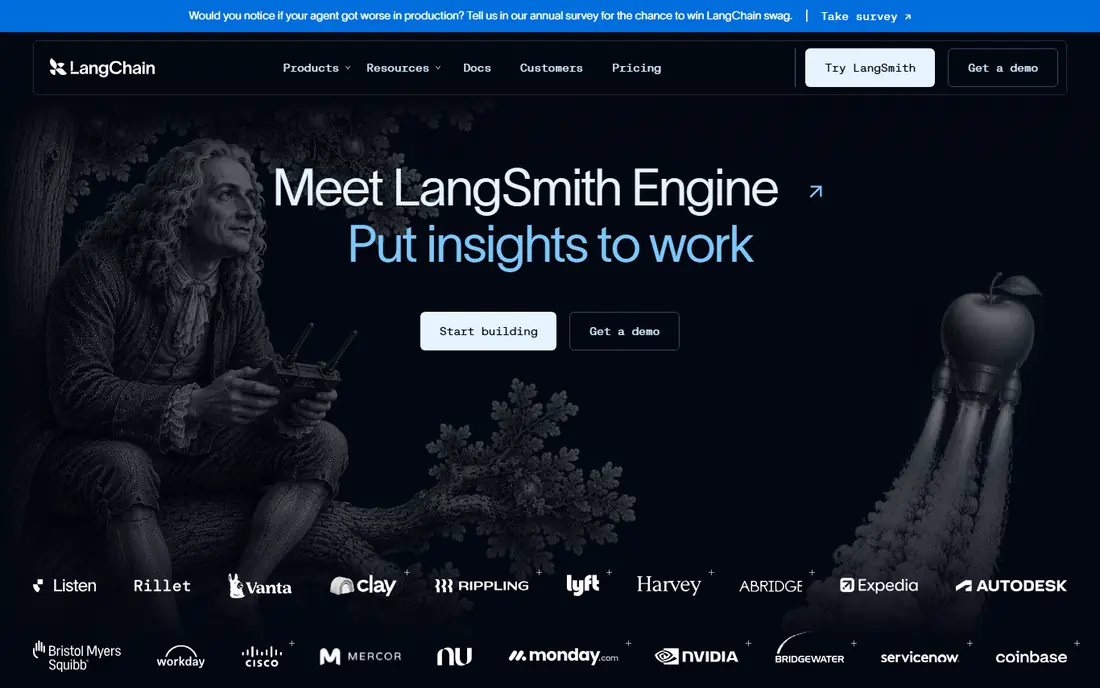
LangChain with LangGraph is the default orchestration stack for most production teams. LangChain connects models, tools, vector stores and APIs, while LangGraph models the app as an explicit graph with state, branches and checkpoints, which makes long-running agents easier to control, pause and resume. The ecosystem is the largest in this category, so a new model provider or tool usually gets an integration quickly.
The complexity is real. The package layout has been split and reshaped several times, so pin versions and follow the current docs rather than old tutorials. Also check licensing for the production server runtime if you plan to host it as a service for others, since that component differs from the free core libraries. For a team that wants the broadest option with the most examples, LangChain and LangGraph remain the safest starting point.
- Widest provider and tool integrations
- LangGraph adds explicit state and checkpoints
- Large community
- Package surface has changed often
- Production server runtime licensing needs checking for hosted use
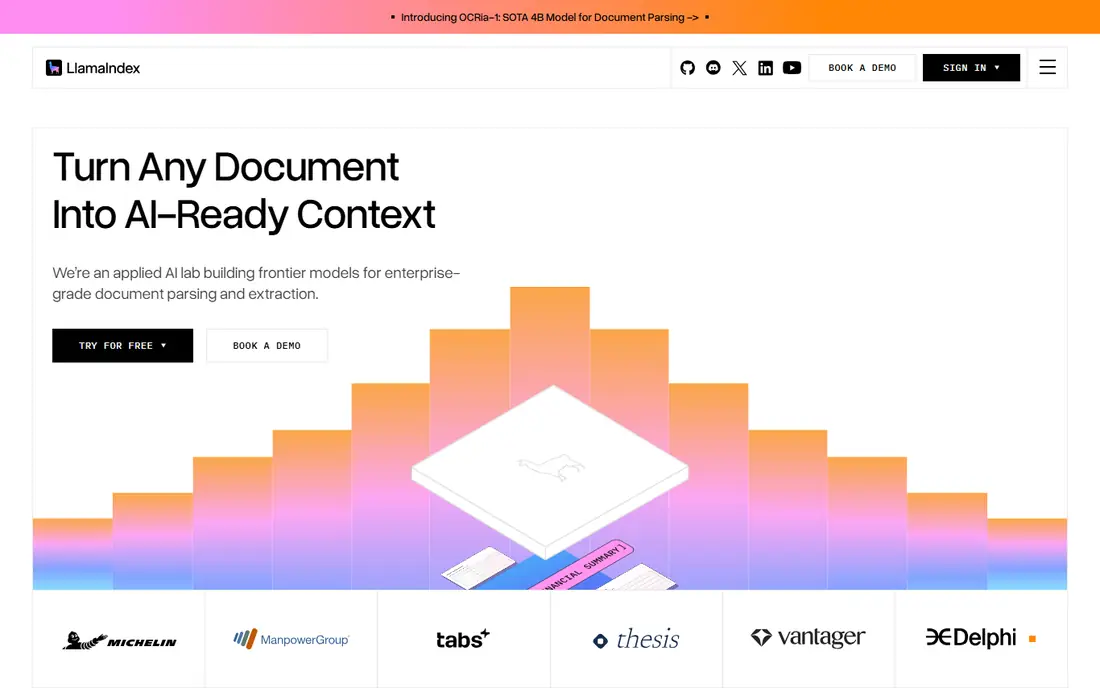
LlamaIndex is the best pick when retrieval quality decides whether your AI app works. It focuses on getting documents into a usable form, parsing, chunking, indexing and retrieving the right passages, and its Workflows feature composes those steps into event-driven apps. Teams that build retrieval-augmented generation systems, where an AI answers from company documents, often get better results here than with a general framework alone.
The multi-agent story is thinner than LangGraph or CrewAI, so a team building complex agent teams may need extra work. Managed parsing and indexing through LlamaCloud also add cost beyond the free core. Choose LlamaIndex when your workload is retrieval-first, and pair it with a general orchestrator only if agent complexity grows.
- Strong document parsing and retrieval
- LlamaParse and LlamaCloud for managed ingestion
- Workflow support
- Thinner multi-agent story than LangGraph or CrewAI
- Managed cloud features add cost
CrewAI suits teams that think in roles: a researcher agent, a writer agent and a reviewer agent working as a crew on a task. The model is readable, the learning curve for a first prototype is short, and the framework supports tools, memory and model context protocol integrations. For a hackathon, a pilot or a small fixed-role agent team, CrewAI gets a working system faster than a graph framework.
Control is the trade-off. LangGraph gives explicit state machines, checkpoints and human-in-the-loop interrupts, while CrewAI abstracts more of that away. As agent counts grow, debugging who did what and why becomes harder. Use CrewAI for fast pilots and small crews, and move to LangGraph when state control and production durability become the priority.
- Readable agent, task and crew model
- Fastest path to a multi-agent prototype
- Native tool and MCP support
- Less fine-grained state control than LangGraph
- Debugging grows harder as agent count rises
Haystack, from deepset, is a framework for building document search and retrieval pipelines that can be evaluated and audited. It covers ingestion, retrieval, ranking and generation, with evaluators that help teams measure whether answers actually come from the right documents. For production RAG where auditability matters, such as regulated or enterprise knowledge apps, Haystack is a strong, disciplined choice.
The general agent ecosystem is smaller than LangChain's, so teams building broad multi-agent apps may find fewer ready integrations. Pipeline design also takes time to learn well. Choose Haystack when your core problem is trustworthy retrieval and evaluation, not when you need the widest possible tool catalogue.
- Mature document pipelines with evaluation tools
- Strong for auditable RAG
- Apache 2.0 licence
- Smaller general agent ecosystem than LangChain
- Pipeline design takes learning
n8n is the visual pick on this list: a workflow builder where AI steps sit alongside webhooks, APIs, databases and messaging tools. It suits automation builders who want to chain model calls, retrieval steps and business tools without writing a full framework app. Cloud Starter costs $20 per month billed annually, and the self-hosted Community Edition is free with unlimited executions, though you run the server yourself.
Team features such as single sign-on, projects, sharing and Git support need paid tiers, and cloud pricing bills by execution volume, so a high-volume workflow needs cost modeling. n8n is best for operational AI automation, such as triaging tickets or enriching records, rather than for deeply stateful agent research. For that job, its visual model saves real engineering time.
- Visual builder with AI nodes
- Self-hosted Community Edition is free
- Execution-based pricing suits multi-step flows
- Cloud has no free plan, only a trial
- Advanced team features need paid tiers
Temporal is the durability pick: a workflow engine that keeps a workflow's state safe across failures, restarts and long waits, so a multi-day process does not lose its place when a server restarts. That makes it a natural fit for AI workflows tied to payments, onboarding, approvals or other processes where a lost or duplicated step has real cost. The open source core can be self-hosted, and Temporal Cloud offers a managed option.
Operational overhead is higher than a lightweight framework, since you run or buy a workflow service, not just a library. Cloud pricing bills by actions, with an Essentials tier reported around $100 per month, so model your action volume before committing. Choose Temporal when durability and exactly-once behavior matter more than prototyping speed.
- Durable execution that survives failures and restarts
- Strong for payments and long processes
- Open source core
- More operational overhead than a simple framework
- Cloud pricing is usage-based and needs modeling
Mastra is the best orchestration framework for TypeScript teams. It provides agents, deterministic workflows, memory and typed tools in a TypeScript-native design, with a stable 1.0 release and growing adoption among JavaScript developers. If your product, APIs and team already run on TypeScript, Mastra avoids the friction of adding a Python service just for AI orchestration.
The ecosystem is smaller than LangChain's, so some integrations need manual work, and Python teams gain nothing from a TypeScript-only tool. Mastra is also newer than the established frameworks, so check that its observability and deployment options fit your production setup. For TypeScript shops, it is the cleanest fit on this list.
- TypeScript-native agents, workflows and memory
- Typed tool definitions
- Stable 1.0 release
- Smaller ecosystem than LangChain
- TypeScript-only, so Python teams should look elsewhere
Flowise lets builders create AI agents and chains by dragging nodes onto a canvas: models, retrievers, tools, memory and outputs connected visually. It is open source, with a hosted cloud option, and it is one of the fastest ways to demo an agent that retrieves documents, calls tools and answers questions. Non-developers and small teams can build a working prototype without writing framework code.
Visual builders have a ceiling. Large, branching agent systems become hard to version, test and debug as a diagram, and complex logic is usually cleaner in code with LangGraph or Mastra. Use Flowise for prototypes, internal tools and demos, and move to code when the system becomes a production service with strict testing needs.
- Drag-and-drop agent and chain building
- Open source with a cloud option
- Fast for prototypes and demos
- Visual flows get hard to maintain at large scale
- Complex logic still benefits from code
How we picked these
We compared orchestration tools with active maintenance, production use and clear documentation in October 2026, and we favored tools with a free core, a defined execution model and integrations for models, vector stores and tools. We mixed code frameworks with visual platforms because orchestration buyers range from platform engineers to automation builders. Tools that were only demos, or that had no verifiable current maintenance, were left out.
What to check before you choose
Start with the execution model, not the brand. Graph frameworks suit stateful agents with branches and human approval. Workflow frameworks suit retrieval pipelines and event-driven steps. Role-based frameworks suit small agent teams with clear jobs. Visual builders suit operational automation and prototypes. Picking the wrong model causes more rework than picking the wrong library inside the right model.
Next, check observability, evaluation and failure handling from the start. Confirm how you will trace a run, replay a failure, test a prompt change and measure answer quality, since these decide whether an AI system survives contact with real users. Also model the full cost: model calls, vector storage, hosting and any managed platform fees. The framework itself is usually free, but the system around it is not.
Finally, prototype with real data and real failure cases. Run the same task through two frameworks, including a tool failure, a bad retrieval result and a long pause, and see which one recovers cleanly. A framework that demos well on a happy path but loses state on a failure will cost far more in production than a slightly slower framework that handles errors properly.
Frequently asked questions
What is the best AI orchestration platform overall?
LangChain with LangGraph is our pick for most production teams, thanks to ecosystem breadth and explicit state control. LlamaIndex is better for retrieval-heavy apps, and CrewAI is faster for role-based multi-agent prototypes. The best platform depends on whether your workload is stateful, retrieval-heavy or crew-based.
Which AI orchestration platform is best for beginners?
CrewAI and Flowise are the easiest starting points: CrewAI for readable role-based agents in code, and Flowise for visual drag-and-drop building. n8n is also approachable for automation builders who already use visual workflows. Beginners should prototype in one of these before committing to a graph framework.
What is the best AI orchestration software for RAG?
LlamaIndex is our pick for RAG-first apps, with strong parsing, indexing and retrieval, while Haystack is best when auditable pipelines and evaluation matter most. LangChain also handles RAG well and adds broader agent support. Choose based on whether retrieval quality, auditability or agent breadth matters most.
Is LangChain still the best AI orchestration tool in 2026?
LangChain with LangGraph remains the broadest and most widely used option in 2026, but it is no longer the only serious choice. LlamaIndex leads on retrieval, CrewAI on fast multi-agent pilots, and Mastra on TypeScript-native work. Use LangChain as the default, and switch only when another tool clearly fits your workload better.
How much do AI orchestration tools cost?
Most core frameworks on this list are free and open source, including LangChain, LlamaIndex, CrewAI, Haystack, Mastra and Flowise. Costs come from model API calls, hosting, vector storage and observability tools, plus paid tiers such as n8n Cloud from $20 per month and Temporal Cloud usage-based pricing. Budget for the system, not just the framework licence.
What is the difference between AI orchestration and an AI agent framework?
Orchestration is the broader job of coordinating steps, models, tools, data and failures in an AI app, while an agent framework is one way to do it, focused on agents that reason and act. Some tools on this list, such as Temporal and n8n, orchestrate workflows without being agent frameworks. Choose the orchestration model that matches your app, whether it uses agents or not.
Sources
See where you really rank - block by block
ProMapRanker scans Google Maps across a grid of your service area. Simple monthly plans from $19, white-label on every plan.
Start freeKeep reading
 outreach alternatives
Outreach Alternatives in 2026
Compare outreach alternatives for 2026, from Salesloft and Apollo to HubSpot and Lemlist, with pricing, channels, features, limits, and honest trade-offs.
Read → best web conference tools
Best Web Conference Tools in 2026
Compare the best web conference tools for meetings, webinars and team calls, with current pricing, free plans and honest limits for each option here today.
Read → best voice cloning tools
Best Voice Cloning Tools in 2026
Compare the best voice cloning tools in 2026, from ElevenLabs and Descript to Resemble and Cartesia, with consent rules, pricing, licenses, and limits.
Read →