 ProMapRanker
Best AI Optimization Tools in 2026


Enterprise teams wanting full AI search tracking · Pricing starts at: See website
Key takeaways
- Profound and Scrunch suit larger teams that want tracking plus content action in one platform.
- Otterly.AI and Rankscale offer lower entry prices for small teams starting with AI visibility.
- Peec AI and AthenaHQ suit teams that want clean prompt-level reporting and clear next steps.
- Semrush suits teams that already pay for Semrush and want AI visibility in the same suite.
Quick comparison
| Pick | Great for | Pricing starts at | Free tier | |
|---|---|---|---|---|
| Profound | Enterprise teams wanting full AI search tracking | See website | Free trial | Visit |
 Peec AI | Teams wanting clean prompt-level reporting | See website | No | Visit |
 Otterly.AI | Small teams starting with AI visibility | $29 per month | No | Visit |
 Scrunch AI | Teams wanting tracking plus AI-served content | $250 per month | No | Visit |
 Goodie AI | Teams wanting high-volume prompt coverage | See website | No | Visit |
 AthenaHQ | Teams wanting prescriptive next steps | $295 per month | Yes | Visit |
 Semrush AI Visibility Toolkit | Teams already using Semrush for SEO | $99 per month | No | Visit |
 Rankscale | Small teams and agencies wanting low-cost tracking | $20 per month | No | Visit |
The best AI optimization tools
AI optimization tools track how your brand appears in AI answers, not only in classic search results. They run prompts across ChatGPT, Gemini, Perplexity, and Google AI features, then show mentions, citations, and sentiment over time. This list focuses on platforms built for that job, with tools to fix content and improve citations, rather than general rank trackers or generic AI writing tools. Prices and engine coverage change often, so confirm the current plan page before you buy.
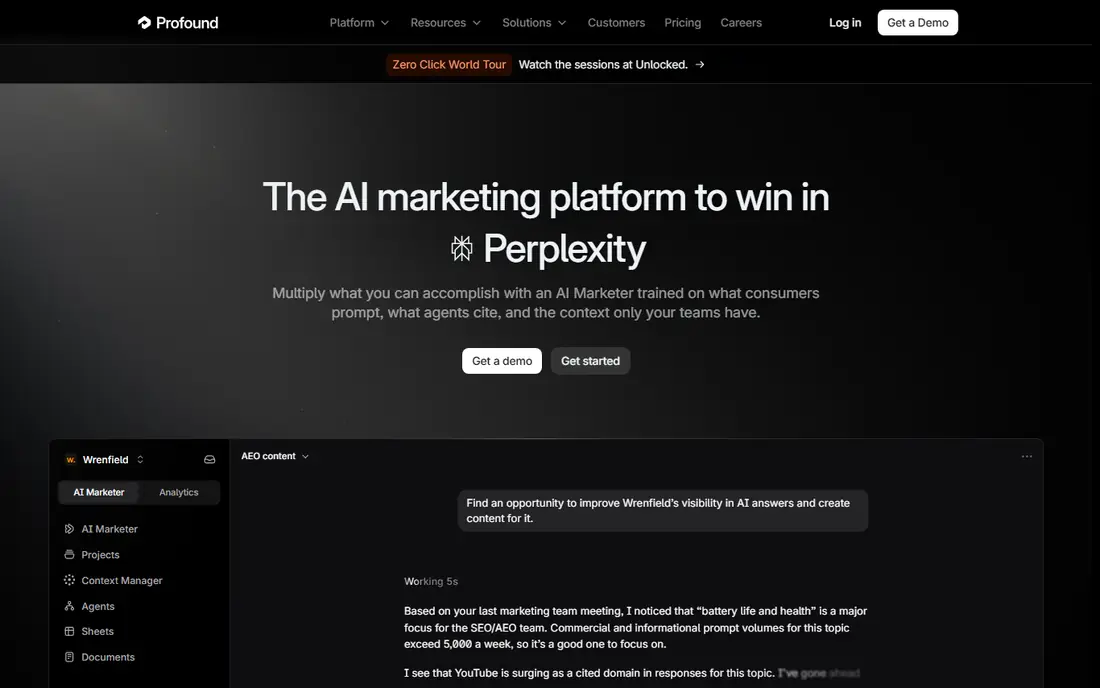
Profound is an enterprise AI search platform that tracks brand visibility across ChatGPT, Gemini, Perplexity, and Google AI features, with agents that can draft content fixes. It suits larger marketing teams that want tracking, benchmarking, and content action in one place. The platform also offers crawler analytics and attribution tools for teams that need to prove impact.
The main drawback is scale and cost, since Profound is built for enterprise programmes rather than a solo founder with a small prompt set. A free trial lets you test the core tracking, but full value needs a dedicated owner and a content workflow. For a large brand with a serious AI search programme, Profound is a leading pick.
- ['Tracks visibility across major AI engines', 'Content agents can draft and stage fixes', 'Benchmarking against competitors and peers']
- ['Enterprise pricing suits larger budgets', 'Overkill for a team that only wants a simple score', 'Setup needs a dedicated owner for best results']
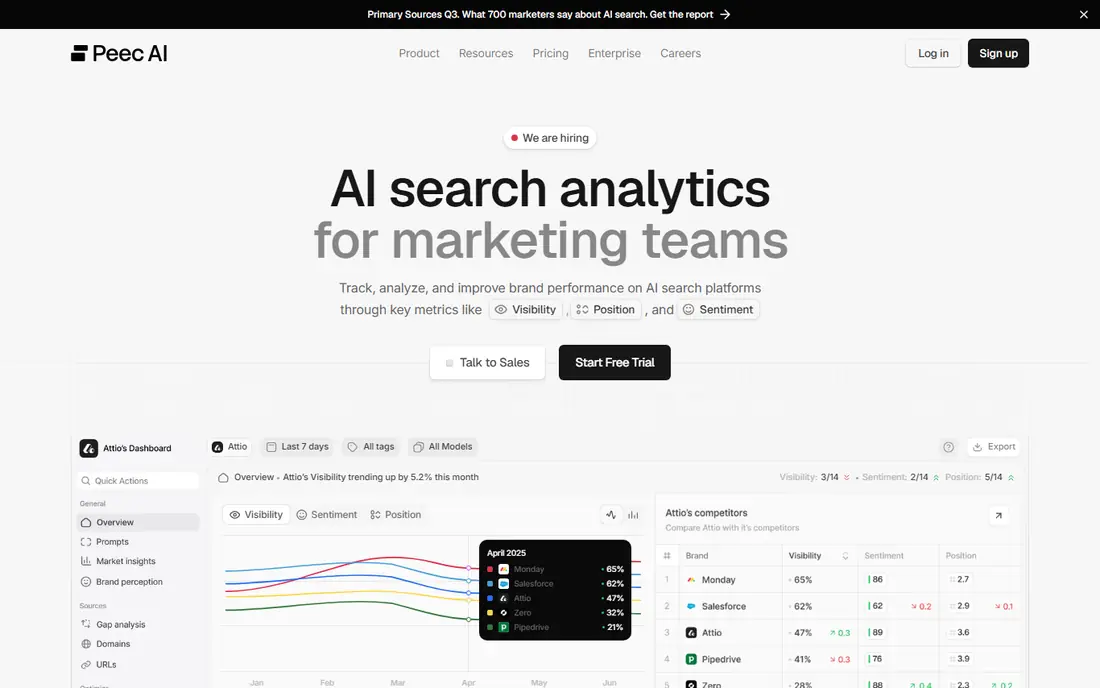
Peec AI focuses on clean, prompt-level tracking across AI engines, with daily updates and screenshot audit trails that make reports easy to share. It suits B2B and SaaS teams that want a trustworthy dashboard without a complex enterprise setup. The interface is clear, and the reporting is built for teams that present results to stakeholders.
Peec AI is mainly a monitoring tool, so content creation and fixes sit outside the platform in most cases. Pricing can also be hard to see without signing up, so ask for a quote and confirm engine coverage for your plan. For teams that want reliable tracking first, Peec AI is a strong choice.
- ['Daily tracking across several AI engines', 'Clear visibility, position, and sentiment reporting', 'Screenshot audit trails for reports']
- ['Monitoring focused, with less content creation', 'Pricing is not always shown to logged-out visitors', 'Engine choice can be limited by plan tier']
Otterly.AI offers a low-cost entry point for AI visibility tracking, with coverage across ChatGPT, Perplexity, Gemini, and Google AI features on its plans. It suits solo founders and small teams who want a fast setup, clear recommendations, and a modest budget. The simple dashboard makes it easy to see mentions and citations without enterprise complexity.
The limits are depth and action, since Otterly.AI does not generate content in-platform in many cases and lacks real prompt-volume data on entry tiers. Larger teams may need more prompts, regions, or seats. For a first AI visibility tool, though, the price and simplicity make Otterly.AI hard to beat.
- ['Low entry price for AI tracking', 'Covers several major AI engines', 'Simple setup with clear recommendations']
- ['No in-platform content generation in many cases', 'No real prompt-volume data on entry tiers', 'Higher tiers needed for more prompts and features']
Scrunch AI combines AI visibility tracking with an agent experience platform that serves AI-optimized pages to crawlers without changing the human-facing site. It suits content teams that want to turn citation gaps into shipped fixes, not only reports. Persona and journey simulation tools add a useful layer for understanding how different buyers are answered.
The entry price is higher than budget trackers, so Scrunch suits teams with a real content budget. Some content features also vary by plan, and prompt sets are configured by the user rather than pulled from real conversations in all cases. For a team that wants tracking plus action, Scrunch is a leading option.
- ['Tracks several AI surfaces on every tier', 'Agent experience pages for AI crawlers', 'Persona and journey simulation tools']
- ['Entry price is higher than budget trackers', 'Content generation features vary by plan', 'Prompt sets are configured, not pulled from real chats in all cases']
Goodie AI focuses on high-volume prompt coverage across many AI models, with reporting and attribution tools for larger teams. It suits brands that need to track many prompts, products, and regions, and that want to connect AI visibility to revenue. The breadth of model coverage is a clear advantage for teams with a wide prompt set.
Pricing suits larger teams, so small businesses may find the entry cost high. High-volume tracking also needs a clear prompt strategy, or reports can become hard to act on. For a larger team with many prompts and a need for attribution, Goodie AI is worth a demo.
- ['High-volume prompt tracking', 'Covers many AI models on higher tiers', 'Revenue attribution and reporting tools']
- ['Pricing suits larger teams', 'Entry tier may be limited for small budgets', 'Setup needs a clear prompt strategy to get value']
AthenaHQ offers AI visibility tracking with an action centre that turns data into prescriptive next steps for content teams. It suits teams that want clear guidance on what to fix, not only a visibility score. A free essential tier lets small teams start, while paid plans add more models, analytics integrations, and citation tools.
The paid entry price is higher than budget trackers, and the prompt volume model is not fully disclosed. Recommendations also often need editing before they are ready to publish. For a team that wants guided action alongside tracking, AthenaHQ is a practical choice, especially if the free tier fits a first test.
- ['Action centre turns data into next steps', 'Free essential tier for starting out', 'Citation engine and analytics integrations']
- ['Entry paid price is higher than budget tools', 'Prompt volume model is not fully disclosed', 'Recommendations often need editing before shipping']
Semrush AI Visibility Toolkit adds AI search tracking to the Semrush suite, with a large prompt database and coverage across ChatGPT, Google AI, Gemini, and Perplexity. It suits teams that already pay for Semrush and want AI visibility in the same workflow as rankings, keywords, and site audits. The combined view helps connect AI citations to classic SEO work.
The toolkit is an add-on, so total cost includes a Semrush plan plus the per-domain AI fee, which adds up for many sites. It is also less focused than a dedicated AI platform for teams that only need AI tracking. For an existing Semrush team, though, it is the simplest way to add AI visibility.
- ['AI visibility inside a full SEO suite', 'Large prompt database for context', 'Combines AI tracking with classic SEO data']
- ['Price is an add-on on top of a Semrush plan', 'Per-domain pricing adds up for many sites', 'Less focused than a dedicated AI platform for some teams']
Rankscale offers low-cost AI visibility tracking with coverage across many engines on its plans, plus credit rollover on some tiers. It suits small teams and agencies that want a budget entry point without giving up engine breadth. White-label options on higher tiers also help agencies that report to clients.
Rankscale is a newer brand than the largest platforms, so long-term track record is shorter. Some features vary by tier, and full agency tools need higher plans. For a small team or agency starting with AI optimization, the low price and broad engine coverage make Rankscale a useful first tool.
- ['Low entry price with many engines', 'Credits roll over on some plans', 'White-label options on higher tiers']
- ['Newer brand than the largest platforms', 'Some features vary by plan tier', 'Agency features need higher tiers for full use']
How we picked these
We compared AI optimization platforms that are live in October 2026, using their own homepages and pricing pages plus recent AEO tool comparisons. We kept only platforms that track brand visibility across AI answer engines and offer prompt, citation, or content tools, and we left out generic rank trackers with only a token AI feature. Prices change often in this fast-moving market, so we use See website where a price could not be confirmed from the vendor page at writing time.
How to choose an AI optimization platform
Start with the prompts your buyers actually ask
List 20 to 50 real questions your buyers ask before they buy, including comparisons, prices, and how-to questions. A tool that only tracks brand name prompts will miss the category questions where AI answers shape decisions. Check whether the tool lets you add your own prompts, competitors, and regions, since those controls decide how useful the data will be.
Check citations, not only mentions
A mention without a citation is weaker than a cited answer that links to your page. Look for citation tracking, source analysis, and page-level detail, so you can see which pages AI engines trust. If a tool only gives a single visibility score, ask what sits behind it before you pay.
Plan who will act on the data
Tracking alone does not improve visibility. Someone must update pages, add clear facts, fix structured data, and create missing answers. Choose a tool with recommendations your team can actually ship, or pair a tracker with a content workflow. Review results monthly, and keep prompts stable so trends are comparable over time.
Frequently asked questions
What are AI optimization tools?
AI optimization tools track how a brand appears in answers from AI engines such as ChatGPT, Gemini, Perplexity, and Google AI features. They run prompts, record mentions and citations, and show how visibility changes over time against competitors. The better tools also suggest content fixes, such as clearer facts, better page structure, and missing answers.
How are AI optimization tools different from SEO tools?
Classic SEO tools track rankings and links in search results, while AI optimization tools track mentions and citations inside AI-generated answers. The two overlap, since pages that rank well often get cited, but AI answers also draw on reviews, forums, and structured facts. Many teams now use both, with an SEO suite for rankings and an AI platform for answer visibility.
What is the best AI optimization tool for a small business?
Otterly.AI is a good low-cost start, with entry pricing from 29 dollars per month in recent comparisons. Rankscale also offers a low entry price for small teams. Start with a small prompt set, learn which pages get cited, and upgrade only when you need more prompts, regions, or seats.
Can AI optimization tools guarantee a citation?
No tool can guarantee that an AI engine will cite your page, since engines choose sources based on their own models and data. A good tool shows which sources are cited, what content is missing, and what to fix, but results depend on content quality and competition. Treat any guarantee of a citation as a warning sign.
How many prompts should I track?
Start with 20 to 50 prompts that cover your main products, comparisons, and buyer questions. Too few prompts give a noisy picture, while too many prompts cost money and create reports no one reads. Add prompts as you learn which questions drive traffic and sales, and keep the core set stable for trend tracking.
Sources
See where you really rank - block by block
ProMapRanker scans Google Maps across a grid of your service area. Simple monthly plans from $19, white-label on every plan.
Start freeKeep reading
 zoho inventory alternatives
6 Alternatives to Zoho Inventory, Compared on Price and Fit
Zoho Inventory alternatives: 6 tools compared on price, free plans and fit. Katana leads the list for manufacturers. Fit and flaws are laid out for each entry.
Read → zoho crm alternatives
Best Zoho CRM Alternatives (2026)
Need Zoho CRM alternatives? We compare 7 tools on cost, free access and who each suits. Every pick gets a straight assessment. Built for quick decisions.
Read → zelle alternatives
Best Zelle Alternatives in 2026
Compare the best Zelle alternatives for sending money to friends, paying sellers and moving funds abroad, with honest notes on fees, speed and safety in 2026.
Read →