 ProMapRanker
Best AI HR Software in 2026: 9 Tools Compared

Key takeaways
- BambooHR and Zoho People offer the clearest published pricing, while Workday, HiBob, and Rippling are quote-based.
- Lattice leads on performance and engagement, while Paradox and Eightfold AI focus on hiring and talent matching.
- AI features vary widely, from drafting and summaries to screening and scheduling, so test them on your own HR tasks.
- Check data privacy, bias controls, and human review steps before using AI for hiring or performance decisions.
Quick comparison
| Pick | Great for | Pricing starts at | Free tier | |
|---|---|---|---|---|
 Workday | Enterprise HR and finance | See website | No | Visit |
 BambooHR | Small and mid-size HRIS | $10 per employee per month | Free trial | Visit |
 HiBob | Global mid-size teams | See website | No | Visit |
 Rippling | HR, IT, and payroll in one | See website | No | Visit |
 Deel | Global hiring and payroll | See website | No | Visit |
 Lattice | Performance and engagement | $13 per seat per month | No | Visit |
 Eightfold AI | Talent matching and hiring | See website | No | Visit |
 Paradox | High-volume hiring automation | See website | No | Visit |
 Zoho People | Budget core HR | $3 per user per month | Free trial | Visit |
The best AI HR software
We compared official pricing pages, published AI feature guides, and product documentation, focusing on tools that use AI for real HR work such as drafting, screening, scheduling, summaries, and insights. AI should save HR time and improve fairness, not replace human judgment on hiring or performance decisions.
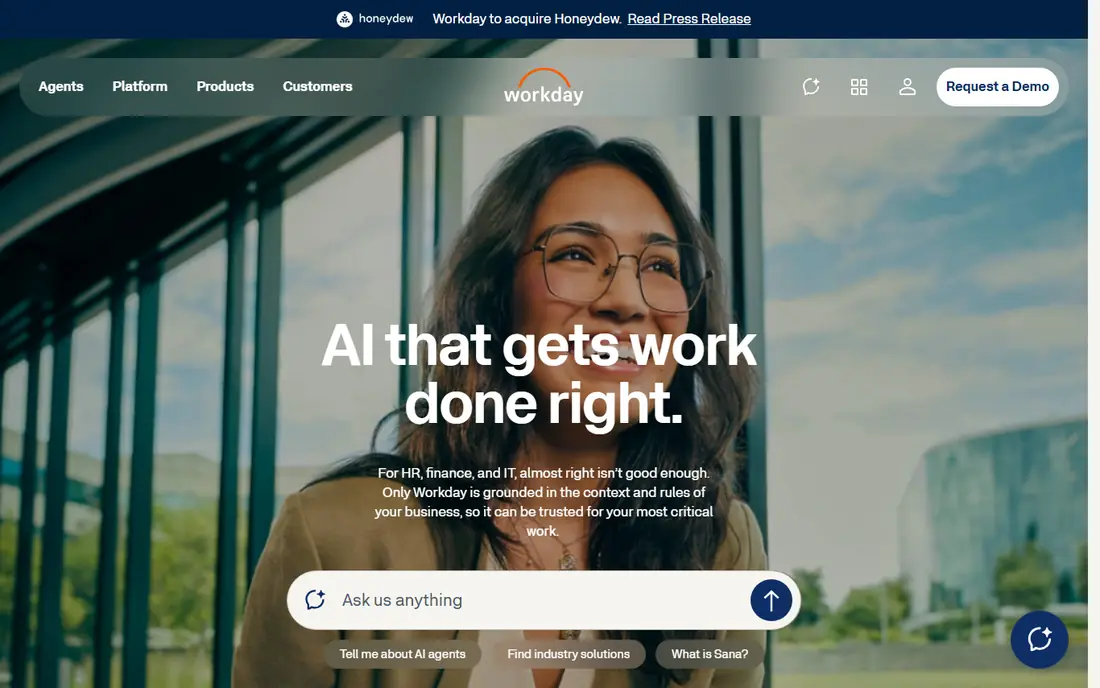
Workday is the enterprise pick for companies that need HR and finance on one system. Its AI features help with skills insights, workforce planning, and drafting, while its core covers payroll, benefits, time, and talent in a single record. Large firms value its audit, security, and compliance controls.
Pricing is quote-based and implementation can take months, so Workday suits larger firms with dedicated HR and IT teams. Small businesses will find it heavier and costlier than needed. Choose Workday when scale, compliance, and a unified system matter more than a quick setup.
- Broad HCM and finance suite
- AI-assisted insights
- Strong compliance tools
- Quote-based pricing
- Long implementation for large firms

BambooHR is a friendly HR system for small and mid-size teams moving off spreadsheets. Its AI assistant, Ask BambooHR, answers HR questions and groups employee feedback themes, while core tools cover onboarding, time off, and employee records. Published pricing starts at $10 per employee per month for Core, with Pro and Elite tiers above it.
US payroll is an add-on rather than a core inclusion, and global employment runs through partners, so check those costs if you hire abroad. BambooHR suits US-focused small teams that want a clear price, a simple interface, and light AI help without an enterprise project.
- Clear published pricing
- Simple onboarding
- AI assistant for HR questions
- US payroll is an add-on
- Global features need partners

HiBob, known as Bob, targets mid-size and multinational teams that want a modern people platform. Bob AI drafts reviews, job descriptions, and messages, and answers employee questions in plain language. Core HR, onboarding, performance, and engagement sit in one system, with a payroll hub linking to local payroll providers.
Pricing is quote-based, so budgeting needs a demo and a formal quote. HiBob suits growing global teams that value culture, engagement, and a polished employee experience. Small teams with a tight budget may prefer a tool with published pricing.
- Modern employee experience
- Bob AI drafting
- Global payroll hub
- Quote-based pricing
- No published starting price
Rippling unites HR, IT, and finance around one employee record, so onboarding can trigger payroll, benefits, app access, and device shipping in one flow. AI features help with drafting, data entry, and workflow automation across those areas. That unity saves time for fast-growing companies that hire across locations.
Pricing is quote-based, with a platform fee plus modules priced separately, so the total depends on which products you add. Rippling suits scaling companies that want HR and IT in one place. Teams that only need core HR may find a simpler, cheaper system sufficient.
- Unified employee record
- IT device management
- Payroll and benefits
- Quote-based pricing
- Modules add cost quickly
Deel helps companies hire contractors and employees in other countries without setting up local entities. Its platform covers contracts, payroll, benefits, and compliance, with AI tools that assist with drafting and document checks. For distributed teams, Deel removes much of the legal and payroll friction of global hiring.
Pricing varies by worker type, with published guides listing contractor plans from $49 per month and employer-of-record plans far higher. US-only teams will not need most of that global machinery. Deel is the pick when your hiring spans borders and compliance risk matters.
- Global contractor and employee hiring
- Payroll in many countries
- AI help
- Quote and per-worker pricing varies
- Complex for US-only teams
Lattice leads on performance management, with reviews, goals, feedback, and engagement surveys in one place. AI features summarize review feedback and help draft goals and messages, which saves managers time during review cycles. Its Foundations plan starts at $13 per seat per month, with a $4,000 minimum annual agreement in published pricing.
Lattice is not a full HR system on its own, though it has added HRIS features, so many teams pair it with a separate HRIS and payroll tool. That pairing adds cost and integration work. Choose Lattice when performance and engagement are your main HR goals, and you already have a system of record.
- Strong reviews and goals
- Engagement surveys
- AI summaries
- Not a full HRIS alone
- Minimum annual agreement applies
Eightfold AI focuses on talent intelligence, matching candidates and current employees to roles based on skills and experience. Recruiters can surface internal candidates for open roles, while hiring teams get ranked matches and skills gaps. That focus helps large firms fill roles faster and retain staff through internal moves.
Pricing is quote-based and aimed at mid-size and enterprise employers, so small hiring teams may find it out of reach. Bias and fairness controls matter here, so ask how matching is audited and how human reviewers stay in the loop. Eightfold suits firms with steady hiring volume and a skills-based talent strategy.
- AI talent matching
- Skills insights
- Internal mobility tools
- Quote-based pricing
- Enterprise focus
Paradox, known for its Olivia assistant, automates high-volume hiring conversations. Candidates can apply, answer screening questions, and schedule interviews through chat, without waiting for a recruiter email. That speed helps retail, hospitality, healthcare, and logistics employers that hire many frontline staff each month.
Pricing is quote-based, and the value drops for low-volume or executive hiring where personal recruiter contact matters more. Paradox also needs careful setup of screening questions to avoid unfair filtering. It is the pick for high-volume hiring teams that need speed and a mobile-first candidate experience.
- Conversational hiring assistant
- Fast screening and scheduling
- High-volume focus
- Quote-based pricing
- Less suited to low-volume executive hiring
Zoho People offers core HR at a low published price, starting around $3 per user per month in published comparisons. It covers employee records, time off, attendance, and basic performance, with links to other Zoho apps for payroll and recruiting. For small teams that need a simple system of record, it is hard to beat on price.
AI features are lighter than dedicated AI HR platforms, and advanced talent or analytics tools sit in higher tiers or other Zoho products. Zoho People suits budget teams that want solid core HR and light automation, not a full AI talent suite. If AI hiring is your main goal, pair it with a dedicated recruiting tool or pick a stronger AI platform.
- Low published pricing
- Core HR and time tools
- Zoho app links
- AI features are lighter
- Advanced talent tools need higher tiers
How we picked these
We checked official pricing pages, AI feature descriptions, and published comparisons, and we kept only tools that offer real AI help for HR tasks, not only a chatbot label. We favored a mix of enterprise, mid-market, and budget options, and we flagged quote-based pricing, since that affects how easily small teams can compare costs.
How to buy AI HR software safely
Start with the HR problem, not the AI label. List the tasks that take the most time, such as scheduling interviews, drafting reviews, answering policy questions, or summarizing feedback. Then test the AI feature on those exact tasks during a trial, with your own policies and job descriptions, and check the output for errors and tone.
Next, review privacy and fairness controls. Ask where employee data is stored, whether it trains vendor models, how long data is kept, and how bias is tested for screening and performance features. Keep a human in the loop for hiring, promotion, and discipline decisions, and document that review step in your HR policy. AI can draft and suggest, but people should decide.
Finally, price the full system, including payroll, benefits, and any AI add-ons. A low core price can grow fast when you add modules for payroll, recruiting, or engagement. Ask about contract length, user minimums, and renewal terms, and trial with a small group before rolling out to the whole company.
Frequently asked questions
What is the best AI HR software for small businesses?
BambooHR and Zoho People suit small businesses best, thanks to published pricing and simple core HR tools. BambooHR offers a stronger AI assistant, while Zoho People offers a lower starting price for basic HR needs.
How does AI help HR teams?
AI drafts job descriptions and reviews, answers policy questions, screens and schedules candidates, and summarizes feedback themes. The best tools save time on routine work while leaving hiring, pay, and discipline decisions to human reviewers.
Is AI hiring software fair?
It can be, but only with controls. Ask vendors how models are tested for bias, what data they use, and how human reviewers check matches and screening results. Avoid tools that auto-reject candidates without human review, and monitor outcomes by group over time.
Do I need a full HRIS to use AI HR tools?
No, not always. Lattice, Paradox, and Eightfold AI can sit alongside an existing HRIS, while BambooHR, HiBob, Rippling, and Workday bundle AI into a full system. Pick a bundle when you need one record, and a point tool when you only need one HR job improved.
How much does AI HR software cost?
Published pricing ranges from about $3 per user per month for Zoho People to $10 per employee per month for BambooHR Core and $13 per seat per month for Lattice Foundations. Enterprise tools such as Workday, HiBob, and Rippling are quote-based, so request a formal quote for your headcount.
Sources
See where you really rank - block by block
ProMapRanker scans Google Maps across a grid of your service area. Simple monthly plans from $19, white-label on every plan.
Start freeKeep reading
 zscaler alternatives
Best Zscaler Alternatives in 2026
Looking for zscaler alternatives? We compare 9 SASE and zero trust platforms on architecture, data protection, pricing, and fit for your network and team.
Read → zapier alternatives free
Best Zapier Alternatives Free in 2026
Nine automation tools for zapier alternatives free in 2026, all with genuinely free tiers, plus free plan limits, starting prices and upgrade paths explained.
Read → which platform is best for online reputation
Which Platform Is Best for Online Reputation in 2026
Wondering which platform is best for online reputation? We compare 8 review, listing, and response tools for small and multi-location businesses and agencies.
Read →