 ProMapRanker
Best AI Development Company in USA in 2026

Key takeaways
- LeewayHertz leads on enterprise AI agents and multi-agent systems, with its ZBrain platform for data connections.
- Turing and Vention suit companies that need large engineering teams or full product teams, not just a single prototype.
- 10Pearls and Simform suit product-focused builds where AI is part of a wider digital product.
- DataRobot suits enterprises that want a governed AutoML and MLOps platform rather than a purely custom build.
Quick comparison
| Pick | Great for | Pricing starts at | Free tier | |
|---|---|---|---|---|
 LeewayHertz | Enterprise AI agents | See website | No | Visit |
 Turing | AI engineering talent at scale | See website | No | Visit |
 Vention | Full product teams | See website | No | Visit |
 10Pearls | AI-first digital products | See website | No | Visit |
 Simform | Enterprise GenAI engineering | See website | No | Visit |
 Markovate | Generative and agentic AI | See website | No | Visit |
 Master of Code Global | Conversational AI | See website | No | Visit |
 DataRobot | Governed AutoML platform | See website | No | Visit |
The best AI development companies in USA
We compared these companies on AI services, delivery model, industry focus, platform offerings, and how they handle production, governance, and support after launch. Prices for custom AI work are quoted per project, so confirm scope, team, and timeline in a written proposal before you sign.
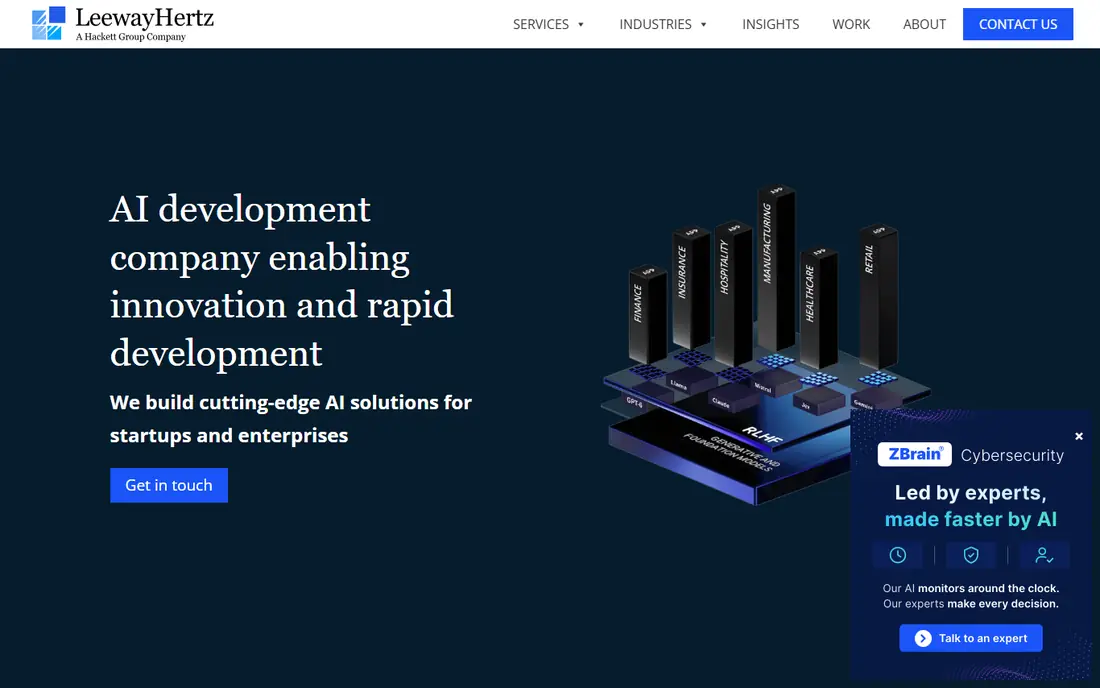
LeewayHertz suits a large company that wants AI agents built around its own data and workflows, not a generic chatbot wrapper. Its ZBrain platform supports multiple foundation models and a large set of data connectors, which helps when an agent must pull from enterprise apps, databases, and documents. The company also covers computer vision, natural language processing, and predictive analytics, so a project that mixes document work, search, and automation can stay with one team.
Enterprise scope is also the limit. A small business with a single simple use case may find the engagement larger and more formal than it needs, and a platform-based build needs someone inside your company to own it after launch. Ask for a clear proof-of-concept scope, success measures, and a handover plan, and check how model, data, and evaluation changes will be handled once the agent is live.
- End-to-end GenAI and agent development
- ZBrain platform with many data connectors
- Computer vision, NLP, and predictive work
- Enterprise pricing and scope may be too large for a small pilot
- Platform approach needs internal ownership after launch
Turing suits a company that needs AI and ML engineers quickly, or a team that can scale up and down with project phases. Its model combines vetted talent with AI transformation services, which helps when you have a product roadmap but not enough in-house AI capacity to deliver it. That flexibility matters for companies that want to keep product direction in-house while adding specialist engineering capacity.
A talent model needs management. If you do not have a product manager or tech lead who can direct an external team, a full-service product company may deliver more cleanly. Ask how engineers are vetted for your stack, how knowledge transfer works, and what happens if a key engineer leaves mid-project. For a well-managed team, Turing is a practical way to build AI capacity without a long hiring cycle.
- Large vetted engineering talent pool
- AI transformation and product engineering services
- Flexible team scaling
- Talent model suits companies that can manage an external team
- Less suited to a fixed-price single feature
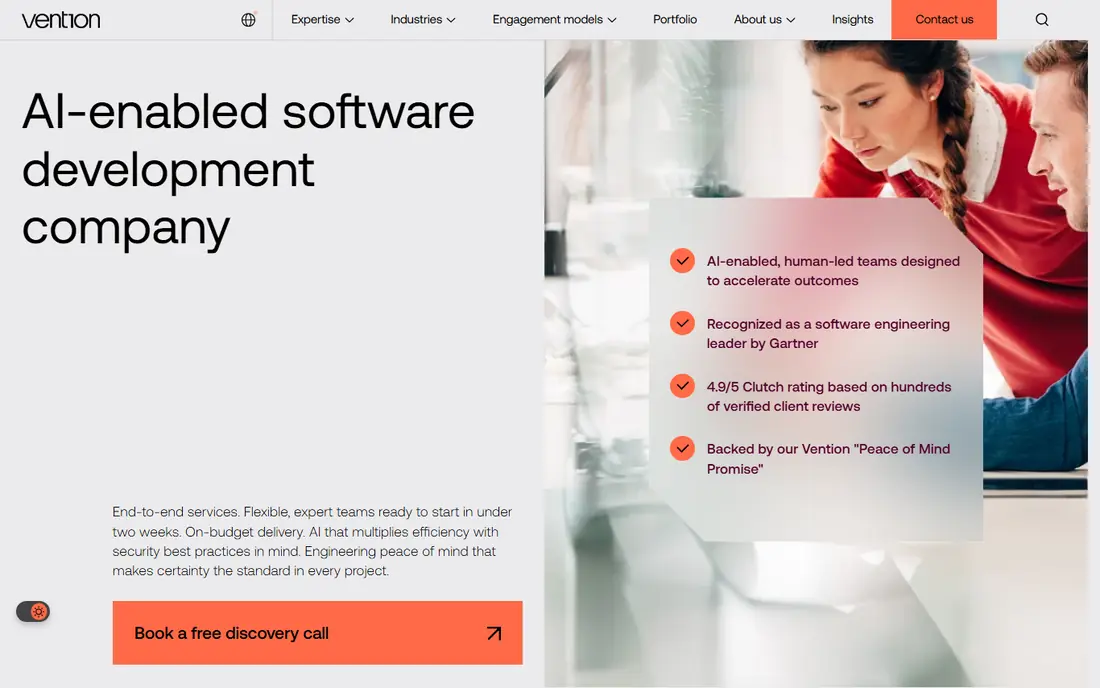
Vention suits a company that wants a full product team, not just a few engineers, to design, build, and ship an AI product. Its teams cover product design, engineering, and delivery, which helps when AI is part of a larger platform, such as a customer portal, an internal tool, or a data product. Scale is also a benefit, since a team can grow as the product moves from prototype to production.
Full teams cost more than a single freelancer or a small agency, so a tiny pilot may not fit the model well. Ask for a team composition, a delivery plan with milestones, and a clear split of responsibilities between Vention and your internal team. For a product with a real roadmap and a budget to match, a full team often ships faster and with fewer handover gaps than a patchwork of contractors.
- Custom software and AI engineering at scale
- Full product teams including design and delivery
- Experience across industries
- Team-based pricing suits mid-size and larger projects
- Small one-off tasks may be too small for a full team
10Pearls suits a company that wants AI built into a digital product from the start, rather than added as a side feature. Its work covers product engineering, AI, and digital transformation, with experience in complex and regulated settings where security, testing, and compliance matter. That product focus helps when the AI feature must fit a wider user experience, data model, and release process.
Enterprise product builds take time and budget, so a startup that needs a quick prototype may find a smaller specialist faster. Ask for case examples in your industry, a prototype timeline, and how AI model performance will be measured after launch. For a company building a product that must last, with AI as a core part of the value, 10Pearls is a strong candidate.
- Enterprise product engineering
- AI-first product focus
- Experience with regulated and complex domains
- Enterprise focus may price out small startups
- Project timelines can be longer for full product builds
Simform suits a mid-size or enterprise company that wants GenAI and ML engineering on a cloud-native stack. Its services cover custom AI and ML, generative AI, platform modernization, and data engineering, which helps when an AI project also needs data pipelines, cloud setup, and integration with existing systems. That breadth is useful for companies whose AI work is blocked by data or infrastructure gaps, not just model work.
Breadth also means you should confirm who will actually work on your project, since a generalist firm can staff a project with engineers who are stronger in one area than another. Ask for the team profiles, the AI stack proposed, and how the project will handle data quality, model evaluation, and ongoing costs. For a cloud-based GenAI build with real integration needs, Simform is a solid choice.
- AI and ML engineering plus GenAI services
- Cloud-native delivery on AWS and Azure
- Product modernization experience
- Broad service range means you must confirm the exact AI team for your project
- Pricing is project-based
Markovate suits a company that wants a generative AI or agentic AI solution for a defined workflow, such as claims processing, document analysis, or operational reporting. Its focus on purpose-built agents for specific processes helps when you have a clear workflow to automate, rather than a vague request for AI in general. A prototype-to-production path also helps a company move from a demo to a working system without changing vendors.
A workflow specialist is not a full transformation consultancy, so a company that needs organization-wide change management and a multi-country rollout may need a larger partner. Ask for workflow examples close to yours, a clear evaluation plan for agent accuracy, and a support plan for model and data changes. For a defined agentic AI project, Markovate is a focused and practical pick.
- Generative AI and agentic AI focus
- Workflow-specific agents
- Prototype to production delivery
- Specialist focus may be less suited to a full enterprise transformation
- Pricing and team size need confirming per project
Master of Code Global suits a company whose main AI need is conversational, such as a customer support assistant, a voice agent, or an LLM-powered helper that connects to business systems. Its work covers chatbot and voice AI, LLM connectors, and customer experience design, which matters because a good assistant needs more than a model. It needs conversation design, fallback handling, and integration with the systems that hold real answers.
If your project is mainly computer vision, forecasting, or a governed enterprise platform, a broader firm may fit better. For conversational AI, ask for live examples, handling of edge cases and handover to a human, and metrics for resolution rate and user satisfaction. A conversational project that looks good in a demo but fails on real customer questions is a common risk, and Master of Code's focus helps reduce it.
- Conversational AI and chatbot expertise
- Voice AI and LLM connector work
- Customer experience focus
- Conversational focus is narrower than a full AI platform firm
- Large enterprise scale may need a bigger partner
DataRobot suits an enterprise that wants a governed platform for building, deploying, and monitoring many models, rather than a single custom build. Its AutoML and MLOps tools help data teams build predictive models faster, while its governance features help track model versions, data sources, and performance over time. That governance layer matters in regulated industries, where a model cannot simply be deployed and forgotten.
Platform cost and internal ownership are the limits. DataRobot works best when you already have data teams and a pipeline of use cases, not when you need a vendor to invent your first AI project from scratch. Ask for a trial or pilot on your own data, a clear licensing model, and a support plan for model drift and retraining. For an enterprise with many models to govern, it is a strong platform choice.
- AutoML and MLOps platform
- Enterprise AI governance
- GenAI and predictive model management
- Platform licensing plus services can be costly
- Needs internal data and ML ownership to get full value
How we picked these
We compared official service pages, platform descriptions, and current 2026 company rankings, and we cross-checked those details against industry and delivery focus. We favored companies with a current United States presence, a clear AI service range, and evidence of production delivery rather than prototype-only work. We left out companies with only a thin AI offering, unclear current services, or no verifiable operating site.
How to choose an AI development company without wasting the budget
Start with a single, measurable problem. Write down the workflow, the data you have, the decision the AI must support, and how you will know if it worked. A company that cannot turn that description into a prototype scope, a data plan, and success measures is not ready to build for you, no matter how impressive its sales material looks. Avoid starting with a large platform purchase before you have proven value on one workflow.
Next, check data, security, and ownership before you check the model. Ask where your data will be stored, how it will be used for training, who owns the code and the model outputs, and how the system will handle private or regulated data. Ask how the vendor will evaluate accuracy, handle errors, and monitor performance after launch. A vendor that cannot answer those questions clearly is a risk, even if its demo looks strong.
Finally, compare proposals on the same terms. Ask each vendor for team composition, timeline, milestones, total cost including platform and model usage fees, and a handover and support plan. Model usage fees, data pipeline work, and ongoing monitoring can add a large amount to the headline build cost. Choose the vendor whose plan is most specific about data, evaluation, and support, not the vendor with the broadest claim about AI capability.
Frequently asked questions
How much does it cost to hire an AI development company in the USA?
Cost depends on scope, team size, timeline, and whether you need a platform license as well as custom work. Small prototypes can cost far less than a full enterprise agent system, which can run into six figures. Ask for a written proposal with team, milestones, and total cost, including model usage and support fees, before you commit.
Should I choose a custom AI company or a platform like DataRobot?
Choose a custom company if you need a specific workflow, agent, or product built around your data and systems. Choose a platform like DataRobot if you have many models to build, deploy, and govern, and you already have data teams to use it. Some projects need both, with a custom build on top of a governed platform.
How long does it take to build an AI product?
A focused prototype can take a few weeks, while a production agent or product with data integration, testing, and governance can take several months. Timeline depends on data quality, system integration, and how many workflows are in scope. Ask for a milestone plan and a clear definition of what counts as production-ready.
Do I need to own my data before hiring an AI company?
Yes, in practical terms. An AI project needs clean, accessible, and legally usable data to work well. Before you hire, list your data sources, check access rights, and clean obvious quality problems. A vendor can help with data engineering, but it cannot fix missing, restricted, or poor-quality data on its own.
What should I ask an AI company before signing?
Ask for team profiles, past work in your industry, a prototype scope with success measures, data and security handling, model evaluation methods, total cost including usage fees, and a handover and support plan. Also ask who owns the code, the prompts, and the model outputs, and how changes will be priced after launch.
Sources
See where you really rank - block by block
ProMapRanker scans Google Maps across a grid of your service area. Simple monthly plans from $19, white-label on every plan.
Start freeKeep reading
 zoro.to alternatives
Best Zoro.to Alternatives in 2026
We compare the best zoro.to alternatives in 2026, listing only legal licensed anime streaming services, from Crunchyroll to free options for fans today.
Read → zip alternatives
Best Zip Alternatives in 2026
We compare the best zip alternatives for buy now, pay later in 2026, covering pay-in-4 plans, fees, spending limits, and credit reporting options today.
Read → yesware alternatives
Best Yesware Alternatives in 2026
Compare the best yesware alternatives for sales email tracking, templates, and sequences, with current pricing and honest tradeoffs for small sales teams.
Read →