 ProMapRanker
8 Top AI Database Software for Businesses Compared (2026)


Teams that want managed vector search without operating infrastructure · Pricing starts at: $20/month
Direct answer
Start with Pinecone if you need teams that want managed vector search without operating infrastructure. Alternatives: Neo4j for AI applications built on connected data and relationships, and MongoDB Atlas for teams adding AI search to existing MongoDB workloads. The full list of 8 tools follows, with prices and free plan facts.
Key takeaways
- Pinecone is the opening pick, best for teams that want managed vector search without operating infrastructure.
- Zilliz Cloud fits large-scale vector workloads on managed Milvus.
- A free plan is offered by 8 of the 8 tools, including Pinecone, Neo4j, MongoDB Atlas and Weaviate.
- One limit worth knowing about Pinecone: proprietary service with no self-hosted choice.
Quick comparison
| Pick | Great for | Pricing starts at | Free tier | |
|---|---|---|---|---|
| Pinecone | Teams that want managed vector search without operating infrastructure | $20/month | Yes | Visit |
 Neo4j | AI applications built on connected data and relationships | $65/GB/month | Yes | Visit |
 MongoDB Atlas | Teams adding AI search to existing MongoDB workloads | From $9/month | Yes | Visit |
 Weaviate | Teams that want open-source adaptability with a managed choice | From $45/month | Yes | Visit |
 Chroma | Developers who want the simplest open-source embedding store | See website | Yes | Visit |
 Qdrant | Engineering teams that require quick open-source vector search | See website | Yes | Visit |
 DataStax Astra DB | Enterprises building on the IBM watsonx.data system | See website | Yes | Visit |
 Zilliz Cloud | Large-scale vector workloads on managed Milvus | From $0/month | Yes | Visit |
Tool-by-tool breakdown
If you are comparing AI database software for businesses, this page covers 8 tools in one place: what each is best for, what it costs to start, whether it has a free plan, and the main limit to know about.
Pinecone
Great for: Teams that want managed vector search without operating infrastructure
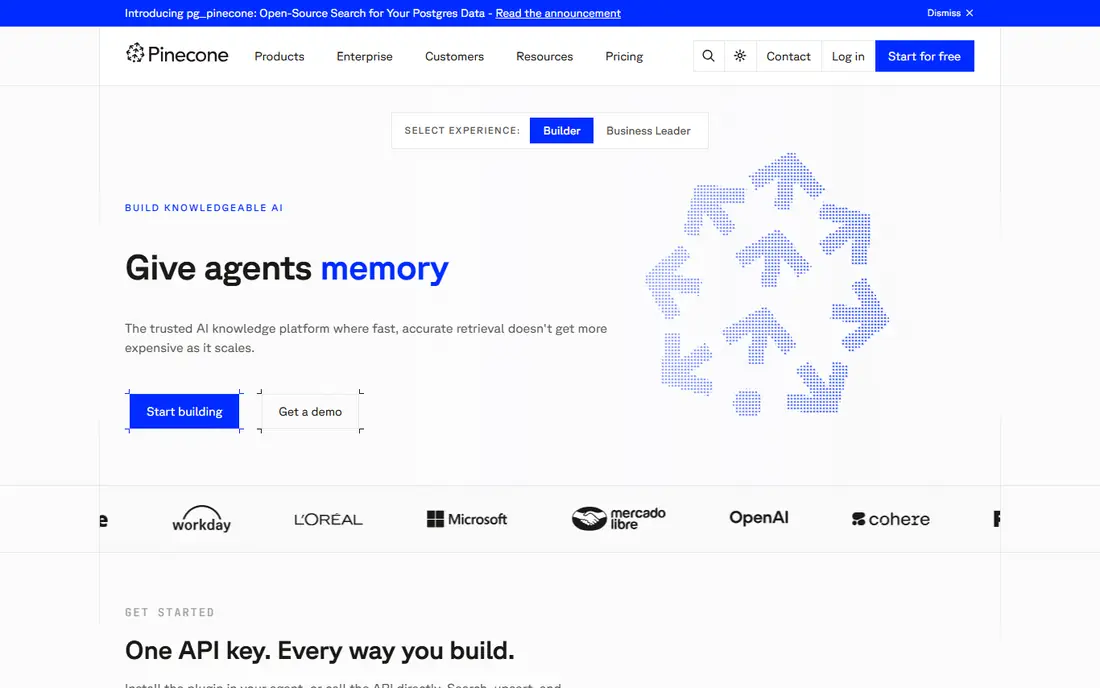
Pinecone was built for teams that want managed vector search without operating infrastructure. Pinecone was one of the first managed vector databases to go mainstream, and it still wins on simplicity. There is no cluster sizing, no sharding strategy, no late-night pages about disk pressure.
Limits to weigh: Costs scale with usage and can surprise teams that do not monitor it.
More specifically, you build an index, upsert vectors, and query. As for the details, for a business that wants vector search as an utility, that matters more than any benchmark. Starting cost for Pinecone: $20/month. Pinecone has a free plan.
- Clear upgrade path from free to enterprise
- Completely managed with no clusters to tune
- Proprietary service with no self-hosted choice

Neo4j makes the most sense for AI applications built on connected data and relationships. Fraud rings, recommendation engines and knowledge graphs are the classic examples. In daily use, do not pick Neo4j as a generic vector store.
AuraDB has a free level for getting started. That pricing reflects its enterprise positioning. The starting price for Neo4j: $65/GB/month. Neo4j has a free plan.
Downsides: Per-GB pricing gets pricey quick.
- Capable fit for fraud and recommendation use cases
- The established leader in graph databases
- Graph modeling has a ramp-up time for new teams

MongoDB Atlas is aimed squarely at teams adding AI search to existing MongoDB workloads. The trade-off is specialization. A general-purpose database doing vector search will not match a purpose-built vector engine on raw retrieval speed or scale.
If your AI workload is a chatbot over a handful of thousand documents, you will never notice. Rather than standing up a separate vector database, you store embeddings alongside your documents and query them with the same product your team already operates. Entry price for MongoDB Atlas: From $9/month. You can start on MongoDB Atlas without paying.
Drawbacks to consider: Pricing gets complicated as usage grows.
- Familiar document model developers already know
- Vector search built into the same database
- Vector performance trails purpose-built vector databases at very large scale
Weaviate is designed for teams that want open-source adaptability with a managed choice. You can run it yourself at no cost, forever, or pay for Weaviate Cloud when you would rather not think about infrastructure.
Where it falls short: Self-hosting needs real DevOps effort at scale.
In practice, the free level spans 100,000 objects, which deals with a surprising number of real prototypes. Worth adding: Flex opens at $45 per month when you outgrow it. The starting price for Weaviate: From $45/month. Free access exists with Weaviate.
- Open source with a real community
- Modular design supports several vectorization approaches
- Smaller ecosystem than the biggest managed players
Choose Chroma for developers who want the simplest open-source embedding store. Honesty needs saying what Chroma is not. It is not the database you pick for a hundred million vectors in production.
Main advantages: frequently just a handful of lines of code.
Teams that start with Chroma and succeed normally migrate to a heavier system later. That is fine. The open-source version costs nothing and runs anywhere. You can have embeddings stored and queryable in minutes, which makes it a favorite for hackathons, prototypes and AI features inside small applications. Chroma shows no starting price here, so confirm the cost on the vendor site. Free access exists with Chroma. Watch-outs: Not aimed at massive production scale.
- Very simple to start
- Decent fit for prototypes and small apps
- Managed cloud is usage-based with less pricing transparency
Pick Qdrant if this describes you: engineering teams that require quick open-source vector search. It is written for performance, and teams that benchmark open-source vector databases tend to put it near the top.
Where it is weaker: Managed pricing is usage-based and harder to predict.
Worth adding: the free level never expires, so small projects and experiments can live there indefinitely. Qdrant does not show a starting price in this comparison, so check the vendor site for current pricing. Qdrant offers a free plan.
- Free level with no time limit
- Clean API and decent documentation
- Fewer enterprise features than the biggest commercial vendors
Where DataStax Astra DB fits: enterprises building on the IBM watsonx.data product. That changes the buying calculus. For everyday use, pricing is quote-based, so expect a sales conversation.
Honest limits: Pricing details need talking to sales.
In daily use, treat Astra DB as an enterprise product decision, not a fast developer signup. Worth adding: if your organization has standardized on IBM's data system, Astra DB is the natural vector-capable database inside that world. Pricing for DataStax Astra DB is not stated here, so ask the vendor for current figures. Free access exists with DataStax Astra DB.
- Now backed by IBM for enterprise buyers
- Serverless architecture with no capacity planning
- Product direction is tied to IBM's roadmap
Think of Zilliz Cloud for large-scale vector workloads on managed Milvus. It means the underlying engine has been tested at serious scale, and skills your team builds transfer to the open-source project if you ever leave. Beyond that, serverless pricing opens from zero and grows with use, whereas dedicated clusters start at $126 per GB a month for teams that require predictable performance.
For everyday use, work through which level matches your query patterns before you commit, since the jump between them is significant. The free level contains 5GB of storage, which is enough for meaningful testing. Zilliz Cloud cost at the entry level: From $0/month. Zilliz Cloud includes a free tier.
The main drawbacks: Enterprise features sit behind the higher plans.
- Built on the widely adopted Milvus engine
- Serverless choice opens at zero
- Pricing levels can confuse first-time buyers
How we compared the tools
Each tool was reviewed on what its vendor publishes: price, plan limits, core features and stated drawbacks. We did not run hands-on tests. Treat prices as a snapshot: vendors change plans often, so check the vendor site for the figure that applies today. The sequence is a judgement call: typical use case first, then pricing transparency, then free access. Use the profiles to check fit.
Questions to settle before buying
- Ask Chroma, Qdrant and DataStax Astra DB for a written quote, since no starting price is shown.
- Read the fine print on the free plans from Pinecone, Neo4j, MongoDB Atlas and others; seat, project and feature caps differ.
- Read the limits listed for Pinecone first: proprietary service with no self-hosted choice.
- Ask Weaviate about contract length, onboarding fees and user minimums before you sign.
- Ask the daily users to test Neo4j on a live task before you roll it out to everyone.
Frequently asked questions
What is the cheapest option for AI database software for businesses in this list?
On published monthly entry prices, Zilliz Cloud is the lowest here at $0/month. Entry price is only part of the cost, because seats, add-ons and billing terms can change the total.
Can I switch vector databases later?
Yes, but plan for it. Your embeddings are portable since they are just numbers, but indexes, metadata schemas and query patterns differ between systems. As for the details, teams that keep their application code separated from database-specific calls find migration much simpler.
Do these tools publish their prices?
Not all of them. Chroma, Qdrant and DataStax Astra DB publish no starting price, so expect a quote request for those. The rest, Pinecone included, show a starting price, though seats and billing terms still change the final cost.
Which options for AI database software for businesses have a free plan?
On this list, 8 of 8 tools include a free plan, among them Pinecone, Neo4j, MongoDB Atlas and Weaviate. Caps on seats, usage or features are common, so test the free plan against your real workload.
What is the difference between Pinecone, Weaviate and Qdrant?
Pinecone is a completely managed proprietary service with no self-hosted choice. Weaviate and Qdrant are open source, so you can self-host at no cost or pay for their managed clouds.
Is a free level enough for production?
Free levels are made for prototypes and evaluation, with limits on data volume, query rates or features. They are very good for validating that a database suits your needs.
Sources
See where you really rank - block by block
ProMapRanker scans Google Maps across a grid of your service area. Simple monthly plans from $19, white-label on every plan.
Start freeKeep reading
 zscaler alternatives
Best Zscaler Alternatives in 2026
Looking for zscaler alternatives? We compare 9 SASE and zero trust platforms on architecture, data protection, pricing, and fit for your network and team.
Read → zapier alternatives free
Best Zapier Alternatives Free in 2026
Nine automation tools for zapier alternatives free in 2026, all with genuinely free tiers, plus free plan limits, starting prices and upgrade paths explained.
Read → which platform is best for online reputation
Which Platform Is Best for Online Reputation in 2026
Wondering which platform is best for online reputation? We compare 8 review, listing, and response tools for small and multi-location businesses and agencies.
Read →