 ProMapRanker
Best AI Content Detection Tools in 2026

Key takeaways
- No detector proves who wrote a text, so treat every score as a first-pass signal that needs human review.
- GPTZero is the strongest free start for educators, while Originality.ai suits publishers and content teams.
- Copyleaks and Turnitin fit institutions that need LMS integration and enterprise controls.
- False positives hit formulaic and second-language writing hardest, so never punish on a single score alone.
Quick comparison
| Pick | Great for | Pricing starts at | Free tier | |
|---|---|---|---|---|
 GPTZero | Educators and quick triage | $14.99 per month | Yes | Visit |
 Originality.ai | Publishers and content teams | $14.95 per month | Free trial | Visit |
 Copyleaks | Enterprise and LMS screening | $16.99 per month | Free trial | Visit |
 Turnitin | Universities already licensing it | See website | No | Visit |
 Winston AI | Agencies needing PDF reports | $18 per month | Free trial | Visit |
 ZeroGPT | Budget users wanting quick checks | $9.99 per month | Yes | Visit |
 Sapling | API and writing-app detection | $25 per month | Yes | Visit |
 QuillBot AI Detector | Students already using QuillBot | $19.95 per month | Yes | Visit |
 Scribbr AI Detector | Students wanting a quick free check | Free | Yes | Visit |
The best ai content detection tools
AI detectors score text against statistical patterns typical of machine writing, but independent research shows they misclassify a meaningful share of human writing, especially formal or second-language text. We compared official pricing, free limits, reporting detail and integration options. Our pick for most individual users is GPTZero for its free tier, with Originality.ai as the publisher pick.
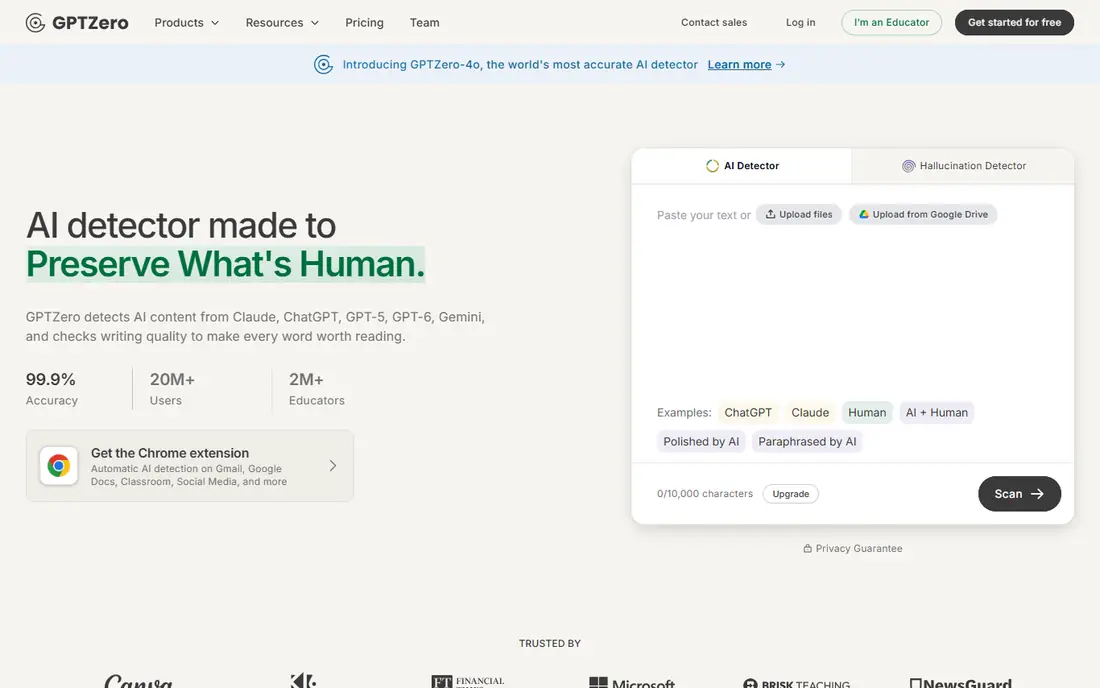
GPTZero started as an education tool and still fits classrooms best. Its free plan covers 10,000 words a month, which is enough for triage of student work, and sentence-level highlighting shows which passages triggered the score rather than hiding behind one number. Writing replay, which shows how a document was composed in supported editors, adds useful context that a raw score cannot give.
The caution applies to every tool here, but it matters most where grades are at stake. GPTZero states high accuracy for human text on its own site, yet independent studies have found detectors unreliable on paraphrased and second-language writing. Use it to start a conversation with a student, not to end one. Paid plans start at $14.99 a month for larger word volumes and team features.
- Generous free tier at 10,000 words a month
- Sentence-level highlighting
- Writing replay feature
- Vendor accuracy claims are not independent proof
- Plan lineup has changed often
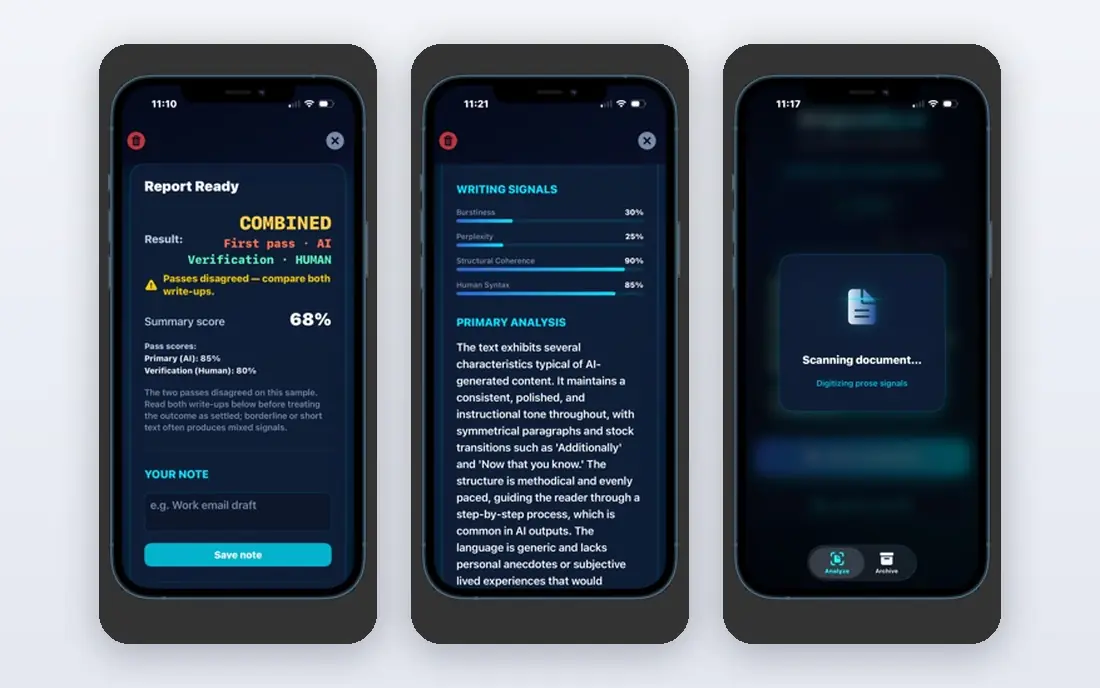
Originality.ai is built for publishers, agencies and content teams that need to check freelance work at volume. One report can cover AI detection, plagiarism, readability and fact checking, and full-site scans help editors audit a whole publication rather than one article at a time. Team management and history make it workable for an editorial workflow.
Credit pricing needs care. The Pro plan includes a monthly credit pool, and running AI plus plagiarism checks together consumes credits faster than a single check. At $14.95 a month, or $12.95 billed annually, it is priced for professional use rather than casual checks. For a publisher that needs audit trails and team controls, it is the strongest pick here.
- AI, plagiarism, readability and fact checks in one report
- Full-site scans
- Team management
- Credit-based pricing can be confusing
- AI plus plagiarism checks use extra credits

Copyleaks suits schools, universities and companies that need detection inside existing systems. It integrates with learning management systems, offers an API for screening at scale, and covers many languages for both AI detection and plagiarism. A Google Docs add-on and AI image detection broaden it beyond plain text pasted into a website.
The Personal plan, at $16.99 a month or $13.99 billed annually, is limited to 25,000 words a month, so heavy users move quickly to higher tiers. Enterprise buyers should get a written quote for volume and integration needs. For an institution that needs detection as part of a wider integrity system, Copyleaks is a leading choice.
- Detection in many languages
- Plagiarism in over 100 languages
- LMS and API options
- AI image detection
- Personal plan includes only 25,000 words a month
- Enterprise pricing is custom
Turnitin is not a tool an individual buys. It is licensed by schools and universities, and its AI detection sits inside the same workflow teachers already use for similarity reports. That integration is its strength: scores appear beside existing academic integrity tools, with institutional settings and controls around them.
Individuals, freelancers and small publishers cannot buy it directly, and pricing is not public, so we list it as See website. Its vendor claim of a low false positive rate above a threshold should still be read with the same caution as every detector claim. If your institution already licenses Turnitin, use it in that workflow. If not, start with GPTZero or Originality.ai.
- Deep LMS integration
- Institutional controls
- AI detection beside plagiarism and similarity reporting
- No public price
- Only available through an institution
- Not for individual buyers
Winston AI fits agencies and educators who need a report they can hand to a client or file. Its shareable PDF reports make results easy to present, and OCR support means scanned or handwritten material can be checked rather than only typed text. AI image checks add a further layer for teams reviewing visual content.
The entry Essential plan costs $18 a month, or $10 billed annually, and plagiarism checking and team seats sit on the Advanced plan and above. That tiering matters for an agency that needs both checks for several staff. For report-led work, especially with PDFs and scanned material, Winston is a strong pick.
- Shareable PDF reports
- OCR for handwriting
- AI image and deepfake checks
- Plagiarism and team seats start on higher plans
- Monthly plan is pricier than annual
ZeroGPT is the budget option for a quick check before publishing or submitting work. Its free tier needs no card, and results break down by document, paragraph and sentence, which is more useful than a single percentage. The Pro plan, from $9.99 a month, bundles extra writing tools that some users will value.
The trade-offs are reporting depth and evidence. Public accuracy data is thinner than for GPTZero or Originality.ai, and the free tier carries ads. It is fine for personal triage and casual checks. It is not the right backbone for a publisher or school that needs audit trails and consistent reporting.
- Free checks without an account for quick use
- Document and sentence-level results
- Low paid price
- Ads on the free tier
- Less public accuracy data than leading rivals
- Weaker reporting for teams
Sapling fits teams that want detection where writing happens, rather than as a separate website visit. Its browser and app integrations put a detector inside Chrome, Google Docs, Outlook and Word, and a developer API lets companies screen text inside their own tools. That workflow suits support teams and companies checking inbound content.
Reporting is narrower than a dedicated integrity platform, and the Pro plan at $25 a month, or $12 billed annually in some listings, needs checking against the current plan table before buying. For a developer or a team that needs detection embedded in other software, Sapling is the most practical pick here.
- Detector inside Chrome, Docs, Outlook and Word
- Metered developer API
- Free checks up to 2,000 characters
- Narrower reporting than dedicated integrity tools
- Pro price is high for the word volume
QuillBot makes sense only if you already use QuillBot. Its AI detector sits beside a paraphraser, grammar checker and plagiarism checker, so a student can check and revise work in one place. Free checks cover 1,200 words per check, which suits short assignments, and Premium at $19.95 a month, or $8.33 billed annually, gives full access.
As a standalone detector it is not the strongest on this list, since detection is a secondary feature rather than the core product. Students who already pay for QuillBot get useful extra value from it. Buyers who need detection alone should pick GPTZero or Originality.ai instead.
- Detector bundled with paraphraser and plagiarism checker
- Free checks up to 1,200 words
- Familiar student tool
- Detection is one feature in a wider suite
- Full access needs Premium
Scribbr offers a free AI detector that students can use without an account for a quick check. That low friction is its main appeal: paste text, get a result, and decide whether to revise or seek advice. Paid plagiarism checks per document are available for students who need a fuller integrity check before submission.
It is not built for publishers, agencies or schools that need history, team seats or API access. For a student who wants a fast second opinion beside another detector, Scribbr is a useful free extra. For professional use, pair it with a reporting tool rather than relying on it alone.
- Free detector with no account needed for a quick check
- Plagiarism checks available as a paid add-on
- Limited depth for professional workflows
- No team or API features for publishers
How we picked these
We compared official pricing pages, free limits, reporting detail, language coverage and integration options, and we weighed independent research on detector accuracy alongside vendor claims. We kept only tools that are live in October 2026 and that offer a real AI text detection function, and we left out tools whose main product is humanising or evading detection. Vendor accuracy figures are reported as vendor claims, not as verified facts, because methods and test sets differ.
How to use a detector responsibly
Never act on one score alone. Run a second tool, read the flagged passages yourself, and check the draft history, notes or sources behind the work. Detectors struggle most with short texts, heavily edited text, paraphrased text and formal writing, so a high score on a short or formulaic passage is weak evidence. For academic or employment decisions, a human review and a conversation with the author should come before any penalty.
Also check privacy before pasting sensitive text. Read the retention and training terms for each tool, since drafts may be stored or used in ways that matter for unpublished work. For student work, follow your institution policy on detector use and disclosure. A detector is a triage tool that helps a human decide where to look, not a verdict machine.
Frequently asked questions
What is the best AI content detection software for publishers?
Originality.ai is our publisher pick because it combines AI detection, plagiarism, readability and fact checks with full-site scans and team controls. GPTZero is a good second check for individual articles. Use both where a freelance dispute or a client audit is at stake.
What is the best AI content detection platform for teachers?
GPTZero is the strongest teacher pick for its free tier, sentence highlighting and classroom-friendly workflow. Turnitin is the better pick inside an institution that already licenses it, since scores sit inside existing LMS workflows. Either way, use scores to start a conversation, not to assign a penalty alone.
Are AI content detectors accurate?
They are useful but not reliable enough to prove authorship. Vendor claims often exceed real-world performance, and independent studies have found high misclassification rates for second-language and formulaic writing. Treat results as one signal, run a second tool, and add human review before acting.
Can AI detectors be fooled by paraphrasing?
Yes. Paraphrasing, heavy editing and humanising tools degrade detector performance sharply, which is one reason scores should never be treated as proof. A low score does not prove a text is human, just as a high score does not prove it is machine written.
Is there a good free AI content detector?
GPTZero offers 10,000 free words a month, ZeroGPT offers free checks without a card, and Scribbr offers a free quick check. For casual use, GPTZero is the most useful free option because of its sentence detail and word allowance. Professional users will still need a paid plan for volume and reporting.
Sources
See where you really rank - block by block
ProMapRanker scans Google Maps across a grid of your service area. Simple monthly plans from $19, white-label on every plan.
Start freeKeep reading
 zscaler alternatives
Best Zscaler Alternatives in 2026
Looking for zscaler alternatives? We compare 9 SASE and zero trust platforms on architecture, data protection, pricing, and fit for your network and team.
Read → zapier alternatives free
Best Zapier Alternatives Free in 2026
Nine automation tools for zapier alternatives free in 2026, all with genuinely free tiers, plus free plan limits, starting prices and upgrade paths explained.
Read → which platform is best for online reputation
Which Platform Is Best for Online Reputation in 2026
Wondering which platform is best for online reputation? We compare 8 review, listing, and response tools for small and multi-location businesses and agencies.
Read →