 ProMapRanker
Best AI Card Grading App in 2026

Key takeaways
- CardGrading.app, CardGrade and CardGrade IQ suit collectors who want a clear pre-grade before paying for official grading.
- CollX and Ludex suit collectors who also want pricing, collection tracking and a marketplace in the same app.
- No AI app gives an official grade, so treat every result as a screening estimate, not a PSA, BGS or CGC grade.
- Photo quality drives accuracy, so scan front and back in even light on a dark, non-reflective surface.
Quick comparison
| Pick | Great for | Pricing starts at | Free tier | |
|---|---|---|---|---|
 CardGrading.app | Pre-grading before PSA | $9.99 per pack | Yes | Visit |
 CardGrade | Low-cost monthly pre-grading | $4.99 per month | Yes | Visit |
 CardGrade IQ | Detailed pre-grade reports | Free | Yes | Visit |
 Mint Condition | Dealer-scale pre-grading | $5 per pack | Yes | Visit |
 CardMintAI | Fast single-photo pre-grades | Free | Yes | Visit |
 HSA Card Grade Pro | Free monthly scans plus Pro | Free | Yes | Visit |
 CollX | Scanning, pricing and selling | Free | Yes | Visit |
 Ludex | Sports and TCG scanning plus pricing | Free | Yes | Visit |
The best AI card grading app
AI card grading apps estimate a card condition grade from photos, usually by scoring centering, corners, edges and surface. They are useful for deciding which cards are worth sending to PSA, BGS or CGC, since official grading fees and shipping add up fast. They are not official grades, and they do not authenticate a card. We compared vendor pages, pricing pages and app store listings in October 2026. This is not financial advice, and card values change with the market, so check recent sales before you buy or sell.
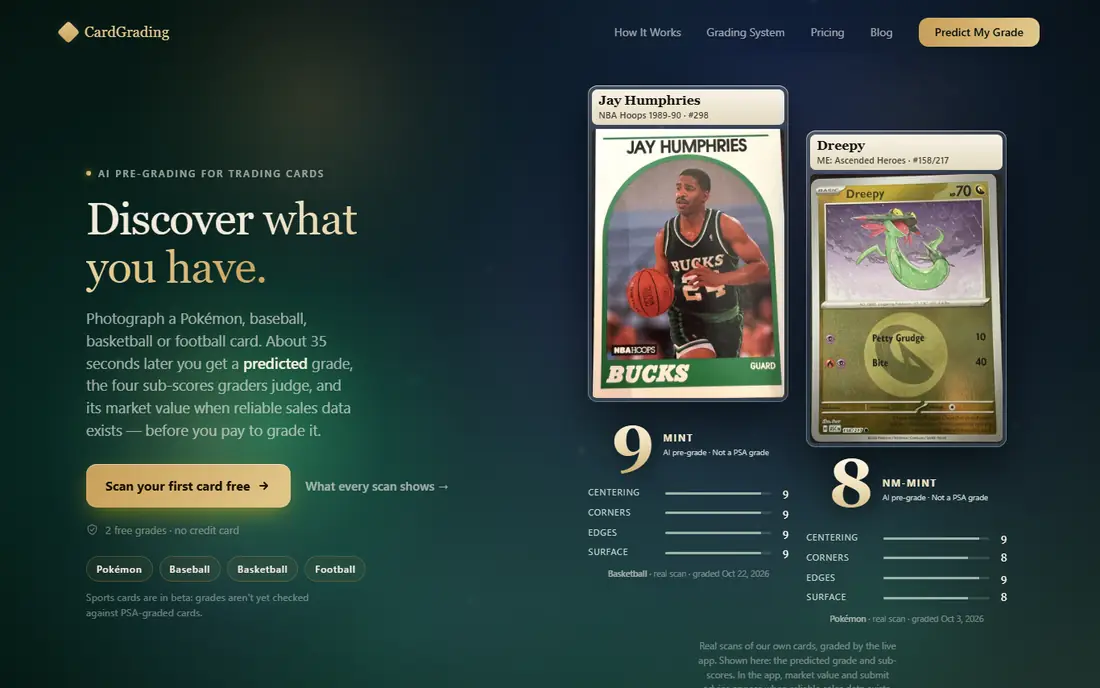
CardGrading.app suits a collector with a small stack of possible submissions who does not want another monthly subscription. New accounts get two free grades plus a free price check and bulk scan, then one-time packs cost $9.99 for five decisions, $19.99 for 15 and $49.99 for 50, with decisions that do not expire. That pay-once model is easy to budget for occasional grading decisions.
The app focuses on Pokemon cards in its main pitch, so sports collectors should check coverage for their sets before buying a pack. As with every tool here, the result is an estimate based on photos, not a PSA grade. Use it to filter out cards that are unlikely to grade high, then submit only the strongest candidates.
- Clear one-time packs with no subscription
- Free grades for new accounts
- Grade in about 35 seconds in vendor claims
- Packs are pay-per-decision
- Accuracy depends on photo quality
- Not an official grade
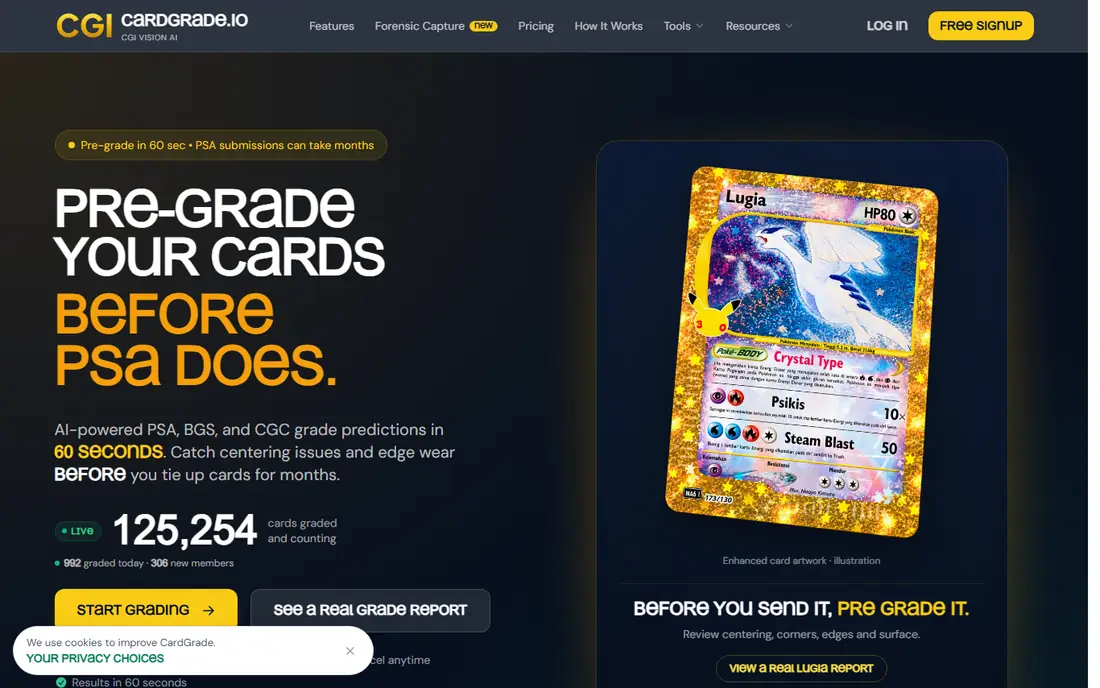
CardGrade suits a collector who pre-grades a steady trickle of cards each month. Plans start at $4.99 per month for 10 grades, $9.99 for 25, $24.99 for 80 and $74.99 for 300, with credit packs from $5 that do not expire. That tiering makes the per-card cost easy to compare with a one-time pack tool.
The monthly cap matters if you scan in bursts. A dealer with a large intake may hit the cap quickly and need a higher tier or a pack top-up. For a hobby collector grading a few cards a month before submission, CardGrade is one of the cheapest and clearest monthly options here.
- Low monthly starting price
- Credit packs from $5
- Clear per-card cost at each tier
- Monthly grades are capped
- Accuracy is an estimate only
- Coverage varies by card type
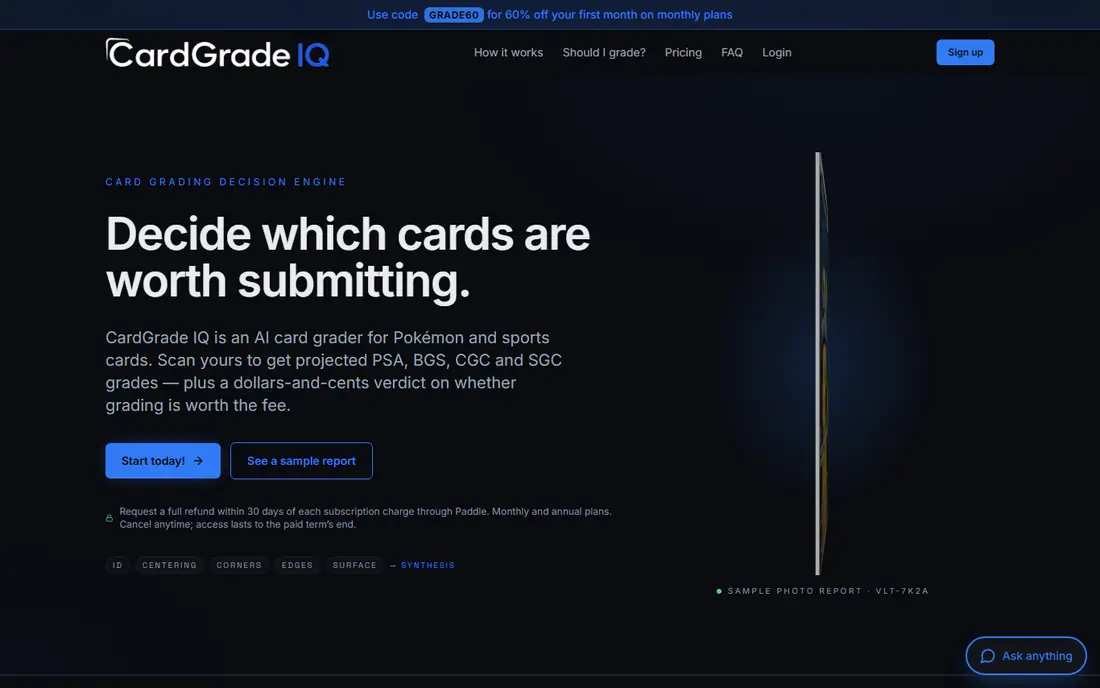
CardGrade IQ suits a collector who wants to understand why a card scored as it did, not just a single number. Each report shows confidence, names what limited the grade and tells you when photos were not good enough to make a call. That transparency helps you reshoot a card rather than accept a weak estimate.
The free offer is two lifetime grades, not a monthly reset, so use them on cards you actually care about. The Collector plan is listed at $24.99 per month for 100 scans, with a first-month discount, plus a per-scan charge for extras. For detailed pre-submission checks, that report depth is worth the higher monthly price.
- Two free lifetime grades
- Detailed reports with confidence and limiting factors
- Sample report available before signup
- Paid plan starts at $24.99 per month after discount
- Free grades do not reset
- Extra scans cost more
Mint Condition suits a dealer or high-volume collector who needs to triage many cards fast. Starter packs start at $5 for 10 scans on first-pack pricing in vendor listings, with larger packs dropping the per-scan cost to around $0.25 at scale. Phone camera triage and uploaded photos both work, which helps when you are scanning at a show or in a shop.
As a newer tool, it has less long-term track record than CollX or Ludex for pricing and collection features. Test it on cards you already know well before you rely on it for buying decisions. For pure pre-grading volume at a low per-scan cost, it is a strong option.
- Low per-scan cost at scale
- Phone camera and upload options
- Built for dealer workflows
- Newer brand than PSA-adjacent tools
- Pricing is pack-based
- Accuracy claims need your own testing
CardMintAI suits a collector who wants a quick check from one photo before deciding whether to scan properly. It is free to try with no credit card, and it returns a predicted grade with sub-grades for centering, corners, edges and surface. It covers sports cards plus Pokemon, Magic and Yu-Gi-Oh, which makes it useful for mixed collections.
Single-photo grading is also its limit. A back defect, such as a crease or print flaw on the reverse, will not show in a front photo, so always scan front and back for any card you plan to submit. Use CardMintAI for a fast first filter, then use a detailed tool for final submission decisions.
- Free to try with no card required
- Fast single-photo grades
- Covers sports and TCG
- Accuracy claims are vendor claims
- Paid credit pricing is less detailed in listings
- Single-photo grades can miss back defects
HSA Card Grade Pro suits a collector who wants a regular free allowance without paying each month. The free plan offers five scans per calendar month with front and back upload and sub-grade assessment. Pro costs $9.99 per month for 600 scans, with market values, collection management and CSV export, while a higher tier adds API and dealer tools.
Five free scans will not cover a large intake, but they are enough for a hobbyist grading a few key cards a month. Vendor accuracy claims of within half to one grade point should be tested on your own cards, since lighting and centering affect every AI tool. For a free monthly habit, HSA is a practical starting point.
- Five free scans per month
- Pro at $9.99 per month
- Collection and export tools on paid plans
- Free scans are capped monthly
- Accuracy is within a grade point in vendor claims
- Newer brand
CollX suits a collector who wants scanning, pricing, collection tracking and selling in one app, rather than a pure pre-grading tool. Scan a card to identify it, track its value, and buy or sell through the marketplace with CollX Protect, which holds payment until the card arrives. Pro costs $9.99 per month on the vendor site, with Gold at $24.99 per month for sellers who want lower commissions and monthly credit.
Its AI features help with insights and selling, but they do not replace a dedicated pre-grade report for submission decisions. Use CollX for identification, pricing and trading, and pair it with CardGrading.app or CardGrade IQ when you need a detailed condition estimate before sending a card to PSA.
- Large card database
- Marketplace with buyer protection
- CollX AI and Pro tools for sellers
- AI grading is not its main focus
- Pro costs $9.99 per month
- Price estimates are not official values
Ludex suits a collector with mixed sports and trading card game holdings who wants fast identification and pricing in one scan. It identifies series, year, brand and player from a photo, pulls market values from marketplace sales, and offers tools to list on eBay. That breadth makes it useful for a collection that spans baseball, basketball, Pokemon and Magic.
Grading assistance is lighter here than in dedicated pre-graders, and some listings note that Ludex lacks detailed grade-split pop reports. Use Ludex for identification and pricing, and use a dedicated pre-grader for the final condition call on cards you plan to submit. For everyday scanning and selling, it remains one of the fastest tools in this list.
- Fast AI identification for sports and TCG
- Market values from marketplace sales
- EBay listing tools
- Grading assistance is lighter than dedicated pre-graders
- Free scan limits vary by listing
- No grade-split pop reports in some listings
How we picked these
We compared vendor pricing pages, feature pages and app store listings in October 2026. We kept tools that offer AI condition estimates, AI identification with grading assistance, or both, and that are still available for collectors today. Where pricing varies by listing or by app store, we used the vendor site price where available and wrote the starting price as Free for apps with a free entry tier.
How to get a useful AI pre-grade
Photo quality matters more than which app you pick. Photograph the card front and back in even light on a dark, non-reflective surface, with the card centered and in focus. Avoid glare, shadows and sleeves that add reflections, and reshoot if the app warns that photos were not good enough. A weak photo produces a weak estimate, no matter how good the model is.
Next, count the full submission cost before you send anything. Include the grading fee, shipping both ways, insurance and declared value, plus the time your card will be away. AI pre-grading saves money only when it stops you from submitting cards that would grade low, so submit only the cards where the estimate, the recent sales for that grade and the fee together make sense.
Treat every AI grade as a screening step
No app here assigns an official PSA, BGS or CGC grade, and actual grades may differ by a point or more. Use AI grades to rank candidates, then inspect the top cards yourself under good light for centering, corners, edges and surface. If a card is close to a grade boundary, get a second opinion from another tool or from a trusted dealer before you pay for submission.
Frequently asked questions
What is the best AI card grading app for free?
HSA Card Grade Pro offers five free scans per month, CardGrading.app offers two free grades for new accounts, and CardGrade IQ offers two free lifetime grades. CollX and Ludex also offer free scanning tiers for identification and pricing.
What is the best free AI card grading app for Pokemon cards?
CardGrading.app and CardMintAI both focus on Pokemon pre-grading with free entry points, while CardGrade also covers Pokemon in its AI pre-screen. Scan front and back, since a single front photo can miss back defects.
Is an AI grade the same as a PSA grade?
No. An AI grade is a predicted estimate from photos, while a PSA grade is an official grade assigned after physical inspection. Use AI tools to decide what to submit, not as a replacement for official grading.
How accurate are AI card grading apps?
Accuracy varies by photo quality, card type and model, and vendor claims should be treated as estimates. Many tools claim results within about one grade point for clear, well-lit photos, but actual PSA grades may differ, so test a tool on cards you know well first.
Should I pre-grade cards before sending them to PSA?
In most cases, yes, when grading fees are high. Pre-grading helps you submit only cards likely to grade 9 or 10, where value gains are largest, and avoid paying fees on cards that would grade lower.
Sources
See where you really rank - block by block
ProMapRanker scans Google Maps across a grid of your service area. Simple monthly plans from $19, white-label on every plan.
Start freeKeep reading
 zoho inventory alternatives
6 Alternatives to Zoho Inventory, Compared on Price and Fit
Zoho Inventory alternatives: 6 tools compared on price, free plans and fit. Katana leads the list for manufacturers. Fit and flaws are laid out for each entry.
Read → zoho crm alternatives
Best Zoho CRM Alternatives (2026)
Need Zoho CRM alternatives? We compare 7 tools on cost, free access and who each suits. Every pick gets a straight assessment. Built for quick decisions.
Read → zelle alternatives
Best Zelle Alternatives in 2026
Compare the best Zelle alternatives for sending money to friends, paying sellers and moving funds abroad, with honest notes on fees, speed and safety in 2026.
Read →