 ProMapRanker
Best AI Agent Development Companies in 2026


Enterprise multi-agent systems · Pricing starts at: See website
Key takeaways
- The strongest firms show production agents, not demos, with clear links to real business systems.
- Enterprise buyers should weigh governance and support, while startups should weigh speed and a scoped first build.
- Voice and conversational agents need different skills from back-office workflow agents, so match the firm to the use case.
- Custom pricing is the norm, so a short paid pilot often tells you more than a long sales deck.
Quick comparison
| Pick | Great for | Pricing starts at | Free tier | |
|---|---|---|---|---|
| LeewayHertz | Enterprise multi-agent systems | See website | No | Visit |
 Markovate | Workflow agents for growing firms | See website | No | Visit |
 Master of Code Global | Conversational and voice agents | See website | No | Visit |
 Azumo | Nearshore engineering teams | See website | No | Visit |
 SoluLab | AI plus blockchain projects | See website | No | Visit |
 Suffescom Solutions | Full-stack agent builds | See website | No | Visit |
 Intuz | End-to-end enterprise deployment | See website | No | Visit |
 Tribe AI | Senior AI engineering bench | See website | No | Visit |
 HatchWorks AI | Guided move from chatbot to agent | See website | No | Visit |
The best ai agent development companies
These firms build agents that plan steps, call tools, and work with business data, rather than simple scripted chatbots. We compared their stated focus, client fit, and delivery models.
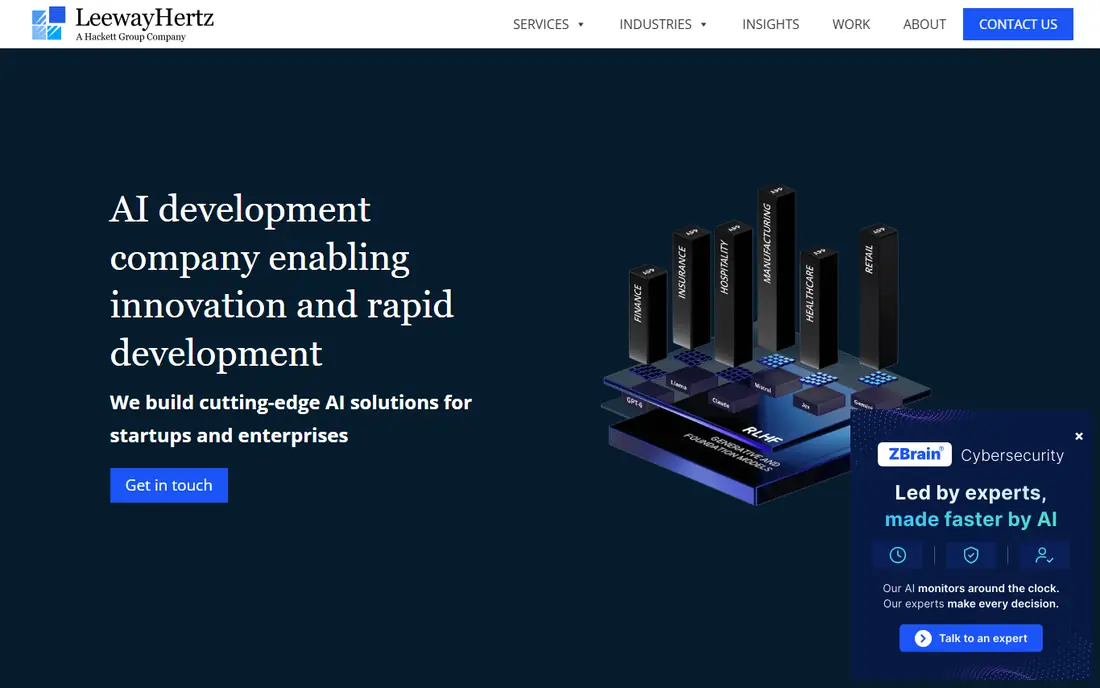
LeewayHertz is a frequent name on enterprise agent lists, and its focus on multi-agent systems fits firms with complex workflows. Its platform approach, alongside custom development, helps when several agents must share data, tools, and rules. Industries such as finance, healthcare, and supply chain appear often in its work.
The trade-off is fit. A small firm with one clear task may find the process heavy and the price high. LeewayHertz suits buyers who already know the workflow, the systems involved, and the governance rules the agent must follow.
- Deep enterprise experience
- Multi-agent orchestration focus
- Platform plus custom build
- Enterprise pricing and process
- Overkill for a simple agent
- Longer sales cycle
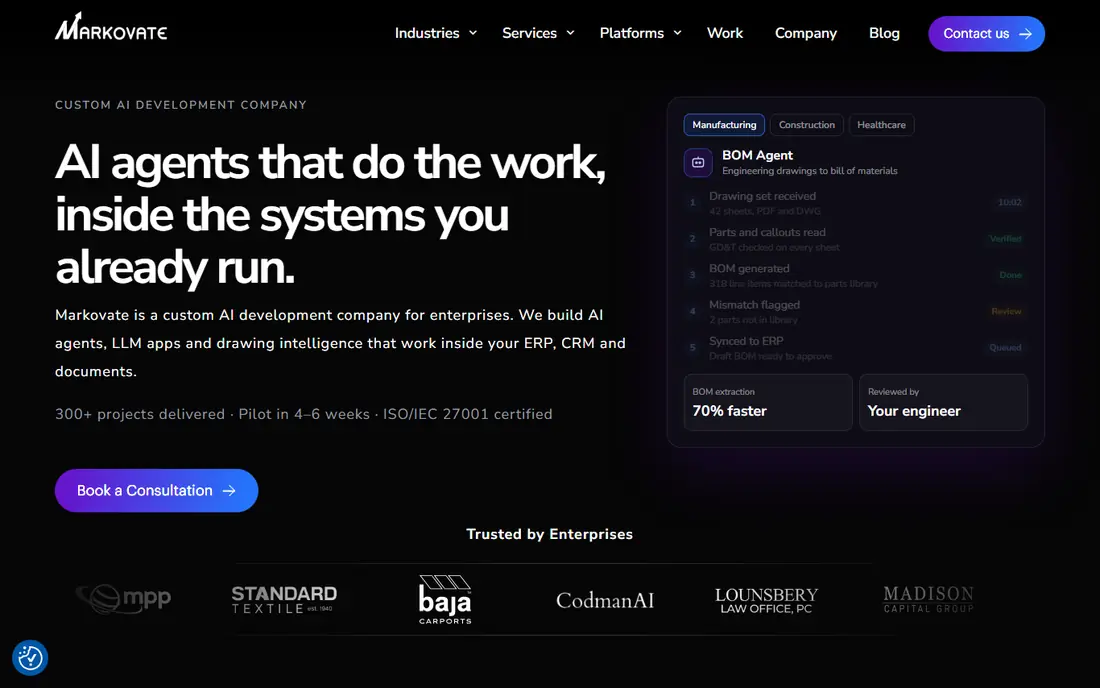
Markovate fits firms that want a working agent tied to a defined workflow, such as claims, reporting, or operations. Its end-to-end model covers product design and build, which helps teams without a large internal AI staff. That focus makes it a practical choice for a first production agent.
Scope control matters here. A workflow agent grows quickly if every edge case is added before launch. Agree on one workflow, one set of tools, and clear success measures, then expand only after the first version works in daily use.
- End-to-end product builds
- Workflow-specific agents
- Faster path for startups and mid-market firms
- Custom pricing
- Quality depends on scope control
- Less suited to very large transformation programmes

Master of Code Global is a strong pick when the agent talks to customers. Its work covers conversational design, voice agents, and multi-channel support, which need different skills from a back-office automation. Tone, fallback handling, and handoff to a human all matter more in this setting.
Buyers should test the agent with real customer language, not clean demo scripts. Ask how it handles unclear requests, angry customers, and cases it cannot solve, and how those cases reach a person. A voice agent that sounds smooth in a demo but fails on real calls is not a finished product.
- Strong conversational AI background
- Voice and customer-facing agents
- Enterprise rollout experience
- Enterprise focus
- Custom pricing
- Less focused on back-office data agents
Azumo suits a firm that wants an engineering team rather than a one-off project handoff. Its nearshore model gives North American clients closer time-zone overlap than a far-offshore team, while still offering cost flexibility. That model works well when the client can own product decisions and review work often.
The risk is ownership. A staffed team still needs a clear product owner, a backlog, and regular reviews, or progress drifts. Azumo is a better fit for firms with internal product leadership than for firms that want the vendor to decide everything.
- Nearshore teams for North American clients
- AI and software engineering depth
- Flexible team models
- Staffing model needs strong internal product ownership
- Custom pricing
- Time-zone fit varies by location
SoluLab is worth a look when an agent must work alongside blockchain or Web3 systems, such as decentralised finance tools or token-based workflows. That combination is rare, and a firm that already understands both sides can save time on integration. It also builds standard AI agents for mid-market clients.
For a plain customer support or operations agent, the blockchain angle adds nothing. Judge SoluLab on its agent work alone in that case, and ask for a comparable case study without any blockchain element.
- Combined AI and blockchain experience
- Mid-market fit
- Custom product builds
- Niche combination may distract from a plain agent need
- Custom pricing
- Project scope needs care
Suffescom Solutions fits firms that want an agent plus the product around it, such as a web or mobile app, an admin panel, and integrations. Its full-stack range helps when the agent is part of a larger product launch rather than a standalone tool. Voice agents are also part of its stated work.
Breadth needs checking. Ask which team will build your agent, what they built recently in the same area, and how support works after launch. A firm with many service lines can still be excellent, but the specific team matters more than the service list.
- Full-stack builds including voice agents
- Broad product experience
- Web and mobile delivery
- Broad range can dilute depth
- Custom pricing
- Case fit varies by team
Intuz suits firms that need consulting, build, and deployment under one roof. Its multi-cloud and enterprise integration focus helps when an agent must connect to several older systems, not just one modern app. That end-to-end model reduces handoffs between vendors.
The process can feel heavy for a small pilot. If your first need is a single agent for one team, a smaller, more focused firm may move faster. Intuz makes more sense when the agent is one part of a wider system change.
- Full consulting plus deployment
- Multi-cloud experience
- Enterprise system integration
- Enterprise process
- Custom pricing
- May be heavy for a small pilot
Tribe AI is a different model, built around a network of vetted senior AI engineers rather than a single in-house product team. That suits firms with a clear technical direction that need senior help to build it, especially for complex language model and agent work. The bench model also lets a team scale up or down.
Management is the catch. A network engagement still needs internal leadership, code review, and a shared plan, or quality will vary by person. Ask how engineers are matched, how they are reviewed, and what happens if a match does not work out.
- Vetted senior engineers
- Flexible engagement
- Strong fit for complex LLM work
- Network model varies by engineer
- Needs internal management
- Custom pricing
HatchWorks AI fits firms moving from a basic chatbot to a real agent with tool use and workflow steps. Its stated focus on method, governance, and post-deployment operations addresses the reason many agent projects stall after a pilot. For mid-market firms, that guidance can matter as much as the code.
A very small, single-purpose agent may not need this level of method. HatchWorks AI is best when the firm plans several agents over time and wants a repeatable way to build, test, and run them safely.
- Clear methodology for agent adoption
- Focus on governance and operations
- Mid-market fit
- Methodology-heavy for a tiny build
- Custom pricing
- Less known than the largest firms
How we picked these
We compared firms that were still offering AI agent development in October 2026 and that described production agent work, not only chatbot or consulting services. We checked stated specialties, client fit, and delivery models across enterprise, mid-market, and startup buyers. We left out firms with no clear agent service page and firms whose only evidence was a generic AI claim.
How to choose an agent development partner
Start with one workflow and one measure of success. Name the task the agent will complete, the systems it must touch, and the result that counts as success, such as time saved, cases resolved, or errors reduced. A vendor that cannot restate that workflow back to you in plain terms is not ready to build it.
Next, check production evidence. Ask for a live agent, a case study with real numbers, or a reference you can contact. Ask how the agent handles errors, how it logs its steps, who can see those logs, and how a human can stop or correct it. Governance is not extra paperwork here; it is how you stay in control of a system that acts on your behalf.
Finally, plan the pilot in writing. Agree on scope, data access, security rules, testing, and what happens to code and data if you part ways. A short paid pilot with real data and real users tells you more than a polished demo, and it limits risk if the fit is wrong. Keep the first build small, then expand only when the agent proves itself in daily use.
Frequently asked questions
What is the best AI agent development company?
LeewayHertz suits large enterprise multi-agent work, Markovate suits workflow agents for growing firms, and Master of Code Global suits conversational and voice agents. There is no single best firm, because the right partner depends on the workflow, the systems involved, and the budget.
How much does AI agent development cost?
Most firms price by project or retainer after a scoping call, so costs vary widely by workflow complexity, integrations, and support needs. A scoped pilot is often the cheapest way to get a firm price, and it also tests whether the vendor can deliver.
What is the difference between an AI agent and a chatbot?
A chatbot mainly answers or routes a conversation, while an agent plans steps, calls tools, checks results, and completes a task across systems. That difference is why agent projects need stronger testing, logging, and human oversight than a simple chat widget.
Should I build an agent in-house or hire a firm?
Build in-house when you have senior AI engineers, clear data access, and time to maintain the system. Hire a firm when you need speed, specialist skills, or experience with a similar workflow, and keep internal ownership of the product decisions and the data rules.
What should I check before signing with an agent firm?
Check production case studies, security practices, data handling, logging, human oversight, and exit terms for code and data. Agree on a pilot scope, success measures, and support terms in writing before committing to a large programme.
Sources
- https://www.ayautomate.com/blog/best-ai-agent-development-agencies
- https://perimattic.com/best-ai-agent-development-companies/
- https://www.leewayhertz.com
- https://www.markovate.com
- https://www.masterofcode.com
- https://www.azumo.com
- https://www.solulab.com
- https://www.suffescom.com
- https://www.intuz.com
- https://www.tribe.ai
- https://www.hatchworks.com
See where you really rank - block by block
ProMapRanker scans Google Maps across a grid of your service area. Simple monthly plans from $19, white-label on every plan.
Start freeKeep reading
 zscaler alternatives
Best Zscaler Alternatives in 2026
Looking for zscaler alternatives? We compare 9 SASE and zero trust platforms on architecture, data protection, pricing, and fit for your network and team.
Read → zapier alternatives free
Best Zapier Alternatives Free in 2026
Nine automation tools for zapier alternatives free in 2026, all with genuinely free tiers, plus free plan limits, starting prices and upgrade paths explained.
Read → which platform is best for online reputation
Which Platform Is Best for Online Reputation in 2026
Wondering which platform is best for online reputation? We compare 8 review, listing, and response tools for small and multi-location businesses and agencies.
Read →