 ProMapRanker
Best Agentic Analytics Platform for Data Analytics in 2026


Search driven agentic analytics · Pricing starts at: $25 per user per month
Key takeaways
- ThoughtSpot leads for search driven, agent based analytics, with a published entry price and a clear agent model.
- Tableau, Power BI, and Looker suit teams that already use those ecosystems and want agents grounded in governed metrics.
- Domo, Sigma, and Qlik suit teams that want agents inside a broader data app or spreadsheet style workspace.
- Zoho Analytics and Hex suit smaller or analyst led teams that want AI help without enterprise pricing.
- An agent is only as trustworthy as its metric definitions, so governance and source grounding matter more than demo speed.
Quick comparison
| Pick | Great for | Pricing starts at | Free tier | |
|---|---|---|---|---|
| ThoughtSpot | Search driven agentic analytics | $25 per user per month | Free trial | Visit |
 Tableau | Visual analytics with agents | $15 per user per month | Yes | Visit |
 Microsoft Power BI | Microsoft centered analytics | $14 per user per month | Yes | Visit |
 Looker | Governed metrics with AI | See website | No | Visit |
 Domo | Data apps with AI agents | See website | Free trial | Visit |
 Sigma | Spreadsheet style analytics | See website | Free trial | Visit |
 Qlik | Associative analytics with AI | See website | Free trial | Visit |
 Zoho Analytics | Low cost AI analytics | $24 per month | Free trial | Visit |
 Hex | Analyst notebooks with AI | See website | Yes | Visit |
The best agentic analytics platform for data analytics
Agentic analytics means more than a chatbot on a dashboard. The platforms in this list let an agent plan a question, run queries, check results, and present an answer, often with follow up steps. We favored platforms where agents work from governed data models, not only from raw tables, because that grounding decides whether an answer can be trusted.
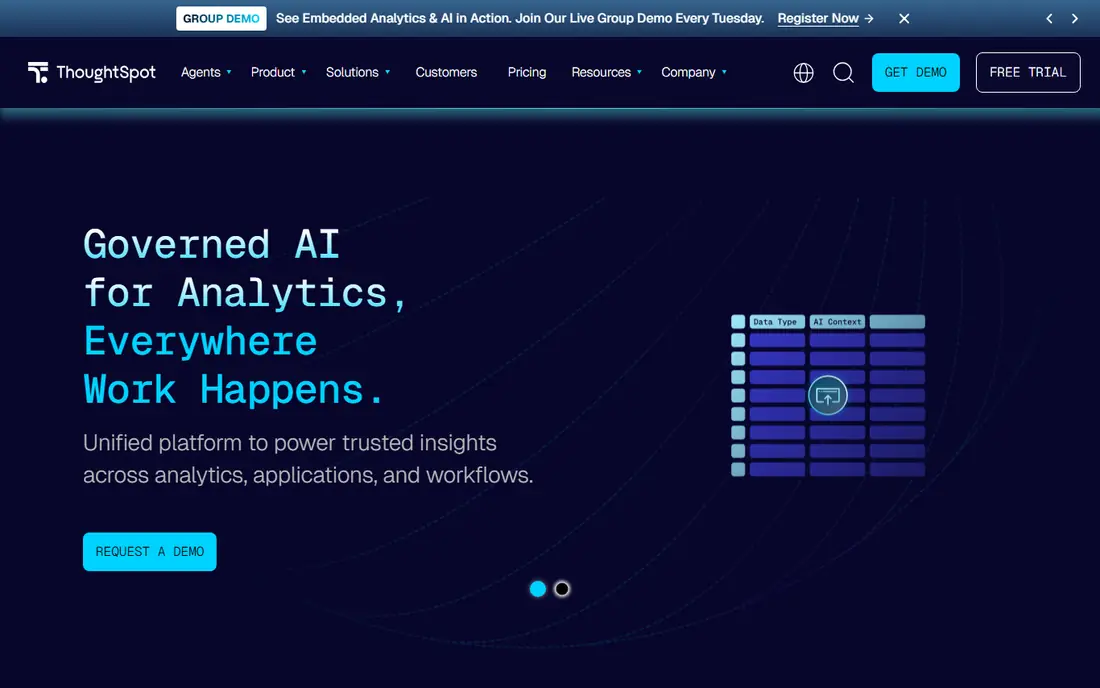
ThoughtSpot is our pick for agentic analytics, because its search first model fits how agents should work. A user asks a question in plain language, Spotter agents turn it into queries, and answers appear as charts and tables that can be refined with follow up questions. That flow suits business users who know the question but not the SQL.
The catch is modeling. Agents need clean, well defined data models to give good answers, and a messy warehouse will produce confident but wrong results. ThoughtSpot pricing also combines seats with consumption, so a team should check both parts before rolling out to a large user base.
- Search first interface
- Spotter agents for natural language questions
- Published entry pricing
- Search model needs good data modeling
- Costs rise with users and consumption
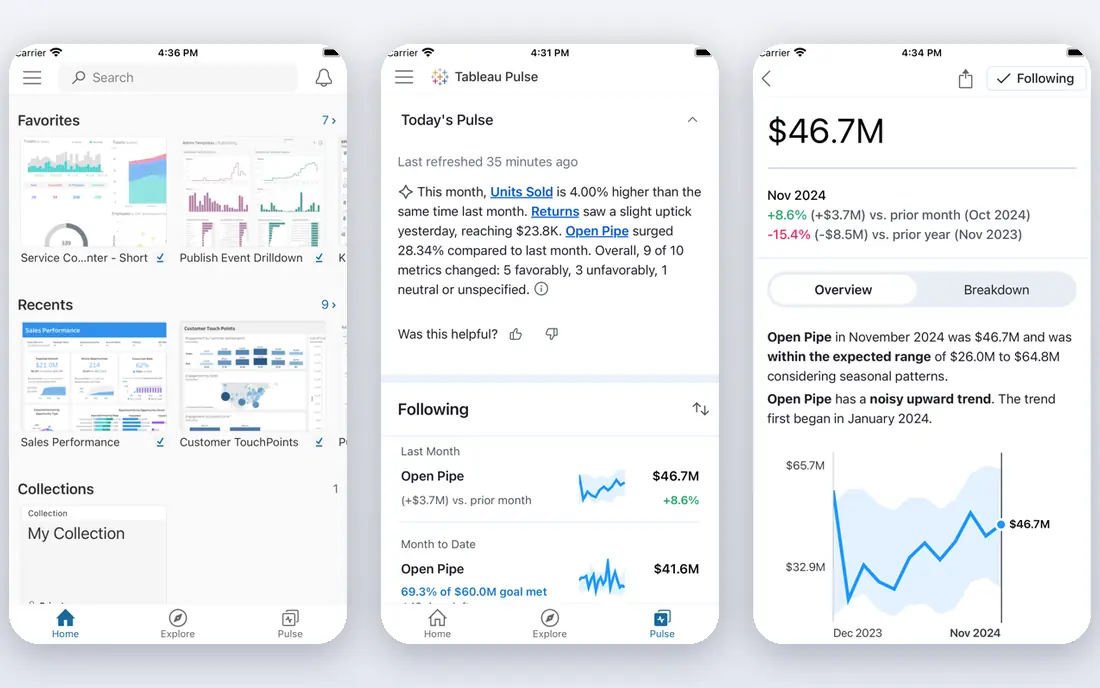
Tableau brings agents to a platform many analysts already know. Tableau Agent answers natural language questions, Pulse surfaces AI driven insights, and Tableau Next adds agents inside Salesforce and Slack. Visual exploration remains the core strength, with agents as a faster route to a chart or an explanation.
The limit is licensing. Viewer, Explorer, and Creator tiers carry different capabilities, and agent features may need a higher plan or a specific cloud tier. A team should map its user types to tiers before buying, and should test whether agent answers respect the same filters and permissions as a manual dashboard.
- Deep visual analytics
- Tableau Agent and Pulse for AI insights
- Free Desktop option
- Licensing across Viewer, Explorer, and Creator tiers can be complex
- Agent features vary by plan
Power BI is the best agentic pick for a Microsoft centered company. Pro gives a low entry price, Copilot helps draft narratives, explain charts, and build visuals, and Fabric capacity adds deeper AI features for larger teams. Integration with Excel, Teams, and Azure data sources is a practical advantage.
The caution is that Copilot features depend on capacity and plan, not only on a Pro license. A small team may find some agent features gated behind Fabric capacity, which changes the cost. Modeling also still matters: Copilot helps faster on a clean semantic model than on a raw table.
- Low Pro entry price
- Copilot for narrative and chart help
- Strong Microsoft 365 fit
- Copilot needs Fabric capacity on higher tiers
- Modeling still needs analyst skill
Looker suits a team that cares most about metric trust. LookML defines each metric once, so an agent, a dashboard, and a report all use the same definition. Gemini powered conversational analytics then lets users ask questions against those governed models, which reduces the risk of two teams reporting different numbers for the same metric.
The trade-off is skill and cost. LookML needs dedicated modelers, and pricing is quoted rather than self serve. For a Google Cloud team with a governance mandate, that investment pays off. For a small team that wants quick AI answers, a lighter tool will be faster.
- LookML gives consistent metric definitions
- Gemini powered conversational analytics
- Strong Google Cloud fit
- Pricing is quoted and enterprise level
- LookML needs dedicated modeling skill
Domo is a broad platform that now includes AI agents inside data apps, not only inside dashboards. AI Chat answers questions, custom agents can be built for repeat tasks, and connectors bring data from many sources into one place. That breadth suits a company that wants apps, alerts, and analytics together.
The downside is pricing clarity. Domo uses consumption credits and quoted pricing, so a team should ask for a worked example based on its users and data volume. A team that only needs dashboards may also find Domo heavier than Tableau or Power BI.
- Broad data app platform
- AI Chat and custom agents
- Many connectors
- Pricing is credit based and quoted
- Platform breadth can feel heavy for a simple BI need
Sigma suits business users who think in spreadsheets but need live warehouse data. Workbooks look familiar, formulas and pivots work on live data, and Sigma Assistant and agents help build analyses and answer questions. Because data stays in the warehouse, there is no extract to refresh.
The limit is the warehouse requirement. Sigma needs a cloud warehouse such as Snowflake or BigQuery, so a team without one must set that up first. Pricing is also quoted, which makes a quick cost comparison harder than with ThoughtSpot or Power BI.
- Spreadsheet familiar interface on live warehouse data
- Sigma Assistant and agents
- No data extracts needed
- Pricing is quoted
- Warehouse first design needs a cloud warehouse
Qlik brings AI to an associative model that shows how data points relate, not only the result of a single query. Qlik Answers and the AI assistant help users ask questions and explore related values, which suits analysts who investigate a problem from several angles. Data integration features also help when sources sit outside the warehouse.
The trade-off is learning curve and pricing. New users may need time to use the associative model well, and many plans are quoted. A team that already uses Qlik will get the most from its agents, while a new team should compare the onboarding effort with ThoughtSpot or Power BI.
- Associative engine for exploring related data
- Qlik Answers and AI assistant
- Strong data integration
- Pricing is quoted for many plans
- Interface learning curve for new users
Zoho Analytics is the best low cost route into AI assisted analytics. Ask Zia answers natural language questions, insights surface trends, and the entry price covers a small team. Connectors cover Zoho apps and many third party tools, which suits a company already in the Zoho ecosystem.
The limit is depth. Zia and insights help with common questions, but they are simpler than the agent workflows in ThoughtSpot, Tableau, or Domo. For a small team that needs affordable AI help on routine reporting, Zoho is good value. For a large team with complex governance needs, an enterprise platform will fit better.
- Low entry price
- Ask Zia for natural language questions
- Broad Zoho and third party connectors
- Less depth than enterprise BI at scale
- AI features are simpler than agent platforms above
Hex suits a data team that works in notebooks and wants AI help inside that workflow. Analysts can query, chart, and build data apps in one place, with AI assistance for SQL, Python, and explanations. A free tier lets a small team test the workflow before paying.
The catch is audience. Hex is built for analysts, not for casual business users who want a search bar answer. A company that needs self serve analytics for non technical staff should pair Hex with a business facing tool, or pick ThoughtSpot, Tableau, or Power BI as the main platform.
- Notebook and app workflows for analysts
- AI help for SQL and Python
- Free tier for testing
- More analyst focused than business user focused
- Pricing for teams needs a quote for larger use
How we picked these
We compared official feature and pricing pages, agent capabilities, governance models, and warehouse or ecosystem fit, and we favored platforms with clear agentic features in October 2026, not only a chatbot label. We kept tools that let an agent plan, query, and present results, and we left out tools with only basic natural language search and no agent workflow. Where a starting price could not be verified on the vendor page at the time of writing, we wrote See website.
What to check before you choose
Start with metric governance. Ask each vendor how an agent chooses a metric definition, whether it can show the query it ran, and whether row level security applies to agent answers. An agent that bypasses permissions or invents a metric is a risk, not a feature.
Next, test the agent on your own questions, including a hard one with a known answer. Check whether it cites sources, shows its work, and admits uncertainty when data is missing. Finally, model cost on real users and usage, since agent features often sit on higher tiers or consumption credits that a headline seat price does not show.
Frequently asked questions
What is agentic analytics?
Agentic analytics uses AI agents that plan a question, run queries, check results, and present an answer, often with follow up steps. It goes beyond a single chatbot reply, because the agent can chain steps and use tools. The quality of the result still depends on governed data models and on whether the agent shows its work.
Which agentic analytics platform is best for most teams?
ThoughtSpot is the best starting point for search driven agentic analytics, because its agent model and entry pricing are clear. Tableau and Power BI suit teams already in those ecosystems, while Looker suits teams that need strict metric governance. Pick the platform that matches your existing stack and your governance needs.
Can AI agents replace data analysts?
No. Agents speed routine questions and first drafts, but they can misread a metric, miss a data quality issue, or present a plausible but wrong answer. Analysts still need to define metrics, check agent output, and handle complex or sensitive decisions. Treat agents as assistants, not as replacements.
How do I keep agent answers trustworthy?
Use governed metric definitions, require the agent to show its query and sources, and apply the same permissions as dashboards. Test agents on known answers before rollout, and set a rule that any figure for an external report must be checked by a human. Governance matters more than agent speed.
Do agentic features cost extra?
Often yes. Some agent features are included in a base plan, while others need a higher tier, Fabric or platform capacity, or consumption credits. Check the plan that actually includes the agent feature you want, and model cost on real users and usage rather than on a headline seat price.
Sources
See where you really rank - block by block
ProMapRanker scans Google Maps across a grid of your service area. Simple monthly plans from $19, white-label on every plan.
Start freeKeep reading
 zoro.to alternatives
Best Zoro.to Alternatives in 2026
We compare the best zoro.to alternatives in 2026, listing only legal licensed anime streaming services, from Crunchyroll to free options for fans today.
Read → zip alternatives
Best Zip Alternatives in 2026
We compare the best zip alternatives for buy now, pay later in 2026, covering pay-in-4 plans, fees, spending limits, and credit reporting options today.
Read → yesware alternatives
Best Yesware Alternatives in 2026
Compare the best yesware alternatives for sales email tracking, templates, and sequences, with current pricing and honest tradeoffs for small sales teams.
Read →