 ProMapRanker
Best Agency Recruiting Software in 2026


Scale and back-office depth · Pricing starts at: $99 per user per month
Key takeaways
- Bullhorn suits mid-size and large agencies that need scale, integrations, and back-office depth.
- Recruit CRM and Manatal suit small agencies that want published pricing and a fast start.
- Loxo suits sourcing-led and executive search firms that want sourcing, tracking, and outreach in one tool.
- Vincere and JobAdder suit agencies that need reporting, back office, or broad integration coverage.
- Compare per-user pricing at your real recruiter count, since annual billing and minimums change totals fast.
Quick comparison
| Pick | Great for | Pricing starts at | Free tier | |
|---|---|---|---|---|
| Bullhorn | Scale and back-office depth | $99 per user per month | No | Visit |
 Recruit CRM | Small and mid-size agencies | $95 per user per month | Free trial | Visit |
 Loxo | Sourcing-led agencies | $149 per user per month | Free trial | Visit |
 Vincere | Reporting and back-office depth | See website | No | Visit |
 JobAdder | Cloud-first agencies | See website | No | Visit |
 Crelate | Configurable agency CRM | $85 per user per month | Free trial | Visit |
 Manatal | Budget AI recruiting | $15 per user per month | Free trial | Visit |
 Zoho Recruit | Budget teams on Zoho | $25 per user per month | Yes | Visit |
The best agency recruiting software
We compared agency tools on ATS and CRM depth, sourcing, client and candidate management, back-office features, integrations, and pricing clarity for staffing and search firms.
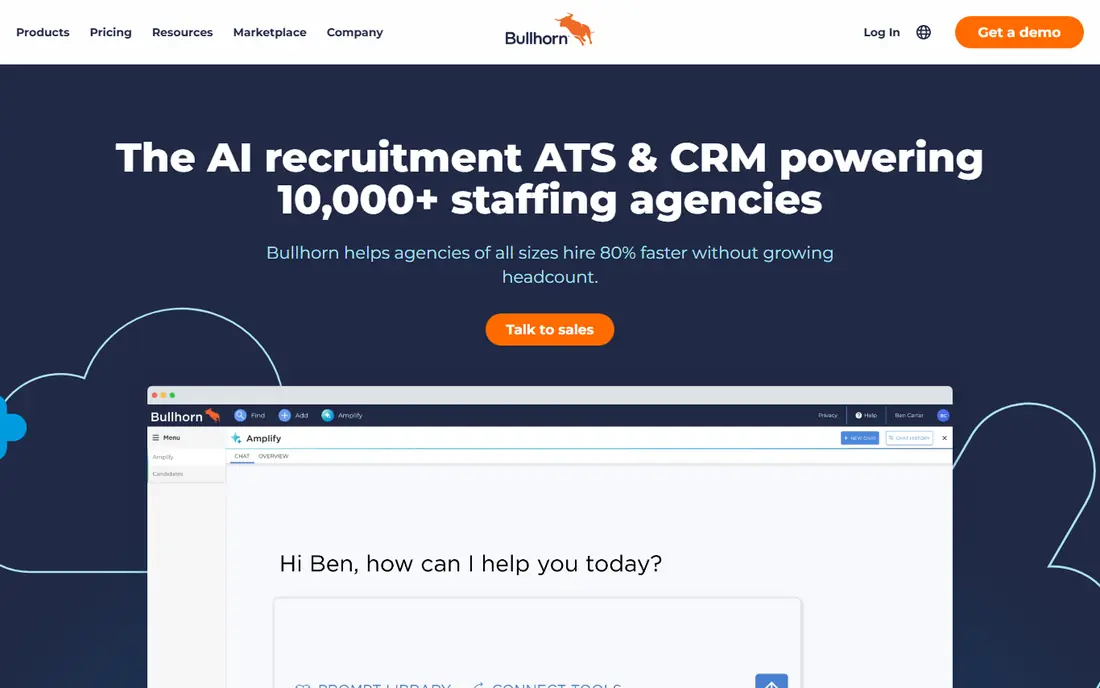
Bullhorn is the default enterprise pick for staffing agencies, with an ATS and CRM built for perm, contract, and temp workflows. Published comparisons list pricing from $99 per user per month on Starter, rising to higher tiers for larger teams, with middle-office add-ons for timesheets, billing, and payroll processes. The integration marketplace covers job boards, background checks, and back-office tools that large agencies rely on.
Cost and setup are the trade-offs. Seat costs add up fast at 10 or 20 recruiters, and implementation needs planning for data migration and workflow design. Small agencies may find Recruit CRM or Manatal faster and cheaper. For a mid-size or large agency with contract staffing, Bullhorn earns its price through depth and integrations.
- Deep agency ATS and CRM
- Large integration marketplace
- Middle-office add-ons
- Higher seat costs at scale
- Implementation can take time
- No free plan
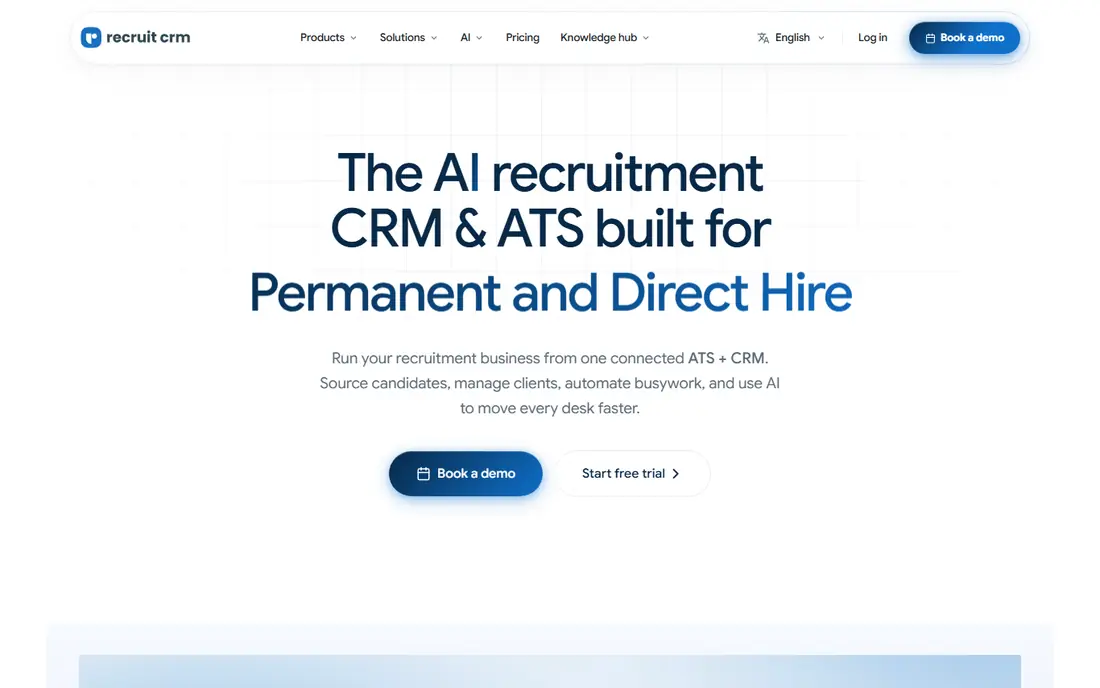
Recruit CRM suits small and mid-size agencies that want a combined ATS and CRM without an enterprise sales process. Published comparisons list pricing from $95 per user per month billed annually, with a free trial and month-to-month options in some plans. It covers candidate pipelines, client management, job posting, and email outreach, plus timesheets and invoicing for contract work.
Reporting and back-office depth are lighter than Bullhorn, so large temp agencies with complex payroll needs may need add-ons or a second system. For perm, contract, and executive search firms with up to a dozen recruiters, Recruit CRM offers a practical balance of features, price, and ease of use.
- Combined ATS and CRM
- Published pricing
- Timesheets and invoicing tools
- Reporting is lighter than Bullhorn
- Back-office depth is limited
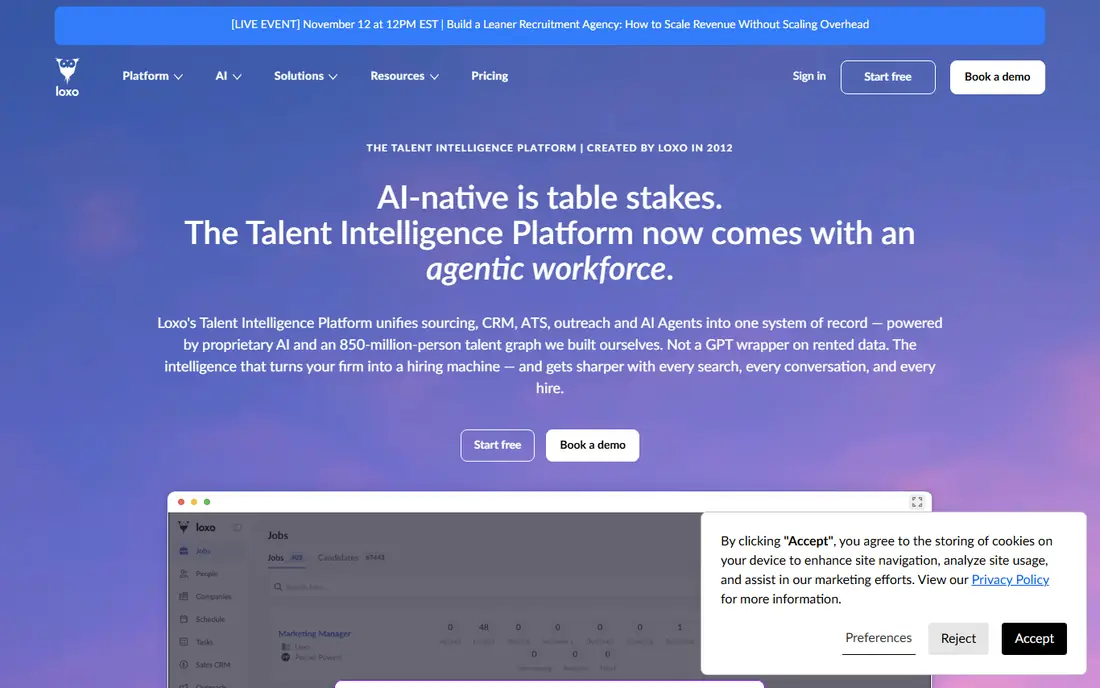
Loxo is built for agencies that live on sourcing, especially executive search and direct-hire firms. It combines AI sourcing, a candidate database, ATS pipelines, CRM records, and outreach sequences in one system, so recruiters spend less time switching tools. Published comparisons list pricing from $149 per user per month billed annually, with a short free trial.
The price is higher than budget tools, and there is no native back office for payroll and billing. That makes Loxo a better fit for perm and search firms than for high-volume temp staffing. If sourcing speed and outreach are your main bottlenecks, Loxo can pay for itself in placements. If back office is the bottleneck, Bullhorn or Vincere may fit better.
- Sourcing, ATS, and CRM in one tool
- AI sourcing features
- Outreach automation
- Higher per-user price
- Annual billing on core plans
- No native back office
Vincere positions itself as an agency operating system, covering front-office recruiting plus back-office work for perm, contract, and temp placements. Reporting is a clear strength, with team performance, pipeline, and placement views that managers use daily. Built-in back-office tools reduce the need for separate timesheet and invoicing systems for many agencies.
Pricing is by quote in most comparisons, with published UK figures around 150 pounds per month for a single user in some guides, so US agencies should request a firm quote for their team size. Annual contracts are common, which suits stable teams but not firms testing a new system. For mid-size agencies that want reporting plus back office, Vincere is a strong Bullhorn alternative.
- Agency operating system
- Strong reporting
- Built-in back-office tools
- Quote-based pricing
- Annual contracts in comparisons
- Smaller than Bullhorn ecosystem
JobAdder is a cloud ATS and CRM built for small and mid-size perm and temp agencies, with particular strength in the United Kingdom and Asia Pacific markets. It covers candidate pipelines, client records, job board posting, and workflow automation, with a broad integration list for background checks, assessments, and payroll partners.
Pricing is by quote, and back office runs through partners rather than as a native payroll engine. That makes JobAdder a good fit for agencies that already have a back-office partner, or that focus on perm placements. US agencies should check job board coverage and support hours for their region before committing.
- Cloud ATS and CRM
- Broad integrations
- Strong in UK and APAC markets
- Quote-based pricing
- Back office runs through partners
- No free trial in comparisons
Crelate suits boutique search firms and direct-hire agencies that want to shape workflows, fields, and pipelines to their own process. Published comparisons list pricing from $85 per user per month billed annually, with a free trial. That configurability helps firms with a distinct search process, where a rigid pipeline would slow recruiters down.
The trade-off is setup effort. Crelate needs configuration to reach its best form, and back office runs through integrations rather than natively. Firms that want a system that works well out of the box may prefer Recruit CRM or Manatal. Firms that want control over every stage will value Crelate.
- Highly configurable workflows
- Good for executive search
- Free trial
- Back office through integrations
- Interface needs setup to shine
Manatal is the budget pick here, with published pricing from $15 per user per month billed annually and a 14-day free trial in comparisons. It covers ATS pipelines, CRM records, job posting, and AI features such as candidate scoring and profile enrichment, at a price far below Bullhorn, Loxo, or Recruit CRM. Setup is fast, which suits solo recruiters and boutique firms.
Back office is the limit, since Manatal does not offer native payroll and billing. Reporting is also lighter than enterprise platforms. For a small agency focused on perm placements and sourcing, that trade-off is often worth it. For high-volume temp staffing, pair Manatal with a separate back-office tool, or pick a platform with native back office.
- Low entry price
- AI candidate scoring and enrichment
- Easy setup
- No native back office
- Reporting lighter than enterprise tools
Zoho Recruit suits cost-sensitive teams, especially those already using Zoho CRM, Zoho Books, or other Zoho apps. Published comparisons list a free plan plus paid plans from $25 per user per month billed annually, with a trial on paid tiers. It covers job posting, resume parsing, pipelines, and client management, with workflow automation that fits in-house and agency teams alike.
Zoho Recruit is not built only for agencies, so some agency-specific workflows, such as complex back-office or staffing billing, need workarounds or integrations. Job board coverage also varies by region, so check your key boards before you buy. For a budget agency already on Zoho, it is a low-risk, low-cost start.
- Free plan available
- Low paid entry price
- Strong Zoho suite links
- Not built only for agencies
- Job board coverage varies by region
How we picked these
We compared official pricing pages and published 2026 agency software comparisons for ATS and CRM depth, sourcing, back-office coverage, and pricing transparency. We favored tools built for agencies over general HR tools, and we noted where pricing is by quote. Where US and UK pricing differed, we used the published US or commonly cited figure and flagged the need for a firm quote.
How to choose agency recruiting software
Start with your placement mix. Perm, contract, temp, and executive search need different workflows, and a tool that excels at perm may struggle with timesheets and payroll. List your core workflow: sourcing, screening, submission, interview, offer, placement, timesheet, and invoice. A tool that covers the full workflow without spreadsheets will save more time than a tool with a longer feature list but gaps in the middle.
Test sourcing and pipeline speed with real data
Import a real set of candidates, rebuild one live pipeline, and run one submission end to end during a trial. Measure time to shortlist, time to submit, and how easy it is to find a candidate again later. Sourcing claims matter less than search speed, duplicate handling, and resume parsing quality on your actual resumes. If the trial only uses demo data, ask for a pilot with real data before you sign.
Check back office before you sign
For contract and temp staffing, back office is where cheap tools often fail. Confirm timesheet collection, approval, invoicing, payroll links, and compliance reporting for your placements. Ask who handles tax, worker classification, and client billing corrections. If back office runs through a partner, confirm that partner cost and support model, since it becomes part of your total cost.
Compare total seat cost, not just the entry price
Multiply the per-user price by your real recruiter count, including part-time and admin users who need access. Annual billing can lower the monthly rate, but it locks you in for a year. Check minimum seats, implementation fees, and add-on costs for sourcing, SMS, or background checks. Audit dormant seats before renewal, since unused seats are a common waste in agency software.
Frequently asked questions
What is the best recruiting software for agencies?
Bullhorn suits larger agencies, Recruit CRM suits small and mid-size agencies, and Loxo suits sourcing-led search firms. The best pick depends on placement mix, recruiter count, and back-office needs. Run a real-data trial with one live role before you commit.
What is the best recruiting agency software for small agencies?
Recruit CRM and Manatal are strong small-agency picks, with published pricing and fast setup. Manatal starts from $15 per user per month in comparisons, while Recruit CRM starts from $95 per user per month. Zoho Recruit also suits budget teams, with a free plan and paid plans from $25 per user per month.
Is Bullhorn worth the price for a small agency?
Often, no. Bullhorn earns its price at scale, with integrations and back-office depth for mid-size and large agencies. A small perm firm may get similar placement results from Recruit CRM, Manatal, or Crelate at a lower total cost. Revisit Bullhorn when contract volume or team size makes back office a daily bottleneck.
What is the best staffing software for temp agencies?
Bullhorn and Vincere suit temp agencies that need timesheets, billing, and back-office tools. Avionte also covers high-volume temp staffing, though it was not in our top eight here. Confirm timesheet, payroll, and compliance features for your worker types before you buy.
Do agency tools include sourcing, or do I need a separate tool?
Loxo and Manatal include sourcing and AI enrichment, while other tools rely more on job board posting and database search. Check sourcing coverage for your roles and regions, since some tools source well for tech roles but poorly for healthcare or industrial roles. A separate sourcing tool may still be needed for niche markets.
How long does it take to switch recruiting software?
A small agency can migrate in days to weeks with a clean candidate import and a simple pipeline rebuild. A large agency with contract history, timesheets, and integrations may need weeks to months. Keep the old system running during the trial, test one live role end to end, and plan data cleanup before migration, not after.
Sources
See where you really rank - block by block
ProMapRanker scans Google Maps across a grid of your service area. Simple monthly plans from $19, white-label on every plan.
Start freeKeep reading
 outreach alternatives
Outreach Alternatives in 2026
Compare outreach alternatives for 2026, from Salesloft and Apollo to HubSpot and Lemlist, with pricing, channels, features, limits, and honest trade-offs.
Read → best web conference tools
Best Web Conference Tools in 2026
Compare the best web conference tools for meetings, webinars and team calls, with current pricing, free plans and honest limits for each option here today.
Read → best voice cloning tools
Best Voice Cloning Tools in 2026
Compare the best voice cloning tools in 2026, from ElevenLabs and Descript to Resemble and Cartesia, with consent rules, pricing, licenses, and limits.
Read →