 ProMapRanker
Best AEO Tools in 2026: 8 Platforms Compared


Dedicated answer engine analytics · Pricing starts at: $99 per month
Key takeaways
- The trailing word in this topic name adds no meaning, so this guide covers AEO tools and platforms plainly, as answer engine optimization software.
- Profound and Scrunch lead for dedicated AI visibility tracking, while Semrush and Ahrefs suit teams that already use those SEO platforms.
- Otterly.AI is the most affordable entry point here, but prompt limits matter more than the headline price.
- AEO results change as AI models change, so judge a tool on whether you can see the raw answers and sources behind its scores.
Quick comparison
| Pick | Great for | Pricing starts at | Free tier | |
|---|---|---|---|---|
| Profound | Dedicated answer engine analytics | $99 per month | Free trial | Visit |
 Scrunch | AI answer monitoring and site fixes | $250 per month | Free trial | Visit |
 Peec AI | Prompt tracking and gap reports | See website | Free trial | Visit |
 Otterly.AI | Budget AI visibility tracking | $29 per month | Free trial | Visit |
 Semrush AI Visibility | SEO teams adding AI tracking | See website | Free trial | Visit |
 Ahrefs Brand Radar | Large-scale citation research | See website | Free trial | Visit |
 Surfer AI Search Analytics | Content teams using Surfer | See website | Free trial | Visit |
 Goodie | Closed-loop AEO with attribution | $399 per month | Free trial | Visit |
The best AEO tools
AEO stands for answer engine optimization: helping your brand get named and cited when someone asks ChatGPT, Gemini, Perplexity, or Google AI features a question. The tools below track those answers, show which sources were cited, and in some cases help you fix the pages that should be cited instead.
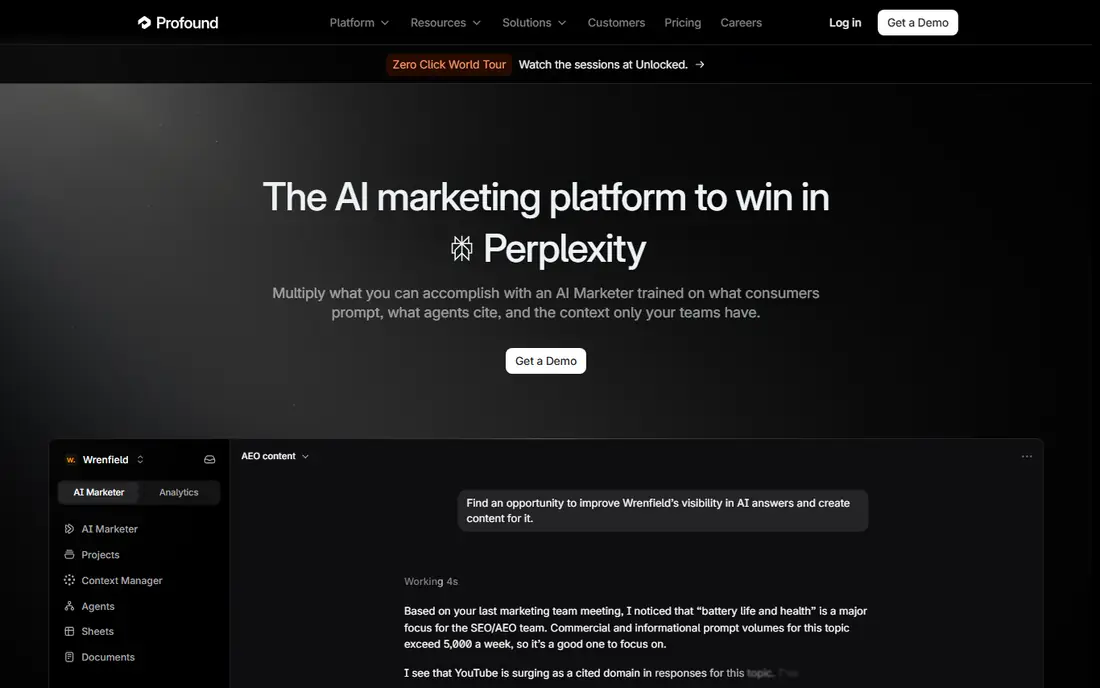
Profound is the dedicated AEO platform most often named first in 2026, and for a clear reason: it is built only for this job. It tracks how a brand appears in AI answers, which prompts trigger those answers, and which sources the model cites. That focus helps marketing teams move from vague worry about AI search to a concrete list of questions, competitors, and cited pages. Enterprise reporting options also help larger teams share results across brand, SEO, and content groups.
The trade-off is price and scope. At the entry level, Profound is a serious subscription for a small business, and it measures visibility rather than writing all your content for you. Teams that need both measurement and content production may need to pair it with writers or another platform. If AI visibility is a board-level concern, Profound is a strong first trial.
- Focused AI visibility analytics
- Prompt intelligence across major AI platforms
- Enterprise reporting options
- Entry price is high for a solo site
- Content fixes still need your own team or another tool

Scrunch pairs monitoring with action, which sets it apart from trackers that only report scores. It watches AI answers about your brand and category, then audits your site for the technical and content issues that may keep your pages from being cited. That link between measurement and fix is valuable, because many AEO problems are practical: missing structure, unclear pages, or content that answers a question only indirectly. For a technical SEO team, that workflow feels familiar and useful.
The limit is cost. Scrunch is priced for companies, not for a solo blogger testing AI visibility for the first time. Teams should also check prompt limits and model coverage on their plan, because those details decide how much of their market they can actually track. If you want monitoring plus a fix list in one tool, Scrunch is worth a trial.
- Pairs answer monitoring with site audits
- Helps teams fix pages AI crawlers read
- Useful for technical SEO teams
- High entry price
- Smaller teams may not use the full audit depth

Peec AI focuses on the core AEO question: for the prompts your buyers actually ask, does the AI name your brand, and what does it cite instead? Its source and gap reports make that answer easy to act on, because you can see which competitor pages or third-party articles are winning citations. Agencies like that clarity, because it turns a monthly report into a list of pages to create or improve. Model coverage can be chosen on some plans, which helps teams that care about specific platforms.
The weakness is that Peec AI is mainly a measurement tool. It will not write and publish a full content program for you, so teams need writers or a content platform alongside it. Pricing also depends on prompts, models, and volume, so get a quote for your real prompt list. For clean tracking and gap analysis, Peec AI is a solid choice.
- Clear prompt tracking with source reports
- Competitor comparison
- Agency-friendly reporting
- Pricing varies by prompts and models
- Content creation is not its main strength
Otterly.AI is the best way to start AEO tracking on a small budget. It checks a defined prompt list daily across major AI platforms and reports brand mentions, citations, and content gaps. For a small business or freelancer, that is enough to learn which questions matter, which competitors appear, and which pages need work, without committing to an enterprise contract. The content audit features add practical next steps beyond a simple score.
The catch is scale. Entry plans cover a limited number of prompts, so a business with many products or locations will need a higher tier or a narrower prompt list. Depth of reporting is also lighter than Profound or Scrunch. Start with your ten to twenty most valuable questions, test the tool for a month, and only expand the prompt list once you know the reports drive real content work.
- Lowest entry price in this list
- Daily checks on a prompt list
- Citation and content audits included
- Prompt limits are tight on entry plans
- Less depth than enterprise platforms
Semrush makes sense for teams that already live in Semrush for keyword research, rank tracking, and site audits. Its AI Visibility features add mentions and sources to that familiar workflow, so a team does not have to learn a second platform or reconcile two data sets. That integration is valuable when AEO work is part of a wider SEO plan, because the same team can move from a keyword gap to an AI answer gap in one session.
The limit is focus and pricing clarity. AI visibility may sit in a specific toolkit or higher tier, so check what your current Semrush plan includes before assuming it is covered. Dedicated platforms also tend to offer deeper prompt and citation detail. If you already pay for Semrush and want AI tracking without a second subscription, this is the most practical route.
- AI visibility sits inside a full SEO suite
- Keyword, rank, and content tools in one place
- Familiar to SEO teams
- AI features may be add-ons or higher tiers
- Not as focused as a dedicated AEO platform
Ahrefs Brand Radar adds AI prompt tracking to a platform already known for backlink and keyword research. That matters for research-heavy teams, because AI citations often come from pages that also rank well and earn links. Seeing those signals together can help a team decide which pages to improve, which topics to cover, and which competitors to watch. For agencies and SEO teams that already use Ahrefs daily, Brand Radar is a natural extension.
The downside is that it is a feature inside a larger SEO suite, not a dedicated AEO workflow with the same depth as Profound. Plan limits and included prompt counts vary, so check the current Brand Radar terms for your tier. If your team already relies on Ahrefs for search data, Brand Radar is a sensible way to add AI visibility without a separate tool.
- Backed by a large search data set
- AI prompt tracking alongside backlink and keyword research
- Strong for research-heavy teams
- Brand Radar pricing and limits vary by plan
- Less of a standalone AEO workflow than Profound
Surfer AI Search Analytics suits content teams that already use Surfer to optimize articles. It shows how a brand appears in AI search results and connects that insight to the content work those teams already do. That link is practical, because many AEO wins come from clearer headings, direct answers, and better-structured pages, which are exactly the edits Surfer guides. For a team publishing several articles a week, having AI visibility in the same workflow saves time.
The limit is scope. As a standalone AEO platform, Surfer is narrower than Profound or Scrunch, and its best value depends on already using Surfer for content. Teams that do not optimize content in Surfer may get more from a dedicated tracker. If Surfer is already part of your content process, its AI analytics are a logical add-on.
- Links AI visibility to content optimization
- Useful for teams that already optimize articles in Surfer
- Prompt-level insight
- Best value only for existing Surfer users
- Standalone AEO depth is narrower than dedicated tools
Goodie positions itself as a closed-loop AEO platform, meaning it tries to connect AI visibility not only to mentions, but also to the traffic and outcomes that follow. That matters for larger teams that must justify AEO spending to leadership, because a mention count alone does not prove business value. Structured reporting and content guidance help teams turn tracking into a repeatable program, rather than a monthly chart that no one acts on.
The trade-off is price. At the entry level, Goodie is a company-level subscription, not a tool for a solo site. Smaller teams should start with Otterly.AI or an existing SEO platform and move to Goodie only when attribution and scale become real needs. For a larger brand that needs to prove AEO impact, Goodie is worth evaluating.
- Aims to link AI visibility to traffic and outcomes
- Structured reporting for larger teams
- Content guidance included
- High entry price
- Smaller teams may not need attribution depth
How we picked these
We compared official product pages, pricing pages, and public AEO comparisons for tools that track brand visibility in AI answers in 2026. We favored tools that show prompts, answers, and cited sources, rather than tools that only report a single score. We did not claim hands-on testing. Where pricing varied by prompts, models, or plan tier, we wrote See website rather than publishing a figure we could not verify.
What to check before you choose
Start with your prompt list. Write the twenty questions your buyers actually ask, including comparison and buying questions, not only brand searches. A tool is only useful if it tracks those questions on the AI platforms your buyers use. During a trial, check whether you can read the full answer and the cited sources, because a score without that detail cannot guide content work.
Next, decide whether you need measurement only or measurement plus fixes. Dedicated trackers are best for reporting, while Scrunch and content-linked tools help with fixes. Also check prompt limits, model coverage, update frequency, and export options, because those details decide whether the tool scales with your market. Finally, assign an owner for the reports. AEO tools only pay off when someone turns citation gaps into new or improved pages each month.
Frequently asked questions
What are AEO tools?
AEO tools track whether AI answer engines name your brand and cite your pages when users ask questions. They run prompts through systems such as ChatGPT, Gemini, Perplexity, and Google AI features, then report mentions, position, and cited sources.
What is the best AEO platform?
Profound is the strongest dedicated choice for larger teams, Scrunch is best for monitoring plus site fixes, and Otterly.AI is the best budget start. Teams already using Semrush or Ahrefs may do better adding AI tracking inside those platforms.
Are AEO tools the same as GEO tools?
In practice, yes for most buyers. AEO stresses being the source an answer extracts, while GEO stresses presence in a generated answer, but the same tools usually cover both jobs. Judge a tool on prompt tracking, source detail, and content help, not on which acronym it uses.
Can AEO tools guarantee a citation in ChatGPT?
No tool can guarantee a citation, because AI models change and choose sources by their own rules. A good tool shows where you stand, which sources win instead, and which page changes are most likely to help, but results still need real content work.
How many prompts should I track?
Start with twenty to fifty high-value questions, including buying and comparison questions. A short, relevant list beats a long list of low-value prompts, because each prompt should lead to a content decision or a page fix.
Sources
See where you really rank - block by block
ProMapRanker scans Google Maps across a grid of your service area. Simple monthly plans from $19, white-label on every plan.
Start freeKeep reading
 zscaler alternatives
Best Zscaler Alternatives in 2026
Looking for zscaler alternatives? We compare 9 SASE and zero trust platforms on architecture, data protection, pricing, and fit for your network and team.
Read → zapier alternatives free
Best Zapier Alternatives Free in 2026
Nine automation tools for zapier alternatives free in 2026, all with genuinely free tiers, plus free plan limits, starting prices and upgrade paths explained.
Read → which platform is best for online reputation
Which Platform Is Best for Online Reputation in 2026
Wondering which platform is best for online reputation? We compare 8 review, listing, and response tools for small and multi-location businesses and agencies.
Read →