 ProMapRanker
Best Accounting Software for Real Estate Agents in 2026


Agents with a QuickBooks accountant · Pricing starts at: $38 per month
Key takeaways
- QuickBooks Online suits agents whose accountant already uses QuickBooks, while Xero suits teams that want unlimited users and broad integrations.
- FreshBooks suits agents who bill clients and track time, while Wave and Zoho Books suit solo agents on a tight budget.
- Sage suits agents who want straightforward bookkeeping with inventory and reporting depth, but check local US pricing first.
- Bench suits agents who want bookkeeping done for them, while RealtyJuggler suits agents who want real-estate-specific tracking in one place.
Quick comparison
| Pick | Great for | Pricing starts at | Free tier | |
|---|---|---|---|---|
| QuickBooks Online | Agents with a QuickBooks accountant | $38 per month | Free trial | Visit |
 Xero | Teams with many users | $25 per month | Free trial | Visit |
 FreshBooks | Invoicing and client billing | $23 per month | Free trial | Visit |
 Wave | Solo agents on a budget | Free | Yes | Visit |
 Zoho Books | Value and automation | Free | Yes | Visit |
 Sage Accounting | Straightforward small-business books | See website | Free trial | Visit |
 Bench | Done-for-you bookkeeping | $199 per month | No | Visit |
 RealtyJuggler | Real-estate-specific tracking | See website | Free trial | Visit |
The best accounting software for real estate agents
This is not tax advice. Real estate income, commissions, deductions, and filing duties vary by state, business structure, and whether an agent is an employee or an independent contractor. We compared tools that handle agent income, expenses, invoicing, and tax-ready reports, and we gave extra weight to commission tracking, mileage and expense capture, and accountant access.

QuickBooks Online is the safest default for many US agents because most accountants already use it. Bank feeds, expense categorisation, invoicing, and tax-ready reports cover the core agent workflow, and higher plans add payroll, inventory, and multi-user access. Sharing books with an accountant is simple, which saves time at tax season.
The entry plan is limited to one user, so a team or an agent with an assistant will need a higher plan. Prices also rise steeply from Simple Start to Plus and Advanced. QuickBooks suits agents who want depth and accountant compatibility, and who accept paying more for that ecosystem.
- Widest accountant familiarity in the US
- Strong reporting and bank feeds
- Payroll and inventory on higher plans
- Entry plan allows only one user
- Price rises steeply across plans

Xero suits agents and small brokerages where several people need access without per-user fees. Every plan allows unlimited users, bank reconciliation is clean, and the app marketplace covers CRM, expense, and property tools. Multi-currency support on higher plans helps agents with international clients.
The entry Early plan limits invoices to 20 and bills to 5 per month, so active agents should check the Growing plan. US payroll is also a separate add-on, powered by Gusto, with its own monthly and per-person charges. Xero is a strong pick for teams that value user access and integrations over QuickBooks familiarity.
- Unlimited users on every plan
- Broad app integrations
- Clean bank reconciliation
- Entry plan limits invoices and bills
- Payroll is a separate add-on in the US
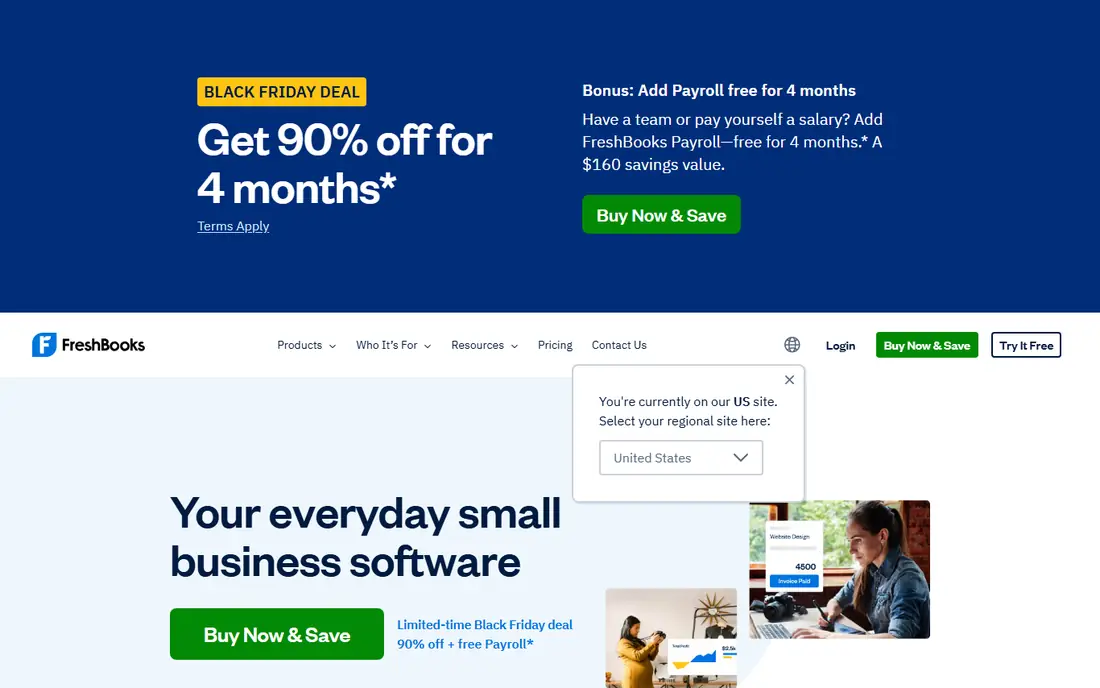
FreshBooks suits agents and solo brokers who bill clients for services, track time, and need a clean client portal. Invoicing is its strength, with payment reminders, expense capture, and project tracking that help service-based work. The interface is simpler than full accounting suites, which helps agents who dislike bookkeeping.
Limits matter for larger books. The Lite plan covers only a small set of billable clients, and extra users cost extra. FreshBooks also lacks the full double-entry depth of QuickBooks or Xero on lower tiers in some comparisons. It fits service-billing agents, not brokerages with complex trust or inventory needs.
- Strong invoicing and client portal
- Time tracking
- Simple expense capture
- Entry plan limits billable clients
- No double-entry accounting on the entry tier in some comparisons
Wave is the genuine free option for a solo agent starting out. Core invoicing and accounting are free, setup is quick, and the tool covers the basic income and expense tracking a new agent needs. For an agent with low volume and simple books, Wave removes the monthly software cost entirely.
The free Starter plan does not include automatic bank import, so transactions need manual entry or an upgrade to Pro. Payroll is also a paid add-on, and Wave lacks the depth of QuickBooks or Xero for larger brokerages. Wave suits solo agents on a budget, with a clear upgrade path when volume grows.
- Free core invoicing and accounting
- Simple setup
- Good for sole proprietors
- No automatic bank import on the free Starter plan
- Payroll is a paid add-on
Zoho Books offers the best value for agents already using Zoho tools, and a strong free plan for new agents. The free plan covers businesses with revenue up to $50,000 per year, with invoicing, expenses, and bank feeds. Automation for recurring invoices, payment reminders, and workflows saves time for busy agents.
The free plan limits invoices to 1,000 per year, and larger agents will need a paid plan from $20 per month. Zoho Books also feels best inside the Zoho ecosystem, so agents using other CRMs should check integrations first. For value-focused agents, it is hard to beat.
- Free plan for revenue up to $50,000 per year
- Strong automation
- Zoho app integrations
- Free plan limits invoices per year
- Paid plans needed for larger volumes
Sage Accounting suits agents who want straightforward bookkeeping with solid reporting, without the complexity of a full ERP. It covers invoicing, expenses, bank reconciliation, and cash flow views, with inventory tools on higher tiers. Sage has a long history in small-business accounting, which helps agents who want a stable vendor.
We wrote See website because US pricing for Sage Accounting varies by plan, region, and promotion, and recent comparisons give ranges rather than one current US list price. Agents should check the Sage US pricing page for the exact plan they need. Sage fits agents who value reporting depth and a proven vendor over the lowest entry price.
- Straightforward bookkeeping
- Reporting and inventory tools
- Long track record in accounting
- US pricing varies and is not a single published figure
- Promotional discounts can confuse comparisons
Bench is a service, not just software, and that is its appeal for busy agents. A dedicated bookkeeper handles monthly categorisation, reconciliation, and financial statements, and a year-end package prepares the books for tax filing. Agents who hate bookkeeping can hand it off and focus on clients.
Bench has no software-only version, so agents who want to do their own books should choose another tool here. Pricing varies by monthly expense volume, connected accounts, and tax needs, with plans starting at $199 per month billed monthly on the vendor page. Some reviews note a cash-basis focus, so accrual-basis agents should confirm fit before signing.
- Dedicated bookkeeper handles monthly books
- Tax-ready year-end package
- Simple visual reports
- No software-only option
- Pricing varies by expense volume and accounts
- Cash-basis focus in some reviews
RealtyJuggler is the only tool here built specifically for real estate agents, and that focus shows in its workflow. It tracks contacts, transactions, closings, and commissions in one place, which helps agents see which deals are pending, closed, or paid. For agents who want agent-specific tracking rather than generic accounting, it fills a gap the big tools leave.
Accounting depth is narrower than QuickBooks or Xero, so many agents will still need a full accounting tool or an accountant for tax filing. Pricing is also not a single clear published figure, so we wrote See website. RealtyJuggler suits agents who want deal and commission tracking first, with accounting handled alongside it.
- Built for real estate workflows
- Commission and closing tracking
- Contact and transaction management
- Pricing is not a single clear published figure
- Narrower accounting depth than QuickBooks or Xero
How we picked these
We compared vendor pricing pages and recent small-business accounting comparisons that cite vendor prices from September and October 2026. A tool made the list only if it is actively sold, covers income, expenses, and reporting for small businesses or agents, and fits real estate work. Where US pricing varied or conflicted, we wrote See website rather than picking one disputed figure.
What to check before you buy
Start with how you earn and spend. List commission income, referral fees, marketing costs, mileage, dues, and software costs, then check how each tool categorises and reports them. A tool that cannot separate commission income from other income will make tax time harder.
Track commissions by deal
Check whether the tool, or a connected app, tracks commissions by closing, agent split, and referral fee. RealtyJuggler covers this natively, while QuickBooks and Xero need a clear chart of accounts or an integration. Ask your accountant which setup they prefer before choosing.
Capture expenses on the road
Test receipt capture and mileage tracking from a phone during a trial. Agents spend much of the day out of the office, so a tool that only works well on a desktop will leave expenses unrecorded. Check bank feeds and card connections for the accounts you actually use.
Confirm accountant access
Ask whether your accountant can access the books without an extra seat fee, and whether they already use the tool. Accountant familiarity saves money at tax time, even if another tool looks cheaper on its own. Xero allows unlimited users, while QuickBooks entry plans limit users, so check this early.
Frequently asked questions
What is the best accounting software for real estate agents?
QuickBooks Online is the safest default for US agents whose accountant uses QuickBooks. Xero suits teams with many users, FreshBooks suits service billing, and Wave or Zoho Books suit solo agents on a budget. RealtyJuggler adds deal and commission tracking that generic tools lack.
What is the best accounting software for realtors who are independent contractors?
QuickBooks Online and Xero both handle independent contractor income, expenses, and tax-ready reports well. Wave is a free starting point for low-volume agents. Check with a tax professional about deductions, quarterly taxes, and business structure, since this guide is not tax advice.
Is QuickBooks or Xero better for real estate agents?
QuickBooks suits agents who want the widest US accountant familiarity and deep reporting. Xero suits teams that want unlimited users and broad integrations at a lower entry price. Both handle agent income and expenses, so accountant preference often decides it.
Is there free accounting software for real estate agents?
Yes. Wave offers free core invoicing and accounting, and Zoho Books offers a free plan for revenue up to $50,000 per year. Both have limits on bank import or invoice volume, so active agents may need a paid plan. Test the free plan with real transactions before relying on it.
Do real estate agents need special accounting software?
Not always. Most agents can use QuickBooks, Xero, or Zoho Books with a real-estate-friendly chart of accounts. Special tools such as RealtyJuggler help with deal, closing, and commission tracking, but they do not replace full accounting or tax advice. Many agents use both types together.
Sources
See where you really rank - block by block
ProMapRanker scans Google Maps across a grid of your service area. Simple monthly plans from $19, white-label on every plan.
Start freeKeep reading
 zscaler alternatives
Best Zscaler Alternatives in 2026
Looking for zscaler alternatives? We compare 9 SASE and zero trust platforms on architecture, data protection, pricing, and fit for your network and team.
Read → zapier alternatives free
Best Zapier Alternatives Free in 2026
Nine automation tools for zapier alternatives free in 2026, all with genuinely free tiers, plus free plan limits, starting prices and upgrade paths explained.
Read → which platform is best for online reputation
Which Platform Is Best for Online Reputation in 2026
Wondering which platform is best for online reputation? We compare 8 review, listing, and response tools for small and multi-location businesses and agencies.
Read →