 ProMapRanker
Best Accounting Software for Multiple Entities in 2026


multi-entity close and consolidated reporting · Pricing starts at: See website
Key takeaways
- Sage Intacct and Oracle NetSuite lead for true multi-entity close and consolidation, with a price jump to match.
- Dynamics 365 Business Central and Acumatica give multi-company finance inside a wider ERP, which suits firms that also need operations.
- QuickBooks Online Advanced, Xero, and Zoho Books work for several small businesses, but consolidation is lighter and often needs workarounds.
- The real cost is implementation and close time, not just the monthly subscription, so test a full multi-entity close before you buy.
Quick comparison
| Pick | Great for | Pricing starts at | Free tier | |
|---|---|---|---|---|
| Sage Intacct | multi-entity close and consolidated reporting | See website | No | Visit |
 Oracle NetSuite | multi-entity ERP with operations included | See website | No | Visit |
 Dynamics 365 Business Central | multi-company finance in the Microsoft ecosystem | $80 per user per month | Free trial | Visit |
 Acumatica | multi-entity cloud ERP for growing firms | See website | No | Visit |
 QuickBooks Online Advanced | owners running several small businesses | $340 per month | Free trial | Visit |
 Xero | small firms with several organizations | $27 per month | Free trial | Visit |
 Zoho Books | low-cost accounting for several small businesses | $15 per month | Yes | Visit |
 Odoo | modular multi-company ERP on a budget | See website | Yes | Visit |
The best accounting software for multiple entities
Multiple entities can mean several legal companies, several locations, or several small businesses owned by one person. The accounting need is the same: shared charts where useful, separate books where required, intercompany entries, and consolidated reports without spreadsheet gymnastics. These tools cover that range, from light multi-business accounting to full multi-entity ERP.

Sage Intacct is our pick for finance teams whose main pain is the multi-entity close. You can manage several entities in one system, post intercompany entries, eliminate them on consolidation, and report by dimensions such as location, department, and project without rebuilding the chart for each entity. That structure is why many firms move to Intacct once spreadsheets stop coping.
The catch is price and rollout. Pricing is quote-based, with partner and third-party figures often starting around 13,200 dollars per year for a small deployment before implementation, and implementation commonly adds a large multiple of the subscription. Intacct covers finance, not inventory-heavy operations, so firms that need warehousing or manufacturing should also shortlist NetSuite or Business Central.
- Native multi-entity management
- Dimensions for location, department, and project
- Strong audit trail
- Quote-based pricing
- Implementation adds large cost
- Finance-first, so operations need other tools
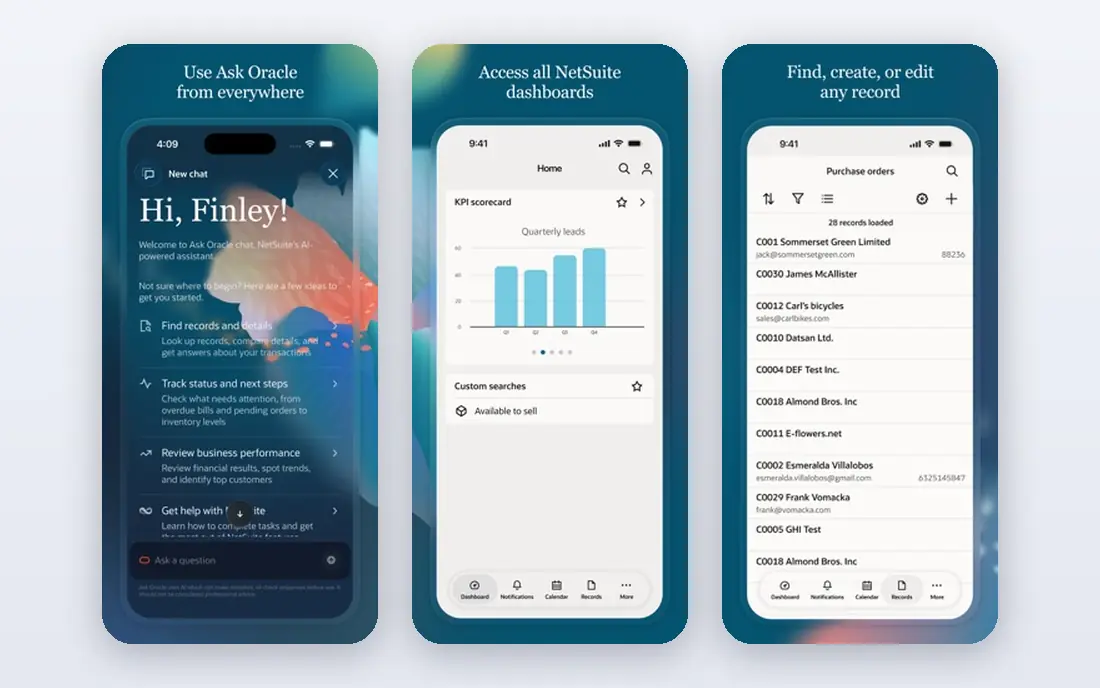
Oracle NetSuite suits a company whose multi-entity pain crosses into operations. With the OneWorld edition, you can run multiple subsidiaries, currencies, and tax rules in one system, while inventory, orders, fulfillment, and finance share the same data. That single system is the reason firms accept NetSuite pricing and rollout time.
The downside is total cost. Pricing is quote-based, with typical mid-market contracts reported far above a small accounting subscription, and implementation commonly runs to a large multiple of the software cost. NetSuite is the right pick when operations and finance must live together across entities. If you only need accounting consolidation, Sage Intacct will usually cost less and close faster.
- OneWorld multi-subsidiary management
- Finance plus inventory, orders, and CRM
- Global currency and tax support
- Quote-based pricing
- Implementation is long and costly
- Complexity needs admin time
Dynamics 365 Business Central
Great for: multi-company finance in the Microsoft ecosystem
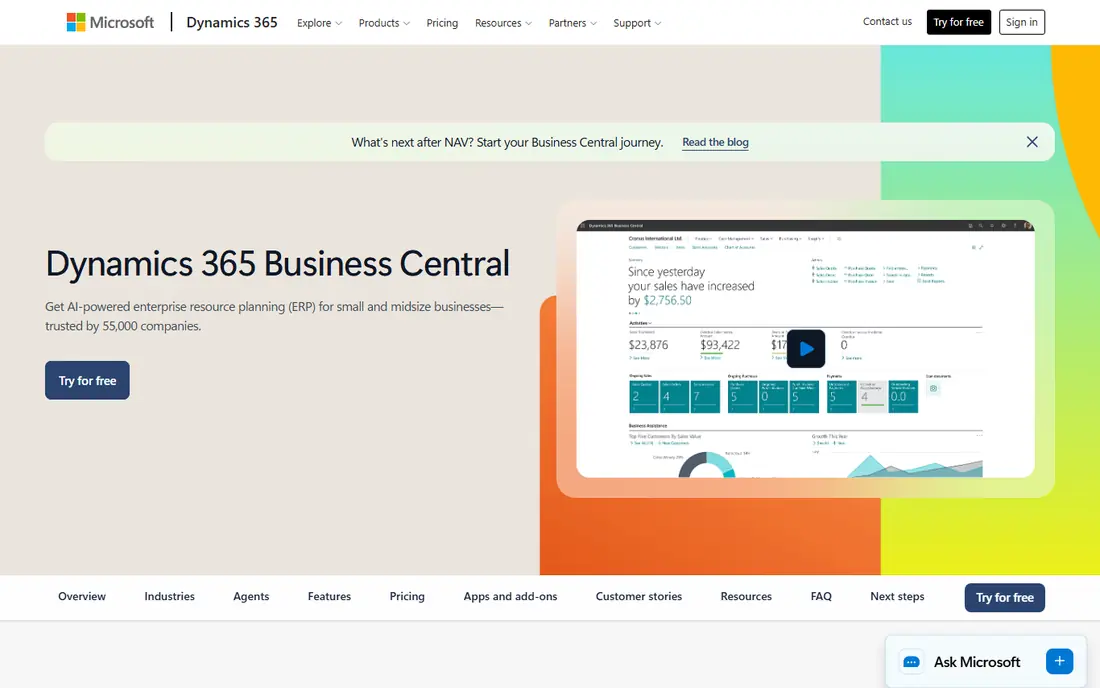
Business Central is a strong middle path for firms standardized on Microsoft tools. You can run multiple companies, consolidate reporting across them, and work in Outlook, Excel, and Teams without switching systems. The Essentials plan lists at 80 dollars per user per month paid yearly, with a 30-day free trial and a Premium plan at 110 dollars per user per month.
The limits are setup and reporting depth. Multi-company consolidation and detailed reporting beyond the basics often need Power BI, extensions, or partner help, and advanced customization needs developers. Business Central suits a firm that wants multi-company finance plus operations in one Microsoft system and can invest in partner setup. It is less finance-only than Intacct, and less all-in-one than NetSuite.
- Multiple companies in one tenant
- Microsoft 365 and Power BI integration
- Clear per-user pricing
- Consolidation and advanced reporting need setup
- Customization needs developers
- Implementation takes time
Acumatica suits a growing firm that needs multi-entity accounting today and wider ERP tomorrow. You can manage several entities and currencies, consolidate reporting, and add distribution, manufacturing, or construction modules as the business grows, without moving to a new platform. That growth path is the main reason to choose Acumatica over a small-business tool.
The catch mirrors other mid-market ERP: pricing is quote-based and annual, implementation is partner-led, and users note a learning curve. Third-party data puts entry near 10,000 dollars per year before implementation. Choose Acumatica when the five-year plan includes more entities and more operations; choose a small-business tool when the entity count will stay low and simple.
- Multi-entity and multi-currency support
- Cloud ERP with finance and operations
- Scales without replatforming
- Quote-based annual pricing
- Partner-led implementation
- Learning curve
QuickBooks Online Advanced
Great for: owners running several small businesses
QuickBooks Online Advanced is the practical pick for a small-business owner who runs several small companies and wants a familiar tool. Advanced supports up to 25 users, offers batch transactions, custom roles, and workflow tools, and uses classes and locations to segment results within a company. For simple multi-business bookkeeping, that is often enough.
The honest limit is consolidation. QuickBooks treats entities as separate files, so a true multi-entity close with intercompany eliminations is not native in the way Intacct handles it. Published 2026 reports list Advanced at 340 dollars per month after an August 2026 price rise, up from 275 dollars, so check the current list price before you buy. Use QuickBooks when each business is simple and separate; move up when consolidated reporting becomes a monthly burden.
- Familiar QuickBooks workflow
- Up to 25 users on Advanced
- Classes and locations for basic segmentation
- Each entity is largely a separate file
- Consolidation needs reporting workarounds
- Price rose sharply in 2026 reports
Xero suits a small firm or bookkeeper who manages several client organizations or several small businesses. Each organization has its own books, bank feeds, and invoicing, and tracking categories help you segment results within an organization. Plans list at 27 dollars for Early, 59 dollars for Growing, and 97 dollars for Established per month in published October 2026 pricing.
The catch is the same as QuickBooks: Xero is not a native multi-entity consolidation engine. You can run many organizations, but consolidated reporting across them needs an add-on, a reporting tool, or manual work. Xero is a good fit when each business is small and the owner wants a clean, low-cost system per organization. It is not the pick for a finance team that closes many entities together each month.
- Clean interface
- Unlimited users on higher plans in many markets
- Tracking categories for segments
- Each organization is separate
- Consolidation needs add-ons or manual work
- Project limits vary by plan
Zoho Books is the budget pick for an owner with several small businesses who wants a separate set of books per organization at a low price. Paid plans list from 15 dollars to 240 dollars per organization per month, and a free plan stays free only at or under 50,000 dollars of financial-year revenue in the US, with one user. That per-organization model keeps costs clear when each business is small.
The limit is consolidation. Like Xero and QuickBooks, Zoho Books does not give you a native multi-entity close with eliminations; you manage organizations separately and combine reports outside the system if you need a group view. Zoho Books suits a cost-conscious owner with simple books. It does not suit a mid-market finance team with intercompany volume.
- Low entry price
- Free plan for very small businesses
- Per-organization pricing
- Multi-organization work is per organization, not consolidated
- Free plan has revenue and user limits
- Advanced features need higher tiers
Odoo suits a firm that wants multi-company accounting inside a wider, modular ERP without a large enterprise price tag. You can run multiple companies in one database, share or separate charts as needed, and add apps for sales, inventory, manufacturing, and HR as the business grows. A community edition is free to self-host, while the hosted enterprise edition is priced by quote and by app.
The trade-off is effort. Odoo needs careful setup, accounting configuration varies by module, and a clean multi-company close still needs testing with your real entities. We list hosted pricing as See website because it depends on apps and users. Odoo is a good fit for a technically comfortable team that wants modular ERP value; it is not a plug-and-play accounting app for a first-time bookkeeper.
- Multi-company support in one database
- Modular apps for sales, inventory, and HR
- Open-source community edition
- Setup and configuration take time
- Accounting depth varies by module
- Support depends on edition and partner
How we picked these
We compared vendor pricing pages, feature pages, and public reviews for tools that can handle more than one company, location, or business in a credible way. We distinguished native multi-entity consolidation from per-organization accounting, and we stated that difference plainly for each tool. Tools that only handle one company with no multi-organization support were left out.
How to choose accounting software for multiple entities
Start by naming the job: separate books for several small businesses, or one consolidated close across legal entities. For separate books, QuickBooks, Xero, or Zoho Books will do, and price per organization matters most. For a consolidated close, shortlist Sage Intacct, NetSuite, Business Central, and Acumatica, and test intercompany entries and eliminations with your real data.
Next, count the hidden costs. Implementation, data migration, training, and reporting tools can exceed the subscription in the first year for mid-market ERP. Ask for a written first-year total, a close timeline, and a demo close using your entities. Finally, check audit needs: a clear audit trail, approval workflows, and role permissions matter far more once several entities share staff and systems.
Frequently asked questions
What is the best accounting software for multiple businesses?
Sage Intacct is the best finance-first pick for true multi-entity work, while QuickBooks Online Advanced is a practical pick for several simple small businesses. The right choice depends on whether you need consolidation or just separate books.
What is the best accounting software for multiple small businesses?
QuickBooks Online Advanced, Xero, and Zoho Books all work for several small businesses, with Zoho Books cheapest at the entry level. Pick the one your bookkeeper already knows, since familiarity saves more time than a small price gap.
What is the best multi company accounting software for mid-market firms?
Sage Intacct and Oracle NetSuite lead for mid-market firms, with Business Central and Acumatica as strong ERP alternatives. Intacct wins on finance depth, NetSuite wins when operations must share the same system.
Can QuickBooks handle multiple entities?
QuickBooks can run several companies as separate files, with classes and locations for segmentation inside each company. It does not offer native multi-entity consolidation with intercompany eliminations in the way Intacct or NetSuite do.
How much does multi-entity accounting software cost?
Entry prices here range from 15 dollars per month per organization to quote-based ERP contracts in the tens of thousands of dollars per year. The subscription is only part of the cost: implementation, training, and reporting tools can add a large first-year amount.
Sources
See where you really rank - block by block
ProMapRanker scans Google Maps across a grid of your service area. Simple monthly plans from $19, white-label on every plan.
Start freeKeep reading
 zoho inventory alternatives
6 Alternatives to Zoho Inventory, Compared on Price and Fit
Zoho Inventory alternatives: 6 tools compared on price, free plans and fit. Katana leads the list for manufacturers. Fit and flaws are laid out for each entry.
Read → zoho crm alternatives
Best Zoho CRM Alternatives (2026)
Need Zoho CRM alternatives? We compare 7 tools on cost, free access and who each suits. Every pick gets a straight assessment. Built for quick decisions.
Read → zelle alternatives
Best Zelle Alternatives in 2026
Compare the best Zelle alternatives for sending money to friends, paying sellers and moving funds abroad, with honest notes on fees, speed and safety in 2026.
Read →