 ProMapRanker
Best Account-Based Marketing Tools in 2026

Key takeaways
- Demandbase and 6sense are the leading full-suite account-based marketing platforms for enterprise teams.
- RollWorks is the strongest mid-market starting point for teams that want account-based ads without full-suite complexity.
- HubSpot ABM suits teams already running on HubSpot, since it layers account targeting into existing workflows.
- Most enterprise ABM platforms use custom pricing, so budget for onboarding, data and ad spend on top of the platform fee.
- LinkedIn Sales Navigator and Apollo.io are useful lower-cost complements, not full replacements for an ABM suite.
Quick comparison
| Pick | Great for | Pricing starts at | Free tier | |
|---|---|---|---|---|
 Demandbase | Full-suite enterprise ABM | See website | No | Visit |
 6sense | Predictive intent and orchestration | See website | Free trial | Visit |
 Terminus | Multi-channel account execution | See website | No | Visit |
 RollWorks | Mid-market account-based ads | See website | No | Visit |
 HubSpot ABM | Teams already on HubSpot | See website | No | Visit |
 LinkedIn Sales Navigator | Sales-led account prospecting | $99.99 per month | No | Visit |
 ZoomInfo | B2B contact and account data | See website | No | Visit |
 Bombora | Third-party intent data | See website | No | Visit |
 Apollo.io | Budget-first prospecting and outreach | Free | Yes | Visit |
The best account-based marketing tools
We compared account-based marketing platforms on intent data, account identification, advertising, orchestration, measurement and pricing transparency. Most enterprise tools in this category hide pricing behind sales calls, so where a vendor does not publish a price, we say so rather than guess. The right tool depends on deal size, team size and whether you already have a CRM and data foundation in place.
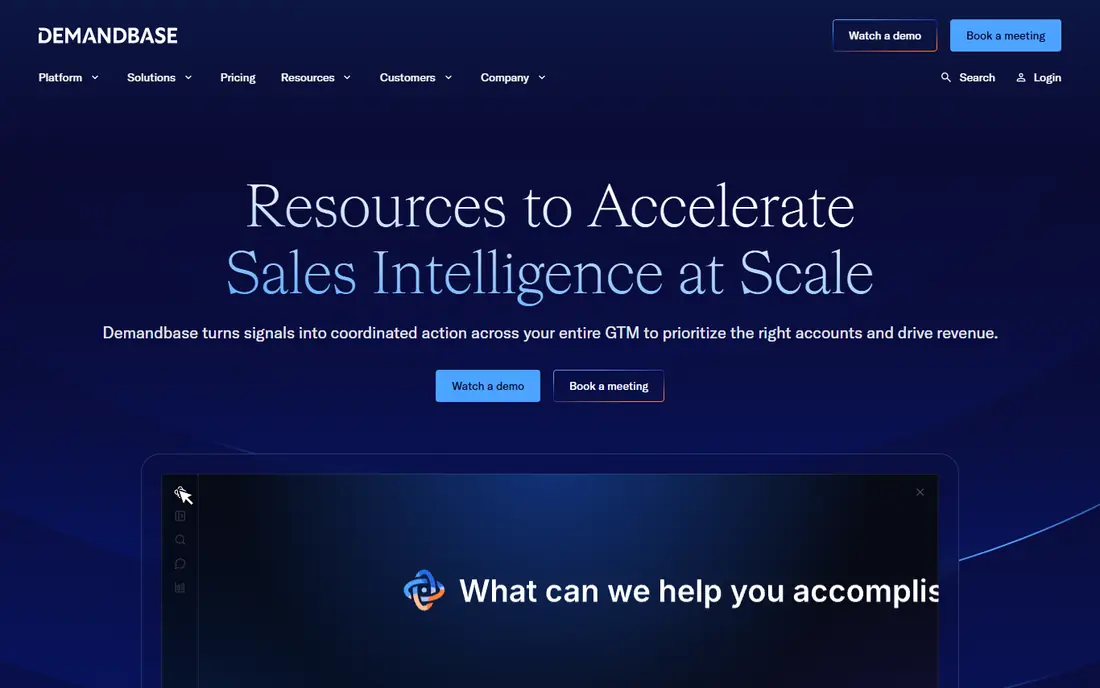
Demandbase is the full-suite option for enterprise teams that run account-based marketing as a core motion. It combines account identification, intent signals, advertising, web personalization and measurement in one platform, so marketing and sales can work from the same account list and the same priorities. Buying-group views help teams see who is involved at an account, not just which company is active.
The cost and effort are the honest catches. Demandbase uses custom pricing, and published contract comparisons place typical deals well into five figures per year, with onboarding on top. Teams also need clean CRM data and a dedicated operator to get value from the suite. For large teams with high deal values, that investment can pay. For small teams, it is usually too much platform too soon.
- Account intelligence, ads and orchestration in one suite
- Strong Salesforce and HubSpot links
- Deep buying-group views
- Custom pricing with onboarding costs
- Needs dedicated staff to run well
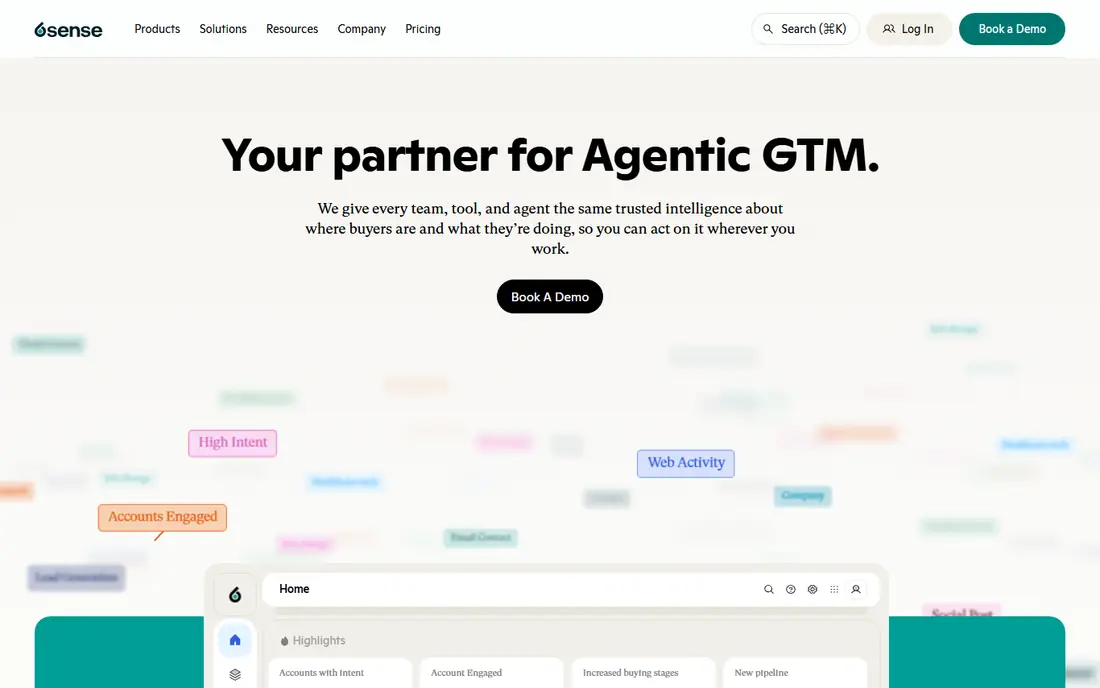
6sense built its name on predicting which accounts are in market. It processes buying signals to flag accounts by stage, recommend next actions and trigger orchestrated plays across ads, email and sales outreach. Teams that live by timing, reaching an account while it is actively researching, tend to value 6sense most.
A limited free tier exists for basic intelligence, but full plans use custom pricing, and published comparisons place typical deals in the tens of thousands of dollars per year. Implementation is not a weekend job, and teams usually need RevOps help to wire signals into the CRM cleanly. For mid-market and enterprise teams with a clear ideal customer profile, 6sense is a leading choice.
- Strong predictive intent and buying-stage signals
- Orchestration across channels
- Large signal volume
- Custom pricing for full plans
- Implementation can take weeks
- Needs RevOps support
Terminus focuses on coordinated execution across channels. Ads, chat, web personalization, email and direct mail can run against the same target account list, so an account sees a consistent program rather than disconnected touches. The Salesforce integration is a strength for teams that already run on Salesforce.
Terminus suits mature programs. Teams need a defined target list, clean CRM data and a dedicated operator, plus a platform budget separate from ad spend. Published comparisons place typical deals in the tens of thousands of dollars per year. New ABM teams should prove the model on a cheaper tool first, then move to Terminus when the program is ready.
- Account-based ads plus chat, email and direct mail coordination
- Strong Salesforce link
- Clear account engagement views
- Custom pricing
- Needs a mature ABM program to justify the cost
RollWorks is the practical starting point for mid-market teams. It centers on account-based advertising with targeting, bidding and engagement alerts, and it connects well to HubSpot and Salesforce. Setup is faster than a full suite, which matters for a small marketing team that needs to show results in a quarter, not after a six-month implementation.
The trade is depth. RollWorks does not match Demandbase or 6sense for intent data or predictive scoring, and teams that need that depth will add a data tool alongside it. Ad spend sits on top of the platform fee, so budget for both. For teams proving ABM for the first time, RollWorks is the most sensible first platform.
- Faster setup than full suites
- Strong HubSpot link
- Account-based ads with engagement alerts
- Less intent depth than Demandbase or 6sense
- Ad spend is extra
HubSpot ABM is not a separate product. It is a set of account-based tools inside HubSpot Marketing Hub, available on Professional and Enterprise tiers, that lets teams build target account lists, score accounts, personalize content and report on account engagement. For teams already running marketing and sales in HubSpot, that native fit is a major advantage, since there is no new system to learn or sync.
The limit is scope. HubSpot ABM does not match the advertising depth of Terminus or RollWorks, nor the intent depth of 6sense. Pricing also scales with hub tier and contacts, so the cost depends on your HubSpot setup. Teams already on HubSpot should start here before buying a separate ABM suite.
- ABM tools inside the CRM teams already use
- Target account lists and personalization included
- No new login for core work
- Pricing scales with contacts and hub tier
- Less ad depth than dedicated ABM suites
LinkedIn Sales Navigator is a prospecting tool, not an ABM suite, and it earns a place here because many ABM programs run on sales-led outreach. It helps reps find the right people inside target accounts, track job changes, save leads and find warm introduction paths through shared connections. The Core plan starts at $99.99 per month.
Sales Navigator does not run account-based ads, intent scoring or multi-channel orchestration on its own. It works best as a complement to a platform such as RollWorks or HubSpot ABM, giving sales teams the people-level view that account-level tools lack. Teams that buy it expecting a full ABM system will be disappointed.
- Detailed people and company search
- Job-change alerts
- Warm introduction paths
- Not a full ABM platform
- Advanced CRM sync sits on higher tiers
ZoomInfo supplies the data layer that many ABM programs depend on. Its database covers companies and contacts with firmographics, technographics and intent signals, and it syncs with Salesforce, HubSpot and other CRMs. Teams use it to build target lists, enrich accounts and find contacts inside buying groups.
Pricing is custom and credit-based, and published comparisons place typical deals in the tens of thousands of dollars per year. Data quality also varies by industry and company size, so teams should test coverage for their own target list before signing. As a data complement to an ABM platform, ZoomInfo is strong. As a standalone ABM tool, it is incomplete.
- Large B2B contact and company database
- Intent signals and technographics
- Wide CRM integrations
- Custom pricing
- Renewal increases are a common complaint
- Data quality varies by segment
Bombora provides intent data rather than a full ABM platform. Its co-op model tracks research activity across many business sites, then surfaces which companies are surging on specific topics. ABM teams feed those signals into Demandbase, 6sense, HubSpot or their CRM to prioritize accounts and time outreach.
The catch is that intent is only one input. Bombora does not run ads, orchestration or measurement on its own, so teams need activation tools alongside it. Pricing is custom and topic-based, with published comparisons placing typical deals in the tens of thousands of dollars per year. Teams that already own an activation platform will get the most from Bombora.
- Deep third-party intent topics from a large data co-op
- Works with many ABM and CRM platforms
- Topic-level surge signals
- Custom pricing
- Intent alone does not run an ABM program
- Topic costs add up
Apollo.io is the budget entry point in this list. A free tier covers basic prospecting, and paid plans start low compared with enterprise ABM suites. The platform combines a contact database with sequencing, so a small team can build a target list and run outreach from one tool without a large contract.
Apollo.io does not offer the account orchestration, advertising or measurement depth of the suites above. It suits early-stage teams and sales-led programs that need contacts and outreach more than intent modeling. Larger teams will outgrow it as a primary ABM system, but as a low-cost complement, it is hard to beat.
- Free tier to start
- Large contact database
- Built-in sequencing for outreach
- Minimal ABM orchestration
- Data accuracy varies
- Paid plans needed for serious volume
How we picked these
We compared vendor feature pages, pricing pages and recent independent pricing comparisons for ABM tools live in October 2026. We weighed intent data, account identification, advertising, orchestration, CRM links and pricing transparency, and we favored tools with a clear ABM role, whether as a suite, an ads platform, a data layer or a prospecting complement. Where vendors do not publish pricing, we wrote See website rather than repeating unverified contract estimates as list prices.
What to check before you buy an ABM tool
Start with deal size and program maturity. ABM suites pay when average deal values are high enough to justify platform, data and staff costs, and when sales and marketing already agree on a target account list. If deal values are low or the target list is still vague, a cheaper tool such as RollWorks, HubSpot ABM or Apollo.io will teach you more for less money. Buying a suite before the program is ready is the most common ABM mistake.
Budget the full cost, not the platform fee alone. Enterprise deals often add onboarding, intent data, ad spend and staff time, and published comparisons show first-year costs running well above the headline platform price. Ask vendors for the total first-year figure, including onboarding and required data, and get renewal terms in writing. A platform that doubles at renewal can wipe out a good first year.
Check the CRM fit before the feature list. ABM lives or dies on clean account data, so confirm the native Salesforce or HubSpot sync, field mapping and reporting work for your setup. Run a pilot on a small account list with clear success measures, such as meetings booked or pipeline created, before rolling out to the full target list. A pilot with real accounts beats a polished demo every time.
Frequently asked questions
What are the best account-based marketing tools?
Demandbase and 6sense lead for enterprise full-suite ABM, Terminus leads for multi-channel execution, and RollWorks leads for mid-market teams starting out. HubSpot ABM suits teams already on HubSpot, while Bombora and ZoomInfo supply intent and contact data that feed those platforms.
What is the best account-based marketing software for small teams?
RollWorks and HubSpot ABM are the strongest starting points for small and mid-market teams, with Apollo.io as a budget prospecting option. Full suites such as Demandbase and 6sense usually cost too much and need too much staff time for a small team. Prove the model on a cheaper tool first, then upgrade when deal volume justifies it.
What is the best account-based marketing platform for enterprise teams?
Demandbase and 6sense are the leading enterprise platforms, with Demandbase stronger on full-suite orchestration and 6sense stronger on predictive intent. Terminus is a strong third option for teams that prioritize multi-channel ad execution. All three need dedicated staff and clean CRM data to deliver value.
How much does ABM software cost?
Costs range from free with Apollo.io and around $99.99 per month for LinkedIn Sales Navigator Core, up to tens of thousands of dollars per year for enterprise suites such as Demandbase, 6sense and Terminus. Mid-market tools such as RollWorks sit between those ends, plus ad spend. Always budget onboarding, data and ad spend on top of the platform fee.
What tools are best for customer journey mapping in ABM?
Account-based marketing tools and journey mapping tools serve different jobs, and many teams use both. ABM platforms such as Demandbase and 6sense track account engagement across channels, while dedicated journey tools such as UXPressia and Smaply map the steps a buyer takes. Use the ABM tool for activation and the journey tool for planning the experience.
Is HubSpot good for account-based marketing?
HubSpot ABM works well for teams already running marketing and sales in HubSpot, since target lists, scoring and reporting live inside the CRM. It is less strong for account-based advertising and intent depth than dedicated suites. Teams that need deep ads or predictive intent should pair HubSpot with RollWorks, Bombora or a full suite.
Sources
See where you really rank - block by block
ProMapRanker scans Google Maps across a grid of your service area. Simple monthly plans from $19, white-label on every plan.
Start freeKeep reading
 zoom alternatives for webinars
Best Zoom Alternatives for Webinars in 2026
Discover zoom alternatives for webinars in 2026, from browser-based rooms to sales-focused platforms, with pricing, audience limits and honest trade-offs.
Read → tipalti alternatives
Best Tipalti Alternatives in 2026
Compare the best tipalti alternatives for accounts payable, global payouts and bill pay, with pricing and free plans for small teams in 2026 for US teams.
Read → mixpanel alternatives
Best Mixpanel Alternatives in 2026
Compare the best mixpanel alternatives for product analytics, funnels and retention, with free tiers and current pricing for growing teams in 2026 for US teams.
Read →