 ProMapRanker
7 Academic Scheduling Software Options Ranked for 2026

Key takeaways
- The list opens with Ad Astra, aimed at data-driven course scheduling.
- aSc TimeTables suits school timetabling.
- Before buying TimeEdit, weigh this: European roots, smaller US presence.
- No starting price is shown for any of the 7 tools, Ad Astra and aSc TimeTables included, so plan time for sales calls.
- Ad Astra, aSc TimeTables and the 5 others all need a premium plan or a trial, since no free plan is listed.
Direct answer
Ad Astra leads the list, best for data-driven course scheduling. TimeEdit fits academic operations system; Localist fits campus event calendars. The full list of 7 tools follows, with prices and free plan facts.
Quick comparison
| Pick | Great for | Pricing starts at | Free tier | |
|---|---|---|---|---|
 Ad Astra | Data-driven course scheduling | See website | No | Visit |
 TimeEdit | Academic operations system | See website | Free trial | Visit |
 Localist | Campus event calendars | See website | No | Visit |
 25Live | Campus event and space scheduling | See website | No | Visit |
 Mazevo | Modern room and event management | See website | Free trial | Visit |
 Coursedog | Integrated academic operations | See website | No | Visit |
 aSc TimeTables | School timetabling | See website | Free trial | Visit |
Tool-by-tool breakdown
Short on time? The summary and table above give the quick view of 7 tools for academic scheduling software, and the profiles that follow give the detail behind each entry.
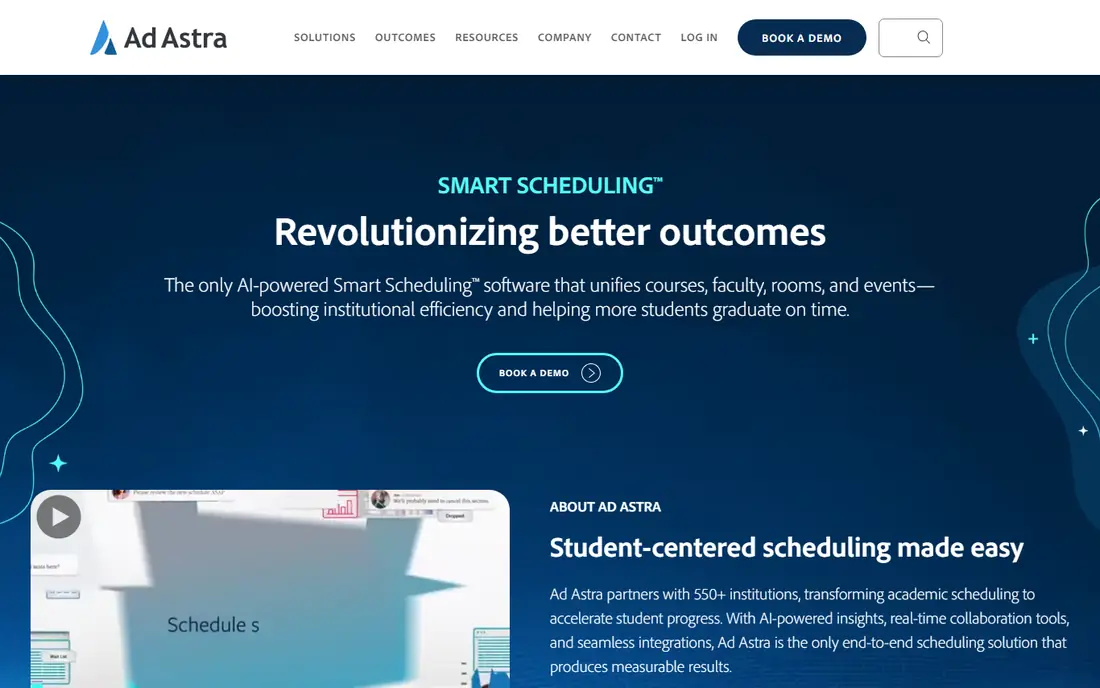
Ad Astra works best for data-driven course scheduling. The pitch is financial as much as operational: better schedules mean fuller classes and quicker completions.
Honest limits: Implementation is a project.
More specifically, pick Ad Astra if your scheduling problem is really a student-success problem. As for the details, the company reports more than 500 college and university partners, with case studies showing measurable gains in enrollment, degree velocity and on-time graduation. No starting price is listed for Ad Astra here; confirm pricing on the vendor site. No free plan comes with Ad Astra.
- Smart Scheduling analytics
- 500-plus institutions
- Best for bigger institutions
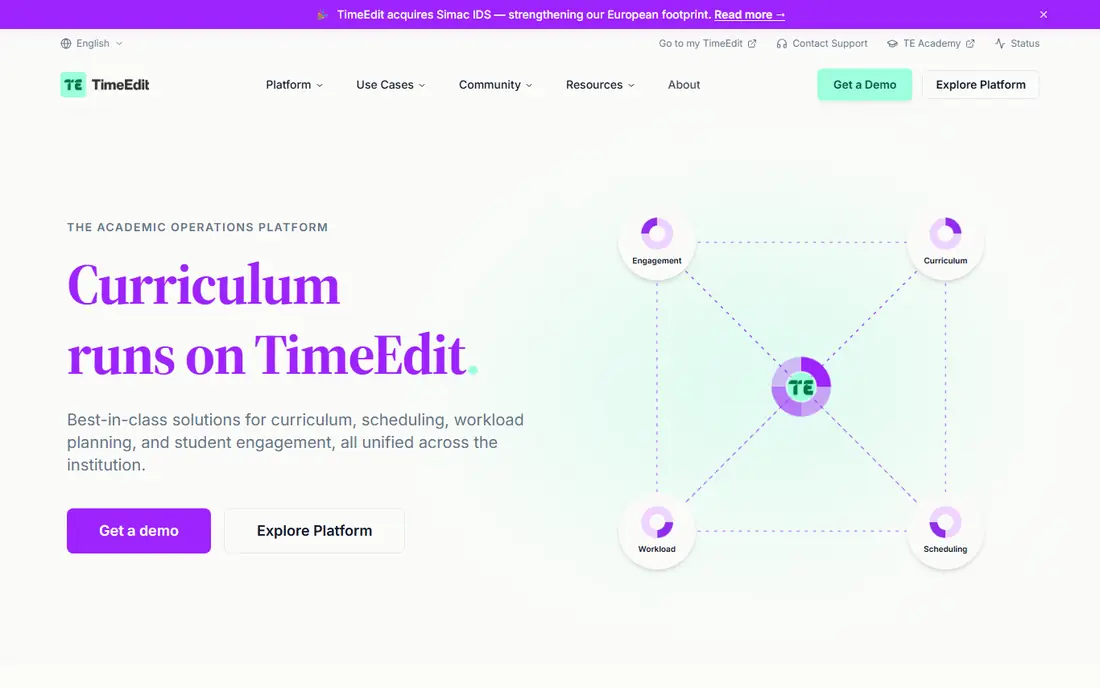
TimeEdit targets academic operations platform. Trusted by more than 200 academic institutions globally, it recently acquired Simac IDS to strengthen its European footprint and added a TimeEdit AI layer for schedulers. In practice, consider TimeEdit if you want scheduling as part of a unified academic operations strategy.
European universities will find the most solid local presence. As for the details, TimeEdit is a Swedish academic operations product handling curriculum management, workload planning, scheduling, exams and student engagement in one unified system. Check the vendor site for TimeEdit pricing; none is listed in this comparison. Free plan details: Free trial.
What to check first: European roots, smaller US presence.
- Unified curriculum to scheduling suite
- 200-plus institutions
- Enterprise sales process

Localist is aimed squarely at campus event calendars. Universities including the University of Arkansas, DePaul, UNR and Harvard College use it for their public calendars.
Trade-offs to know: Event marketing focus, not room scheduling.
Localist centralizes campus events into a single branded calendar, with widgets, channels, social features and analytics that help departments promote events. Localist does not show a starting price in this comparison, so check the vendor site for current pricing. There is no free plan with Localist.
- Beautiful branded calendars
- Widgets and API
- Quote-based pricing
Pick 25Live if this describes you: campus event and space scheduling. 25Live is CollegeNET's flagship for event and space scheduling at colleges and universities, used by institutions including Stanford, Yale and Johns Hopkins. As for the details, choose 25Live if you need a proven, higher-ed-specific scheduling backbone.
Worth adding: CollegeNET has built automated classroom scheduling for higher education since 1979, and customers consistently praise its support. Registrars and facilities teams get the most from its depth. 25Live shows no starting price here, so confirm the cost on the vendor site. 25Live does not include a free plan.
Downsides: Dated interface in places.
- Series25 integration
- Purpose-built for higher ed
- Enterprise pricing
Pick Mazevo if this describes you: modern room and event management. The company emphasizes simplicity for requesters and schedulers alike, with mobile access and automatic notifications. It plugs into Ellucian Banner, Jenzabar, Oracle PeopleSoft and Workday Student.
In daily use, pricing starts around $3,000 a year based on room count, with a free trial available. From a buyer's view, the free trial makes it simple to test with a real department before committing to a campus-wide rollout. From a buyer's view, try Mazevo if your current system frustrates the people who book rooms. Mazevo shows no starting price here, so confirm the cost on the vendor site. On free options: Free trial.
Points against: Fewer higher-ed-specific analytics.
- Invoicing built in
- Cloud-native and easy-to-learn
- Smaller vendor
Coursedog is built with integrated academic operations in mind. The company reports serving more than 500 campuses and 3.5 million students, with customers from community colleges to research universities.
An exclusive 2025 partnership with eLumen extended its curriculum and catalog reach. Beyond that, two-way integration with the student information system keeps catalog and schedule data consistent, and AI-powered operations aim to cut the manual work of building term schedules. Pricing for Coursedog is not stated here, so ask the vendor for current figures. Coursedog has no free tier.
Watch-outs: Newer vendor.
- Two-way SIS sync
- Curriculum and catalog
- Pricing not published
aSc TimeTables works best for school timetabling. Online and PC versions keep data in sync. From a buyer's view, aSc TimeTables is the veteran school timetabling tool, evaluating millions of scheduling possibilities to create balanced timetables in minutes.
It manages class divisions, odd and even weeks, substitutions with cover-teacher suggestions, class registers, room booking and an integrated AI panel for timetable changes. Worth adding: the unlimited free trial performs all premium functions except export, so schools can create their full schedule before buying. aSc TimeTables does not show a starting price in this comparison, so check the vendor site for current pricing. Free access: Free trial.
Where it is weaker: Windows-centric.
- Capable automatic generator
- Unlimited free trial
- Less suited to universities
What went into this list
ProMapRanker used vendor pricing pages and product documentation as the base, then compared plans, free access and documented limits for 7 tools. Figures are shown as the vendors publish them. Billing terms, seat minimums and add-ons can change the real cost. The order reflects how well each tool fits the most common buying scenario for academic scheduling software, then price clarity, then free plan access. It is a starting point, not a verdict.
Before you commit
- Request quotes from Ad Astra, aSc TimeTables and the others; the list shows no fixed prices.
- Run a trial of TimeEdit, Mazevo and aSc TimeTables with real work before paying for a year; your own workflow is the best test.
- Before choosing Ad Astra, weigh its main limit: implementation is a project.
- Add up seats, add-ons and usage charges for Localist before comparing it with cheaper entries.
- List the apps you already depend on and check that 25Live supports each one on the plan you would buy.
Frequently asked questions
Can I try these options before paying?
Often, yes. TimeEdit, Mazevo and aSc TimeTables offer a free trial. Use your own data and a real task during the test, and check what the free tier or trial limits before you rely on it.
Do these tools publish their prices?
No. None of the tools, from Ad Astra to aSc TimeTables, shows a fixed starting price here, so budget time for quotes.
Is Ad Astra the right pick for everyone comparing academic scheduling software?
No single tool suits every team. Ad Astra comes first because it fits data-driven course scheduling, while TimeEdit suits academic operations platform and Localist suits campus event calendars. Match the tool to your own size, budget and workflow before deciding.
What is the difference between 25Live and Ad Astra?
25Live concentrates on event and space scheduling with request workflows, whereas Ad Astra emphasizes data-driven course scheduling and student success analytics. Plenty of universities use both.
How are the tools for academic scheduling software ordered?
Ad Astra sits first and aSc TimeTables last because the order follows typical fit for academic scheduling software, then price clarity and free access. It is a judgement call, so read each profile for fit and limits.
Sources
See where you really rank - block by block
ProMapRanker scans Google Maps across a grid of your service area. Simple monthly plans from $19, white-label on every plan.
Start freeKeep reading
 zscaler alternatives
Best Zscaler Alternatives in 2026
Looking for zscaler alternatives? We compare 9 SASE and zero trust platforms on architecture, data protection, pricing, and fit for your network and team.
Read → zapier alternatives free
Best Zapier Alternatives Free in 2026
Nine automation tools for zapier alternatives free in 2026, all with genuinely free tiers, plus free plan limits, starting prices and upgrade paths explained.
Read → which platform is best for online reputation
Which Platform Is Best for Online Reputation in 2026
Wondering which platform is best for online reputation? We compare 8 review, listing, and response tools for small and multi-location businesses and agencies.
Read →