 ProMapRanker
Best ABA Data Collection Software in 2026

Key takeaways
- Motivity and Rethink Behavioral Health lead for clinical teams that want program design, live graphs and offline mobile data collection in one place.
- CentralReach suits larger, multi site practices that need scheduling, billing and data collection under one system, with pricing on request.
- Theralytics and AlohaABA are worth a close look for smaller clinics that want published per client or per staff pricing.
- Offline mobile collection, quick graphing and clean session notes matter more day to day than a long feature list.
- Always test data collection on a real session, with a real behavior plan, before you move a full caseload onto a new system.
Quick comparison
| Pick | Great for | Pricing starts at | Free tier | |
|---|---|---|---|---|
 CentralReach | Large multi site practices | See website | No | Visit |
 Motivity | Clinician first data collection | $24 per learner per month | No | Visit |
 Rethink Behavioral Health | Program library and training | See website | No | Visit |
 Theralytics | Budget conscious clinics | $20 per client per month | Yes | Visit |
 AlohaABA | Billing plus data add on | $29.99 per staff per month | No | Visit |
 Hi Rasmus | Deep program customization | See website | No | Visit |
 Raven Health | In home and school sessions | See website | No | Visit |
 Ensora Data Collection | Former Catalyst users | See website | No | Visit |
 BIPTrack | Multidisciplinary teams | See website | No | Visit |
The best ABA data collection software
Applied behavior analysis lives or dies on clean data. A therapist needs to record a trial, a frequency count or an ABC observation in seconds, without losing the session to tapping through menus. A BCBA needs a graph that shows progress clearly, and a practice owner needs notes and billing that line up with the data. We compared official feature pages, pricing pages and product documentation for the tools below, and we focused on data collection first, with practice management as a supporting factor.
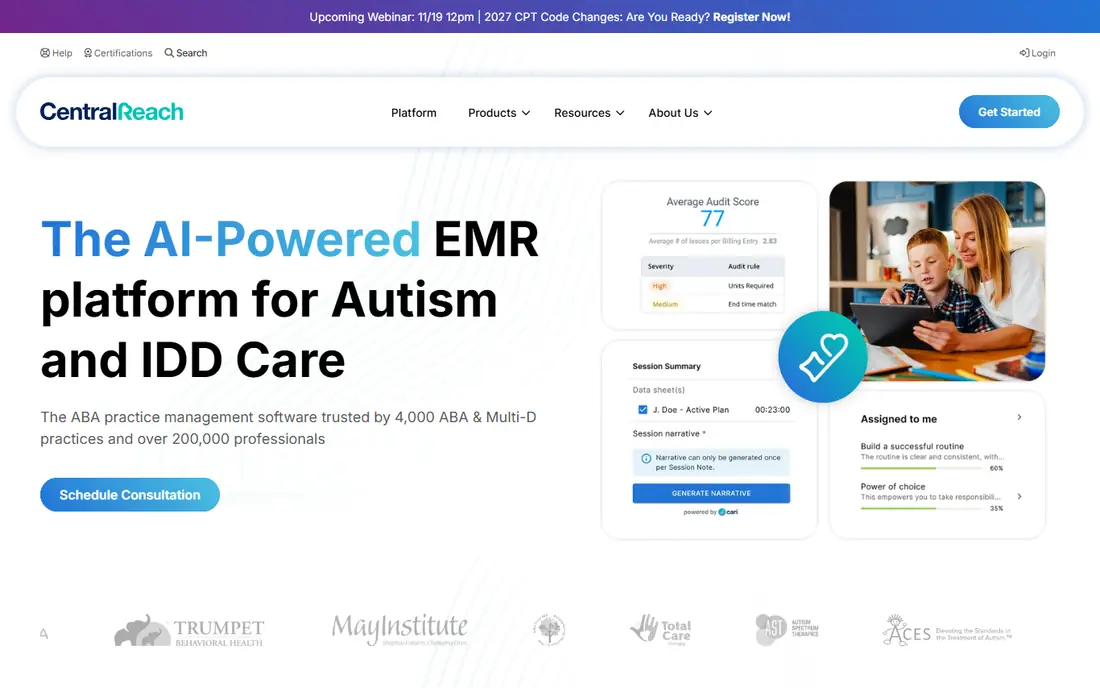
CentralReach is the broadest system on this list, and that breadth is its main appeal for larger practices. Data collection sits beside scheduling, authorization tracking, billing and reporting, so a session note, a claim and a graph can all draw on the same record. Mobile collection with offline sync helps therapists working in homes or schools where WiFi is unreliable, and supervisors can review data without waiting for paper forms to be scanned.
The trade off is scale and cost. Pricing is quoted rather than published, which makes budgeting harder for a small clinic, and implementation can take real staff time. A two therapist practice may find the system more than it needs, while a multi site group with admin staff will get more value from the dashboards, permissions and integrations. Ask for a demo using your own behavior plans, and confirm which modules are included in the quote.
- Broad ABA platform
- Offline mobile collection
- Scheduling, billing and reporting in one system
- Pricing is quote based
- Setup can be heavy for small clinics
- Some features need add on modules
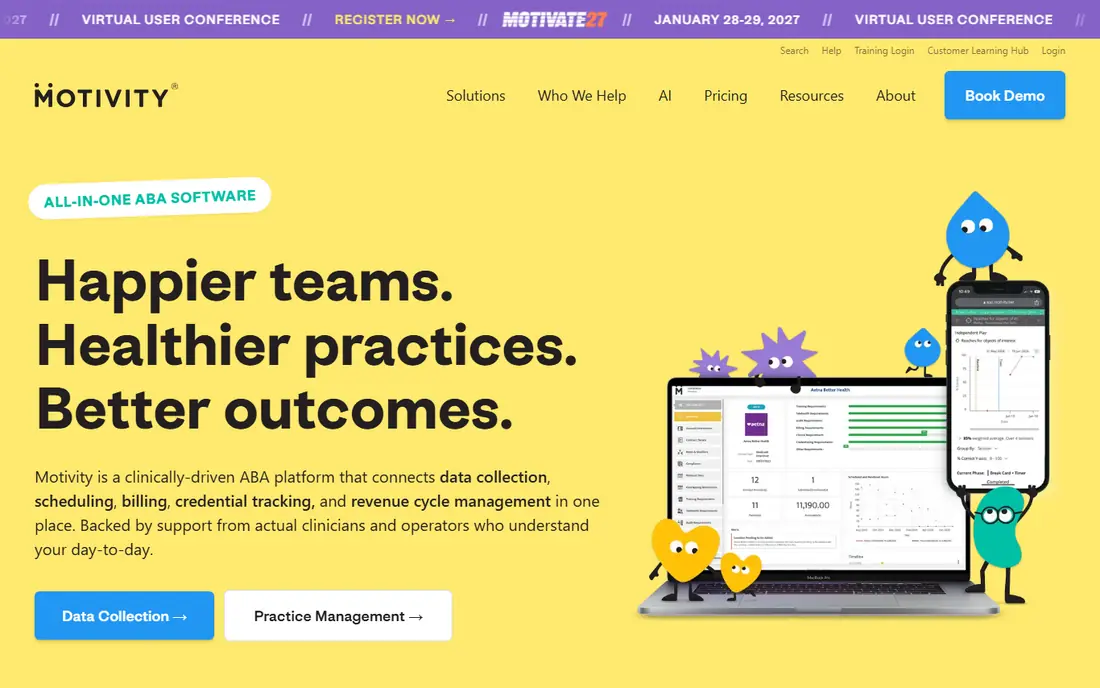
Motivity puts clinical work first, and therapists tend to notice that in the session view. Programs can use different measurement types, from frequency and duration to task analysis, and graphs update as data comes in, so a BCBA can spot a trend during supervision rather than at the end of the week. Session data can feed into notes, which reduces double entry after a busy day of home sessions.
Pricing is published per learner, which helps small and mid size practices budget without a sales call. The data collection module starts at $24 per learner per month in the pricing information we reviewed, with a higher all in price when practice management is added. That per learner model means costs rise as you add clients, so compare the total at your current caseload and at the caseload you expect in six months.
- Published per learner pricing
- Customizable measurement types
- Live graphs and session based notes
- Billing and practice tools sit in a separate module
- Per learner cost grows with caseload
- Learning curve for new staff
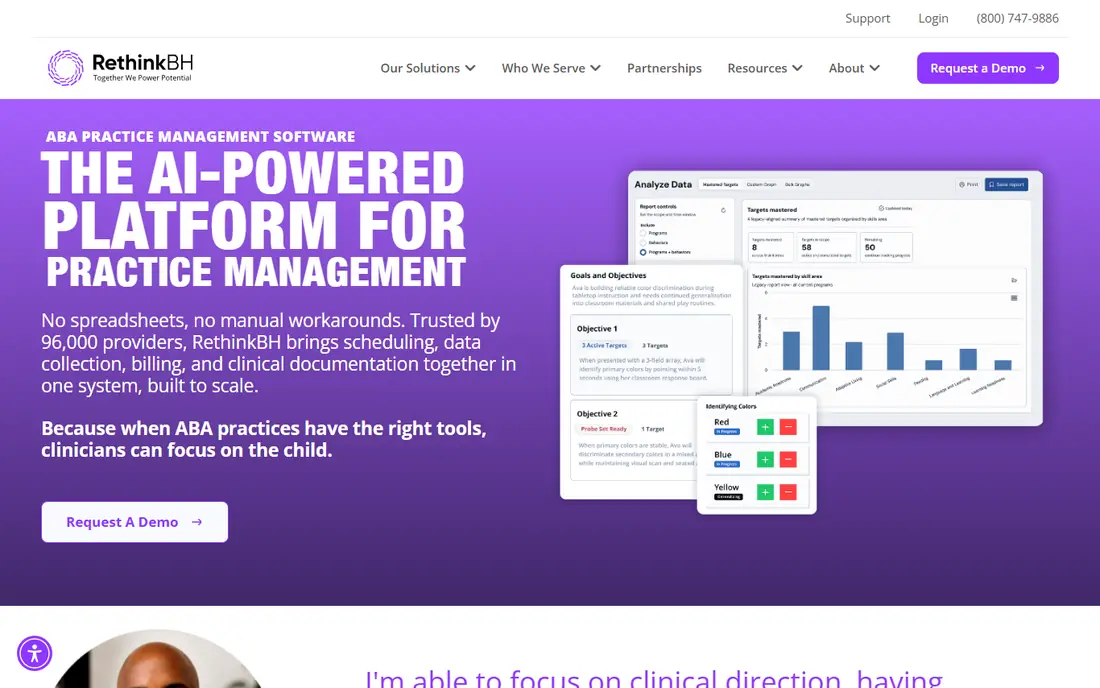
Rethink Behavioral Health pairs data collection with a large library of programs and goals, which can save BCBAs time when building a new plan. Frequency, duration, interval, ABC and task analysis data types are covered, and offline mobile collection supports sessions away from the clinic. Staff training on the same platform helps new RBTs learn the system and the clinical content in one place.
The main drawback is pricing transparency. Quotes vary by practice size and modules, so two clinics may pay different amounts for a similar setup. Teams that only need data collection should ask what a clinical only setup costs, and whether training and AI note drafting are included or charged separately. For larger organizations that want content, training and data in one contract, the bundle can still be worth the quote process.
- Large program and goal library
- Offline mobile collection
- Staff training built into the platform
- Pricing is quote based
- Full platform can feel large for data only teams
- Check which AI features cost extra
Theralytics appeals to clinics that want a clear price before they talk to sales. Per client pricing starts at $20 per client per month in the information we reviewed, and a free startup tier gives small teams a way to try the system without an upfront commitment. Graphing is detailed, offline collection is supported, and the platform covers clinical work, scheduling and billing for many practices.
The honest catch is scale. A smaller vendor may not match the largest platforms on every integration or enterprise report, and billing needs vary a lot by payer. Use the free tier for a real pilot, test your most complex behavior plan and your most common payer workflow, and confirm data export options before you commit a full caseload. For a budget conscious clinic, that pilot is the best way to judge fit.
- Published per client pricing
- Free startup tier
- Detailed graphing and offline capability
- Smaller vendor than CentralReach or Rethink
- Check billing depth before switching
- Some features vary by module
AlohaABA starts from practice management, with scheduling, billing and payroll as its core strengths, and data collection available as an add on. That order matters. A practice that already uses AlohaABA for billing can add skill acquisition, behavior reduction and ABC data without moving to a second system, and pre built documentation templates help standardize notes.
The cost structure needs a careful read. Practice management starts at $29.99 per staff per month in the pricing information we reviewed, with data collection charged per client on top. At a larger caseload, that combined cost can pass a clinical first tool. Test the mobile data flow on a real session, since a billing led system does not always feel as fast in the therapy room as a data led one.
- Strong billing and payroll tools
- Data collection add on
- Scheduling in the same system
- Data collection is an add on, not the core
- Per staff plus per client costs add up
- Check mobile workflow carefully
Hi Rasmus suits practices that want deep control over how programs are built and measured. A wide range of data types, offline capture and detailed program design let a BCBA shape a plan around a specific learner, rather than fitting the learner into a template. Video based interobserver agreement features, where offered, can also help teams check reliability in a practical way.
That flexibility comes with setup time. A BCBA will spend longer building programs at the start, and billing usually lives in a separate system, so the practice needs a clear handoff between clinical data and claims. Hi Rasmus is a good fit for data only clinics or teams with strong clinical leadership, and a weaker fit for a practice that wants one vendor to handle billing, payroll and data together.
- Wide range of data types
- Offline capable
- Strong customization for complex programs
- Pricing is quote based
- Separate system needed for billing
- Setup takes BCBA time
Raven Health is built for therapists who spend most of their day outside a clinic. Offline first collection means a session in a home or school does not depend on a strong connection, and dashboards update when the device syncs, so supervisors can follow progress without chasing paper. Skill acquisition and behavior events are covered, with notes and electronic signatures in the same workflow.
Pricing needs a direct conversation, since Raven Health offers both software and managed billing models. That bundling can suit a small practice that wants billing handled, but it also makes a simple software only comparison harder. Ask for a clear breakdown of software fees, setup fees and billing percentages, and test the app in a low signal location before you decide.
- Offline first mobile design
- Real time dashboards
- Skill and behavior data in one app
- Pricing varies by billing model
- Newer vendor than the largest platforms
- Confirm payer coverage for your state
Ensora Data Collection is the current home for the data collection product formerly known as Catalyst, now offered beside Ensora practice management tools. Offline capture and customizable graphing remain central, and clinics can buy modules rather than taking a single large bundle. That modular approach helps a practice that wants data collection now and billing or scheduling later.
Migration is the point to test. Practices moving from an older Catalyst setup, or from paper, should run old and new systems in parallel for a short pilot and check that program types, targets and historical graphs carry over cleanly. Pricing is not fully published for every module, so get a written quote for the modules you will actually use, not just the headline platform price.
- Offline capture
- Customizable graphing
- Modular purchase beside Ensora practice tools
- Pricing is partly quoted
- Migration from older systems needs planning
- Check feature parity for your plans
BIPTrack suits practices that offer more than ABA, or teams that work across languages and therapy types. Voice to text notes can speed documentation after a session, and a single system for several disciplines reduces the number of logins a therapist must manage. Tiered pricing lets a practice start smaller and add features as it grows.
The trade off is ABA depth. A general therapy platform may not match Motivity or Rethink on ABA specific program templates, graphing options or behavior plan structure. If ABA is your core service, test your most detailed behavior reduction plan in BIPTrack before you switch, and confirm that graphs, targets and session notes meet your BCBA supervision needs.
- Multiple therapy types in one system
- Voice to text notes
- Multilingual options for diverse teams
- Less ABA specific depth than clinical leaders
- Pricing is tiered and quoted
- Check ABA graphing depth
How we picked these
We focused on tools that are live in October 2026, that support ABA data collection on mobile, and that are used by real ABA practices rather than generic therapy note tools. We compared official feature pages, pricing pages and product documentation, and we noted where pricing is published and where it is quoted. Where a price could not be confirmed on the vendor page, we wrote See website rather than repeating a third party estimate as fact.
We weighted offline collection, measurement variety, graphing clarity and note quality above billing extras, because those are the features a therapist uses every session. A tool with strong billing but slow data entry scored lower here than a tool built for the therapy room. That is why data led tools and a few billing led tools both appear, with their order made clear in each write up.
What to check before you choose
Start with a pilot on your hardest cases, not your easiest ones. Pick one learner with a complex skill program, one with a behavior reduction plan, and one home based session with poor connectivity. Run the new tool beside your current system for two weeks, and compare how long data entry takes, whether graphs are clear to a parent or funder, and whether notes are complete without extra typing after the session.
Next, check data ownership and export. Ask how you export learner data, session notes and graphs if you leave, how long you can access records after closing, and who can see data inside the system. ABA records involve children and sensitive health information, so confirm privacy, access controls and audit trails in writing, and check that the vendor meets your state and payer requirements. Finally, cost the whole workflow. A per learner price, a per staff price and a quote based platform look different at 20 learners than at 200, and add on modules for billing, AI notes or training can change the total. Get the full price for your caseload, your staff count and the modules you need, in writing, before you sign.
Frequently asked questions
What is the best ABA data collection software?
The best ABA data collection software depends on practice size. Motivity and Rethink Behavioral Health lead for clinical teams that want program design and live graphs. CentralReach leads for larger practices that want one system for data, scheduling and billing. Smaller clinics often start with Theralytics or AlohaABA because pricing is published.
What is the best ABA software for small practices?
Theralytics is a strong small practice option because it offers a free startup tier and published per client pricing. AlohaABA can also work for a small clinic that needs billing and payroll first, with data collection added on. Test both on real sessions before you choose, since mobile speed matters more than a feature list.
What are the best ABA data collection apps for RBTs?
The best ABA data collection apps for RBTs are fast on mobile, work offline and show the current targets clearly at the start of a session. Motivity, Rethink Behavioral Health, Raven Health and Ensora Data Collection all offer offline mobile collection. Ask RBTs to test the app in a home or school, not just in the clinic, before you roll it out.
Does ABA data collection software work offline?
Many leading tools do, including CentralReach, Motivity, Rethink Behavioral Health, Theralytics, Hi Rasmus, Raven Health and Ensora Data Collection. Offline mode usually stores session data on the device and syncs when a connection returns. Always test sync after a long offline session, and confirm what happens if a device is lost before syncing.
How much does ABA data collection software cost?
Prices vary by model. Published examples we reviewed include Motivity from $24 per learner per month, Theralytics from $20 per client per month, and AlohaABA practice management from $29.99 per staff per month plus a data add on. Larger platforms such as CentralReach and Rethink Behavioral Health use quotes, so get a written price for your caseload and modules.
Can I export my ABA data if I switch software?
Most vendors offer export, but the format, completeness and access period after closing vary. Ask for a sample export, check whether graphs and historical session data are included, and confirm how long you can access records after you close an account. Put export terms in your contract before you migrate a full caseload.
Sources
See where you really rank - block by block
ProMapRanker scans Google Maps across a grid of your service area. Simple monthly plans from $19, white-label on every plan.
Start freeKeep reading
 zscaler alternatives
Best Zscaler Alternatives in 2026
Looking for zscaler alternatives? We compare 9 SASE and zero trust platforms on architecture, data protection, pricing, and fit for your network and team.
Read → zapier alternatives free
Best Zapier Alternatives Free in 2026
Nine automation tools for zapier alternatives free in 2026, all with genuinely free tiers, plus free plan limits, starting prices and upgrade paths explained.
Read → which platform is best for online reputation
Which Platform Is Best for Online Reputation in 2026
Wondering which platform is best for online reputation? We compare 8 review, listing, and response tools for small and multi-location businesses and agencies.
Read →