 ProMapRanker
Best Auth0 Alternatives in 2026

Key takeaways
- Clerk and Stytch are the easiest starts for modern web apps that want ready-made login screens.
- Firebase Authentication and Supabase Auth keep costs low for consumer apps with many free users.
- Keycloak and FusionAuth suit teams that want to self-host and avoid per-user billing.
- WorkOS and Descope suit business apps that need enterprise single sign-on and customer organisations.
Quick comparison
| Pick | Great for | Pricing starts at | Free tier | |
|---|---|---|---|---|
 Clerk | React and Next.js apps | $25 per month | Yes | Visit |
 Firebase Authentication | Google and mobile apps | Free | Yes | Visit |
 Supabase Auth | Postgres-backed apps | Free | Yes | Visit |
 Amazon Cognito | AWS-based apps | Free | Yes | Visit |
 Keycloak | Free self-hosted identity | Free | Yes | Visit |
 FusionAuth | Self-hosted with support | Free | Yes | Visit |
 Stytch | Passwordless login | Free | Yes | Visit |
 Descope | Visual login flows | Free | Yes | Visit |
 WorkOS | Business single sign-on | See website | No | Visit |
The best auth0 alternatives
These nine tools cover login, sign-up, social sign-in, passwordless options, and business single sign-on. We left Auth0 itself out, because this is a list of replacements, and we focused on tools with clear documentation and current pricing pages.
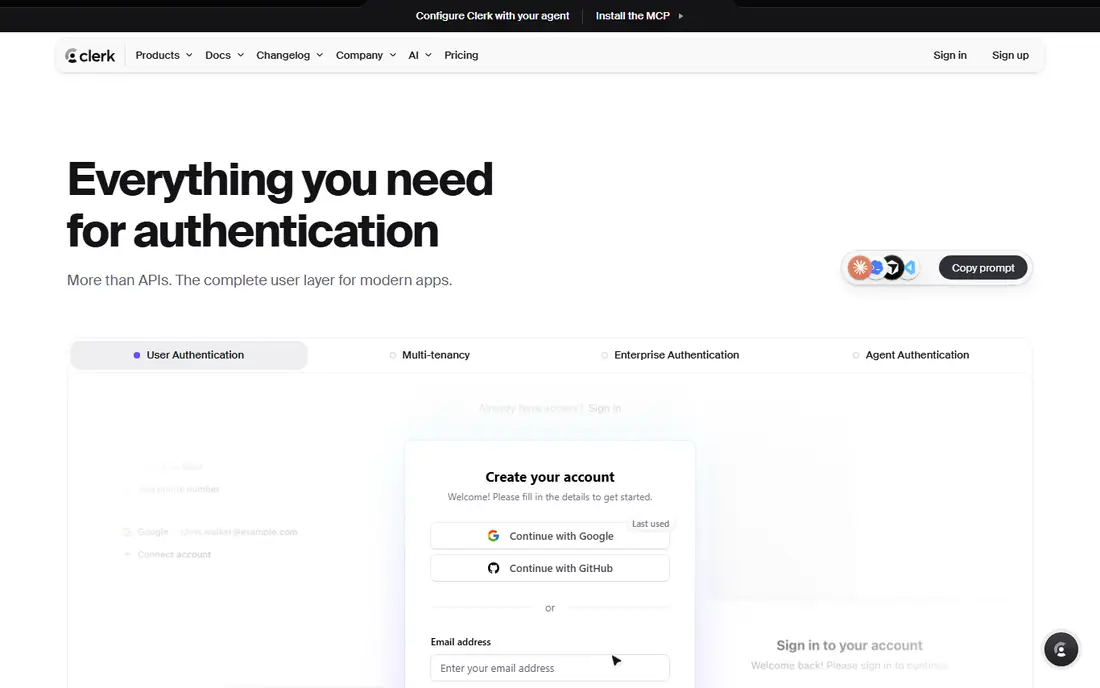
Clerk gives developers prebuilt sign-in, sign-up, and profile components that drop into a React or Next.js app with little custom design work. It handles email, password, social login, and multi-factor authentication, and it includes a dashboard for managing users and sessions. That combination explains why many small SaaS teams pick it first.
We like Clerk when speed matters and the team uses a modern JavaScript stack. The free plan covers early testing and small launches. The catch is pricing at scale. Per-user charges and paid add-ons can grow faster than a flat-rate tool, so model costs at your expected user count before you build deeply on it.
- Ready-made login and sign-up components
- Built-in user management
- Strong Next.js support
- Costs rise with monthly active users
- Enterprise single sign-on sits in paid add-ons
Firebase Authentication is Google identity service for mobile and web apps. It supports email and password login, social providers, phone sign-in, and anonymous accounts, and it pairs with Firestore security rules for access control. For a consumer app, the free allowance covers a large early user base.
Our pick for mobile-first prototypes and consumer apps is Firebase Authentication, especially when the rest of the app already runs on Firebase. The weakness shows up in business apps. If you need full enterprise single sign-on, directory sync, or complex organisation models, you will likely need another tool or extra custom work.
- Generous free allowance for many apps
- Simple mobile SDKs
- Social and phone sign-in
- Enterprise single sign-on options are limited
- Ties you closely to Google Cloud
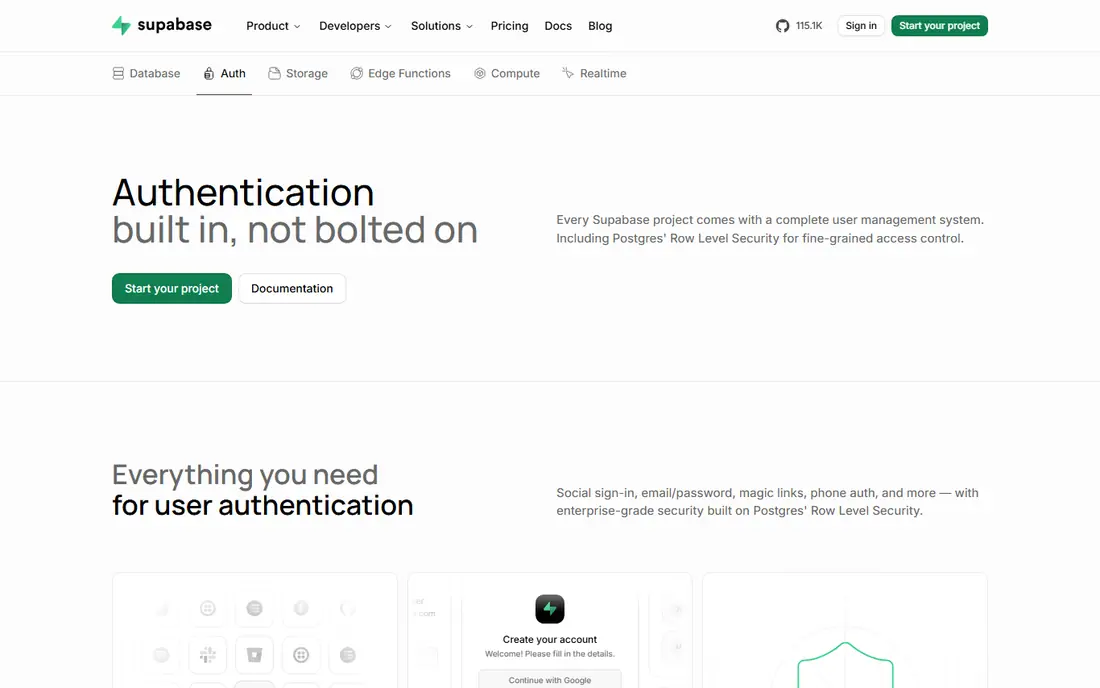
Supabase Auth is part of Supabase, an open source Firebase-style platform built on Postgres. It handles email login, magic links, OAuth providers, and phone sign-in, and it works with Postgres row-level security so database rules can check the signed-in user. The free plan includes a large monthly active user allowance, and the Pro plan is a flat monthly fee.
We like Supabase Auth for teams that already want a Postgres backend and a simple auth layer. It keeps costs predictable and avoids a separate identity vendor. Teams building complex business-to-business apps with many customer organisations should check whether its organisation model fits before committing.
- Built into Supabase projects
- Row-level security in Postgres
- Predictable Pro pricing
- Business organisation features are less deep than dedicated business identity tools
- Newer than older vendors
Amazon Cognito provides user pools for sign-up and sign-in, and identity pools for granting AWS resource access to signed-in users. It supports social login and, on paid tiers, SAML and OpenID Connect federation for enterprise customers. Apps running on AWS benefit from close integration with other AWS services.
We would pick Cognito when the app already lives on AWS and the team wants a low-cost, managed identity layer. The downside is developer experience. Setup, customisation, and hosted user interface work take more effort than with Clerk or Stytch, and SAML federation has a much smaller free allowance than direct sign-in.
- Deep AWS integration
- User pools and identity pools
- Low entry cost for direct sign-in
- Interface and setup feel dated
- Federation pricing changes the cost picture fast
Keycloak is an open source identity server from the open source community, maintained with Red Hat involvement. It supports single sign-on, social login, LDAP and Active Directory federation, multi-factor authentication, and fine-grained authorisation. You host it yourself, so there is no per-user licence fee.
This is the best pick for teams with DevOps capacity that want full control and predictable infrastructure cost. It is not a hands-off service. Production use needs monitoring, backups, upgrade planning, and security patching, and that staff time is the real price. Small teams without that capacity should choose a hosted tool.
- No licence cost
- Single sign-on, social login, and user federation
- Full data control
- You run upgrades, security patches, and uptime
- Theming and setup take engineering time
FusionAuth offers a self-hosted community edition that is free with unlimited users, plus paid cloud hosting and support tiers. It supports standard protocols, social login, multi-factor authentication, and multi-tenant setups. Teams can start self-hosted and move to cloud hosting later without changing the core product.
We like FusionAuth for teams that want Keycloak-style control with a more polished product and a paid support path. The trade-off is that business-to-business features, such as customer organisations and admin workflows, still need design work by your team. Price the cloud tier carefully, because it is a flat monthly fee rather than a small per-user charge.
- Free self-hosted edition with unlimited users
- Hosted cloud option
- Clear standard protocols
- Business organisation modelling needs custom design
- Paid cloud tiers start higher than some rivals
Stytch focuses on passwordless login for consumer and business apps. It supports email magic links, SMS and WhatsApp one-time codes, passkeys, social login, and business single sign-on and directory sync on business tiers. Fraud prevention tools, including device fingerprinting, sit on enterprise plans.
We would pick Stytch when you want to reduce password friction and improve conversion on sign-up. Passwordless flows can help mobile apps in particular. The catch is cost modelling. Free tiers are generous for early apps, but per-user pricing and connection charges need a forecast at your real scale.
- Email magic links, one-time codes, and passkeys
- Fraud tools on enterprise tiers
- Consumer and business products
- Per-user pricing grows with scale
- Some advanced features need higher tiers or add-ons
Descope lets teams build login and sign-up flows with a visual editor instead of writing every screen from scratch. It supports passkeys, social login, one-time codes, and business features such as single sign-on connections. The free tier covers early projects and small apps.
This is a strong pick for product teams that want to test different login flows quickly without rebuilding screens each time. Highly custom authentication logic may still need code, and the visual model takes some learning. Teams with strict custom requirements should run a proof of concept before switching.
- Drag-and-drop login flow builder
- Passkeys and social login
- Business single sign-on options
- Visual approach may feel limiting for fully custom flows
- Pricing at scale needs a sales check
WorkOS is built for business-to-business SaaS apps that need to offer enterprise single sign-on, directory sync, and admin portals to their customers. Instead of replacing your whole login system, it can sit alongside it and add the enterprise features that large customers ask for during procurement.
We like WorkOS when enterprise readiness is the bottleneck. It saves weeks of SAML and directory work per customer. The pricing model is the catch. Per-connection charges mean a growing list of enterprise customers raises the bill directly, so forecast that cost against the revenue those customers bring.
- Enterprise single sign-on and directory sync built for business apps
- Clear APIs
- Strong docs
- Priced per connection, which adds up with many enterprise customers
- Not a cheap consumer auth tool
How we picked these
We compared official pricing and feature pages, documentation, and protocol support for tools that replace Auth0 login, sign-up, and single sign-on. We kept only tools that are still offered in October 2026, and we mixed hosted services with self-hosted options so different team sizes and budgets are covered. Where pricing was unclear or sales-led, we wrote See website rather than inventing a figure.
How to choose the right replacement
Start with your app type. Consumer apps with many free users care most about per-user cost and simple social login. Business apps care most about single sign-on, directory sync, and organisation models. A tool that is cheap for one type can be costly for the other, so do not judge on the free tier alone.
Check migration costs early
Moving identity providers means migrating users, passwords, sessions, and social connections. Some tools offer import helpers and gradual migration, while others need custom scripts. Test password migration with a small group first, because a forced password reset can hurt sign-in rates. Keep the old provider running until the new login flow is proven.
Watch the pricing meter
Identity pricing uses several meters: monthly active users, connections, organisations, and add-ons. A flat-rate tool suits steady growth, while a per-user tool suits a small paid user base. Ask what counts as an active user, what happens above a free allowance, and whether single sign-on connections are billed separately. Run costs at three sizes: today, next year, and a high-growth case.
Security checks that matter
Confirm multi-factor authentication, passkey support, session controls, audit logs, and data residency options. Check how the vendor handles breached passwords, bot sign-ups, and account recovery. For business apps, confirm SAML, OpenID Connect, SCIM directory sync, and admin roles before you sign a contract.
Frequently asked questions
What is the best Auth0 alternative for a startup?
Clerk is a strong startup pick for modern web apps, while Firebase Authentication and Supabase Auth suit consumer apps that need low early costs. Pick based on your stack, not on the longest feature list.
Are there free alternatives to Auth0?
Yes. Clerk, Firebase Authentication, Supabase Auth, Amazon Cognito, Keycloak, FusionAuth, Stytch, and Descope all offer free tiers or free editions. Free limits differ, so check monthly active users, connections, and feature caps.
What is the best alternative to Auth0 for self-hosting?
Keycloak leads for a fully free, open source self-hosted server. FusionAuth is the next pick when you want self-hosting plus a paid support and cloud path. Both need staff time for upkeep.
Which Auth0 alternative is best for business single sign-on?
WorkOS is built for that job, with single sign-on and directory sync as its core. Descope and Stytch also offer business tiers, so compare per-connection pricing against your expected enterprise customer count.
Can I migrate users from Auth0 without forcing password resets?
It depends on the target tool and on whether password hashes can be imported. Some tools support bulk import and gradual migration, while others require a reset. Test migration with a small group and plan support messages before a full switch.
Sources
See where you really rank - block by block
ProMapRanker scans Google Maps across a grid of your service area. Simple monthly plans from $19, white-label on every plan.
Start freeKeep reading
 zoho inventory alternatives
6 Alternatives to Zoho Inventory, Compared on Price and Fit
Zoho Inventory alternatives: 6 tools compared on price, free plans and fit. Katana leads the list for manufacturers. Fit and flaws are laid out for each entry.
Read → zoho crm alternatives
Best Zoho CRM Alternatives (2026)
Need Zoho CRM alternatives? We compare 7 tools on cost, free access and who each suits. Every pick gets a straight assessment. Built for quick decisions.
Read → zelle alternatives
Best Zelle Alternatives in 2026
Compare the best Zelle alternatives for sending money to friends, paying sellers and moving funds abroad, with honest notes on fees, speed and safety in 2026.
Read →