 ProMapRanker
Best Answer the Public Alternatives in 2026

Key takeaways
- Answer the Public turns a seed keyword into a visual map of questions people ask. The closest swaps are tools that mine autocomplete, People Also Ask, and related questions.
- AlsoAsked and Answer Socrates are the closest direct matches for question trees, while Semrush and Ahrefs add volume, difficulty, and competitor data at a higher price.
- KeywordsPeopleUse and QuestionDB suit content planning from clustered questions, while KeywordTool.io suits cross-platform ideas from Google, YouTube, and Amazon.
- Free plans are useful for a few searches a day, but regular publishing usually needs a paid plan for exports and higher limits.
- No single tool here replaces both question mining and full SEO research. Many teams pair a question tool with a suite tool.
Quick comparison
| Pick | Great for | Pricing starts at | Free tier | |
|---|---|---|---|---|
 AlsoAsked | People Also Ask trees | See website | Yes | Visit |
 Answer Socrates | Question clustering | Free | Yes | Visit |
 KeywordsPeopleUse | Clustered question maps | $15 per month | Yes | Visit |
 QuestionDB | Reddit and Quora questions | $9.99 per month | Yes | Visit |
 KeywordTool.io | Cross-platform autocomplete | See website | Yes | Visit |
 Semrush | Full SEO suite with questions | $139 per month | Yes | Visit |
 Ahrefs | Keyword depth plus questions | $29 per month | Yes | Visit |
 Ubersuggest | Budget keyword research | $12 per month | Yes | Visit |
 Mangools | Simple keyword research | $29.90 per month | Yes | Visit |
The best answer the public alternatives
Answer the Public is a search listening tool that shows the questions, prepositions, and comparisons people type around a topic. Writers use it to plan articles that match real search intent. The tools below do that job in different ways, from pure question trees to full SEO suites. We compared official pricing pages and published tool comparisons from October 2026, and we did not include Answer the Public itself in the list.
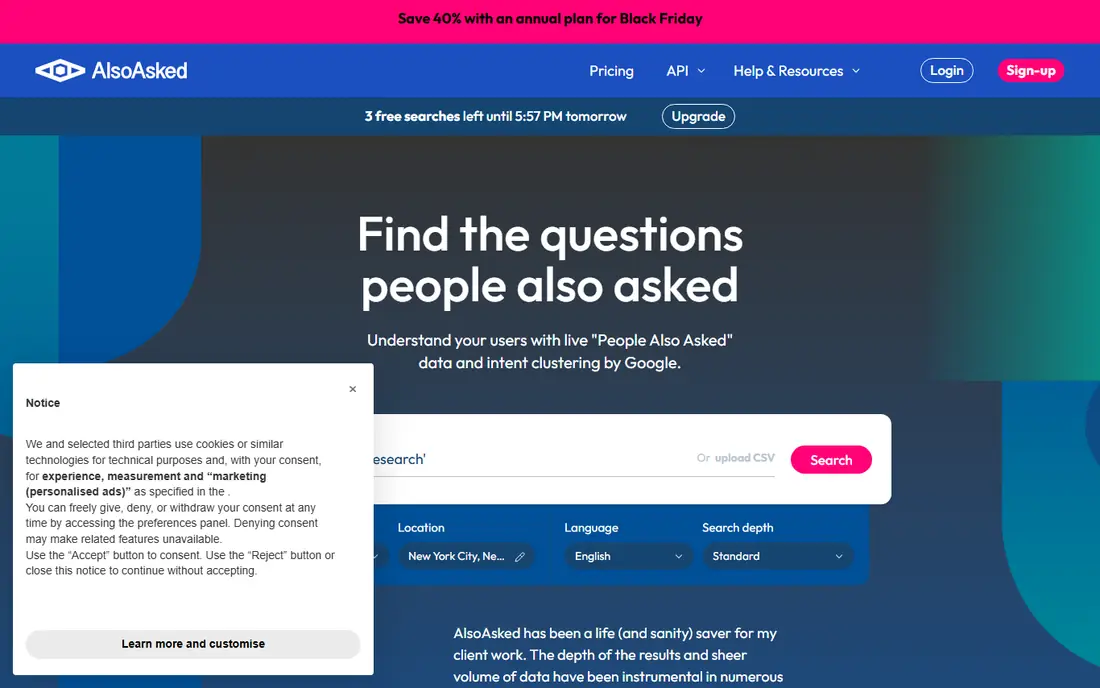
AlsoAsked is the most direct visual replacement for Answer the Public. You enter a seed, and it returns a branching tree of People Also Ask questions, showing which questions lead to further questions. That structure is ideal for planning a FAQ section or a cluster of related articles, since you can see the path a searcher follows.
The limit is scope. AlsoAsked shows question relationships well, but it does not give you the full keyword suite that Semrush or Ahrefs provide, such as backlink data or site audits. Use it when the job is question discovery and outline planning. Pair it with a volume tool when you need to judge which questions deserve a full article.
- Clear visual tree of People Also Ask questions
- Shows how questions branch
- Useful for FAQ and article outlines
- Focused on People Also Ask data, not full keyword volume
- Paid limits apply for heavy use
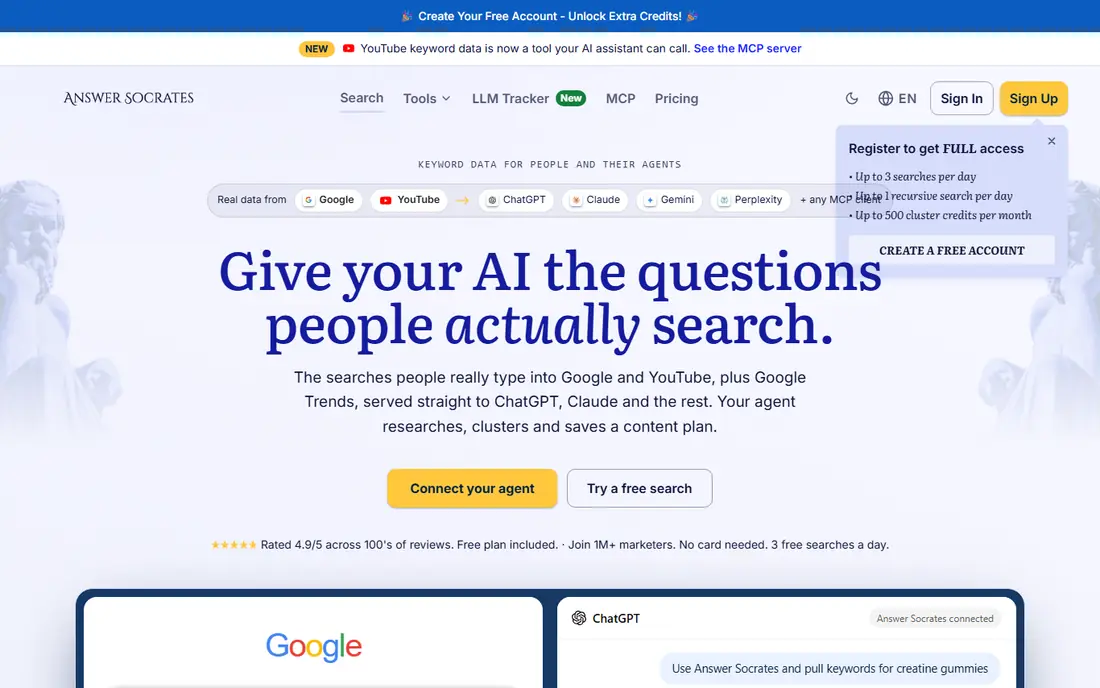
Answer Socrates is a strong value pick for content teams that live on question data. It pulls from Google Suggest, People Also Ask, and Trends, then groups results into clusters so you can plan content hubs without manual sorting. The free plan includes daily searches and CSV exports, which is generous for a tool in this category.
Published plan comparisons put paid plans from $9 to $49 per month in some listings, and higher in others, so check the current pricing page before you budget. The tool does not track rankings or pull backlink data, so it is not a suite replacement. For question research and clustering alone, it is one of the best priced options here.
- Free plan with daily searches and CSV exports
- Pulls from autocomplete, People Also Ask, and Trends
- Clusters keywords by topic
- No backlink or rank tracking tools
- Google data only in most workflows
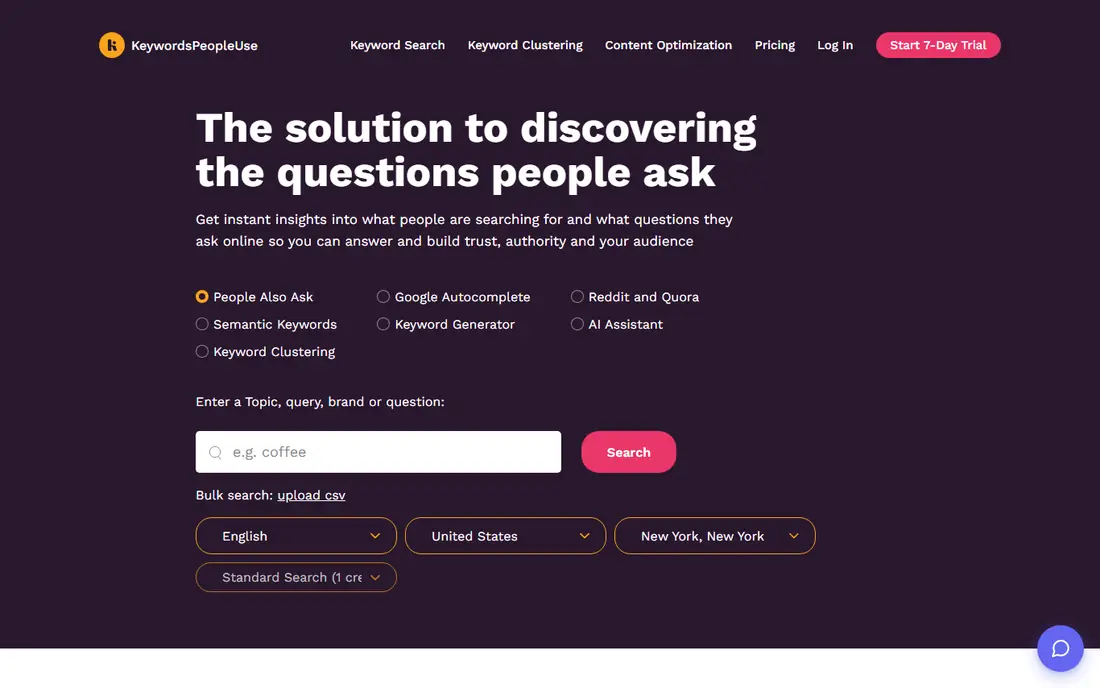
KeywordsPeopleUse turns a seed into a tree of questions grouped by topic, which helps writers avoid publishing several articles that compete for the same query. The visual clustering makes it easy to spot a hub topic, a subtopic, and a FAQ question at a glance. That is the same planning job Answer the Public does, with a stronger clustering step.
It is a specialist tool, not a suite. You will still need another source for search volume, difficulty, and competitor pages if those numbers drive your editorial choices. For a solo writer or a small team that plans by questions first, KeywordsPeopleUse is a tidy, focused option at a modest monthly price.
- Tree structured question clustering
- Clear topic maps for content planning
- 7 day free trial on paid plans in published listings
- Smaller tool than a full SEO suite
- No backlink or audit features
QuestionDB looks where Google autocomplete does not. It mines questions from Reddit and Quora, which often reveal how people phrase a problem in their own words, including frustrations and edge cases. That language is gold for introductions, FAQ answers, and product comparisons, since it matches how readers actually talk.
Treat community questions as leads, not facts. A popular Reddit thread does not prove search volume, and an answer there may be wrong. Use QuestionDB to find angles and wording, then check volume and accuracy with another tool before you publish. At $9.99 per month for the Solo plan in published listings, it is a cheap second source of ideas.
- Mines questions from Reddit and Quora
- Free plan with monthly searches
- Good for angles Google data misses
- Community questions need fact checking
- Volume data is thinner than suite tools
KeywordTool.io is the pick when your content spans more than Google web search. It pulls autocomplete suggestions from YouTube, Bing, Amazon, and other platforms, so a video title or a product page can be planned from the same seed as a blog post. That cross-platform view is something Answer the Public does not offer in the same way.
The free tool is limited, and paid plans in published comparisons range from $68 to $199 per month depending on the source and plan, so check the current page before you commit. KeywordTool.io also lacks the clustering and content brief features of some rivals. Use it for breadth of suggestions, then cluster and prioritize elsewhere if needed.
- Autocomplete data from Google, YouTube, Bing, Amazon, and more
- Large suggestion lists
- Useful for video and shopping content
- No clustering on lower plans in published reviews
- Paid plans are pricier than pure question tools
Semrush is the suite option. Its Keyword Magic Tool includes question filters that surface the same kinds of queries Answer the Public shows, plus volume, difficulty, intent, and SERP features. You also get site audits, rank tracking, and competitor data in the same subscription, which makes it a one tool answer for a larger SEO team.
The price is the barrier. At $139 per month for the SEO plan in October 2026 listings, with a lower annual equivalent in some listings, Semrush only makes sense if you use the suite beyond questions. A free account with limited daily reports can test the question filters, but regular publishing needs a paid plan. Choose Semrush when questions are one part of a wider SEO job.
- Keyword Magic Tool with question filters
- Site audit, rank tracking, and PPC data
- Large keyword database
- High monthly price for question research alone
- Interface can feel busy for beginners
Ahrefs is the depth option. Keywords Explorer includes a Questions report that shows what people ask around a seed, alongside traffic potential, parent topic, and difficulty based on links. That depth helps you judge whether a question deserves a full article, a FAQ entry, or no article at all.
Pricing needs care. Starter at $29 per month gives limited research access, while Lite at $129 per month is the full feature entry point in many listings. Webmaster Tools gives free but limited access for your own verified sites. Ahrefs suits teams that already need backlink and competitor data, with question research as a strong extra rather than the only reason to subscribe.
- Large keyword index
- Questions report in Keywords Explorer
- Strong backlink and traffic data
- Full features start at $129 per month Lite in many listings
- No standard free trial
Ubersuggest is the budget suite pick. For $12 per month in published listings, you get keyword suggestions, content ideas, and basic tracking in a simple interface. That is enough for a freelancer or a small site that needs real keyword data without a $100 plus monthly bill.
The trade is depth. Difficulty scores, volume estimates, and competitor data are less detailed than the larger suites, and the interface promotes upgrades. Ubersuggest also does not cluster questions as cleanly as Answer Socrates or KeywordsPeopleUse. Use it as a low cost all rounder, and add a question specialist when clustering becomes the bottleneck.
- Low monthly price
- Keyword ideas, content ideas, and basic rank tracking
- Beginner friendly
- Data depth is thinner than Semrush or Ahrefs
- Upsells appear in the workflow
Mangools, through KWFinder, is the simplest suite here to learn. You type a seed, see keyword ideas with difficulty and volume, and check the search results page without wading through a dense dashboard. That clarity suits beginners and small teams who want answers fast.
The free plan allows a handful of lookups per day, and paid plans start at $29.90 per month in published listings. Mangools does not match the larger suites on database size or competitor depth, and it does not specialize in question trees. Pick it when ease of use matters more than maximum data, and pair it with AlsoAsked or Answer Socrates for question mapping.
- Clean, easy KWFinder interface
- SERP analysis and rank tracking in the suite
- Good for beginners
- Smaller database than Semrush or Ahrefs
- Limited competitor analysis
How we picked these
We compared official pricing pages and published tool comparisons for tools that surface real questions people ask, cluster them, or add volume and difficulty to them. We favored tools live in October 2026 with a public price or free plan, and we kept the mix broad: pure question tools, cross-platform autocomplete, and full SEO suites. We left out rank trackers with no question feature, since they do not replace Answer the Public.
How to get useful questions without drowning in lists
Start with one seed and one question tool, not five tools at once. Run the seed through AlsoAsked or Answer Socrates, export the list, and delete duplicates and near duplicates. You will usually find a handful of hub questions that deserve full articles, and a longer tail that belongs in FAQ sections. That split is the whole point of question research.
Next, check intent before you write. A question that asks how to do something needs steps. A question that asks which tool is best needs a comparison. A question that asks what something costs needs a price range and a note on what changes it. Matching the answer shape to the question shape will do more for rankings than adding more questions to the page.
Finally, set a limit for free plans. Three searches a day sounds fine until you plan a month of content in one afternoon. If you publish weekly, a paid question tool usually pays for itself in saved time. Our pick for most writers is Answer Socrates for clustering on a budget, with AlsoAsked for visual trees, and Semrush or Ahrefs only when you also need volume, difficulty, and competitor data.
Frequently asked questions
What is the closest free alternative to Answer the Public?
AlsoAsked and Answer Socrates both offer free plans for question research. AlsoAsked gives a visual People Also Ask tree, while Answer Socrates adds clustering and CSV exports on its free plan. For a few searches a day, either one covers the core Answer the Public job.
Do these tools show search volume?
Some do, some do not. Semrush, Ahrefs, Ubersuggest, and Mangools show volume and difficulty estimates. Pure question tools like AlsoAsked focus on question relationships, so you may need a suite tool to judge volume before you commit to a full article.
Can I use question tools for FAQ sections?
Yes, that is one of their best uses. Run a seed, pick the questions that match your page topic, and answer each one directly in two to four sentences. Avoid copying question wording from a tool without checking that the question fits your product or service.
Is Answer Socrates better than AlsoAsked?
It depends on the job. Answer Socrates clusters questions and exports data on the free plan, which suits content hub planning. AlsoAsked shows a cleaner branching tree of People Also Ask questions, which suits FAQ planning. Many writers use both for different stages of the same plan.
Do I need Semrush or Ahrefs just for questions?
No, not for questions alone. A question specialist costs far less and often clusters better. Semrush or Ahrefs make sense when you also need backlink data, site audits, rank tracking, or competitor analysis in the same subscription.
How many questions should an article target?
Target one main question per article, with three to six related questions in FAQ or subheadings. Targeting dozens of questions in one page usually produces a thin answer to each one. A focused page with direct answers tends to serve readers better than a long list of half answered queries.
Sources
- https://alsoasked.com
- https://answersocrates.com
- https://keywordspeopleuse.com
- https://questiondb.io
- https://keywordtool.io
- https://www.semrush.com
- https://ahrefs.com
- https://neilpatel.com/ubersuggest/
- https://mangools.com
- https://piperocket.digital/alternative/alsoasked-alternatives/
- https://rankite.com/blog/best-keyword-research-software
See where you really rank - block by block
ProMapRanker scans Google Maps across a grid of your service area. Simple monthly plans from $19, white-label on every plan.
Start freeKeep reading
 zoro.to alternatives
Best Zoro.to Alternatives in 2026
We compare the best zoro.to alternatives in 2026, listing only legal licensed anime streaming services, from Crunchyroll to free options for fans today.
Read → zip alternatives
Best Zip Alternatives in 2026
We compare the best zip alternatives for buy now, pay later in 2026, covering pay-in-4 plans, fees, spending limits, and credit reporting options today.
Read → yesware alternatives
Best Yesware Alternatives in 2026
Compare the best yesware alternatives for sales email tracking, templates, and sequences, with current pricing and honest tradeoffs for small sales teams.
Read →