 ProMapRanker
Best Ansible Alternatives in 2026

Key takeaways
- Ansible is agentless and YAML based, so alternatives split into two groups: configuration tools that enforce state on servers, and provisioning tools that create cloud infrastructure.
- Puppet, Chef, Salt, CFEngine, and Rudder are the closest configuration swaps, with agents that check in and correct drift over time.
- Terraform, OpenTofu, and Pulumi are provisioning tools, not direct configuration replacements, though teams often pair them with a configuration tool.
- Octopus Deploy suits deployment automation with configuration built in, rather than fleet-wide server management.
- Most tools here have a free open source core, with paid support and management features on top. Check the licence and the commercial tier before you plan a migration.
Quick comparison
| Pick | Great for | Pricing starts at | Free tier | |
|---|---|---|---|---|
 Puppet | Enterprise infrastructure governance | See website | Yes | Visit |
 Chef Infra | Policy as code automation | See website | Yes | Visit |
 Salt | High speed remote execution | See website | Yes | Visit |
 Terraform | Multi-cloud provisioning | See website | Yes | Visit |
 OpenTofu | Open governance provisioning | See website | Yes | Visit |
 Pulumi | Infrastructure in real languages | See website | Yes | Visit |
 CFEngine | Lightweight large fleet management | See website | Yes | Visit |
 Rudder | Continuous compliance | See website | Yes | Visit |
 Octopus Deploy | Deployment automation | See website | No | Visit |
The best ansible alternatives
Ansible automates configuration and deployment with agentless YAML playbooks over SSH or WinRM. Teams look for alternatives when they need continuous enforcement, faster execution at scale, stronger compliance reporting, or a different language for infrastructure. The tools below cover those needs. We compared official documentation and published configuration management comparisons from October 2026, and we did not include Ansible itself in the list.

Puppet is the enterprise standard many teams compare Ansible against. Agents on each node pull their catalog, apply it, and report back, so drift is corrected on a schedule rather than only when someone runs a playbook. That pull model suits large, regulated estates where you need proof that a server stayed in its desired state.
The cost is complexity. You run a Puppet server, manage certificates, and learn the Puppet language, which is more work than dropping a playbook on a control node. Puppet Open Source is free, while Puppet Enterprise adds management, reporting, and support. Pick Puppet when governance and continuous compliance matter more than quick ad hoc runs.
- Mature agent based model with continuous enforcement
- Strong reporting and role based access
- Large module ecosystem
- Own declarative language to learn
- Agent and server setup is heavier than Ansible
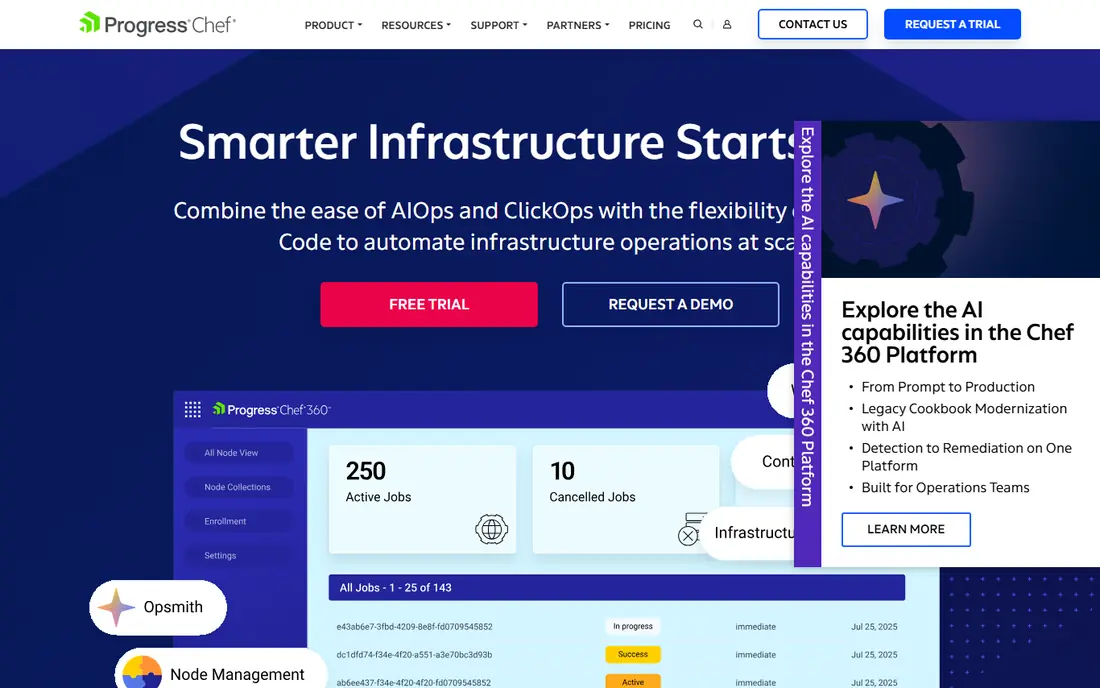
Chef Infra treats infrastructure as code in a literal sense. You write cookbooks and recipes in a Ruby based language, test them, and apply them through a Chef server or in a simpler mode for smaller fleets. That code first approach suits teams who already work in Ruby or who want the same testing discipline for servers as for applications.
For a team coming from Ansible YAML, Chef can feel like a step up in effort. The concepts of cookbooks, roles, and environments take time to learn, and the payoff comes at scale or in regulated work where audit trails matter. Chef is now under Progress, with open source and commercial options. Pick it when policy as code and testability are the priority.
- Code driven configuration in Ruby
- Testable cookbooks and policies
- Strong for regulated and complex estates
- Ruby knowledge needed
- Steeper learning curve than YAML playbooks
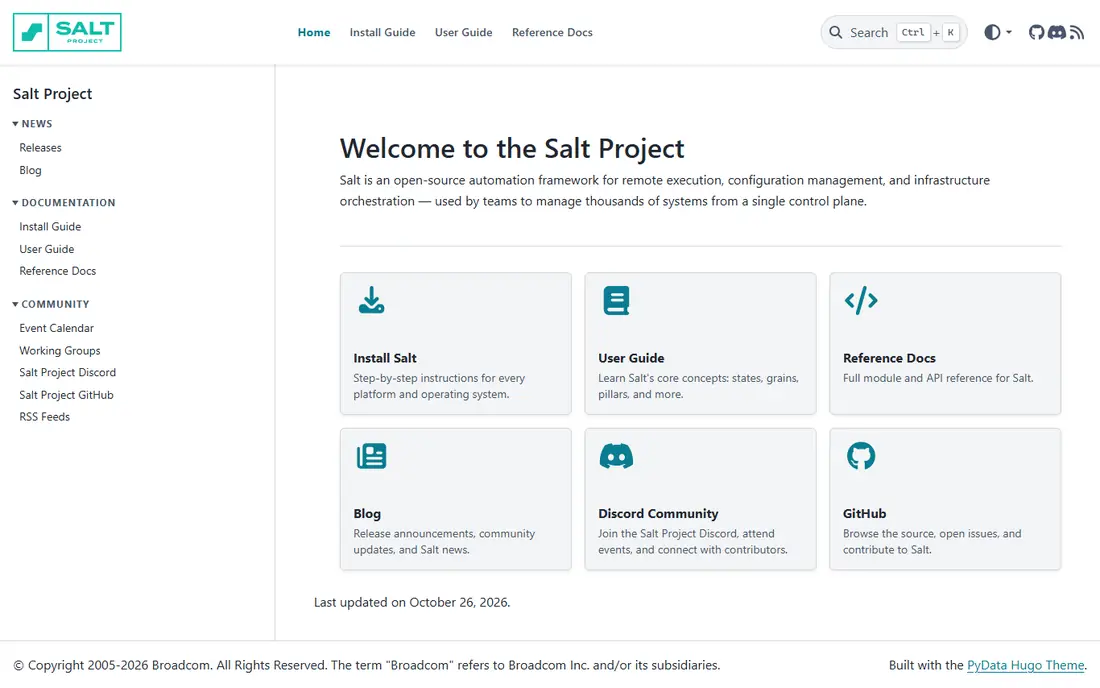
Salt, also called SaltStack, is known for speed. Its event system and remote execution engine can run commands across thousands of minions quickly, which suits large fleets and time sensitive remediation. States are written in YAML with Jinja, so Ansible users will find the syntax familiar, even though the architecture differs.
Salt can run agent based with minions, or agentless over SSH for smaller jobs. That flexibility helps teams migrate in stages. The open source Salt Project is free, while commercial management sits in VMware Aria Automation Config and related Broadcom offerings. Pick Salt when execution speed and event driven work matter most.
- Very fast remote execution at scale
- Event driven automation
- YAML states with Jinja templating
- Architecture can feel complex at first
- Commercial features sit with VMware and Broadcom offerings
Terraform is not a like for like Ansible replacement, and that distinction matters. It creates and manages cloud resources, networks, and services in a declarative way, with a plan step that shows what will change before you apply it. For multi-cloud provisioning, it is the standard most teams reach for first.
Where Terraform stops, a configuration tool starts. You still need something to install packages, manage users, and enforce settings inside the servers Terraform creates. Many teams pair Terraform with Ansible, Puppet, or Chef for that reason. Terraform Open Source is free, with HCP Terraform adding collaboration and governance. Pick Terraform when provisioning is the gap, not server configuration alone.
- Declarative infrastructure as code in HCL
- Huge provider ecosystem
- Clear plan and apply workflow
- Provisions infrastructure, does not configure servers in depth
- State file needs careful handling
OpenTofu is a community governed fork of Terraform, created after HashiCorp changed Terraform licensing. It keeps the HCL workflow and much of the provider compatibility that Terraform users know, while staying under an open source licence and open governance model. For teams that want Terraform style provisioning without licence uncertainty, it is the natural alternative.
The same caveat as Terraform applies. OpenTofu provisions infrastructure; it does not replace a configuration management tool inside servers. Check provider coverage for your clouds before you migrate, since some newer providers may lag. Pick OpenTofu when open governance and provisioning are both priorities.
- Open source fork of Terraform with compatible HCL
- Community governed
- State encryption features
- Provider ecosystem is still catching up in places
- Also a provisioning tool, not a configuration tool
Pulumi lets developers define cloud infrastructure in general purpose languages instead of a dedicated language like HCL. That means loops, functions, tests, and shared libraries from normal software work apply to infrastructure too. For a team that already writes TypeScript or Python daily, that can feel more natural than learning another DSL.
The trade is that infrastructure logic can hide bugs in code, and state handling needs a clear plan, whether you use Pulumi Cloud, a self managed backend, or object storage. Pulumi has a free tier for individuals and small teams, with paid plans for collaboration and policy. Pick Pulumi when your team thinks in code first and wants infrastructure to follow the same practices.
- Define infrastructure in TypeScript, Python, Go, and .NET
- Reuse code, tests, and libraries
- Strong for developer led teams
- Programming skill required
- State management needs planning for larger teams
CFEngine is one of the oldest configuration tools, and its strength is efficiency. The agent is small and autonomous, so it can enforce policy on very large fleets without heavy server load. That makes it a good fit for organizations with tens of thousands of nodes, or with constrained hardware at the edge.
The learning curve is real. CFEngine uses its own declarative policy language, and the community is smaller than the Puppet or Chef communities, so examples and modules are fewer. The open source edition is free, with commercial support and management on top. Pick CFEngine when fleet size and agent weight matter more than a large module library.
- Very lightweight agent
- Autonomous policy enforcement
- Proven on very large fleets
- Own policy language to learn
- Smaller community than Puppet or Chef
Rudder is built for teams that want compliance reporting without writing a lot of custom code. A web interface offers prebuilt policy techniques for common settings, and agents report compliance status back to the server. That makes it easier to show auditors that servers stayed in line, and to correct drift when they did not.
Rudder is closest in spirit to Puppet, but with a stronger focus on the UI and on compliance workflows. The open source edition is free, with a commercial subscription for support and extra features. The ecosystem is smaller, so check that your operating systems and use cases are covered. Pick Rudder when compliance evidence is a daily need, not an occasional report.
- Web UI with prebuilt policy techniques
- Continuous compliance reporting
- Drift correction without heavy coding
- Smaller ecosystem than Puppet or Chef
- Agent based setup for full features
Octopus Deploy automates getting software from build to production, with environments, approvals, variables, and rollbacks built in. Configuration, such as connection strings and feature flags per environment, is part of the release, which reduces the manual steps that cause deployment errors.
It is not a replacement for Puppet or Chef across a server fleet. Octopus manages deployments, not the ongoing desired state of every server. Pricing is quote and plan based, with a trial rather than a permanent free plan in most listings. Pick Octopus when the pain is releases and environment promotion, and pair it with a configuration tool for server state.
- Clear deployment pipelines and environments
- Configuration built into releases
- Strong for .NET and multi-platform apps
- Deployment focused, not a fleet configuration tool
- Paid plans with a free trial rather than a free tier
How we picked these
We compared official documentation and published configuration management comparisons for tools live in October 2026 that cover Ansible jobs: configuring servers, deploying applications, provisioning infrastructure, or enforcing compliance. We favored tools with a free open source core or a clear free tier, and we separated provisioning tools from configuration tools so readers do not mistake one for the other. We left out CI tools that only run scripts, since they do not manage server state.
How to choose the right replacement
Start by naming the job Ansible does for you today. If it is ad hoc tasks and simple playbooks, a configuration tool with a gentler learning curve or a different agent model may be enough. If it is continuous enforcement, pick an agent based tool like Puppet, Chef, Salt, or Rudder. If it is cloud provisioning, pick Terraform, OpenTofu, or Pulumi, and keep a configuration tool for the servers inside.
Next, check the team skill set. YAML familiarity points to Salt. Ruby points to Chef. A dedicated language with a large module library points to Puppet. Real programming languages point to Pulumi. A team that must learn a new language for the tool will move slower for months, so weigh that cost honestly against the feature gain.
Finally, run a pilot on a small, non-critical fleet. Test agent install, a simple policy, a drift correction, and a rollback. Measure how long a change takes from edit to applied state, and how clear the reporting is when something fails. Our pick for most teams is Puppet or Salt for configuration, Terraform or OpenTofu for provisioning, and Octopus Deploy only when deployments are the real bottleneck.
Frequently asked questions
What is the closest direct alternative to Ansible?
Puppet and Chef are the closest configuration management alternatives, with Salt close behind. All three enforce desired state on servers over time, while Ansible is usually run on demand. Puppet suits governance, Chef suits code driven teams, and Salt suits speed at scale.
Can Terraform replace Ansible completely?
No, not on its own. Terraform provisions cloud infrastructure, while Ansible configures servers and deploys applications inside that infrastructure. Many teams use both together, with Terraform creating resources and a configuration tool managing what runs on them.
Is there a free ansible alternative?
Yes. Puppet Open Source, Chef Infra, Salt Project, Terraform, OpenTofu, Pulumi, CFEngine, and Rudder all have free open source editions or free tiers. Paid plans add management, reporting, support, and collaboration, but the core automation is free in most cases here.
Agent or agentless: which is better?
Agentless is simpler to start, since no software needs installing on managed nodes. Agent based tools check in on a schedule, correct drift, and report compliance without someone running a job. For small fleets, agentless wins on simplicity. For large or regulated fleets, agents usually win on enforcement and reporting.
Do I need to rewrite all my Ansible playbooks?
In most migrations, yes, at least in part. Each tool has its own language or model, so playbooks do not move directly. A pilot can show how much logic transfers as concepts, and how much must be rewritten. Budget time for testing, not only for translation.
Which tool is best for compliance reporting?
Rudder and Puppet are the strongest compliance picks here, with continuous reporting and drift correction built in. Chef also supports policy as code with audit features. If compliance evidence is the main driver, shortlist Rudder and Puppet first and test their reports on your own fleet.
Sources
- https://www.puppet.com
- https://www.chef.io
- https://saltproject.io
- https://www.hashicorp.com/products/terraform
- https://opentofu.org
- https://www.pulumi.com
- https://cfengine.com
- https://www.rudder.io
- https://octopus.com
- https://spacelift.io/blog/ansible-alternatives
- https://rankite.com/blog/best-software-configuration-management-tools
See where you really rank - block by block
ProMapRanker scans Google Maps across a grid of your service area. Simple monthly plans from $19, white-label on every plan.
Start freeKeep reading
 zoro.to alternatives
Best Zoro.to Alternatives in 2026
We compare the best zoro.to alternatives in 2026, listing only legal licensed anime streaming services, from Crunchyroll to free options for fans today.
Read → zip alternatives
Best Zip Alternatives in 2026
We compare the best zip alternatives for buy now, pay later in 2026, covering pay-in-4 plans, fees, spending limits, and credit reporting options today.
Read → yesware alternatives
Best Yesware Alternatives in 2026
Compare the best yesware alternatives for sales email tracking, templates, and sequences, with current pricing and honest tradeoffs for small sales teams.
Read →