 ProMapRanker
Alternatives to Whatfix in 2026

Key takeaways
- WalkMe and Userlane suit enterprise digital adoption, while UserGuiding, Userpilot, and Userflow suit product teams that need faster setup.
- Pendo is the strongest alternative when product analytics matter as much as guides, and it has a free tier up to 500 monthly active users.
- Most alternatives price by monthly active users, not seats, so model your real user count before comparing headline prices.
- Whatfix itself is not listed here, because this article covers alternatives only, and each tool below is a separate product.
Quick comparison
| Pick | Great for | Pricing starts at | Free tier | |
|---|---|---|---|---|
 WalkMe | Enterprise digital adoption | See website | No | Visit |
 Pendo | Product analytics plus guides | See website | Yes | Visit |
 UserGuiding | Budget friendly product tours | $249 per month | Free trial | Visit |
 Appcues | No code onboarding flows | $249 per month | Free trial | Visit |
 Userpilot | Activation and retention flows | $299 per month | Free trial | Visit |
 Userflow | Clean branching onboarding | $240 per month | Free trial | Visit |
 Chameleon | Highly customized in-app experiences | See website | Free trial | Visit |
 Product Fruits | Lightweight onboarding for small SaaS | $79 per month | Free trial | Visit |
 Userlane | Enterprise employee adoption | See website | No | Visit |
The best alternatives to whatfix
These are the best alternatives to Whatfix we found for in-app guides, product tours, checklists, and digital adoption, whether the users are customers or employees. We compared official pricing pages and recent digital adoption comparisons, and we kept only tools with a live product in October 2026. Whatfix itself is deliberately not included, as this list covers replacements and alternatives only.

WalkMe is the closest enterprise grade alternative for organizations that used Whatfix for employee training across many internal apps. It overlays guidance on third party software, automates multi-step workflows, and supports change management when a system updates. That cross application reach is the reason large enterprises choose it over a product tour tool built only for their own app. The cost is complexity and price. Pricing is quote only and enterprise led, with published estimates suggesting a high annual commitment, and implementation can take months for a large estate. Smaller teams should look further down this list, while enterprises with many internal systems will find WalkMe scope hard to match.
- Cross application guidance
- Workflow automation
- Strong enterprise and SAP focused options
- Quote only enterprise pricing
- Complex implementation for large rollouts

Pendo suits product teams that want to understand user behaviour before they build a guide. Its analytics show which features people use, where they drop off, and which segments need help, and its guides, polls, and resource centre sit on top of that data. A free tier up to 500 monthly active users makes it the easiest alternative to test without a budget approval. The trade-off is commercial transparency. Paid plans are quote led and module based, so a team that needs analytics, guides, and feedback together should get a scoped quote rather than comparing a single headline price. If guides alone are the need, a simpler tour tool may be cheaper.
- Product analytics and guides in one platform
- Free tier up to 500 monthly active users
- Roadmaps and feedback tools
- Paid pricing is quote led
- Analytics depth adds learning curve
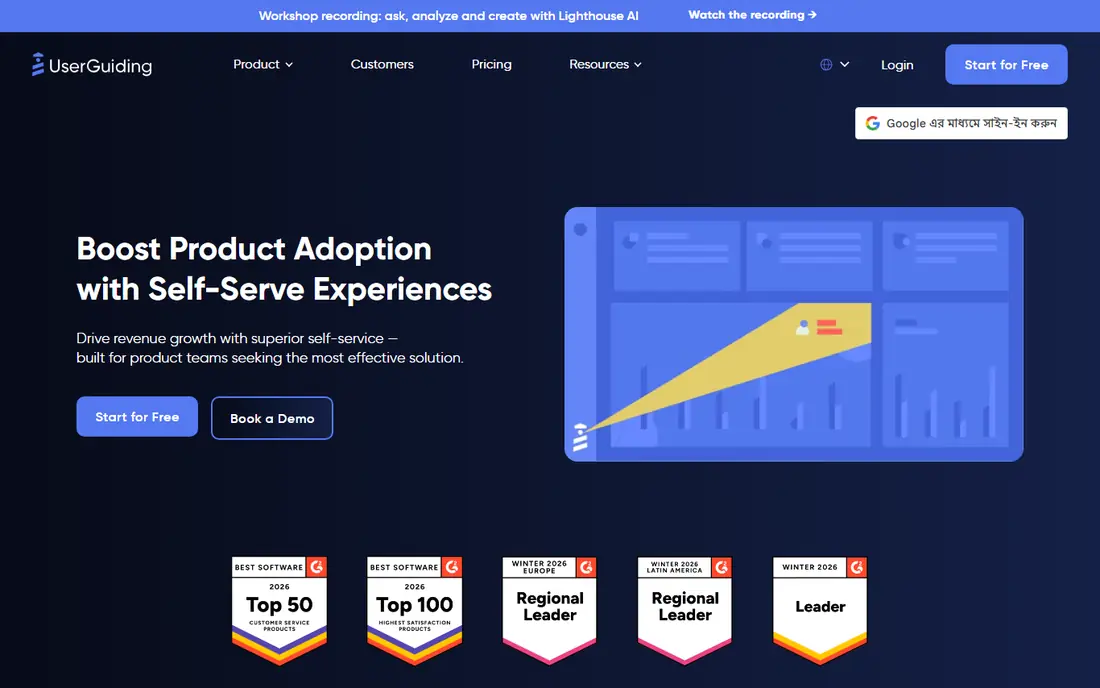
UserGuiding is a practical alternative for small and mid-size SaaS teams that want tours, tooltips, and checklists without hiring developers. The no code builder lets product managers publish a guide quickly, and the resource centre gives users a place to find help inside the product. Published pricing shows a Starter plan near $249 per month on annual billing, with other listings showing lower basic tiers depending on the plan page version, so confirm the current tier and monthly active user limit before buying. The main limit is analytics depth. It covers guide performance well, but teams that need deep product analytics should pair it with a separate tool or choose Pendo.
- No code tour builder
- Checklists and resource centre
- Knowledge base options
- Entry plan limits monthly active users
- Advanced analytics are lighter than Pendo
Appcues suits teams that treat onboarding as a lifecycle, not a single tour. Its visual builder creates in-app flows, and its messaging can reach users by in-app, email, and push channels, with A/B testing to compare which flow drives activation. That breadth helps product and lifecycle teams work from one platform instead of stitching several tools together. The entry plan near $249 per month in published comparisons is a mid-market price, and costs rise with monthly active users, so model growth before committing. Smaller teams with a simple tour need may find UserGuiding or Product Fruits cheaper for the same core job.
- Visual no code builder
- A/B testing for flows
- Lifecycle messaging beyond in-app tours
- Entry price is mid-market
- Pricing rises with monthly active users
Userpilot fits product led teams focused on activation, adoption, and retention, rather than just a first tour. Event based segmentation lets teams show a guide only when a user has taken, or not taken, a specific action, and feature tagging helps track adoption without heavy code changes. Surveys and a resource centre add feedback and self serve help in the same platform. The Starter plan near $299 per month on annual billing in published comparisons is higher than UserGuiding, and Growth plans rise with monthly active users. It earns that price when segmentation and lifecycle flows are central to your growth work, and it is overkill for a team that only needs a simple welcome tour.
- Event based segmentation
- Feature tagging
- Resource centre and surveys
- Entry Starter price is higher than some rivals
- Advanced plans rise steeply with users
Userflow appeals to teams that want a clean, fast builder with proper branching logic. Flows can branch on user behaviour, so a user who completes a step sees a different next step from one who skips it, without building a tangle of separate tours. Published pricing shows Essentials from $240 per month on annual billing for a set monthly active user count, with unlimited team members, which helps small product teams collaborate without seat fees. The scope is narrower than Pendo. Userflow is excellent for in-app onboarding, but it does not replace a full product analytics platform. Pair it with your existing analytics tool if deep behaviour analysis matters.
- Clean builder with branching logic
- Unlimited team members on published plans
- Webhook integrations
- Focused on in-app flows, not full analytics
- Monthly active user limits apply
Chameleon suits design conscious teams that want tours to look like a native part of the product, not a generic overlay. Advanced styling controls, targeting, and rate limiting let teams control exactly who sees a tour, how often, and how it looks. That control is valuable for polished consumer products and for teams with a strong brand system. The downside is pricing clarity. Published listings range from about $279 per month for a startup tier to much higher monthly figures for larger monthly tracked user counts, so the right price depends on your user volume and plan. Setup also takes more care than a template driven tool, because customization is the point.
- Deep design customization
- Rate limiting and targeting controls
- Tours, surveys, and launchers
- Published entry prices vary widely
- Design control adds setup time
Product Fruits is the budget friendly alternative for early stage SaaS teams that need tours, tooltips, checklists, and a feedback widget without a mid-market price. Entry pricing near $79 per month in published comparisons, with some listings showing $111 per month for a starter tier depending on plan version, makes it one of the cheapest paid options here. Setup is fast, which matters when a small team has no dedicated onboarding owner. The trade-off is depth. It will not match WalkMe for enterprise adoption or Pendo for analytics, and integration options are narrower. For a first onboarding tool, that simplicity is a strength, and teams can move up later when needs grow.
- Low entry price
- Fast setup
- Onboarding plus feedback and knowledge base
- Less depth than enterprise platforms
- Smaller ecosystem of integrations
Userlane is the enterprise alternative for employee adoption of internal software, similar in spirit to WalkMe but with a distinct analytics approach. Its interactive guides walk employees through real tasks inside the app they use, rather than showing a video or document, and its HEART analytics framework helps teams measure adoption and happiness with a rollout. App discovery features can also show which internal apps are actually used, which helps with license decisions. Pricing is quote only, and the sales process is enterprise led, so it suits larger organizations rolling out software to many employees. Small SaaS teams building customer onboarding should choose a product tour tool instead.
- Learning by doing guides for employees
- HEART analytics framework
- App discovery and license insights
- Quote only pricing
- Enterprise focus means heavier sales process
How we picked these
We compared official pricing pages and recent digital adoption and product tour comparisons, and we kept only tools with a live product in October 2026 that provide in-app guides, tours, or digital adoption features. We favoured a mix of enterprise adoption platforms, product analytics platforms, and no code tour tools, and we excluded Whatfix itself throughout. We did not claim hands-on testing, and we used See website where pricing is quote led or varies widely by user volume.
What to check before you switch
Start with your audience. Customer onboarding inside your own product and employee training across third party apps are different jobs, and tools built for one may struggle with the other. Next, model monthly active users, not seats, because most tools here charge by users who see the guides. Then test the builder on a real flow, not a demo tour, and check how guides behave on mobile, on slow connections, and after a product update. Finally, ask about content maintenance. Guides break when interfaces change, so a tool that flags outdated steps or updates content easily will save more time than a cheaper tool that needs manual fixes every release.
Migration notes from Whatfix
If you are leaving Whatfix, list every flow, its target app, and its owner before you choose a replacement, because enterprise flows do not map one to one onto a product tour tool. Employee facing flows with simulations may need WalkMe or Userlane, while customer facing tours can move to UserGuiding, Appcues, Userpilot, or Userflow with less effort. Budget time to rebuild, test, and re-measure the most used flows first, rather than migrating everything at once.
Frequently asked questions
What is the best alternative to Whatfix?
WalkMe and Userlane suit enterprise employee adoption, Pendo suits product teams that need analytics plus guides, and UserGuiding suits smaller SaaS teams that need affordable tours. The best alternative depends on whether your users are employees or customers, and on your monthly active user count.
Is there a free alternative to Whatfix?
Pendo has a free tier up to 500 monthly active users, which is the closest free starting point in this list. Open source tour libraries such as Intro.js and Shepherd.js are also free if you have developers to build and maintain tours, though they require code rather than a no code builder.
How much do Whatfix alternatives cost?
Entry prices range from $79 per month for Product Fruits to $299 per month for Userpilot Starter, with WalkMe, Pendo, Chameleon, and Userlane priced by quote. Most paid tools charge by monthly active users, so total cost rises with your user base, not just with team seats.
Can I use a Whatfix alternative for employee training?
Yes, WalkMe and Userlane are built for employee adoption across internal apps, while product tour tools are built mainly for customers inside your own product. If training covers Salesforce, Workday, or other third party apps, choose an enterprise digital adoption platform rather than a customer tour tool.
Do these tools need developers to set up?
Most tools here offer no code builders for tours, tooltips, and checklists, so product managers can publish guides without code. Open source libraries are the exception, and even no code tools may need developer help for advanced targeting, event tracking, or custom styling.
What is the difference between digital adoption and product tours?
Digital adoption covers guidance, training, and workflow support across many apps, often for employees, while product tours focus on onboarding and feature guidance inside one product, usually for customers. Whatfix sits in digital adoption, so enterprise buyers should compare adoption platforms first, not just tour tools.
Sources
See where you really rank - block by block
ProMapRanker scans Google Maps across a grid of your service area. Simple monthly plans from $19, white-label on every plan.
Start freeKeep reading
 zscaler alternatives
Best Zscaler Alternatives in 2026
Looking for zscaler alternatives? We compare 9 SASE and zero trust platforms on architecture, data protection, pricing, and fit for your network and team.
Read → zapier alternatives free
Best Zapier Alternatives Free in 2026
Nine automation tools for zapier alternatives free in 2026, all with genuinely free tiers, plus free plan limits, starting prices and upgrade paths explained.
Read → which platform is best for online reputation
Which Platform Is Best for Online Reputation in 2026
Wondering which platform is best for online reputation? We compare 8 review, listing, and response tools for small and multi-location businesses and agencies.
Read →