 ProMapRanker
Best Alternatives to Software Platforms in 2026

Key takeaways
- AlternativeTo and SaaSHub are the best starting points when you already know a tool and want direct replacements.
- G2, Capterra, and GetApp suit business buyers who want reviews, categories, and side by side comparisons.
- Software Advice suits buyers who want a free advisor call instead of browsing long lists alone.
- TrustRadius and PeerSpot suit enterprise buyers who want longer, more detailed peer reviews.
- Use at least two platforms for any important purchase, since rankings can reflect paid placement as well as quality.
Quick comparison
| Pick | Great for | Pricing starts at | Free tier | |
|---|---|---|---|---|
 AlternativeTo | Finding direct replacements | Free | Yes | Visit |
 G2 | Business software reviews | Free | Yes | Visit |
 Capterra | Small business software search | Free | Yes | Visit |
 Software Advice | Free advisor help | Free | Yes | Visit |
 GetApp | Side by side comparisons | Free | Yes | Visit |
 TrustRadius | Detailed enterprise reviews | Free | Yes | Visit |
 SaaSHub | Alternative lists for indie tools | Free | Yes | Visit |
 SourceForge | Open source software discovery | Free | Yes | Visit |
 Product Hunt | New product discovery | Free | Yes | Visit |
The best alternatives to software platforms
This article is about platforms that help you find alternatives to software, not about one single app. If you search for alternatives to a tool you use today, these sites help you compare replacements, read user reviews, and check features before you switch. We compared how each platform lists software, how it handles reviews, and what kind of buyer it suits best.
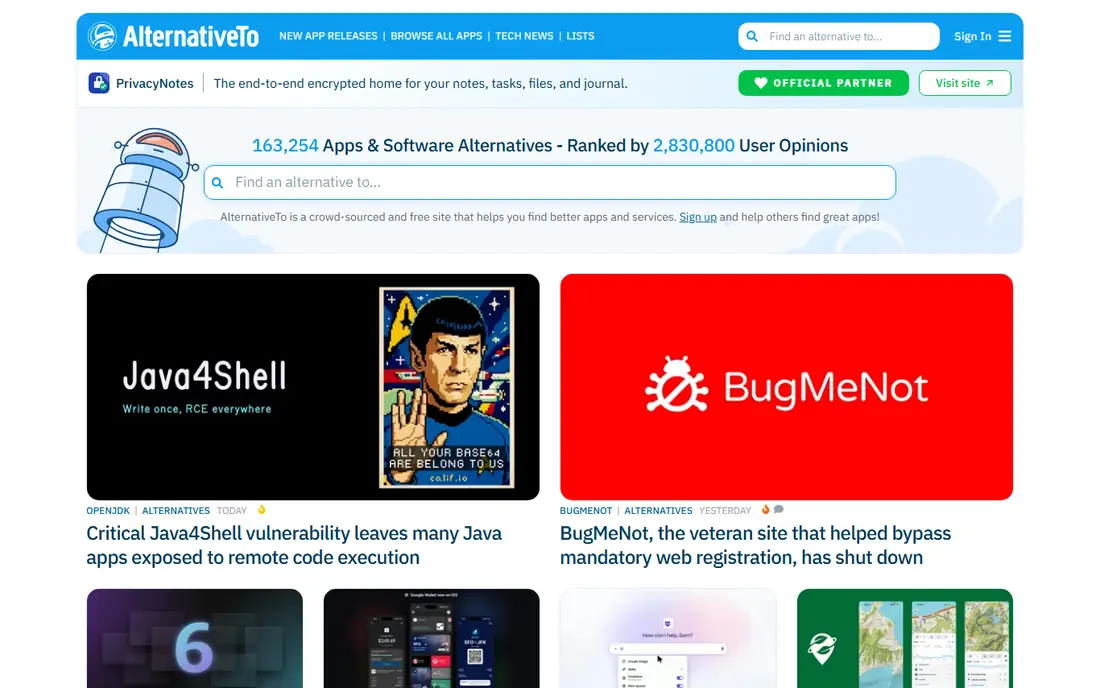
AlternativeTo is the simplest tool on this list for its core job. Type in the software you use now, and you get a list of alternatives, filtered by platform, licence, and features. That direct approach suits anyone who already knows what they want to replace and just needs options.
The downside is uneven detail. Popular tools have rich pages, while smaller tools may have only a short description. Use AlternativeTo to build a longlist, then check vendor sites and reviews before you choose.
- Clear alternative lists for a named tool
- Community votes
- Covers desktop, web, and mobile apps
- Listings vary in detail
- Rankings reflect user votes, not expert testing
G2 is one of the largest business software review sites, with reviews across hundreds of categories. Its grids compare products by satisfaction and market presence, and filters help you narrow by company size, features, and pricing. For a business buyer, it is a useful first stop.
G2 listings can reflect paid visibility and review generation effort, so a top spot is not proof of best fit. Read the written reviews, not just the scores, and check how recent they are before you trust them.
- Large review pool
- Category grids
- Useful filters for company size and features
- Paid placement can affect visibility
- Some categories are crowded
Capterra covers a very wide range of software, including niche and vertical tools that larger review sites may miss. It is free for buyers to browse, and its category pages help small businesses find options quickly. That breadth makes it a good net for early research.
Capterra is paid for by vendors, mainly through pay per click placement, so check how a list is sorted before you trust its order. Use it to discover options, then verify features and prices on vendor sites.
- Very wide category coverage
- Free for buyers
- Simple comparison tools
- Vendor pay per click model affects placement
- Review depth varies
Software Advice differs from a pure directory because it offers a person to talk to. Buyers describe their needs, and an advisor sends a shortlist of matching options, often within a short time. That help suits busy owners who do not want to read dozens of listings.
The service is free for buyers because vendors pay for leads, so advisor picks will reflect partner vendors. Treat the shortlist as a starting point, and still run your own trial before you buy.
- Free one on one advisor calls
- Shortlist sent quickly
- Good for buyers who dislike browsing
- Advisor picks reflect partner vendors
- Less useful if you want to research alone
GetApp is useful when you have two or three finalists and want to compare features, integrations, and pricing in one table. Its category coverage is wide, and browsing is free for buyers. For a structured comparison, it is often faster than opening many vendor tabs.
GetApp, Capterra, and Software Advice now share an owner with G2, so comparing them against each other is less independent than it once was. Use GetApp for comparison, but add an independent source such as AlternativeTo or a peer community before you decide.
- Clear side by side feature tables
- Wide categories
- Free for buyers
- Shares an owner with G2 and Capterra, so it is less independent than it looks
TrustRadius focuses on longer, verified user reviews, which helps enterprise buyers who need detail beyond a star rating. Its reviews often cover implementation, support, and real limits, which are the details that matter in a large purchase. For a high stakes decision, that depth is valuable.
Its coverage is thinner than G2 in some smaller categories, and it is less useful for simple consumer apps. Use TrustRadius when the purchase is large enough that a detailed peer view is worth the extra reading time.
- Longer verified reviews
- Useful for enterprise and mid market buyers
- Clear pros and cons
- Fewer reviews than G2 in some categories
- Less suited to tiny consumer apps
SaaSHub is a close cousin to AlternativeTo, with alternative lists for a large number of products, including indie and long tail tools. It is easy to browse, and its pages help you find replacements that larger business directories may miss.
Review depth is thinner here, and some pages rely mainly on basic descriptions. Use SaaSHub to widen your longlist, especially for smaller tools, then verify with trials and vendor documentation.
- Strong alternative lists
- Good for indie and long tail tools
- Simple interface
- Review depth is thin
- Smaller editorial team than G2 or Capterra
SourceForge is best known as a home for open source projects, and it remains a useful place to find free software alternatives. Its project pages list downloads, documentation, and user feedback, which helps when you want a free or self hosted replacement for a paid tool.
Its interface is older than newer directories, and its business comparison features are lighter than G2 or Capterra. For open source discovery, though, it still earns a place on this list.
- Large open source catalogue
- Download and project pages
- Useful for free tools
- Interface feels dated
- Business review features are limited
Product Hunt is a launch platform where new products are posted daily and voted up by the community. It is excellent for spotting new alternatives early, especially in software, AI tools, and consumer apps. Comments from makers and early users can reveal how a product works in practice.
Product Hunt is not a deep comparison site. A high launch ranking reflects one day of attention, not long term quality. Use it for discovery, then check reviews, pricing, and trials elsewhere before you switch.
- Daily new product launches
- Community comments
- Good for spotting new tools early
- Launch day buzz fades fast
- Not built for deep business comparisons
How we picked these
We compared official site descriptions, category coverage, review models, and buyer fit for each platform. We kept only platforms that are still operating in October 2026, let buyers browse for free, and help users find software alternatives or comparisons. We left out single vendor sites, closed directories, and sites that only listed jobs or news. We weighed breadth of listings, review quality, independence, and ease of use for ordinary buyers.
How to use these platforms without being misled
Start with your requirements, not with a ranking. Write down the must have features, your budget, your team size, and the tools you already use. That list keeps you from choosing a popular tool that does not fit your work.
Next, use two different kinds of platform. Pair a direct alternative finder such as AlternativeTo with a review site such as G2 or TrustRadius. If both point to the same finalists, your shortlist is stronger. If they disagree, that disagreement is useful, since it often reflects different buyer types.
Check how lists are sorted. Many platforms mix unpaid listings with paid placement, and some reward vendors that generate many reviews. Read written reviews, check dates, and look for reviews from companies like yours. Finally, trial the top two options with real work. A directory can narrow the field, but only a trial shows whether a tool fits your daily workflow.
A short research workflow
First, find five alternatives on AlternativeTo or SaaSHub. Second, check reviews and categories on G2, Capterra, or TrustRadius. Third, compare features on GetApp or vendor sites. Fourth, trial two finalists for at least a week. That four step flow keeps research focused and avoids endless browsing.
Frequently asked questions
What is the best platform for finding alternatives to software?
AlternativeTo is the best direct starting point, because you search by the tool you use now and get a list of replacements. SaaSHub is a good second source, especially for smaller and indie tools.
Are these software alternative platforms free?
Yes, browsing is free for buyers on all nine platforms in this list. Vendors pay for placement, leads, or premium profiles on many of them, which is why you should check how lists are sorted.
How do I know if a review is trustworthy?
Look for detailed written reviews, recent dates, and reviewers from companies similar to yours. Be cautious of very short reviews, reviews that repeat marketing language, and rankings that change with paid placement.
What is the difference between G2, Capterra, and GetApp?
All three are business software directories, and they now share an owner. G2 has the largest review pool, Capterra has the widest small business category coverage, and GetApp is best for side by side feature comparisons. Use them together, plus an independent source, for important purchases.
Can I find free software alternatives on these platforms?
Yes. AlternativeTo and SaaSHub let you filter by free and open source options, and SourceForge focuses on open source projects. Always check licence terms on the vendor site, since free can mean free to use, free for personal use, or open source with different rules.
Should I trust a Product Hunt ranking when choosing business software?
Use Product Hunt for discovery, not for a final decision. A launch ranking shows one day of community interest, not long term support, pricing stability, or fit for business use. Check reviews and run a trial before you buy.
Sources
See where you really rank - block by block
ProMapRanker scans Google Maps across a grid of your service area. Simple monthly plans from $19, white-label on every plan.
Start freeKeep reading
 zscaler alternatives
Best Zscaler Alternatives in 2026
Looking for zscaler alternatives? We compare 9 SASE and zero trust platforms on architecture, data protection, pricing, and fit for your network and team.
Read → zapier alternatives free
Best Zapier Alternatives Free in 2026
Nine automation tools for zapier alternatives free in 2026, all with genuinely free tiers, plus free plan limits, starting prices and upgrade paths explained.
Read → which platform is best for online reputation
Which Platform Is Best for Online Reputation in 2026
Wondering which platform is best for online reputation? We compare 8 review, listing, and response tools for small and multi-location businesses and agencies.
Read →