 ProMapRanker
Best Alternatives to Pandas in 2026

Key takeaways
- Polars is the best first switch for most pandas users who want faster single-machine work without moving to a cluster.
- Dask and Apache Spark suit data that will not fit comfortably in memory, with Dask closer to pandas code and Spark better at cluster scale.
- DuckDB is the simplest choice when you think in SQL and want fast analysis on local files without a server.
- Modin suits teams that want to keep pandas code almost unchanged while using more cores.
- GPU and out-of-core tools help only when your data is large or your workload is heavy, so measure your current bottleneck before switching.
Quick comparison
| Pick | Great for | Pricing starts at | Free tier | |
|---|---|---|---|---|
 Polars | Fast single-machine analysis | Free | Yes | Visit |
 Dask | Parallel pandas-style work | Free | Yes | Visit |
 Modin | Near drop-in pandas speedup | Free | Yes | Visit |
 Vaex | Out-of-core exploration | Free | Yes | Visit |
 DuckDB | SQL analysis on local files | Free | Yes | Visit |
 Apache Spark | Cluster-scale processing | Free | Yes | Visit |
 Daft | Fast distributed DataFrames | Free | Yes | Visit |
 RAPIDS cuDF | GPU-accelerated DataFrames | Free | Yes | Visit |
 PyArrow | Columnar data and fast I/O | Free | Yes | Visit |
The best alternatives to pandas
These pandas alternatives cover the same core job, working with tabular data in Python, and each one solves a different pandas pain point, from speed to scale to SQL.
Polars is the switch we suggest first for most pandas users. It is written in Rust, runs work across cores by default, and uses lazy evaluation to plan a query before it runs, which often avoids wasted work. For filtering, grouping, and joining medium to large tables on one machine, it feels noticeably quicker than pandas.
The cost is learning a new API. Polars expressions look different from pandas chaining, and code that leans on pandas quirks will need rewriting. That effort pays off if you run the same pipelines often, but it is overkill for a small one-off notebook.
- Fast multithreaded engine
- Lazy query planning
- Clear expression syntax
- API differs from pandas
- Some pandas habits need rewriting

Dask suits teams whose data has grown past comfortable memory but whose code is still pandas-shaped. It splits a DataFrame into partitions, runs operations in parallel, and only computes results when asked. Much existing pandas code ports with small changes, mainly around partitioning and a few unsupported operations.
The catch is shuffle-heavy work, such as large sorts and joins, which can be slower than expected. Dask rewards thinking about partition size early. If you get that right, it is a practical bridge to larger data without a full rewrite.
- Familiar pandas-like API
- Partitions data across cores or machines
- Lazy execution
- Shuffles can be slow
- Not every pandas operation is covered
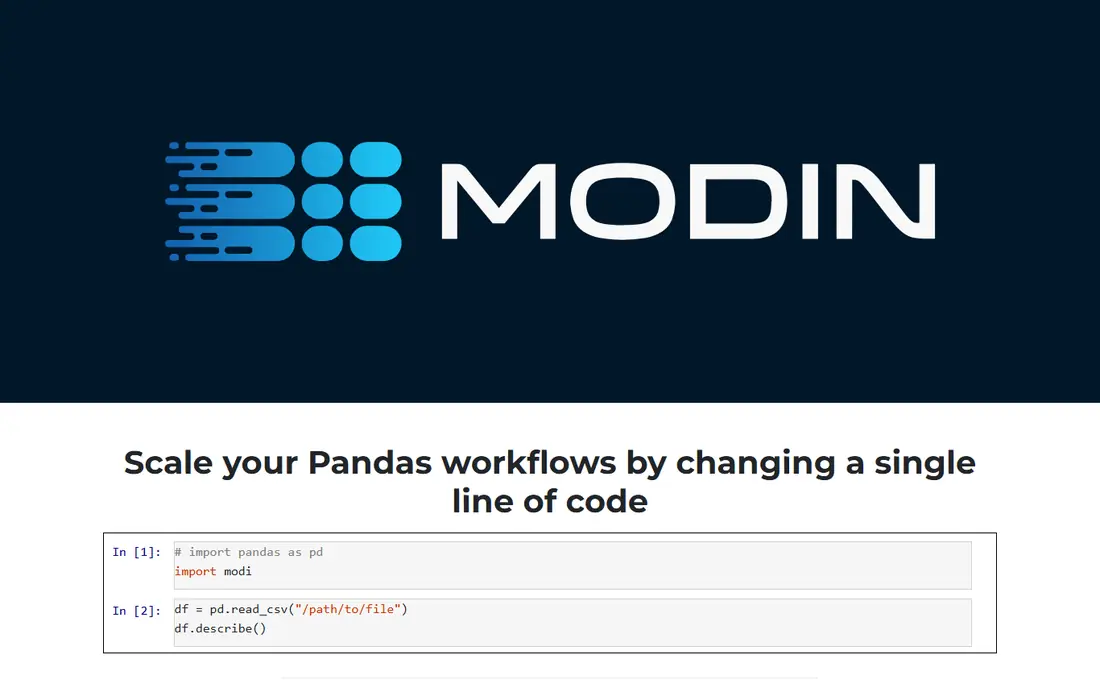
Modin is the lowest-friction experiment on this list. In many cases you change the import and keep the rest of your pandas code, while Modin spreads work across cores through Ray or Dask. For a team with a large pandas codebase and little time to rewrite, that is a real advantage.
Coverage is not complete, and some operations fall back to slower paths, so speed gains vary by workload. Test Modin on your slowest real pipeline, not a toy example, and compare both runtime and results before adopting it widely.
- Keeps most pandas code unchanged
- Uses Ray or Dask backends
- Easy first test
- Some operations fall back to single-threaded work
- Setup varies by backend
Vaex is built for exploring files that are too large to load fully into memory. It memory-maps data, computes statistics and aggregations without reading everything at once, and works well for interactive exploration of large tabular files. Analysts who filter and aggregate billion-row files on a laptop often find it a good fit.
It is less suited to heavy shuffling, sorting, or complex joins. You may also need to convert CSV files to a Vaex-friendly format first. Treat it as an exploration tool first, and pair it with another engine for complex pipeline work.
- Memory-mapped exploration of large files
- Fast filtering and aggregation
- No full load needed
- Requires converting some formats
- Shuffles and sorts are weaker
DuckDB is an in-process analytical database, which means it runs inside your Python process with no server to install. It reads Parquet and CSV files directly, runs SQL fast across cores, and pairs well with pandas or Polars for results. If you think in SQL, it removes a lot of setup friction.
The trade is workflow. DuckDB shines for queries, aggregations, and joins expressed in SQL. If your work leans on pandas-style row manipulation or Python objects, you will still want a DataFrame library beside it.
- Fast in-process SQL
- Reads Parquet and CSV directly
- No server to manage
- SQL-first workflow
- Less suited to general Python object manipulation
Apache Spark, used through PySpark in Python, is the workhorse for data that needs a cluster. It handles distributed storage, fault tolerance, and large joins across many machines, and its SQL API is familiar to analysts. Teams with a data platform already in place often standardize on it.
For a single laptop or a modest dataset, Spark adds setup, tuning, and startup overhead that slows you down. Choose it when scale, scheduling, and shared infrastructure are real requirements, not when a faster single-machine tool would do.
- Proven at very large scale
- SQL and DataFrame APIs
- Wide ecosystem
- Heavy setup and tuning
- Overkill for single-machine work
Daft is a distributed DataFrame engine with a modern, expression-first API and lazy query planning. It runs on one machine and scales out when needed, and it handles multimodal workloads, including tables plus files, more naturally than some older engines. Teams building new pipelines often like its clean design.
As a newer project, its community and third-party examples are smaller than those for pandas, Dask, or Spark. That matters when you hit an edge case at deadline time. Try it on a new project first, where a rewrite is cheap, rather than as a drop-in replacement.
- Expression-based API
- Lazy planning
- Runs locally or distributed
- Newer API to learn
- Smaller community than pandas or Spark
RAPIDS cuDF mirrors much of the pandas API but runs operations on a GPU. For large numeric workloads, such as heavy joins, group-by operations, and feature work, the speedup can be large. It fits teams that already have GPU machines for modeling and want data preparation to keep pace.
The requirement is real hardware. Without a compatible NVIDIA GPU, cuDF is not an option, and installation is heavier than a pure CPU library. It is a specialist pick, not a general pandas replacement, and it earns its place only on GPU-friendly workloads.
- Pandas-like API on GPUs
- Very fast for suitable workloads
- Strong for large numeric data
- Needs a compatible NVIDIA GPU
- Setup is heavier than CPU tools
PyArrow is the engine behind much of the modern data stack, including the columnar format that Polars, DuckDB, and pandas itself increasingly use. It reads and writes Parquet fast, moves data between tools without slow copies, and handles large columnar tables efficiently. Even if you keep pandas, PyArrow-backed types can improve speed and memory use.
On its own, PyArrow is not a full DataFrame replacement. It lacks the broad manipulation API pandas users expect. Think of it as the fast storage and interchange layer in a stack, paired with Polars, DuckDB, or pandas for analysis.
- Fast Parquet and CSV I/O
- Efficient columnar memory
- Wide language support
- Not a full DataFrame API
- Best paired with another tool
How we picked these
We compared official documentation, project pages, and public benchmarks for DataFrame tools that are actively maintained in October 2026. We kept only tools that work with tabular data in Python, are genuinely available today, and solve a clear pandas limitation, such as speed, memory, scale, SQL, or GPU use. We weighed API familiarity, setup effort, and realistic workload fit, and we left out experimental projects with no stable release path.
How to choose the right pandas replacement
The best tool depends less on headline speed and more on where your current work hurts.
Start from your bottleneck
If notebooks feel slow on medium data, Polars is the first test. If memory errors stop you, look at Dask, Vaex, or DuckDB. If you already have a cluster, Spark is the safer standard. Naming the bottleneck first stops you from adopting a powerful tool for a problem you do not have.
Check how much code must change
Modin and Dask preserve the most pandas code. Polars, Daft, and DuckDB need more rewriting, but they often reward it with cleaner, faster pipelines. Budget that rewrite time honestly, especially for shared code that other people maintain.
Test on a real pipeline, not a benchmark
Run your slowest real job on two or three candidates and compare runtime, memory, and output equality. Small benchmark tables hide partition, shuffle, and I/O costs that dominate real work. Keep the winner only if it wins on your data.
Mind the file format
Parquet, Arrow, and other columnar formats make most of these tools faster and leaner. If your pipeline still passes large CSV files between steps, fixing the format can help as much as switching libraries, and it helps whichever tool you pick.
Frequently asked questions
What is the best alternative to pandas for beginners?
Polars is a strong choice for new work because its API is consistent and its lazy engine is fast, but Modin is easier if you already know pandas and want to keep your code. Beginners starting fresh often learn Polars faster than they expect, while existing pandas users get quicker wins from Modin or Dask.
Is Polars a drop-in replacement for pandas?
No, Polars is not a drop-in replacement, since its expression API and some behaviors differ from pandas. Much logic ports cleanly, but code that relies on pandas indexing quirks or specific methods will need rewriting. Plan a conversion pass and test outputs row by row on key pipelines.
Which pandas alternative handles the largest data?
Apache Spark handles the largest, cluster-scale workloads, while Dask and Daft cover large data on smaller clusters or single machines. For data that exceeds memory but fits on one machine, Vaex and DuckDB are often simpler. Choose Spark only when a cluster is genuinely required.
Are pandas alternatives free?
Yes, all nine tools in this list are open source and free to use, though you still pay for the machines you run them on. Cloud, cluster, and GPU costs can add up, so budget compute separately from software. There are no license fees for the libraries themselves.
Should I still learn pandas?
Yes, pandas remains widely used, and its skills transfer to most of these tools. Learning pandas first makes Polars, Dask, and Modin easier to pick up, and many jobs still expect pandas fluency. Treat these alternatives as additions to pandas, not as a reason to skip it entirely.
Sources
See where you really rank - block by block
ProMapRanker scans Google Maps across a grid of your service area. Simple monthly plans from $19, white-label on every plan.
Start freeKeep reading
 zscaler alternatives
Best Zscaler Alternatives in 2026
Looking for zscaler alternatives? We compare 9 SASE and zero trust platforms on architecture, data protection, pricing, and fit for your network and team.
Read → zapier alternatives free
Best Zapier Alternatives Free in 2026
Nine automation tools for zapier alternatives free in 2026, all with genuinely free tiers, plus free plan limits, starting prices and upgrade paths explained.
Read → which platform is best for online reputation
Which Platform Is Best for Online Reputation in 2026
Wondering which platform is best for online reputation? We compare 8 review, listing, and response tools for small and multi-location businesses and agencies.
Read →