 ProMapRanker
Alternatives to NPS in 2026

Key takeaways
- A single loyalty score hides why customers stay or leave, so we looked for tools that capture reasons, effort and satisfaction in plain language.
- SurveyMonkey and Typeform suit small teams that want simple surveys fast, while Qualtrics and Medallia suit larger programs with many touchpoints.
- Survicate, Zonka Feedback and Hotjar help teams collect feedback where customers already are, on websites, in apps and after support chats.
- Productboard and UserVoice turn scattered requests into a ranked product backlog, which a lone score cannot do on its own.
- Our pick for most small businesses is Survicate, because it covers several feedback types in one tool at a clear, approachable level.
Quick comparison
| Pick | Great for | Pricing starts at | Free tier | |
|---|---|---|---|---|
 Qualtrics | Large feedback programs | See website | Free trial | Visit |
 Medallia | Enterprise customer experience | See website | No | Visit |
 SurveyMonkey | Simple surveys at scale | See website | Yes | Visit |
 Typeform | Conversational surveys | See website | Yes | Visit |
 Survicate | Website and in-app feedback | See website | Yes | Visit |
 Zonka Feedback | Multi-channel satisfaction surveys | See website | Free trial | Visit |
 Hotjar | Website behaviour and feedback | See website | Yes | Visit |
 UserVoice | Product feedback and voting | See website | Free trial | Visit |
 Productboard | Product roadmaps from feedback | See website | Free trial | Visit |
The best alternatives to NPS
Net Promoter Score asks one question and gives one number. That number can be useful, but it rarely explains what to fix next. The tools below give you other ways to listen, from satisfaction and effort scores to open comments, product votes and on-site feedback. We compared official feature pages, pricing pages and public documentation, and we focused on tools that work today and fit teams that want more than a single score.
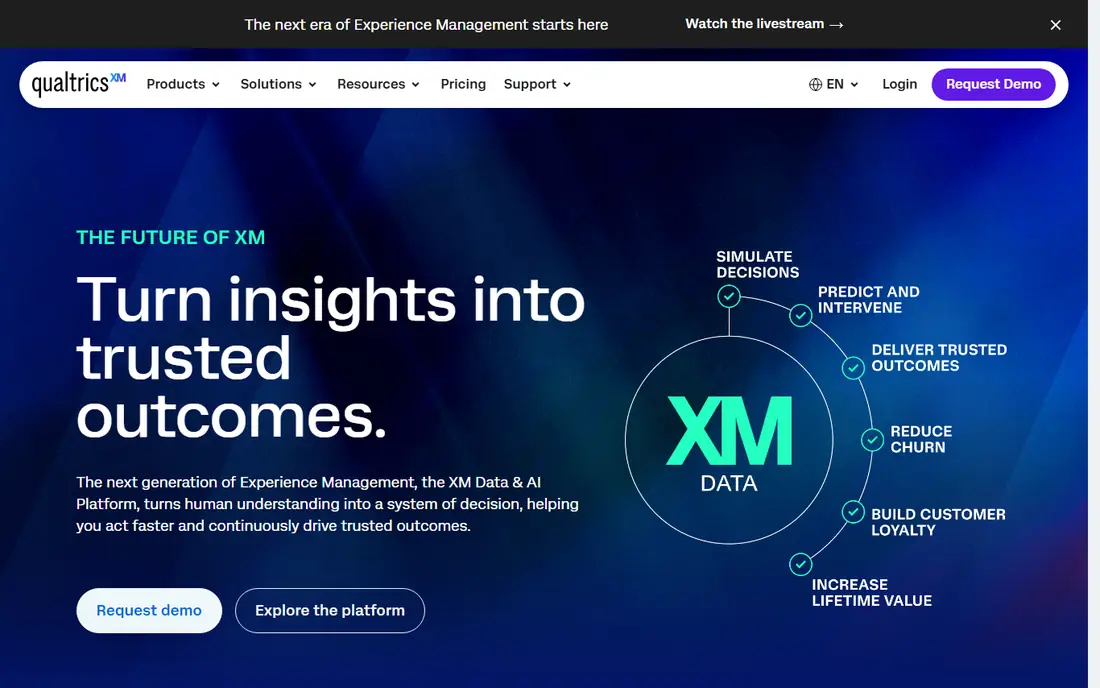
Qualtrics is the broadest option on this list, and that breadth is the point for teams that have outgrown a single metric. You can run satisfaction surveys, effort surveys, employee feedback and market research in one system, then slice results by segment, product or location. The reporting tools help you spot patterns in open text, so a falling score comes with comments that explain it.
The trade-off is complexity and cost. Qualtrics does not publish simple self-serve pricing for its full customer experience platform, so small teams may find the sales process heavy. If you run feedback across many channels and need governance, approvals and deep analysis, that structure pays off. If you only need a short survey each month, a lighter tool below will get you there faster.
- Wide survey types including satisfaction and effort
- Strong reporting and text analysis
- Many integrations
- Pricing is quote based
- Setup can take time for small teams
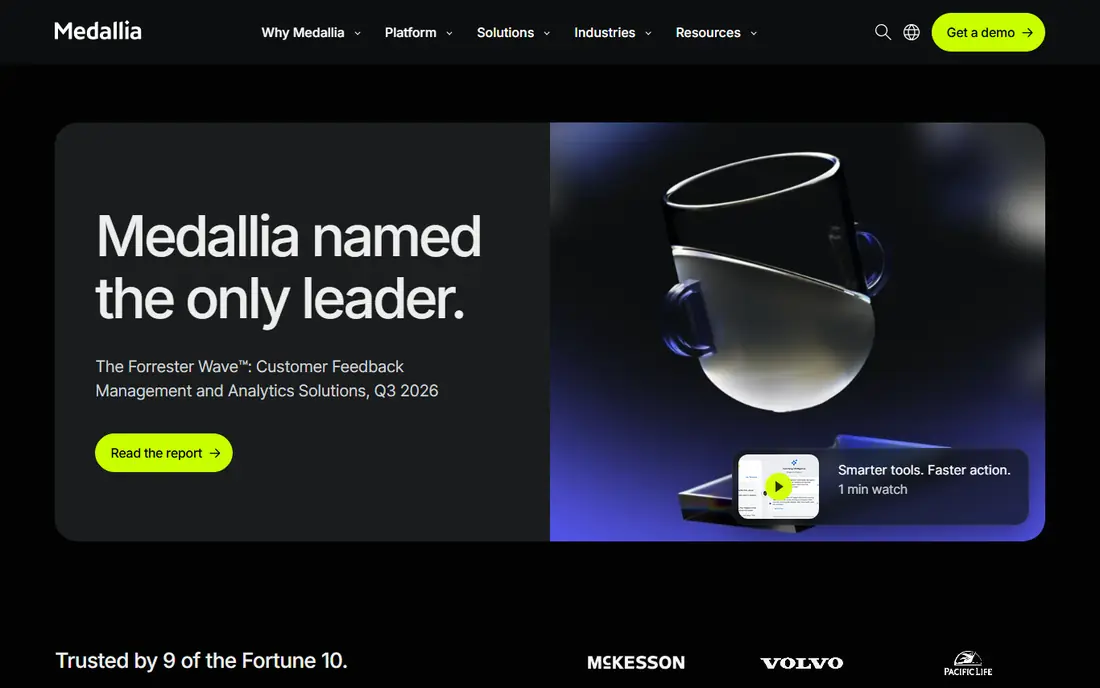
Medallia is built for companies that hear from customers in many places at once, including stores, call centres, apps and email. It pulls those signals together and helps teams assign follow-up actions when a customer reports a problem. That closed-loop habit matters more than any single score, because it turns feedback into a task with an owner and a deadline.
We would not recommend Medallia as a first survey tool for a small business. Pricing is custom, implementation takes planning, and the value shows up at scale. For a larger brand that needs consistent measurement across locations and teams, it is one of the strongest alternatives to a narrow score, because it focuses on action rather than a headline number.
- Omnichannel feedback collection
- Strong analytics for large volumes
- Built for closed-loop follow-up
- Enterprise pricing and onboarding
- More tool than most small firms need
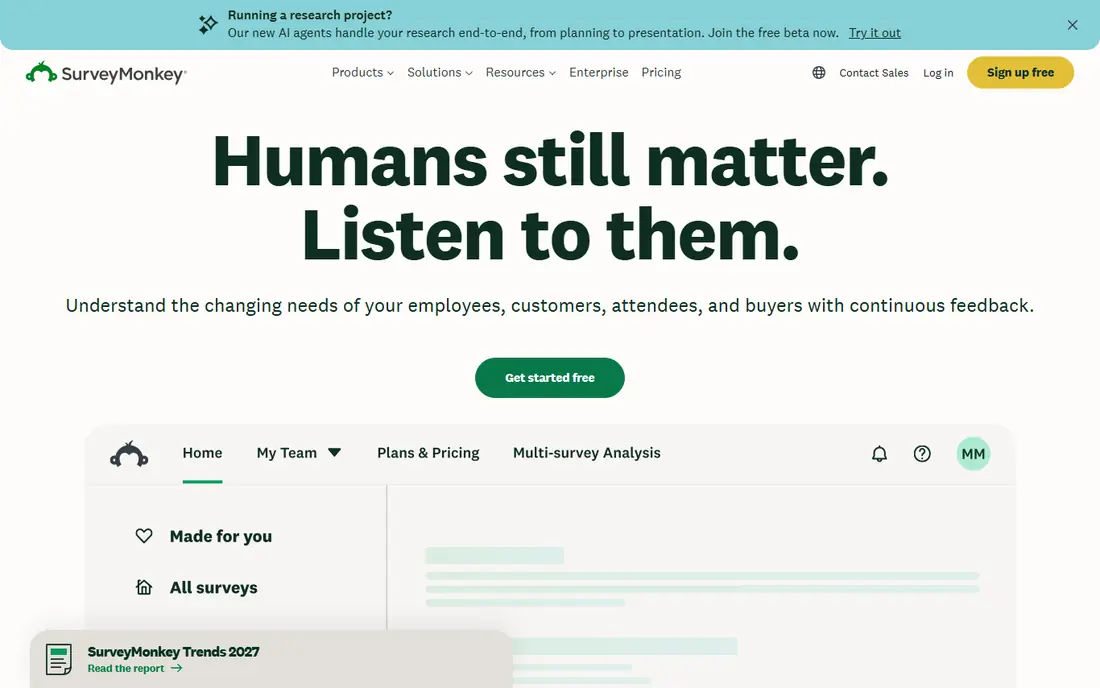
SurveyMonkey is the practical default when you want to ask customers a clear question and get answers quickly. Templates cover satisfaction, effort, post-purchase checks and support follow-ups, so you do not need to design every survey from scratch. Respondents also recognise the format, which can help completion rates.
The free plan works for short, simple surveys, while paid plans add logic, branding and deeper reporting. SurveyMonkey will not replace a full customer experience platform, and it does not turn feedback into a product roadmap on its own. For most small and mid-sized teams, though, it is a dependable way to move past one score and ask about specific moments in the customer journey.
- Easy survey builder with many templates
- Free plan for basic use
- Familiar to respondents
- Advanced analysis sits on paid plans
- Per-user pricing can add up for teams
Typeform takes a different approach to the same problem. Instead of a long form, it shows one question at a time, which can feel more like a conversation and less like homework. That format suits post-purchase checks, event feedback and short satisfaction surveys where you want a higher completion rate.
We like Typeform when the survey itself is part of the brand experience, for example after a booking or a trial. It is less ideal for complex research with heavy branching and large panels, where a traditional survey tool may be cheaper. Check response limits on your plan before you send to a large list, since that is where the cost usually grows.
- Friendly one-question-at-a-time format
- Strong design and branding
- Good for short feedback forms
- Costs rise with responses on paid plans
- Less suited to very long research surveys
Survicate is our pick for most small businesses on this list, because it meets customers where they already are. You can place a short survey on a website, inside a mobile app, in an email or after a chat, and you can ask about satisfaction, effort or a specific feature rather than loyalty in general. That timing gives you feedback tied to a real moment, which is far easier to act on.
The free plan lets small teams test the format before paying, and paid plans add targeting and integrations with tools such as HubSpot and Slack. Survicate does not try to be a full enterprise experience suite, and teams that need complex text analysis may want Qualtrics or Medallia instead. For day-to-day feedback that leads to clear fixes, it is hard to beat.
- Surveys on websites, in apps and by email
- Satisfaction and effort question types
- Many integrations
- Some advanced features need higher plans
- Reporting is simpler than enterprise platforms
Zonka Feedback suits teams that collect feedback in more than one place, including in person. A clinic, hotel or store can run a tablet survey on site, while the same account sends email and SMS surveys after a purchase. Results feed into one dashboard, so you can compare satisfaction across locations or channels without stitching spreadsheets together.
We also like its focus on follow-up. Detractor-style alerts and workflows help a manager respond quickly when a customer reports a poor experience. That habit, replying fast and fixing the cause, matters more than the score itself. Zonka Feedback is less well known than SurveyMonkey, so check its integration list against your own stack before you commit.
- Email, SMS, website and offline surveys
- Satisfaction and effort templates
- Automated follow-up workflows
- Interface takes a short learning period
- Pricing varies by responses and channels
Hotjar answers a different question from most tools here. Instead of asking customers to rate loyalty after the fact, it shows what they do on your website and lets them leave feedback in the moment. A short survey on a checkout page or a feedback button on a help article can reveal friction that a quarterly score would miss entirely.
The free plan suits small sites that want to test on-page feedback, while paid plans raise limits and add filtering. Hotjar is not the right tool for large email panels or employee research, and its survey features are simpler than SurveyMonkey or Qualtrics. Used alongside an email survey tool, it gives you the context behind the numbers, which is often the missing piece.
- On-site surveys and feedback widgets
- Heatmaps and recordings show context
- Free plan for small sites
- Not a full survey platform
- Best as a complement to email surveys
UserVoice replaces a loyalty score with a direct question: what should we build or fix next. Customers submit ideas, vote for the ones that matter most, and see status updates as work progresses. That transparency can reduce support tickets and repeated feature requests, because people can see that their idea is already tracked.
This is a specialist tool, not a general survey platform. If you mainly need satisfaction surveys, pick Survicate or SurveyMonkey instead. If your inbox is full of feature requests and your roadmap arguments never end, UserVoice gives you a shared, ranked list to point to, and that list is often more useful than a single score.
- Customers can submit and vote on ideas
- Public roadmaps build trust
- Helps prioritise product work
- Focused on product feedback, not general surveys
- Smaller teams may need only the basics
Productboard takes feedback from sales calls, support tickets, surveys and customer interviews and ties each insight to a feature on the roadmap. Product teams can then explain why a feature was chosen, which customers asked for it and what problem it solves. That traceability is a strong alternative to reporting a score with no link to action.
The catch is scope. Productboard is built for product and product marketing teams, so a small business that only wants a satisfaction survey will find it heavy. For a software company or a growing product team, it turns scattered comments into decisions, and it keeps customers in the loop when their requests ship.
- Centralises feedback from many sources
- Links insights to roadmap items
- Clear prioritisation tools
- Pricing is aimed at product teams
- More setup than a simple survey tool
How we picked these
We compared official feature pages, pricing pages and public documentation for tools that measure satisfaction, effort, product feedback or on-site experience, rather than tools that only report a single loyalty score. We favoured tools that work today, offer a free plan or trial where stated, and cover different team sizes, from solo operators to enterprise programs. We did not claim hands-on testing, and we left out tools that only repackage one score under a new name.
What to measure instead of one score
Start with the decision you need to make. If customers abandon checkout, an on-site survey from Hotjar or Survicate will tell you more than a quarterly loyalty number. If support quality is the issue, a short effort survey after each ticket points to the exact step that felt hard. If product direction is unclear, voting in UserVoice or Productboard ranks real requests.
Keep surveys short, ask one thing at a time, and always include an open comment box. A score without a reason is a dead end, while a short comment often names the fix. Set a rule for follow-up before you send anything: who replies, how fast, and what happens to repeat complaints. That rule turns feedback into improvement, which is the whole point of moving past a single metric.
Short surveys get better answers
Long surveys lose people in the middle, and the people who finish are not always typical customers. Aim for three to five questions for routine checks, and save longer research for a smaller, willing panel. Test the survey on a phone first, since many customers will answer there. If a question does not lead to a decision, cut it.
Compare scores with care
Satisfaction, effort and loyalty scores move for different reasons, so do not treat them as interchangeable. Effort scores tend to predict repeat support contacts, while satisfaction scores reflect a single visit. Track each metric over time for the same touchpoint, and look at comments alongside the trend. A small change with clear comments is more useful than a large change with no explanation.
Frequently asked questions
What are alternatives to Net Promoter Score?
Alternatives to Net Promoter Score include Customer Satisfaction Score, Customer Effort Score, product feedback voting and on-site feedback. Each measures a different thing, so many teams use two or three together. The best mix depends on whether you need to fix support, improve a product or understand a single visit.
Are alternatives to NPS better than NPS?
Not always, and the honest answer is that it depends on the question. NPS gives a simple loyalty snapshot, while satisfaction and effort scores explain specific moments. Many teams keep a loyalty question but add satisfaction and effort questions, so they get both a trend and a reason.
What is Customer Effort Score?
Customer Effort Score asks how easy it was to get help, complete a purchase or solve a problem. Low effort often links to repeat business and fewer support contacts. It works well after support chats, onboarding steps and checkout, where ease matters more than general loyalty.
Can small businesses use alternatives to NPS for free?
Yes, several tools on this list offer a free plan or trial, including SurveyMonkey, Typeform, Survicate and Hotjar. Free plans usually limit responses or features, so check those limits before a large send. For a small list and short surveys, a free plan is often enough to start.
How often should we survey customers?
For routine touchpoints, survey continuously in small numbers rather than blasting a large list once a year. That gives you a steady trend and fresh comments. For product direction, run feedback voting all year and review the ranked list each planning cycle.
Do we need to drop NPS completely?
No, you do not need to drop it if it already works for trend tracking. The stronger move is to add a reason behind the score, such as a satisfaction or effort question and an open comment. That way you keep comparability and gain something you can act on.
Sources
See where you really rank - block by block
ProMapRanker scans Google Maps across a grid of your service area. Simple monthly plans from $19, white-label on every plan.
Start freeKeep reading
 zscaler alternatives
Best Zscaler Alternatives in 2026
Looking for zscaler alternatives? We compare 9 SASE and zero trust platforms on architecture, data protection, pricing, and fit for your network and team.
Read → zapier alternatives free
Best Zapier Alternatives Free in 2026
Nine automation tools for zapier alternatives free in 2026, all with genuinely free tiers, plus free plan limits, starting prices and upgrade paths explained.
Read → which platform is best for online reputation
Which Platform Is Best for Online Reputation in 2026
Wondering which platform is best for online reputation? We compare 8 review, listing, and response tools for small and multi-location businesses and agencies.
Read →