 ProMapRanker
Alternatives to Julia in 2026

Key takeaways
- Python is the most practical Julia alternative for most teams, thanks to its huge ecosystem for data, AI, and web work.
- R is the best pick for statistics and data visualization, with a deep package library built for analysis.
- MATLAB fits engineering teams that already use its toolboxes, while GNU Octave offers a free, compatible-style option.
- Rust, Go, Fortran, and Scala suit teams that need compiled speed, scale, or a JVM and systems path for numerical work.
Quick comparison
| Pick | Great for | Pricing starts at | Free tier | |
|---|---|---|---|---|
 Python | Largest data and AI ecosystem | Free | Yes | Visit |
 R | Statistics and data visualization | Free | Yes | Visit |
 MATLAB | Engineering toolboxes and simulation | See website | Free trial | Visit |
 GNU Octave | Free MATLAB-style numerical work | Free | Yes | Visit |
 Fortran | High-performance numerical computing | Free | Yes | Visit |
 Rust | Fast, memory-safe numerical services | Free | Yes | Visit |
 Go | Simple, fast data services | Free | Yes | Visit |
 Scala | JVM data and large-scale computing | Free | Yes | Visit |
The best alternatives to Julia
Julia was designed for high-performance numerical computing with a clean, high-level syntax. It combines readable code with speed close to compiled languages, which makes it attractive for science, engineering, and data work. The alternatives below are not Julia itself. Each one offers a different balance of speed, ecosystem, tooling, and hiring ease for numerical and data projects.
Python is the default alternative for most Julia users. Its ecosystem covers data analysis, machine learning, visualization, automation, and web APIs, with libraries that most teams already know. Hiring is easier, learning resources are plentiful, and notebooks make exploration and sharing simple.
Speed is the trade-off. Pure Python loops are slower than Julia, so heavy numerical work usually relies on NumPy, Pandas, or compiled helpers. For many projects, that is fine, since the ecosystem saves more time than raw loop speed costs. We would pick Python when ecosystem, hiring, and AI tooling matter more than single-language numerical speed.
- Huge libraries for data, science, and AI, including NumPy and Pandas
- Easy to learn and easy to hire for
- Strong notebooks, visualization, and web tools
- Slower than Julia for pure numerical loops without compiled extensions
- Performance tuning often needs NumPy, Numba, or C extensions
R is the statistics-first alternative. It offers a vast package library for modeling, time series, visualization, and reporting, with tools that researchers and analysts use every day. RStudio, now part of Posit products, gives a clean environment for scripts, plots, and documents in one place.
Performance and consistency are limits. Heavy compute often needs compiled code, and some language quirks can frustrate developers coming from a cleaner design. We would pick R when statistical analysis and visualization are the main work, and Python or Julia when general programming and production services matter more.
- Deep statistical packages and visualization tools
- Strong community for research and analysis
- RStudio makes interactive analysis pleasant
- Slower for heavy compute without compiled code
- Language design can feel inconsistent to newcomers
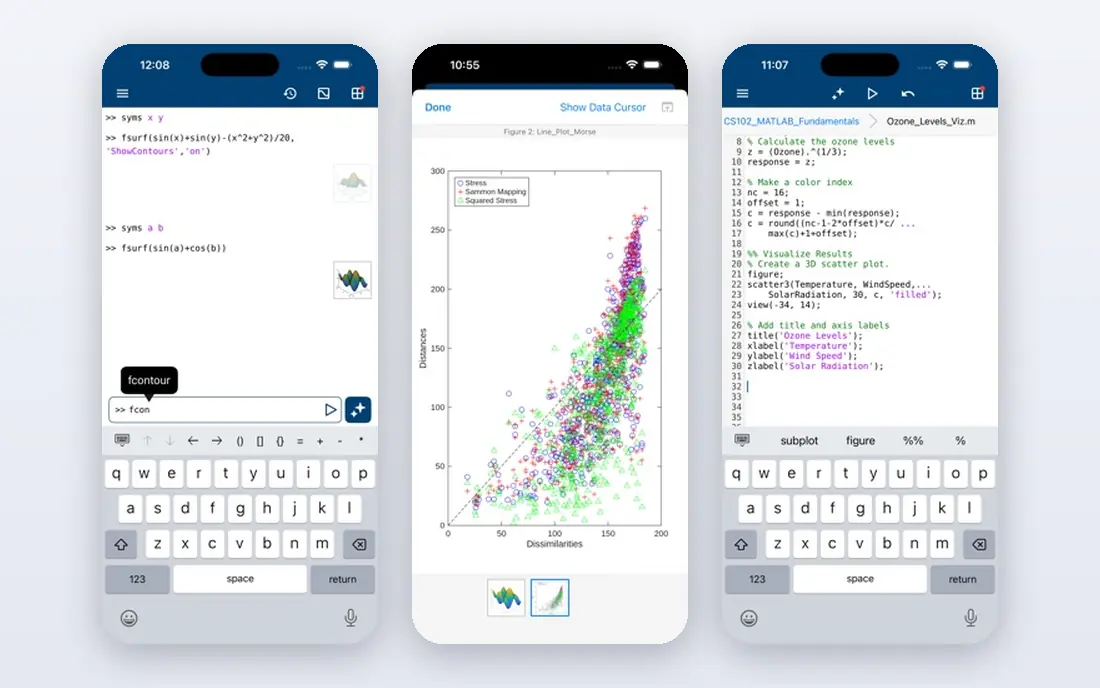
MATLAB remains a strong choice for engineering teams that already use its toolboxes. Control systems, signal processing, image processing, and simulation are well supported, with an integrated environment for plotting, debugging, and app building. Many engineering courses and labs still use MATLAB, which helps hiring in those fields.
Cost is the main drawback. Licensing is commercial and can be expensive, especially with multiple toolboxes, and general software development is less flexible than in Python. We would pick MATLAB when a team already relies on its toolboxes or works in an engineering lab, and a free option such as Octave or Python when cost is a barrier.
- Mature toolboxes for control, signal processing, and simulation
- Integrated environment for plotting and debugging
- Widely used in engineering courses and labs
- Commercial licensing can be costly
- Library breadth is narrower than Python for general software work
GNU Octave is the free, MATLAB-style alternative. It uses largely compatible syntax for many numerical scripts, which helps students and teams move code without a commercial license. It covers matrices, plotting, and common numerical tasks well enough for teaching, prototyping, and many research scripts.
Compatibility is not complete. Some MATLAB toolboxes, advanced features, and GUI polish are missing or less refined. A team with heavy MATLAB toolbox use should test its scripts before switching. We would pick Octave for free numerical work and teaching, and MATLAB when specific toolboxes are essential.
- Free and open source
- Largely compatible syntax with MATLAB for many scripts
- Good for teaching and prototyping numerical work
- Some MATLAB toolboxes and features are missing
- Performance and GUI polish lag behind MATLAB in places
Fortran is still relevant for high-performance numerical work, especially in weather, climate, physics, and engineering codes that have run for decades. Modern Fortran compilers are fast, array handling is natural, and large legacy codebases keep the language alive in research computing.
Ecosystem breadth is the limit. Data science libraries, web tools, and modern hiring pools are far smaller than for Python. A new project should use Fortran when performance and legacy code matter most, not as a general data science language. We would pick Fortran for serious numerical simulation work, and Python for broader data projects.
- Long history in scientific and high-performance computing
- Excellent performance for numerical loops and arrays
- Modern Fortran tooling has improved
- Smaller modern ecosystem for data and web work
- Learning resources feel dated compared with Python
Rust suits teams that need numerical speed in production services with strong safety guarantees. Its compiler checks memory use at build time, which helps for long-running services, parsers, and data pipelines. Crates for numerical work, arrays, and data handling continue to grow, though they do not yet match Python breadth.
Learning time is the cost. Ownership and borrowing take effort, and a simple analysis script may take longer to write than in Python or Julia. We would pick Rust when a numerical service must be fast, safe, and production-ready, and Python when exploration and library coverage matter more.
- High performance with memory safety checks
- Strong ecosystem for servers, tools, and data crates
- Good for production numerical services
- Steeper learning curve, especially around ownership
- Numerical ecosystem is smaller than Python or R
Go is a practical alternative for data services rather than interactive analysis. It compiles fast, deploys as a single binary, and handles concurrent services well, which helps for APIs, workers, and data pipelines. For a team that needs to serve numerical results at scale, Go is a clean and maintainable choice.
It is not a direct replacement for Julia in research analysis. Numerical libraries, plotting, and interactive notebooks are less developed than in Python or R. We would pick Go when the job is a fast, reliable data service, and Python or R when the job is exploration, modeling, and visualization.
- Fast compilation and simple deployment
- Goroutines help with concurrent data services
- Easy to learn for backend developers
- Numerical library ecosystem is smaller than Python
- Less suited to interactive analysis and plotting
Scala fits JVM teams that work with large data pipelines, especially with Apache Spark. It mixes functional and object-oriented styles, and it gives access to Java libraries for production systems. For data engineering at scale, Scala remains a serious and proven choice.
Complexity is the downside. Scala offers many ways to solve the same problem, and large codebases can be hard for newcomers to read. A small analysis project will likely be simpler in Python or R. We would pick Scala for JVM data engineering and Spark work, not for a simple numerical script that Julia or Python handles easily.
- Functional programming on the JVM
- Strong fit for Spark and large data pipelines
- Access to the full Java ecosystem
- Complexity can grow in large codebases
- Compile times and build setup need care
How we picked these
We compared official language sites, documentation, and public ecosystem information for each option, and we included only languages that are live and actively maintained in October 2026. We favored languages that cover the main reasons a team might leave Julia: a larger ecosystem, statistics depth, engineering toolboxes, free MATLAB-style work, compiled speed, or JVM scale. We did not list Julia itself as an alternative to Julia.
We did not claim hands-on testing that did not happen. We compared language design, runtime model, library scope, and practical limits, rather than inventing benchmarks or user counts. That approach helps a team choose based on project type, hiring, and long-term maintenance, not only on raw speed claims.
How to choose a Julia alternative
Start with the project type. A research analysis, a production service, and a large data pipeline need different languages. Speed alone is rarely the deciding factor, since ecosystem, hiring, and tooling often matter more over a project lifetime.
Match the work to the ecosystem
Choose Python for general data and AI work, R for statistics and visualization, MATLAB or Octave for engineering numerical work, and Scala for JVM data pipelines. Choose Fortran or Rust when compiled speed and production reliability are central, and Go when a simple, fast data service is the goal.
Test with a real workload
Port a small but real workload, including data loading, computation, plotting, and output, before committing. That test reveals library gaps, performance quirks, and workflow friction faster than reading docs. Keep Julia code running during the trial so the comparison is fair and the team can fall back if needed.
Consider hiring and maintenance
A language is also a hiring decision. Python and Go have large hiring pools, R has a strong research pool, and Fortran, Rust, and Scala need more specialized hiring. A team should pick a language it can staff and maintain for years, even if another language looks faster in a single benchmark.
Frequently asked questions
What is the best alternative to Julia?
Python is the best alternative for most teams, thanks to its huge data, AI, and web ecosystem and easy hiring. R is better for statistics, MATLAB is better for engineering toolboxes, and Rust or Fortran are better for compiled numerical speed. The best pick depends on the project type.
Is Python faster than Julia?
In general, no, for pure numerical loops. Julia is designed for fast numerical code with a high-level syntax, while pure Python is slower and often relies on NumPy or compiled extensions for speed. In practice, Python ecosystem tools can close much of that gap for data work, but raw loop speed still favors Julia.
Is R better than Julia for statistics?
R is often better for statistics because of its deep package library, visualization tools, and research community. Julia offers speed and a cleaner language design, but its statistical ecosystem is smaller. A statistics-heavy team will usually find more ready-made methods in R.
Can GNU Octave replace MATLAB?
GNU Octave can replace MATLAB for many basic numerical scripts, thanks to largely compatible syntax and free licensing. It cannot fully replace MATLAB toolboxes and advanced features, so teams with heavy toolbox use should test their code first. For teaching and prototyping, Octave is a strong free option.
Should I learn Fortran instead of Julia?
Learn Fortran if you work in high-performance scientific computing, legacy simulation codes, or fields such as weather and physics where Fortran remains standard. For general data science, AI, or web work, Python is a more practical choice. Fortran is a specialist tool, not a general replacement.
Can I mix Julia with another language?
Yes, many teams use Julia for numerical kernels and Python or R for data handling, visualization, or production services. Code can be connected through files, APIs, or language interfaces, though that adds maintenance. A hybrid setup often beats a full rewrite when only part of a system needs a different strength.
Sources
See where you really rank - block by block
ProMapRanker scans Google Maps across a grid of your service area. Simple monthly plans from $19, white-label on every plan.
Start freeKeep reading
 zoho inventory alternatives
6 Alternatives to Zoho Inventory, Compared on Price and Fit
Zoho Inventory alternatives: 6 tools compared on price, free plans and fit. Katana leads the list for manufacturers. Fit and flaws are laid out for each entry.
Read → zoho crm alternatives
Best Zoho CRM Alternatives (2026)
Need Zoho CRM alternatives? We compare 7 tools on cost, free access and who each suits. Every pick gets a straight assessment. Built for quick decisions.
Read → zelle alternatives
Best Zelle Alternatives in 2026
Compare the best Zelle alternatives for sending money to friends, paying sellers and moving funds abroad, with honest notes on fees, speed and safety in 2026.
Read →