 ProMapRanker
Airflow Alternatives in 2026

Key takeaways
- Prefect and Dagster are the closest Python native choices for teams moving to a more modern orchestrator.
- Kestra and Mage suit teams that prefer declarative or notebook style pipeline building.
- Temporal, Windmill, DolphinScheduler and Argo Workflows cover durable business workflows, script based jobs and Kubernetes work.
- Self hosted open source tools cost time and infrastructure even when the license is free, so budget for operations.
- Pick by how your team defines work, Python code, YAML or containers, rather than by feature lists alone.
Quick comparison
| Pick | Great for | Pricing starts at | Free tier | |
|---|---|---|---|---|
 Prefect | Python native orchestration | Free | Yes | Visit |
 Dagster | Asset based data pipelines | Free | Yes | Visit |
 Mage | Notebook style pipelines | Free | Yes | Visit |
 Kestra | YAML based orchestration | Free | Yes | Visit |
 Temporal | Durable long running workflows | Free | Yes | Visit |
 Windmill | Script based workflows and apps | Free | Yes | Visit |
 Apache DolphinScheduler | Scheduled big data workflows | Free | Yes | Visit |
 Argo Workflows | Kubernetes native workflows | Free | Yes | Visit |
The best airflow alternatives
These tools schedule, run and monitor workflows and data pipelines without using the original scheduler. We compared official documentation and pricing pages, and we focused on tools that are actively maintained and available in October 2026.

Prefect turns Python functions into workflows with decorators, so a data team can schedule existing code with little rewrite. Flows and tasks carry retries, logging and scheduling, and the Cloud dashboard shows run history and failures. Hybrid execution means the orchestration service manages metadata while flow runs execute in your own infrastructure, which helps teams with data control rules.
The catch is the step from Hobby to paid tiers. The free Hobby tier covers small use, with limited users and serverless minutes, while paid Cloud starts at 100 dollars per month. Teams with many workflows or strict access controls should price the tier they actually need. Prefect suits Python teams that want a gentle move to modern orchestration without a new definition language.
- Workflows are plain Python functions
- Free Hobby tier for small use
- Hybrid execution keeps code in your infrastructure
- Paid Cloud starts at $100 per month for teams
- Hobby limits suit small projects only
- Advanced governance needs higher tiers
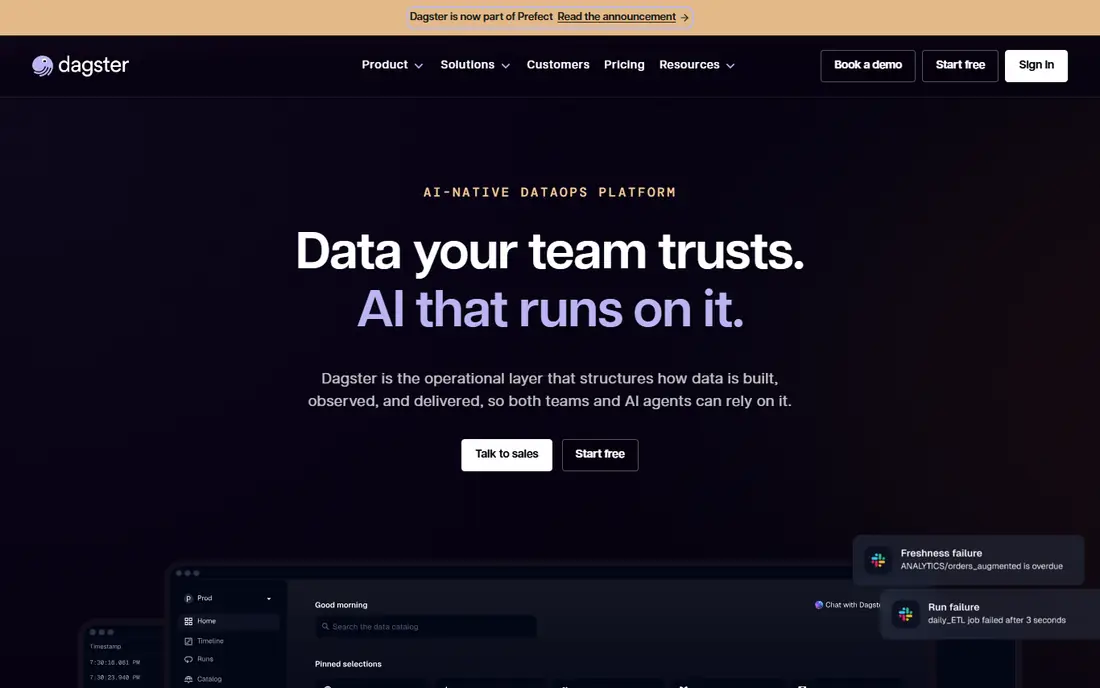
Dagster organizes pipelines around assets, meaning the data products themselves, rather than only the tasks that produce them. That view helps teams see lineage, freshness and dependencies across a warehouse, and it pairs well with dbt models treated as assets. The open source core is free to self host, and Dagster Plus offers a managed service with a Solo tier from 10 dollars per month plus credits.
Learning the asset model is the main cost. Teams used to task lists may need time to reframe pipelines, and managed pricing needs care since credits add to the base fee. Dagster suits data platform teams that want a clear picture of data products and are building for the long term, not teams that only need a simple cron replacement.
- Asset model shows data products and dependencies
- Strong dbt integration
- Open source core plus managed Dagster Plus
- Asset thinking takes time to learn
- Managed pricing uses credits on top of a base fee
- Smaller teams may find it heavy
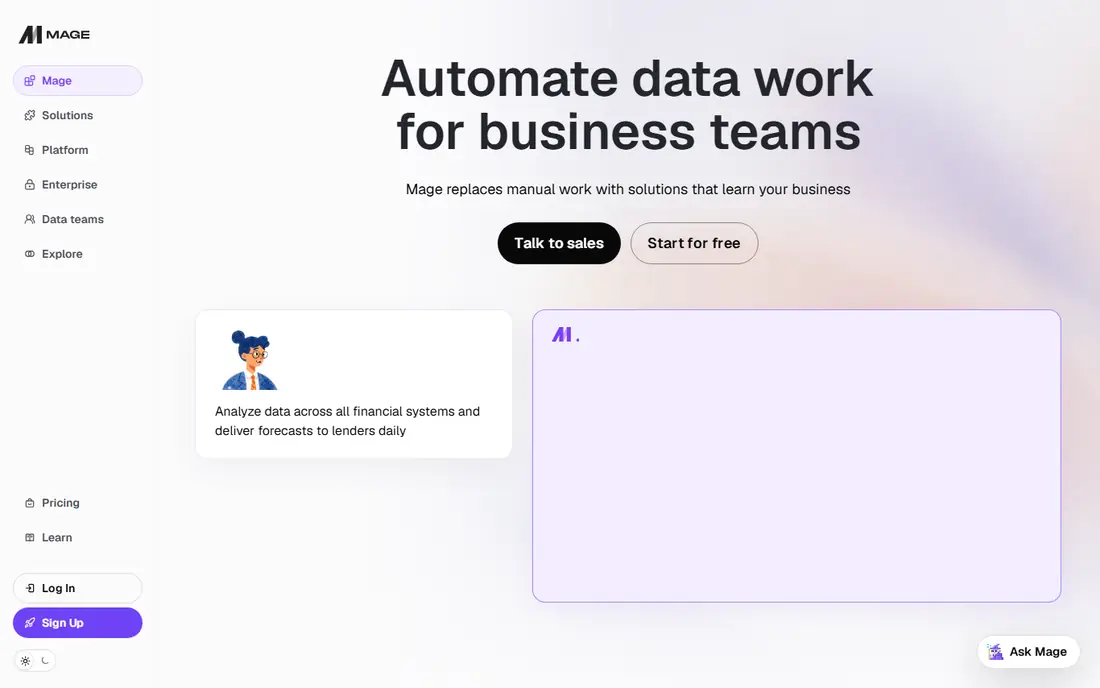
Mage is an open source data pipeline tool built around blocks for loading, transforming and exporting data. The notebook style interface appeals to analysts and data scientists who think in steps and want to test a block at once. Pipelines can run on a schedule, and the visual editor makes dependencies easy to read for new team members.
The weakness is maturity at platform scale. Mage has a smaller production community than the larger orchestrators, and teams running many critical pipelines should test monitoring, retries and deployment carefully. Mage suits smaller data teams and analytics groups that value fast building and a friendly editor over enterprise governance features.
- Open source pipeline tool with notebook style blocks
- Data loader, transformer and exporter blocks
- Visual pipeline editor
- Smaller production community than larger tools
- Managed offering is less established
- Some teams may outgrow its patterns
Kestra defines flows in YAML, so engineers and technically minded analysts can read and edit a pipeline without writing Python. The plugin library covers databases, cloud services, APIs and AI tools, and the user interface updates the YAML when flows are edited visually. The open source core is free, which makes self hosting a low cost way to start.
Complex logic is the trade off. Long YAML files can be harder to test than code, and teams with heavy Python logic may prefer a code native tool. Enterprise and Cloud pricing is not fully published, so larger teams need a quote. Kestra suits teams that want declarative, readable flows and a broad plugin set.
- Declarative YAML flows anyone can read
- Large plugin library
- Open source core is free to self host
- Enterprise and Cloud pricing is not fully published
- YAML can get long for complex logic
- Java based stack may suit some teams less
Temporal is a durable workflow engine rather than a batch pipeline scheduler. Workflows written as code can run for days or months, survive worker failures and resume where they left off, which suits order processing, onboarding and multi step business processes. The open source server is free to self host, and Temporal Cloud starts from 100 dollars per month.
The model takes adjustment. Teams looking only for scheduled data jobs may find Temporal more general than they need, and self hosting a durable system needs careful operations. Temporal suits product and platform teams with long running, failure sensitive workflows, not teams that only need nightly batch runs.
- Durable execution survives failures and restarts
- Code based workflows in several languages
- Managed Cloud from $100 per month
- Different mental model from batch data pipelines
- Self hosting needs operational care
- Pricing for Cloud starts above hobby use
Windmill turns scripts into scheduled workflows, APIs and internal apps, with auto generated interfaces from script inputs. That design suits engineering teams with many small jobs, webhooks and internal tools, since a script can become a runnable job without a separate service. The open source core is free to self host, and the Cloud offering provides a managed path.
Pure data pipeline teams should weigh the fit. Windmill is strong for script based automation, but it is less focused on warehouse asset modeling than Dagster or Prefect. Paid Cloud pricing starts above hobby levels, so small teams may prefer self hosting. Windmill suits teams that already think in scripts and want workflows plus simple internal apps.
- Scripts become workflows, APIs and apps
- Supports several languages
- Self hosted open source core
- Paid Cloud pricing starts higher than hobby tools
- App building features may distract pure pipeline teams
- Smaller data pipeline community
Apache DolphinScheduler is an Apache Software Foundation project for scheduling distributed workflows, with a visual editor for building task graphs. It supports task types common in big data work, including shell, SQL, Spark and Python, and it can run workflows on a schedule with dependencies and alerts. The license is free, and the project suits teams already running Hadoop or Spark based systems.
Operations are the honest cost. Self hosting, upgrades and monitoring fall to your team, and the interface is functional rather than polished. Teams without platform engineering time may prefer a managed service. DolphinScheduler suits organizations that want a proven open source scheduler and can run it themselves.
- Apache open source scheduler
- Visual DAG editor
- Supports many task types including Spark and SQL
- Setup and operations need care
- Interface is functional rather than polished
- Community help is thinner than larger tools
Argo Workflows runs each workflow step as a container on Kubernetes, defined in YAML and managed with Kubernetes tools. That design suits teams already running Kubernetes, since workflows use the same scheduling, scaling and observability patterns as other workloads. It handles parallel steps, retries and artifacts well for container based data and machine learning jobs.
The requirement is Kubernetes itself. Teams without a cluster or platform expertise will face a steep setup cost, and YAML definitions can grow long. Argo Workflows is not a general replacement for teams outside Kubernetes. For Kubernetes native teams, it is a strong, free and well supported choice.
- Workflows run as Kubernetes native resources
- Strong for container based jobs
- Large Kubernetes ecosystem
- Requires Kubernetes expertise
- YAML definitions can be verbose
- Not a fit outside Kubernetes shops
How we picked these
We compared official documentation, pricing pages and public comparisons of orchestration tools, and we favored actively maintained tools that cover different ways of defining work. We included Python native, YAML based, script based and Kubernetes native options, plus a durable workflow engine, so teams can match the tool to their stack. We excluded managed services built directly on the original scheduler, since this guide covers independent choices.
How to choose an alternative
Start with how your team already writes work. Python teams usually settle fastest with Prefect or Dagster, YAML friendly teams may prefer Kestra or Argo Workflows, and script heavy teams may prefer Windmill. Then test the failure path, not only the happy path. Kill a run, retry a step, check the logs and confirm alerts reach the right channel.
Next, price the managed option and the self hosted option honestly. Open source tools are free to download, but they still cost engineer time, servers and on call cover. A managed tier that looks costly may be cheaper than a week of platform work each month. Run a small real pipeline for two weeks before migrating a critical workload.
Migration tips that save time
Move one pipeline at a time, starting with a low risk job that runs daily. Keep the old schedule running until the new run proves stable for a full cycle. Document the mapping from old tasks to new flows, since that record helps the next engineer understand the change.
Frequently asked questions
What are the best Apache Airflow alternatives?
Prefect and Dagster are the most common Python native choices, while Kestra suits YAML based teams and Argo Workflows suits Kubernetes teams. Temporal suits durable business workflows, and Mage and Windmill suit smaller or script based work. The best choice depends on your stack and how your team defines pipelines.
Are there free alternatives to Apache Airflow?
Yes. Prefect, Dagster, Mage, Kestra, Temporal, Windmill, DolphinScheduler and Argo Workflows all offer free open source cores or free tiers. Self hosting is free in license terms, but it still costs infrastructure and engineer time. Managed tiers start from low monthly fees for some tools and higher fees for others.
Which alternative is easiest to migrate to?
Prefect is often the easiest for Python teams, since workflows are plain Python functions with decorators. Dagster takes more reframing around assets, while Kestra and Argo Workflows require YAML work. Migrate one low risk pipeline first, and keep the old schedule until the new run is stable.
Should I choose a managed service or self host?
Choose a managed service if your team lacks platform time or needs support and upgrades handled. Self host if you need full data control, already run the required infrastructure, or have platform engineers available. Compare engineer time against the managed monthly fee before deciding.
Do these tools work with dbt?
Dagster has the closest dbt integration, treating dbt models as assets. Prefect, Kestra and other tools can also run dbt jobs as steps in a larger pipeline. Check the specific integration for your tool, since scheduling, lineage and failure handling differ between setups.
Sources
See where you really rank - block by block
ProMapRanker scans Google Maps across a grid of your service area. Simple monthly plans from $19, white-label on every plan.
Start freeKeep reading
 zoho inventory alternatives
6 Alternatives to Zoho Inventory, Compared on Price and Fit
Zoho Inventory alternatives: 6 tools compared on price, free plans and fit. Katana leads the list for manufacturers. Fit and flaws are laid out for each entry.
Read → zoho crm alternatives
Best Zoho CRM Alternatives (2026)
Need Zoho CRM alternatives? We compare 7 tools on cost, free access and who each suits. Every pick gets a straight assessment. Built for quick decisions.
Read → zelle alternatives
Best Zelle Alternatives in 2026
Compare the best Zelle alternatives for sending money to friends, paying sellers and moving funds abroad, with honest notes on fees, speed and safety in 2026.
Read →