 ProMapRanker
Advice Local vs Yext

Key takeaways
- Advice Local is a white-label listings platform built for agencies, resellers and multi-location brands that manage client locations.
- Yext syncs business data direct to more than 200 publishers and AI assistants, which suits large brands that need fast, verified updates.
- Neither vendor publishes a price for its core platform, so both require a sales call and a written quote before you can budget.
- Choose Advice Local for agency delivery under your own brand, and Yext when direct publisher sync and enterprise controls matter more.
Quick comparison
| Pick | Great for | Pricing starts at | Free tier | |
|---|---|---|---|---|
 Advice Local | Agencies and resellers that manage listings for clients | quote only | No | Visit |
 Yext | Multi-location brands that need direct publisher sync | quote only | No | Visit |
Advice Local vs Yext head to head
Advice Local
Great for: Agencies and resellers that manage listings for clients
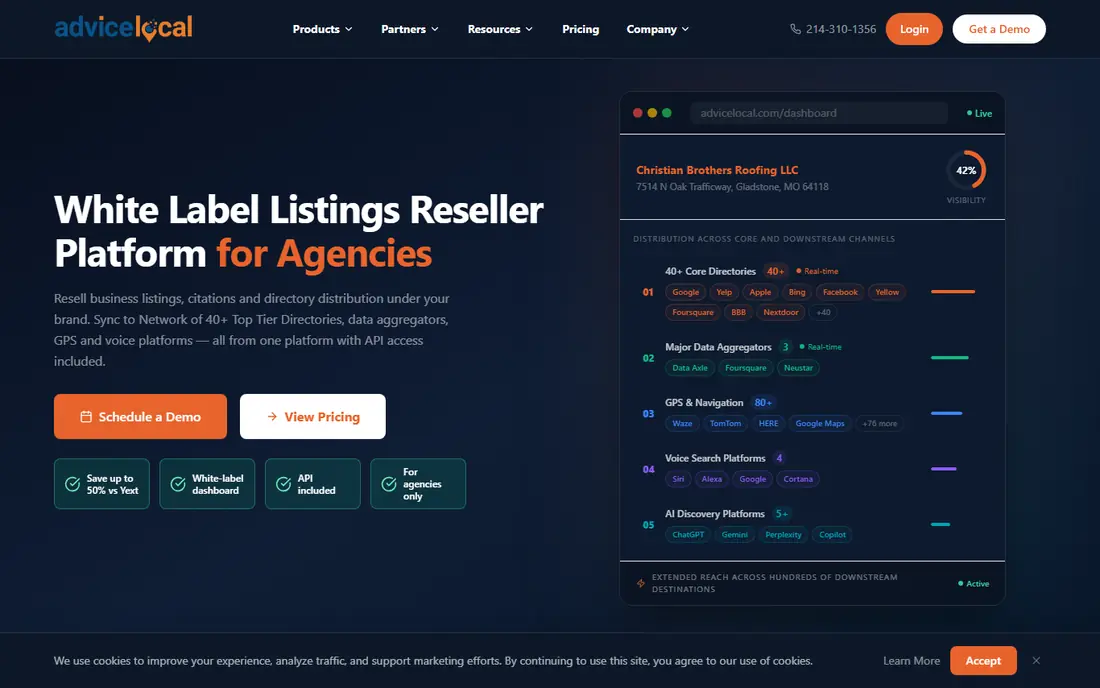
Advice Local is a local presence management hub from Advice Interactive Group, aimed at agencies, brands, resellers and multi-location businesses. One dashboard holds business data for every client location, then sends it to directories, maps, GPS systems and data aggregators. The vendor says its network covers 300 or more directories, with direct connections to 40 or more core directories and major data aggregators. Alongside distribution it offers review monitoring, a local rank tracker, Google Business Profile tools, citation cleanup, locator pages and an AI visibility feature that tracks how a business appears in AI answers.
The white-label model is the main reason agencies pick it. Client reports carry the agency brand, and the vendor states it never discloses client names or relationships to end clients. That matters when listings work is sold as a service rather than bought as software for one business. A September 2026 third-party review reports reseller pricing from $15 per location, with everything above that quoted, and notes that changing a business record means raising a support ticket for the vendor team to carry out. So the workflow is managed rather than self-serve, which suits agencies that want fulfilment handled for them while they keep the client relationship.
The trade-offs follow from that model. A single-location business buying direct will find the platform shaped around agency needs, with pricing that starts with a conversation rather than a checkout page. There is no free plan and no free trial listed on the vendor site, only a demo request. Because edits pass through the vendor team, a business that changes hours or menus often should ask how fast ticketed edits go live before signing. For agencies with steady client rosters, those limits are minor. For a business that wants to edit its own listings in minutes, they matter more than any feature list.
- White-label dashboard for agency delivery
- Distribution to 300 or more directories
- Review monitoring and rank tracking in one place
- Business record edits go through a support ticket
- No published price and no free plan
- Built for agencies, not single-location buyers
Yext is the enterprise option in this pair. It pushes verified business data direct to more than 200 publishers and AI assistants, rather than routing it through data aggregators, so changes reach search, maps and voice answers faster than with a trickle-down model. The platform covers listings, reviews, local pages and analytics in one workspace, and its Knowledge Graph holds the business facts that feed each channel. For a brand with hundreds of locations, that direct connection is the core selling point, since one edit in Yext can update Google, Apple Maps, Bing, Yelp and voice assistants from the same source of truth.
The controls around that sync are built for large teams. Roles and approvals let head office set which fields local managers can change, and the analytics show how each location performs in search and reviews. That structure helps franchises and chains keep hundreds of profiles consistent without letting one store rewrite brand details. Yext also works on AI search visibility, so business facts are structured for the answers that chatbots and voice assistants give. The vendor does not publish prices, and third-party comparison pages report entry plans near $199 per location per year, with higher tiers near $449, but those figures come from third parties and need a live quote to confirm.
The cost of that depth is a sales-led buying process. There is no free plan, no free trial and no published price, so budgeting starts with a call and a quote. Third-party pages report annual billing as the norm for core plans, which means a buyer should ask for the full first-year total in writing, including setup fees and any minimum term. Small businesses with one or two locations often find the process heavy for the job, and a self-serve tool with published per-location pricing may cover their listings at a lower cost and with less admin.
- Direct sync to more than 200 publishers and AI assistants
- Listings, reviews, local pages and analytics in one platform
- Strong controls for large teams
- No published price and no free plan
- Annual billing is the norm for core plans
- Enterprise focus makes it heavy for small teams
How we chose
We compared the vendor pricing pages, product pages and documentation for both tools on 14 November 2026. We checked which directories each tool covers, how edits reach publishers, whether a free plan or trial exists, and what each vendor publishes about price. We did not test either product hands-on, and we did not count review site scores or third-party ratings. Where the vendor hides its price we wrote quote only and said so plainly. Third-party price reports are labelled as such in the text and are not treated as vendor prices, since only the vendor can confirm what a buyer will actually be charged.
We also weighed the buying model itself, not just the feature list. Advice Local sells through agencies and resellers with a managed workflow, so its value depends on how well the vendor team handles edits for your clients. Yext sells direct to brands with a self-serve dashboard and approval controls, so its value depends on how many locations you run and how often their details change. A buyer with a stable set of locations and rare changes will feel the difference in workflow more than the difference in directory counts.
What to check before you buy
- Ask both vendors for a written first-year total, including setup, per-location fees and any minimum term, before you sign anything.
- Ask Advice Local how fast ticketed edits go live, and whether urgent changes such as holiday hours can be pushed the same day.
- Ask Yext which publishers are covered by direct sync on the plan you are quoted, since lower tiers may cover fewer of them.
- Check whether review replies are included in your tier or need a higher plan on either platform.
- Confirm who owns the listings data if you cancel, and how long corrections stay live after you leave.
- Ask Advice Local whether your plan includes manual citation building or only automated distribution to its network.
- Ask Yext whether its AI search features are included in your quoted tier or sold as a separate module.
- Ask both vendors how duplicate listings are handled, and whether suppression of duplicates is included or charged extra.
- Ask both vendors for a named support contact and a written response time for support tickets.
| Locations | Advice Local | Yext | | 1 to 10 | Reseller pricing reported from $15 per location, agency delivery under your brand | Third-party reports put entry plans near $199 per location per year, quote only from the vendor | | 11 to 100 | White-label dashboard scales across client rosters, edits handled by the vendor team | Direct sync to 200 or more publishers suits brands that change data often | | 100 or more | Ask for volume terms and ticket turnaround times in writing | Ask for enterprise terms, API access and dedicated support in the quote |
Frequently asked questions
Which is cheaper, Advice Local or Yext?
Neither vendor publishes a price, so no honest comparison of list prices exists. A September 2026 third-party review reports Advice Local reseller pricing from $15 per location, while third-party comparison pages report Yext entry plans near $199 per location per year. Both figures need a live quote to confirm, since neither comes from the vendor pricing page. Ask each vendor for a written first-year total on the same location count.
Does Advice Local have a free plan?
No. The vendor site offers a demo request and does not list a free plan or a free trial. Agencies and resellers buy through a quoted plan, and a third-party review reports reseller pricing from $15 per location. If you need to test before you commit, ask for a trial location or a short pilot in writing before you sign, and get the scope of that pilot agreed in the same document.
Does Yext have a free plan?
No. Yext does not offer a free plan or a free trial for its core listings platform, and it does not publish prices. You buy through a sales quote, and third-party pages report annual billing as the norm. Ask for a demo on your own locations and a written quote that covers setup, per-location fees and the contract term before you agree to anything.
Is Advice Local good for a single location?
It can work, but the platform is shaped around agencies and resellers that manage many client locations. A single-location business will deal with quoted pricing, ticketed edits and a white-label model built for someone else to resell. A self-serve tool with published per-location pricing may suit a single location better and cost less to run each month.
Is Yext good for small businesses?
Yext is built for multi-location brands and enterprise teams, so small businesses often find the sales process and the annual commitment heavy for one or two locations. The direct sync to more than 200 publishers is real value at scale, but a small business that only needs accurate listings on Google and a few directories can usually get that from a cheaper self-serve tool.
Sources
See where you really rank - block by block
ProMapRanker scans Google Maps across a grid of your service area. Simple monthly plans from $19, white-label on every plan.
Start freeKeep reading
 what’s the best risk software for enterprises
What Is the Best Risk Software for Enterprises in 2026
We compared what’s the best risk software for enterprises on risk registers, controls, third-party risk, and reporting, with pricing notes for large teams.
Read → what's the best pam software for enterprises
What is the Best PAM Software for Enterprises in 2026
Find what's the best pam software for enterprises, with vaulting, session recording, just in time access and pricing compared for large enterprise IT teams.
Read → what’s the best grc software
What Is the Best GRC Software in 2026
We compared what’s the best grc software on risk, compliance, audit and vendor risk, so teams can pick a platform that fits their frameworks and budget.
Read →